
My heart skipped the moment my fingers touched something cold and sharp hidden deep inside the lining of my husband’s jeans. At first, it felt like nothing more than an accidental object left behind after laundry. But as I pulled it out and saw it clearly in my hand, the shape and weight of it immediately changed the atmosphere around me. It was metallic, pointed, and clearly manufactured with purpose. In that instant, my thoughts began to spiral into uncomfortable questions I wasn’t ready for.
I stood still in the laundry room, staring at it under the harsh light. My mind tried to make sense of what I was holding, but instead of clarity, all I found was uncertainty. Why would something like this be in his pocket? Where did it come from? The more I examined it, the more my imagination started filling the gaps with worrying possibilities. What had seemed like a simple household moment suddenly felt heavy and unsettling.
When I finally confronted him, his reaction was calm to the point of frustration. He looked at it briefly and shrugged, saying he had no idea what it was or how it got there. That lack of concern didn’t bring me comfort. Instead, it made my thoughts even louder. I started questioning whether his calmness meant innocence—or whether it was just too natural to be convincing. Silence, in that moment, felt more suspicious than words.
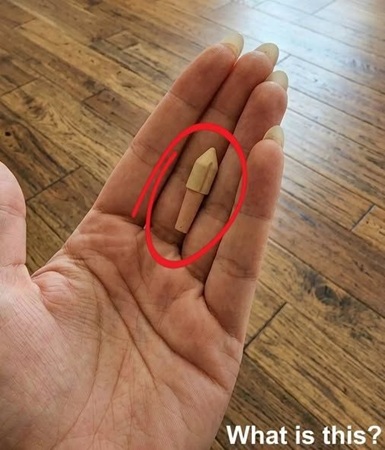
For the next hour, I stayed in the laundry room unable to let it go. I turned the object over and over in my hand, trying to understand its purpose. It was carefully made, with a narrow pointed end and a threaded base that suggested it belonged to something functional. It didn’t look random or broken. It looked intentional. That alone kept my mind from settling.
Every small detail began to feel important. A tiny scratch along the metal. The way it reflected light at certain angles. Even its weight felt oddly specific. I found myself thinking less about what it actually was and more about what it could be. My imagination kept building scenarios I couldn’t confirm, yet couldn’t stop considering either.
At one point, I considered confronting him again, more firmly this time. I was already forming questions in my head, preparing for answers I thought I needed. It was strange how quickly doubt can grow when there is no immediate explanation. What started as curiosity had slowly turned into suspicion, and I didn’t even notice the shift happening.
Then, while examining it more closely under the light, something caught my attention. At the base, there were faint engraved markings I hadn’t noticed before. They were subtle and easy to miss, but once I saw them, I focused completely. My emotions shifted slightly—from anxiety to curiosity. I tried to interpret what they meant, hoping they would finally give me clarity.
That’s when the truth slowly became clear. The object wasn’t dangerous or secretive at all. It was a field point—a practice tip used for archery arrows, designed for target training rather than anything harmful. Something ordinary in a completely different context, but unfamiliar enough to me that I had misunderstood it entirely.
The realization brought immediate relief, but it was quickly followed by embarrassment. My mind had taken a harmless object and turned it into something suspicious without any real evidence. My husband hadn’t been hiding anything. He had simply kept a personal hobby private, something small and unrelated to our shared life.
As I sat there holding the now harmless object, I began to reflect on how easily perception can shift when we don’t understand something. A lack of information had allowed imagination to take control, and imagination had almost turned into certainty. Nothing about the object had changed—only my interpretation of it.
What stayed with me most was not the object itself, but the realization of how quickly doubt can form when clarity is missing. Silence is not always secrecy, and privacy is not always deception. Sometimes, the mind fills in gaps too fast, creating stories that feel real but are built on assumption rather than truth.
In the end, I learned that not everything unknown is something to fear. And sometimes, the most important discovery is not what an object is—but how easily we can misread a situation when we let suspicion speak before understanding.

