
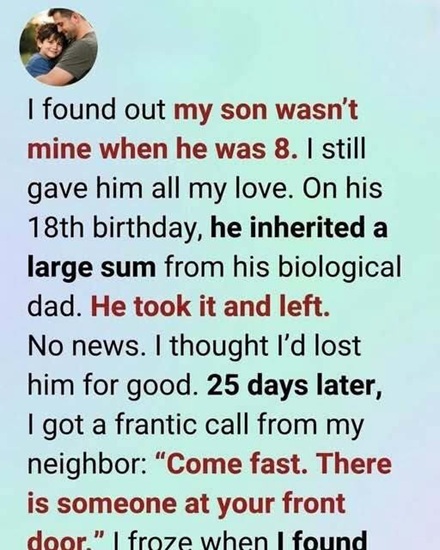
Some moments don’t announce themselves. They don’t arrive with warning signs or dramatic buildup. They slip into ordinary days so quietly that you only recognize their importance long after everything has already changed. For me, that moment happened during what was supposed to be a routine medical appointment with my son. He was eight years old. It was a normal day in every sense—no stress, no concern, no indication that anything unusual was about to occur. Just another quick visit, something we had done before without giving it much thought.
But ordinary moments can shift in unexpected ways. At first, everything followed a familiar pattern. Standard questions, routine checks, a predictable flow of conversation. Then, gradually, the pace changed. The doctor asked more questions than expected. Additional tests were suggested. The tone in the room subtly shifted, becoming more careful, more measured, as if every word now carried extra weight.
What stood out most to me was the silence. The pauses between sentences grew longer. The way the doctor seemed to think before speaking. The feeling that something important was approaching, even though nothing had been said yet. The room itself felt different—heavier, quieter, more focused. And then the truth was spoken. Not dramatically. Not abruptly. Just clearly and without embellishment.
We were told that we were not biologically related. There was no visible reaction from me at first. No immediate emotional outburst. Just stillness. A quiet moment where everything inside me seemed to pause at once, as if my mind needed time to catch up with what had just been said. Then I looked at my son. He was sitting there calmly, swinging his legs slightly, completely unaware of the weight of the moment. When he reached for my hand, it was instinctive, natural, unchanged. In his world, nothing had shifted at all.
And that realization became the most important part of everything.
Because in that instant, I understood something simple but powerful. Biology might explain origin, but it does not define connection. It does not measure the years already lived, the experiences shared, or the bond formed through everyday presence.
I was still his father.
Not because of genetics.
But because of life itself.
After that day, nothing in our daily routine changed in any obvious way. Life continued forward in its usual rhythm. School mornings, evening meals, homework, conversations, and all the small, ordinary moments that make up a shared life.
I remained present in everything.
I attended school events, helped with assignments, listened to stories about his day, and stayed by his side during moments of illness, confusion, or excitement. I was there when things went well, and I was there when they didn’t.
None of that required biology.
It required consistency.
It required choice.
At some point, I made a quiet decision within myself. I would not let this truth redefine our relationship. I would not treat it as a barrier between us. It remained something I knew, but it did not become something I acted upon.
So I kept it to myself.
Years passed in this way. He grew, and our bond continued to develop through shared experience rather than explanation. Life moved forward, shaped by routine, trust, and presence.
Then he turned eighteen.
And everything shifted again.
This time, the truth returned in a different form. It came through legal matters tied to the man who was biologically his father. An inheritance had surfaced, bringing with it questions from the past that now reached into our present.
He came to me to talk about it.
He wasn’t angry. He wasn’t lost. He was simply trying to understand something that had always been part of his story, even if it had been invisible to him until now.
He wanted answers.
Not to replace what he had.
But to complete what he didn’t know.
I listened carefully, without interruption. Some things in life cannot be controlled or stopped. They can only be faced when the time comes.
“I support you,” I told him.
And I meant it completely.
There was no conflict between us. No emotional breaking point. Just understanding. He needed to follow this path for himself, and I knew I could not stand in the way of that.
When he left, the house felt different.
Not empty, but quieter. The routines were still there, but they carried a different tone. Even simple moments felt more noticeable. The absence of his presence changed the way time moved.
I waited.
Not in expectation, but in patience. Some answers take time to form. Some realizations only come after distance and reflection. I knew this was something he had to experience on his own terms.
Then one evening, there was a knock at the door.
I already knew who it was before I opened it.
He stood there a little different than before. More grounded. More certain. Something in his expression had shifted, as if he had returned from a place that required reflection.
He stepped forward and hugged me without hesitation.
That alone said more than words could.
“I needed to understand,” he said quietly.
I nodded.
“And did you?” I asked.
He paused for a moment.
“It changed something,” he said. “But not what I expected.”
I waited for him to continue.
“Where I come from matters,” he said. “But it doesn’t decide who I am.”
Then he looked at me.
“The one who stayed,” he added. “That’s what defines family for me.”
In that moment, everything became clear.
Because family is not a single fact or biological connection. It is something built over time, shaped by presence, care, and consistency. It grows quietly in everyday moments, in shared silence, in ordinary routines that slowly become meaningful.
Biology may explain beginnings.
But belonging is built through life.
And in the end, it is belonging that lasts.

