
The Mariana Trench, the deepest known point on Earth, has long been imagined as a remote and untouched frontier, hidden far beyond the reach of human influence. Located in the western Pacific Ocean, this vast underwater chasm descends to depths of nearly 11,000 meters, where sunlight never penetrates and the pressure is unimaginably intense. For many years, it was widely assumed that such an extreme environment would remain completely isolated from the effects of human civilization.
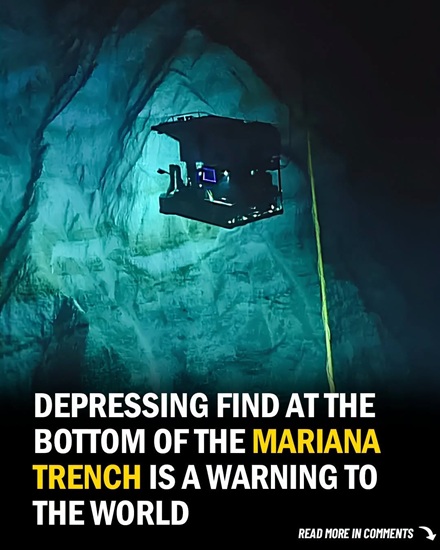
However, modern deep-sea exploration has gradually challenged this belief, revealing that even the most distant and inaccessible parts of our planet are not immune to human impact. As technology has advanced, researchers using deep-sea submersibles and remotely operated vehicles have begun to document surprising evidence of human presence in these extreme environments. Among the most striking discoveries is the detection of marine debris, including plastics and other manufactured materials, resting on the ocean floor.
These findings are not isolated incidents but rather part of a broader and growing global pattern of ocean pollution. Ocean currents, acting as powerful natural conveyor systems, transport waste across vast distances, eventually carrying it into the deepest trenches of the world’s oceans. In this way, human activity on land is indirectly linked to even the most remote parts of the marine environment. Scientific research has consistently shown that plastic pollution is one of the most persistent environmental issues facing the oceans today.
Unlike natural materials, plastics do not fully break down in a short period of time. Instead, they gradually fragment into smaller pieces known as microplastics, which can remain in the environment for decades or longer. These particles have now been found in surface waters, marine sediments, and even within deep-sea ecosystems. Their widespread distribution has raised serious concerns among scientists about the long-term health of marine environments and the organisms that inhabit them.
The presence of waste in the Mariana Trench also reflects the broader global challenge of managing human-generated pollution. A significant proportion of marine debris originates from land-based sources, including mismanaged waste systems, littering, and runoff carried by rivers into the ocean. Once plastics enter marine environments, they can travel immense distances, influenced by currents and natural sinking processes. Some materials remain afloat near the surface for extended periods, while others eventually sink to the deepest parts of the ocean. This movement demonstrates that ocean pollution is not confined to specific regions but is instead a worldwide issue that transcends geographical boundaries.
Deep-sea ecosystems, though often perceived as lifeless, are actually home to a wide variety of specialized organisms adapted to extreme conditions. These ecosystems are delicate and highly sensitive to environmental changes. When human-made materials enter these habitats, they can disrupt natural processes, interfere with feeding behaviors, and introduce foreign substances into fragile ecological systems. Even in the absence of direct human presence, the impact of pollution can still be felt through the materials that accumulate on the ocean floor.
One of the most concerning forms of marine pollution is abandoned or lost fishing gear, often referred to as “ghost gear.” This equipment can remain in the ocean for years, continuing to trap and harm marine life long after it has been discarded. In deep-sea environments, where decomposition occurs very slowly, such materials can persist for extended periods, increasing their long-term ecological impact. This highlights how human activities, even when unintended, can have lasting consequences on ecosystems that are far removed from everyday life.
The discovery of plastic and other debris in the Mariana Trench has prompted scientists and environmental experts to emphasize the urgent need for improved waste management and pollution prevention strategies. Since ocean currents do not respect national borders, marine pollution is inherently a global issue that requires international cooperation. Efforts to reduce plastic production, improve recycling systems, and develop more sustainable materials are all considered essential steps in addressing this growing environmental challenge.
Beyond its scientific importance, the presence of human-made waste in the deepest part of the ocean carries a powerful symbolic message. It serves as a reminder of how closely connected human societies are to the natural world, even when those connections are not immediately visible. Actions taken on land—whether in cities, industries, or households—can eventually influence ecosystems located thousands of kilometers away and thousands of meters below the surface.
This realization has encouraged a growing awareness of environmental responsibility and sustainability. It highlights the importance of reconsidering how resources are used, how products are consumed, and how waste is managed on a global scale. The ocean, once thought to be an endless space capable of absorbing human impact, is now recognized as a fragile system with clear limits.
Ongoing scientific exploration continues to reveal new information about the deep ocean and its ecosystems. These discoveries not only expand our understanding of marine life but also provide critical insight into the scale of human influence on the planet. As research progresses, it becomes increasingly clear that protecting the oceans is not just an environmental concern but a fundamental necessity for maintaining Earth’s overall ecological balance.
In the end, the presence of plastic and other debris in the Mariana Trench stands as a powerful reminder of the far-reaching consequences of modern human activity. It underscores the importance of global cooperation, responsible consumption, and long-term environmental stewardship. Even the deepest parts of the ocean, once believed to be untouched, now reflect the reality of a world where no place is truly isolated from human influence.

