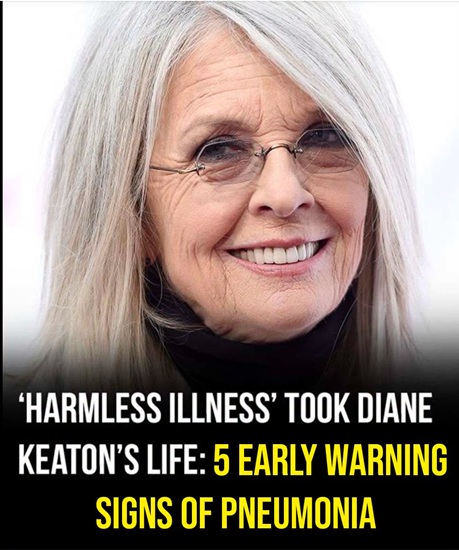
Diane Keaton’s death at the age of 79 brought an immediate wave of sadness from fans, colleagues, and generations of moviegoers who had followed her career for decades. The Oscar-winning actress died on October 11, 2025, in California. In the days that followed, many people wondered what had happened because Keaton had largely kept her recent health concerns private. Her family later confirmed that pneumonia caused her death, providing a clear answer without inviting speculation about private medical details that had not been made public.
The official information became more specific when Keaton’s death certificate identified primary bacterial pneumonia as the immediate cause of death. The record reportedly did not list another significant medical condition as contributing to her death. That distinction is important because rumors can spread quickly after the death of a famous person, especially when older illnesses or previous health problems are brought back into public discussion. In Keaton’s case, the available record supports a straightforward conclusion: bacterial pneumonia was the confirmed cause.
Emergency responders were called to Keaton’s Los Angeles-area residence on the morning of October 11. Fire department personnel responded to a medical emergency and transported a patient to a hospital. Details about what happened immediately before the emergency call remained private, and there is no need to speculate about circumstances that her family did not choose to disclose. The later confirmation of pneumonia provided the central medical fact needed to explain her passing.
Keaton’s death also brought new attention to an illness that is sometimes misunderstood. Pneumonia is not one single disease with one cause. It is an infection that affects the lungs and can be caused by bacteria, viruses, fungi, and other organisms. The infection can inflame the tiny air sacs inside the lungs, sometimes causing them to fill with fluid or other material. This can interfere with normal breathing and reduce the amount of oxygen reaching the bloodstream.
The severity of pneumonia varies greatly. Some people experience relatively mild illness and recover at home with appropriate medical care. Others become seriously ill and require hospitalization. Age, overall health, the organism causing the infection, and how strongly the body responds can all affect the outcome. Older adults are among the groups more likely to experience complications, which is why health professionals take pneumonia especially seriously in people over 65.
Common symptoms can include coughing, fever, chills, tiredness, chest pain, and shortness of breath. Some people may cough up mucus, while others may experience a dry cough. Symptoms can sometimes resemble influenza, COVID-19, bronchitis, or another respiratory infection, particularly during the early stages. Because of this overlap, symptoms alone are not always enough to determine whether someone has pneumonia.
A cough that persists or becomes worse can be one reason to seek medical advice. Coughing is extremely common and does not automatically indicate pneumonia, but it deserves greater attention when combined with fever, breathing difficulty, chest discomfort, or unusual weakness. A healthcare professional can evaluate the overall pattern of symptoms rather than relying on one sign.
Chest discomfort can also occur. Some patients with pneumonia experience pain that becomes more noticeable while breathing deeply or coughing. There are many possible causes of chest pain, including conditions unrelated to the lungs, so unexplained or severe pain should be evaluated rather than self-diagnosed. Medical assessment is particularly important when chest pain appears together with shortness of breath.
Fever and chills are widely associated with respiratory infections, but older adults do not always develop the classic symptoms people expect. Some elderly patients with pneumonia may experience a lower body temperature instead of a high fever. This can make the illness more difficult to recognize if family members or caregivers are waiting for a dramatic temperature increase before seeking help.
Shortness of breath can be especially concerning because pneumonia directly affects the lungs. A person may notice that ordinary activities suddenly leave them unusually winded. In more severe cases, breathing may become difficult even while resting. Medical professionals can check oxygen levels and determine whether additional testing or treatment is necessary.
Extreme fatigue can also be part of pneumonia. Fighting an infection requires considerable energy, and many patients feel weak or exhausted. In older adults, sudden weakness can sometimes be more noticeable than a high fever or dramatic cough. This is another reason pneumonia can occasionally present differently from what people expect.
Confusion is another symptom that deserves special attention in older adults. Sudden disorientation or a noticeable change in mental alertness can accompany serious infection. It should never automatically be dismissed as an ordinary part of aging. When confusion appears suddenly, particularly alongside weakness or respiratory symptoms, professional medical evaluation may be necessary.
Doctors may use several methods to diagnose pneumonia. A physical examination typically includes listening to the lungs and reviewing symptoms and medical history. A chest X-ray may be used to identify areas of inflammation. Blood tests, oxygen measurements, and tests of mucus or other samples may also be used depending on the circumstances.
Treatment depends largely on what caused the infection. Bacterial pneumonia is generally treated with antibiotics. Because Keaton’s official cause of death was listed as bacterial pneumonia, her case falls within this category. Viral pneumonia requires a different approach, and antiviral medication is available only for certain viral infections. Fungal pneumonia may require antifungal treatment.
Antibiotics are not appropriate for every respiratory illness. They work against bacterial infections and do not treat ordinary viral colds or most other viral conditions. This is why medical diagnosis matters. Taking antibiotics unnecessarily can cause side effects and contribute to antibiotic resistance without helping the patient.
For people with mild bacterial pneumonia, treatment may sometimes take place at home. Rest, fluids, prescribed medication, and monitoring can be enough in uncomplicated cases. Severe pneumonia can require hospital treatment, particularly when oxygen levels are low or the patient has difficulty breathing.
Hospital care may include intravenous medication, fluids, supplemental oxygen, and frequent monitoring. In the most serious cases, mechanical breathing support may become necessary. Pneumonia can also lead to complications involving other organs when the body struggles to maintain adequate oxygen or when the immune response to infection becomes severe.
Respiratory failure is one possible complication. Severe infection can make it difficult for the lungs to provide enough oxygen for the body’s needs. Some patients may develop acute respiratory distress syndrome, a serious condition in which lung function becomes severely impaired.
Another possible complication is sepsis, which can occur when the body’s response to infection becomes dangerously widespread. Sepsis can affect multiple organs and requires urgent hospital treatment. The existence of such complications helps explain why pneumonia is treated as a potentially serious medical condition rather than simply another type of cold.
That does not mean every case of pneumonia becomes dangerous. Many people recover completely, particularly when the illness is recognized and treated appropriately. The important point is that severity is unpredictable enough that worsening symptoms should not be ignored.
Diane Keaton was 79 at the time of her death, placing her in an age group associated with a higher risk of serious pneumonia. That general medical fact should not be used to create theories about exactly why her individual illness became fatal. Her full medical records have not been released publicly, and the official information does not provide enough detail to reconstruct every part of her final illness.
This is why claims that another disease must have returned are not supported by the available evidence. Keaton had previously spoken publicly about health issues earlier in her life, but the death certificate reportedly listed bacterial pneumonia without identifying another major contributing condition. Responsible reporting should respect that distinction.
Photographs taken during the final months of a celebrity’s life should not be treated as medical records either. Changes in weight or appearance can have many possible explanations. Looking at an image and deciding that a particular disease must have returned is speculation, not diagnosis.
The same principle applies to emergency recordings or dispatch information. Such material may document that first responders were sent to a medical emergency, but it does not establish a complete diagnosis. The family statement and official death record remain more reliable sources for understanding Keaton’s cause of death.
Her passing understandably encouraged people to learn more about pneumonia, but it is equally important not to turn one individual case into a prediction for everyone else. A person diagnosed with pneumonia should not assume that Keaton’s outcome means the illness will become fatal. Many factors influence prognosis.
Older age is only one factor. Chronic lung disease, heart disease, diabetes, smoking, weakened immune function, and certain other medical conditions can also increase risk. Someone without those conditions can still develop serious pneumonia, while another high-risk patient may recover successfully.
Vaccination can help reduce the risk of several infections that can cause pneumonia. Pneumococcal vaccines are available to protect against certain forms of pneumococcal disease. Recommendations vary according to age, previous vaccination history, and health conditions, so people should follow current medical guidance rather than relying on outdated schedules.
Vaccines against influenza, COVID-19, and certain other respiratory infections can also reduce the risk of illnesses that sometimes lead to pneumonia. No vaccine prevents every possible cause, but vaccination can lower risk for some important pathogens.
Smoking is another relevant factor in respiratory health. Cigarette smoke can damage structures in the airways that normally help remove mucus and infectious material. Avoiding or stopping smoking can reduce many respiratory risks, although no lifestyle choice can guarantee that a person will never develop pneumonia.
Good hand hygiene and reasonable precautions around contagious respiratory infections can also help reduce exposure. These measures are simple but useful because pneumonia can sometimes develop as a complication of another infection.
Recovery from pneumonia can take longer than many people expect. Fever and acute symptoms may improve before energy fully returns. Some patients experience tiredness, coughing, or reduced exercise tolerance for several weeks. Older people may need additional time to regain strength after a serious infection.
The recovery period should therefore not be rushed. Returning immediately to strenuous activity before the body has recovered may be difficult for some patients. Healthcare professionals can advise when normal exercise and activities should be resumed.
Follow-up may also be appropriate in certain situations. Persistent breathing problems, recurring fever, continued weakness, or symptoms that fail to improve can require additional evaluation. People should follow the recommendations of their own clinicians rather than relying on a general timeline.
Keaton’s death reminds audiences that pneumonia is capable of becoming serious even though many cases are treatable. That is a useful public-health message, but it should be communicated without fear or exaggeration. Awareness works best when it helps people recognize symptoms and seek appropriate care.
The story is also about much more than the illness that ended her life. Diane Keaton spent decades building one of the most distinctive careers in American cinema. Her performances ranged from serious drama to romantic comedy, and her unconventional screen presence became central to her appeal.
Born Diane Hall in Los Angeles in 1946, she later used the professional surname Keaton. She first developed her acting career through stage work before moving into film. Her breakthrough came during a period that transformed American cinema.
In 1972, Keaton appeared as Kay Adams in The Godfather. Kay begins the film outside the Corleone family’s criminal world and gradually watches Michael Corleone become increasingly consumed by it. The role gave Keaton a major place in one of the most celebrated films in cinema history.
She returned as Kay in later installments of The Godfather series. The character became increasingly important as Michael’s personal life deteriorated. Keaton’s performance helped give the films an emotional perspective outside the criminal organization itself.
Comedy became equally central to her career. During the 1970s, she worked with Woody Allen in several films, including Sleeper, Love and Death, and Annie Hall. The last of those became one of her defining performances.
Keaton won the Academy Award for Best Actress for Annie Hall. The film also made her personal fashion style part of popular culture. Loose trousers, vests, ties, hats, and layered clothing became strongly associated with both the character and Keaton herself.
Her style stood apart from conventional expectations for female movie stars. Rather than abandoning that individuality as fashion changed, Keaton continued developing it throughout her life. By her later years, her clothing remained almost as recognizable as her performances.
Keaton also demonstrated that she was capable of much darker dramatic work. Looking for Mr. Goodbar gave her a role far removed from the lightness of her romantic comedies. In Reds, she delivered another acclaimed dramatic performance and received an Academy Award nomination.
Later audiences knew her through films such as Father of the Bride. Starring opposite Steve Martin, she played Nina Banks, the mother of a young woman preparing to marry. The film became a popular family comedy and introduced Keaton to viewers who may not have been familiar with her earlier work.
She returned in Father of the Bride Part II, continuing the Banks family story. These movies helped reinforce Keaton’s ability to create warmth and humor without losing the nervous energy that had long been part of her acting style.
Another major comedy came with The First Wives Club. Keaton appeared alongside Goldie Hawn and Bette Midler as one of three longtime friends rebuilding their lives after marital disappointments. The ensemble became one of the best-known comedies of the 1990s.
In 2003, Something’s Gotta Give brought another important late-career role. Keaton starred opposite Jack Nicholson in a romantic comedy centered on middle-aged and older characters. Her performance earned another Academy Award nomination.
The film challenged the common Hollywood tendency to place romantic stories almost exclusively around young characters. Keaton’s character was allowed to be funny, successful, insecure, attractive, and emotionally complicated without pretending to be decades younger.
She continued working well after that film. The Family Stone, Morning Glory, Book Club, and Book Club: The Next Chapter were among the projects that kept her visible to newer audiences.
Keaton also worked outside acting. She directed, produced, wrote books, and pursued photography. Architecture and historic homes became major personal interests, and she became known for restoring and documenting houses.
Motherhood became another central part of her life. Keaton never married, but she adopted two children. Her daughter Dexter joined the family in the 1990s, followed by her son Duke several years later.
Keaton often described motherhood as a transformative experience. Unlike her romantic relationships, which received considerable public attention during various periods of her career, her identity as a parent was largely separated from Hollywood publicity.
Her children remained part of the immediate family mourning her death. Their loss was private even though the public reaction to Keaton’s passing was enormous.
The family’s statement following her death also highlighted Keaton’s affection for animals. They suggested that people wishing to remember her could support animal shelters or food banks. That request reflected personal causes that mattered to her beyond entertainment.
Tributes came from across Hollywood. Actors who had worked with Keaton and performers who had grown up watching her remembered a colleague with a highly distinctive personality. The messages emphasized her humor, originality, warmth, and individuality.
Those qualities had allowed her to remain relevant through several generations of filmmaking. Keaton never seemed completely attached to one era. Someone who discovered her through The Godfather could admire a very different side of her from someone who first encountered her through Book Club.
Few actresses maintain such a recognizable public identity for so many decades. Keaton’s face changed with age, her roles changed, and the film industry around her changed dramatically, but the qualities audiences associated with her remained recognizable.
Her manner of speaking was part of that appeal. Keaton could make hesitation, interruption, and apparent nervousness feel natural rather than rehearsed. She could appear uncertain while simultaneously being extremely funny.
Her characters often seemed to be thinking faster than they could organize their words. That quality helped distinguish her from performers with more polished or conventional comedic delivery.
Keaton’s style also allowed her to move between comedy and drama with unusual ease. The vulnerability that made a comic scene charming could become painful in a dramatic context. Directors could use the same fundamental qualities in very different ways.
That versatility explains why reducing her career to Annie Hall alone would miss much of her achievement. The Oscar-winning performance was enormously important, but it represented only one part of more than five decades of screen work.
Her death from pneumonia closed that long career, but it should not redefine it. The illness lasted a relatively short period compared with the decades she spent working, raising a family, and developing interests outside acting.
This is also why coverage of her death should avoid sensational descriptions. An emergency call can sound dramatic, but the important information is already known. She became seriously ill with bacterial pneumonia and died at 79.
There is no verified hidden explanation that needs to be uncovered.
There is no medical mystery that requires speculation.
There is a confirmed diagnosis.
And there is a grieving family that deserves privacy around details they chose not to release.
The public can still learn something useful from the circumstances without turning Keaton’s final days into entertainment.
Pneumonia can be serious.
Older adults have increased risk.
Symptoms can sometimes be less obvious in elderly patients.
Breathing problems and sudden confusion deserve attention.
Medical treatment depends on the cause.
Vaccination can help prevent some forms.
Those facts are useful whether or not someone follows celebrity news.
They are also more responsible than dramatic warnings suggesting that everyone with a cough faces the same danger.
A cough is common.
Pneumonia is only one possible cause.
Diagnosis belongs with healthcare professionals.
The same is true for chest pain.
The same is true for fatigue.
The same is true for shortness of breath.
Online information can help people understand possibilities, but it cannot replace individualized evaluation.
Anyone experiencing severe difficulty breathing, major chest pain, sudden confusion, or other emergency symptoms should seek urgent medical care.
For less severe but persistent symptoms, speaking with a healthcare professional can help determine whether testing is needed.
People should also avoid taking leftover antibiotics or medication prescribed to someone else. Appropriate treatment depends on diagnosis, dosage, medical history, and the organism suspected.
Keaton’s case involved bacterial pneumonia, but another person with similar symptoms might have influenza, COVID-19, RSV, bronchitis, a heart condition, or something entirely different.
That uncertainty is precisely why accurate health information matters.
Celebrity cases naturally attract attention, but they should never become templates for self-diagnosis.
The most respectful way to connect Keaton’s death with pneumonia awareness is to use confirmed information and clearly separate general medical education from assumptions about her personal treatment.
We know the cause of death.
We know her age.
We know that her family confirmed pneumonia.
We know the official record specified bacterial pneumonia.
What we do not know publicly is the complete sequence of symptoms, tests, treatment decisions, or private conversations with doctors.
Those gaps should remain gaps unless the family chooses to provide more information.
Accuracy is stronger than speculation.
That principle also respects Facebook and advertising standards more effectively than presenting dramatic theories as facts.
Keaton’s story does not need exaggeration to hold attention.
Her career was extraordinary on its own.
Her death was significant on its own.
And pneumonia is serious enough to discuss without making unsupported claims.
More than anything, Diane Keaton left behind a body of work that crossed generations.
She could be Kay Adams.
She could be Annie Hall.
She could be Nina Banks.
She could stand beside Goldie Hawn and Bette Midler in a comedy ensemble.
She could play opposite Jack Nicholson decades into her career and receive another Oscar nomination.
She could appear in later films without pretending that aging had erased her personality or romantic life.
That continuity was unusual.
Hollywood changed around her, but Keaton never seemed interested in becoming a generic version of what the industry expected.
Her clothes remained unmistakable.
Her humor remained slightly unpredictable.
Her performances remained emotionally open.
And her personality remained difficult to imitate.
That is the larger reason her death affected so many people.
Pneumonia explains medically why Diane Keaton died.
It does not explain why people cared.
The answer to that lies in the movies, performances, relationships, and personal individuality she shared with audiences for decades.
Her family’s confirmation provided clarity about her final illness.
The official record provided additional medical precision.
Those facts are enough.
There is no need to search for an unconfirmed hidden cause.
There is no need to treat old photographs as medical evidence.
There is no need to portray pneumonia as universally fatal.
The responsible conclusion is simpler.
Diane Keaton died from bacterial pneumonia at the age of 79.
Pneumonia can be a serious lung infection, particularly for older adults and other high-risk groups.
People with concerning symptoms should seek appropriate medical care.
And Diane Keaton’s legacy should ultimately be remembered through the much larger life and career that came before her final illness.
Her death brought attention to pneumonia.
Her life brought laughter, drama, style, vulnerability, and originality to cinema.
That is the balance worth preserving when telling her story again.
