
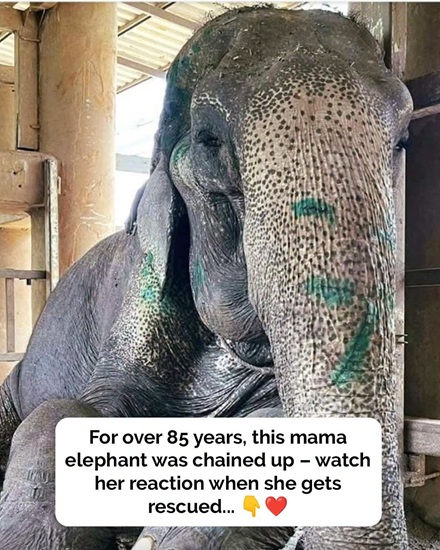
Grandma Somboon’s story drew international attention because it showed how dramatically life can change for an elderly elephant once demanding work is replaced by rest, veterinary support, and long-term care. By the time she was transferred to Elephant Nature Park in Thailand in January 2024, she was estimated to be about 87 years old. Reports connected with her rescue said she had spent much of her life in forms of work linked with logging and tourism.
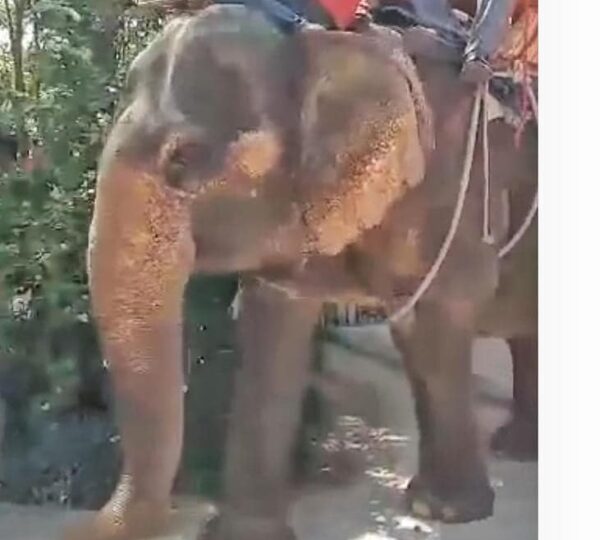
Her advanced age and physical condition made the move particularly significant. Rather than continuing a working routine, she entered an environment where her basic needs and comfort became the main priority. Somboon’s reported history stretches back many decades. Accounts shared around the time of her rescue stated that she had been used in physically demanding work earlier in life and later became involved in tourism-related activities.
Those reports described periods in which she carried people, participated in different forms of commercial elephant activity, and spent long days on her feet. Because much of her history took place many decades ago, not every early detail can be independently confirmed today. The most careful way to describe her past is therefore to say that these activities were part of the history reported by people familiar with her life and by the rescue organization involved.
What was easier to document was Somboon’s condition when she reached the sanctuary. She appeared extremely thin and showed several signs associated with advanced age and a difficult physical history. Reports described her as having missing teeth, weakened mobility, cloudy or reduced vision, and dry skin. She was also said to have been dehydrated. For an elephant of such advanced age, even ordinary movement could be physically demanding. These conditions meant that her care needed to focus not on making her young again, but on improving comfort, nutrition, hydration, and quality of life.
Save Elephant Foundation became involved after learning about her situation. The organization, which is based in Thailand and closely connected with Elephant Nature Park near Chiang Mai, works with captive elephants through rescue, rehabilitation, veterinary support, and long-term sanctuary care. Somboon’s age made her a particularly vulnerable case. When arrangements were finally made to relocate her, the goal was to remove her from a working environment and allow her to spend the rest of her life without being required to perform or carry out physically demanding tasks.
Her transfer to Elephant Nature Park took place in late January 2024. Moving a very old elephant is not a simple operation. Long-distance transportation can be stressful for any large animal, and advanced age increases the need for careful planning. The team needed to consider her strength, hydration, balance, and ability to remain comfortable during the journey. Once she arrived safely, staff prepared a space appropriate for her condition. One of the most important features was a soft bed made from sand.
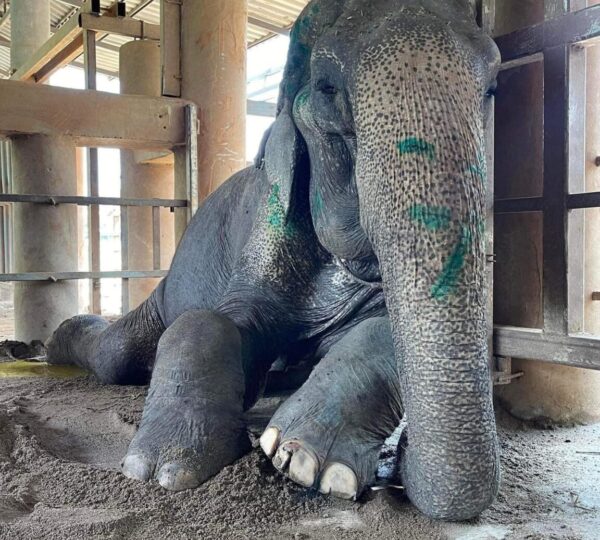
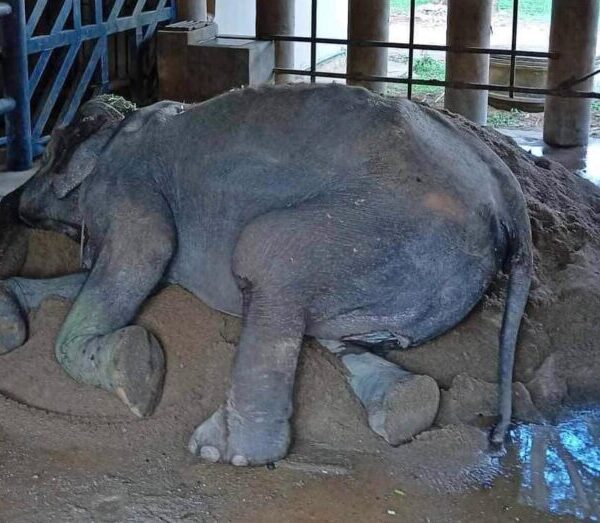
That sand bed soon became central to the story people around the world would remember. Newly rescued elephants sometimes remain cautious when they enter an unfamiliar environment. Some may stand for long periods before feeling comfortable enough to lie down. Somboon behaved differently. According to the rescue organization’s account, she approached the sand area and lay down soon after arriving. She then slept very deeply despite activity around her.
The scene was striking because it looked so peaceful. There was no dramatic performance taking place. Somboon was simply lying on soft ground and sleeping. The meaning came from the context surrounding that moment. She had arrived after a long life reportedly shaped by demanding work, and the sanctuary had prepared a place where nothing was immediately being asked of her. For people following her rescue, the sight of an elderly elephant resting became a powerful image.
It is still important to describe that moment carefully. Some versions of Somboon’s story have claimed that she had not lain down for decades. There is no reliable way to confirm such an absolute statement about every night of an animal’s long life. What is documented is that she lay down very soon after arriving at the sanctuary and slept deeply on the prepared sand bed. That detail is meaningful enough without adding claims that cannot be proven.
Somboon’s long sleep also revealed another challenge associated with her age. When it was time for her to stand again, getting back onto her feet was difficult. Elderly elephants can experience reduced muscle strength and problems with their joints, which can make rising from the ground much harder than it would be for a younger animal. Caregivers therefore needed to assist and closely monitor her. Her ability to lie down comfortably was positive, but the sanctuary also had to make sure she could stand safely afterward.
This difficulty did not mean that allowing her to rest was harmful. Rest is necessary for animals, including elderly elephants. The issue was simply that Somboon’s body required additional support because of her advanced age and weakened condition. Sanctuary staff were prepared to help when necessary. Her daily care became a balance between allowing natural rest and watching carefully for mobility problems.
Food was another major concern. Elephants spend a large portion of each day eating, and dental problems can create serious challenges for older animals. Somboon was reportedly missing teeth, which meant that caregivers needed to pay close attention to what she could comfortably eat. Appropriate nutrition could help restore some body condition and energy, although no diet could completely reverse the effects of advanced age.
Water was equally important. Reports surrounding her arrival described signs of dehydration, making regular access to clean water and careful observation necessary. Hydration can affect many aspects of health, from digestion to circulation and energy. In the sanctuary environment, providing food and water was not tied to whether Somboon could continue working. They were simply part of the care she needed as an elderly animal.
Over time, updates about Somboon became increasingly encouraging. She began exploring more of her surroundings and was seen walking around the sanctuary. Videos showed her near water and mud, engaging in behaviors that can be natural and beneficial for elephants. Mud can help protect elephant skin from sunlight and insects, while water can provide both cooling and relief for a large body.
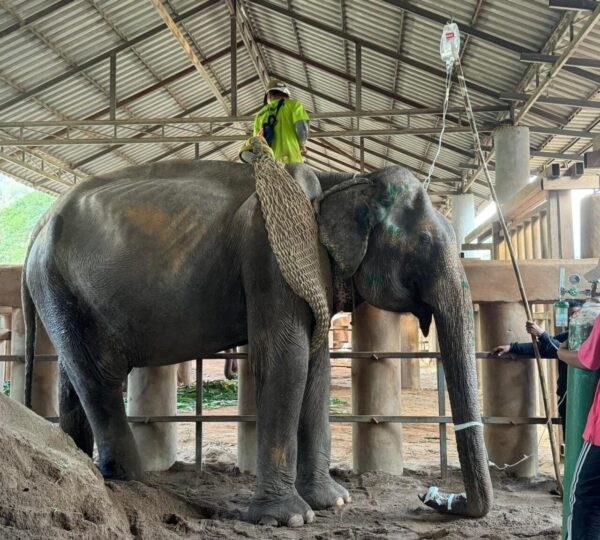
These behaviors did not mean that every health problem had disappeared. Somboon remained an exceptionally old elephant, and age-related conditions continued to require attention. Progress in an animal like her needs to be understood differently from recovery in a young and otherwise healthy animal. Eating more comfortably, walking with greater confidence, resting safely, and showing interest in the environment can all be meaningful improvements.
That distinction matters because rescue stories are sometimes presented as though an animal moves from suffering to perfect health almost overnight. Real rehabilitation is rarely that simple. Physical damage can be permanent, chronic conditions may remain, and age cannot be reversed. Good care often means managing those realities while making daily life more comfortable.
Somboon’s experience therefore became a story of gradual improvement rather than instant transformation. Staff continued watching her ability to move, eat, sleep, and stand. When she needed help, people were nearby. When she wanted to rest, the environment allowed it. The purpose of the care was not to prepare her for another form of work but to support the life she still had.
Her case also drew attention to the complicated history of captive elephants in Thailand. Elephants have been part of labor, tourism, culture, and local livelihoods for generations. Changes in the logging industry over time led many captive elephants and their handlers to depend more heavily on tourism. Riding, performances, photography, and other visitor activities became sources of income.
In recent years, animal-welfare organizations and some tourism operators have increasingly questioned whether certain activities provide appropriate conditions for elephants. Practices that require repeated performances, long hours of riding, or prolonged restraint have faced criticism. At the same time, the broader issue is complex because elephants, mahouts, families, businesses, and local communities may all be economically connected.
For that reason, Somboon’s story is better understood without blaming an entire country or group of people. The organization that rescued her is itself based in Thailand, and much of the work to improve elephant welfare comes from Thai veterinarians, rescuers, mahouts, conservationists, and community members. The challenge is not simply about outsiders telling local people what to do. It is about finding approaches that improve animal welfare while also recognizing the human livelihoods connected with captive elephants.
Save Elephant Foundation promotes a model focused on rescue, rehabilitation, and allowing elephants to live with greater freedom from commercial performance. In a sanctuary setting, the animal does not need to earn its food by carrying riders or appearing in shows. This changes the relationship between people and the elephant. Care exists because the animal needs it, not because the animal must remain productive.
For Somboon, that difference was especially important. At approximately 87 years old when rescued, she had already reached an age at which any continued heavy work could be especially difficult. Her body showed visible signs of aging and weakness. Retirement in her case was less about creating a new active lifestyle and more about removing unnecessary demands.
The simplest aspects of sanctuary life therefore carried real significance. A soft place to sleep mattered. Easy access to food mattered. Water mattered. Veterinary observation mattered. Being allowed to move at her own pace mattered. These things might appear ordinary, but for an elderly animal they can determine whether daily life is painful or manageable.
Her story also illustrates why old animals still benefit from rescue even when they may not have decades of life ahead of them. Sometimes people assume rehabilitation is most worthwhile for young animals because they have more time to recover. Yet quality of life matters at any age. Even a limited period of comfort, safety, and freedom from demanding work can be meaningful.
Nobody involved in Somboon’s rescue could know exactly how much time she had left. The point was not to guarantee a particular number of years. It was to change the conditions of whatever time remained. Her past could not be rewritten, but her daily experience could still improve.
That idea helps explain why her first sleep resonated with so many people. The footage did not show an elephant doing something extraordinary. It showed her doing something very ordinary without interruption. She was resting because she was able to rest.
The caregivers did not need a performance from her. They did not need her to carry anyone. They were not waiting for her to entertain visitors. For that moment, their job was simply to make sure she was comfortable and safe.
When she later needed assistance to stand, they helped her. When her diet needed adjustment, they could respond. When she required veterinary attention, that became part of her routine. The sanctuary relationship was based on supporting her limitations rather than demanding that she hide them.
Somboon’s rescue also raised public awareness about how physical work can affect elephants over time. Large animals may appear powerful, but their joints, feet, muscles, and skin can still be damaged or weakened. Carrying loads or spending long hours on hard surfaces can contribute to physical problems, particularly when an animal becomes old.
Foot and joint health are especially important in captive elephants. Because elephants are extremely heavy, even relatively small mobility problems can become serious. If an elderly elephant struggles to stand, caregivers need to act carefully because prolonged inability to rise can create additional medical complications.
This is one reason soft bedding can be valuable. Sand can reduce pressure compared with harder flooring and give an elephant a more comfortable surface for resting. For Somboon, the prepared bed allowed her to lie down almost immediately after arrival.
Her response also showed why individual behavior matters in animal care. Not every elephant reacts to rescue in the same way. Some may be cautious for weeks. Others may explore quickly. Age, personality, past experience, physical condition, and relationships with people can all influence how an elephant adjusts.
Caregivers therefore need to respond to the individual animal rather than following one rigid routine. Somboon’s deep sleep suggested one immediate need: rest. Other rescued elephants might initially prioritize distance, food, social contact, or simply standing and observing.
The same caution should be applied when interpreting emotions. It is understandable for people to say that Somboon looked relieved or peaceful, but humans cannot know exactly what an elephant is thinking. The strongest reporting focuses on observable behavior. She lay down. She slept deeply. She later explored the sanctuary. She interacted with food, water, mud, and caregivers.
Those observable facts already tell a substantial story.
Over the following weeks, videos showed signs that Somboon was becoming more familiar with her surroundings. Her movement appeared steadier in some updates, and she participated in everyday elephant behaviors. These moments suggested that her new routine was becoming established.
Her caregivers still had to work within the limits created by age. There was no realistic expectation that an elephant in her late 80s would suddenly become physically young. Instead, the goal was to maintain whatever strength she had and reduce unnecessary discomfort.
This type of care can involve daily judgment. If she was tired, staff needed to allow more rest. If she was struggling to eat, food preparation might need adjustment. If her mobility changed, veterinary staff would need to assess why.
That ongoing attention is one of the less visible parts of sanctuary work. Dramatic rescue footage may receive millions of views, but long-term animal welfare depends on repetitive daily tasks performed afterward.
Food needs to be purchased and prepared.
Water needs to remain available.
Shelter and resting areas need maintenance.
Veterinarians need to monitor health.
Caregivers need to observe behavior.
Older animals may need physical assistance.
All of this continues whether or not cameras are present.
Somboon became well known because her rescue was documented publicly, but many animals in sanctuary care require similar work without receiving the same attention.
Her story nevertheless became useful because it gave people a specific example of what retirement can look like for a former working elephant. Instead of speaking only in general terms about welfare, audiences could see one individual animal making the transition.
This kind of storytelling can encourage people to think more carefully about tourism choices. Travelers interested in seeing elephants can ask what the animals are required to do, how much control they have over interactions, and how facilities care for older or injured individuals.
The name of a facility alone does not necessarily reveal its standards. Visitors can research whether elephants are required to perform, whether riding is offered, and whether the animals have opportunities for natural behavior and social contact.
Consumers can influence tourism by choosing experiences that place less emphasis on direct control of animals and more emphasis on observation and welfare.
Still, tourists are only one part of the system. Meaningful change also depends on viable economic alternatives for people who work with elephants. If reforms remove income without replacing it, both families and animals may face new difficulties.
Programs that combine better welfare with sustainable employment can therefore be more effective than simply condemning people who have worked within existing systems.
Somboon’s rescue demonstrates how cooperation can create another option. Instead of remaining in the same working environment indefinitely, she was transferred into long-term sanctuary care.
That move required organization, financial resources, transportation, staff, and a place willing to support her permanently.
Rescue is therefore much more than opening a gate and allowing an elephant to walk away. Captive elephants cannot simply be released into the wild after decades of dependence on people. Many have health problems or lack the ability to survive independently.
Sanctuary care becomes a long-term responsibility.
For Somboon, that responsibility began the moment she arrived.
There was no expectation that she would generate income to justify the cost.
Her age made the situation even clearer.
She needed care because she was old and vulnerable.
That was enough.
Her story also provides an example of how language can shape the way people understand animal welfare. Words such as “rescued,” “retired,” and “sanctuary” can be meaningful, but they should be connected with observable conditions.
In Somboon’s case, the practical changes were clear.
She stopped working.
She was moved to Elephant Nature Park.
She received food and water.
She was given soft bedding.
Her health was monitored.
She was assisted when she struggled to stand.
She was allowed to walk and rest according to her condition.
Those details provide a stronger explanation of her new life than emotional labels alone.
The story also does not require exaggerated claims to be moving.
Somboon did not need to have literally stood without sleeping for 80 years for her first sanctuary rest to matter.
She did not need to understand the concept of “retirement” in a human sense.
She did not need to communicate gratitude.
She simply needed an environment where her needs were finally treated as the priority.
Her physical condition made the difference visible.
An extremely thin body showed that she required nutritional support.
Missing teeth affected how she could eat.
Weakness affected how she moved.
Her eyes and skin reflected age and health concerns.
These were practical problems that caregivers could address as far as possible.
The fact that some problems were permanent did not make the effort meaningless.
Comfort can improve even when complete recovery is impossible.
Pain can be reduced.
Food can become easier to eat.
Rest can become safer.
Movement can become less demanding.
Stress can be reduced.
Those incremental improvements are often what good care looks like for an elderly animal.
Somboon’s story also became a reminder that elephants are highly social and behaviorally complex animals. They respond to their surroundings, develop relationships, and show individual preferences. Sanctuary environments attempt to give them more opportunities to make choices than many working settings allow.
Those choices may seem small.
An elephant can decide whether to enter water.
It can choose to stand in shade.
It can approach another elephant or remain at a distance.
It can stop walking.
It can rest.
For an animal that has spent much of its life following human commands, increased choice can represent a major change.
Somboon’s age may also influence how social she wants to be. Elderly elephants do not necessarily behave like younger animals, and a sanctuary cannot assume that every individual will immediately join a group.
Some may prefer quiet environments.
Others may form close relationships.
Caregivers need to observe what makes each animal comfortable.
The same applies to contact with people.
An elephant that has spent decades around humans may still react differently to new caregivers.
Trust can take time.
Consistency matters.
Force should not be required simply to make an animal appear comfortable.
Somboon’s early willingness to rest therefore stood out because she did not show the extended period of caution sometimes observed in newly rescued elephants.
Whether that behavior was primarily exhaustion, comfort with the sand, or a combination of factors cannot be known with certainty.
What is clear is that she slept.
And the sanctuary allowed her to keep sleeping.
Later, when she had difficulty standing, staff responded to that need rather than preventing her from resting again entirely.
That balance demonstrates the complexity of caring for an old elephant.
Every benefit can create another consideration.
Rest is necessary, but standing may be difficult.
Food is necessary, but teeth may be missing.
Exercise can maintain strength, but too much movement may cause exhaustion.
Care therefore has to remain flexible.
Veterinary expertise and daily observation help determine what is appropriate.
Somboon’s public story can also encourage a more realistic understanding of rescue.
A sanctuary is not a magical place where all past damage disappears.
It is a place where conditions can be changed.
Sometimes those changes lead to dramatic improvement.
Sometimes they simply make life more comfortable.
For an 87-year-old elephant, comfort itself is a meaningful outcome.
Her advanced age also makes every peaceful day significant.
She had already lived through enormous changes in Thailand and the elephant industry.
The environments in which captive elephants worked changed.
Tourism changed.
Public attitudes changed.
Animal-welfare standards began changing.
Somboon survived long enough to experience a different final chapter.
That chapter started with a journey to Elephant Nature Park.
Then came the sand bed.
Then sleep.
Then assistance standing.
Then food, water, mud, movement, and continuing care.
The sequence is simple.
That simplicity is one of the reasons the story remains powerful.
There is no need to invent a dramatic conclusion.
The real achievement was that Somboon no longer had to work.
Her remaining life could revolve around her own physical needs.
That was already a profound difference from much of the history reported before her rescue.
Her story can also encourage compassion without encouraging hostility toward people or communities.
Elephant welfare is a complicated subject involving history, economics, culture, tourism, conservation, and individual animal needs.
Reducing all of that complexity to villains and heroes would make the story less accurate.
What can be said confidently is that Somboon needed a different environment in old age.
Thai rescuers provided one.
The sanctuary took responsibility for her long-term care.
And her condition became the priority.
That is the central fact worth remembering.
Years of work could not be removed from her history.
But they did not need to continue indefinitely.
The damage already done could not all be repaired.
But new damage could be reduced.
Her youth could not return.
But comfort could still be provided.
Somboon’s journey therefore became less about changing the past and more about protecting the present.
For people who saw her sleeping peacefully after arriving at Elephant Nature Park, that distinction was easy to understand.
She had reached a place where stopping was allowed.
She did not need to continue simply because she had worked for decades before.
Age could finally be treated as a reason for care rather than something to work through.
This is especially important when discussing older captive animals. They cannot explain discomfort with words, so people responsible for them must pay attention to behavior and physical condition.
An elephant that struggles to walk needs support.
An elephant that cannot chew certain foods needs a different diet.
An elephant that needs a softer bed should have one.
These are practical responsibilities, not sentimental ideas.
In Somboon’s case, they became the foundation of her new routine.
She could wake without needing to prepare for a day of commercial activity.
She could spend time moving slowly through the sanctuary.
She could rest again when tired.
Caregivers could adapt the day to her condition instead of forcing her condition to fit a schedule.
That is what long-term welfare looks like in practice.
As her story spread online, many people responded emotionally to the footage.
That attention can be useful when it encourages better understanding of elephant care.
It becomes less useful when stories are exaggerated simply to generate stronger reactions.
Accuracy matters because credible animal-welfare information can support real change.
Somboon’s documented story is already compelling.
An elderly elephant with decades of reported work history arrived at a sanctuary in poor physical condition.
She found a soft bed.
She slept deeply.
She needed help standing.
She received food, water, medical attention, and continued care.
Her surroundings gradually became familiar.
She began exploring more.
That is enough.
The facts do not need embellishment.
Her life after rescue also reminds people that care continues long after public attention moves elsewhere.
Social media may focus on the first day.
Sanctuary staff have to focus on every day after that.
The second day matters.
The hundredth day matters.
Every meal matters.
Every veterinary check matters.
Every safe night of rest matters.
That is the commitment involved in caring for an elephant that can no longer work.
Somboon became one individual example of that responsibility.
Her rescue did not end with the truck arriving at Elephant Nature Park.
That was where the responsibility truly began.
Staff accepted that an elderly elephant with complex needs would now depend on them.
They prepared for the possibility that she might require increasing assistance as she aged further.
That willingness to care without expecting performance in return is what made the sanctuary chapter fundamentally different.
Somboon’s story ultimately does not need to be framed as a perfect happy ending.
Old age remains old age.
Her body remains fragile.
Her past remains part of her history.
The better description is that her circumstances changed.
She moved from work into care.
From obligation into rest.
From a routine shaped by human demands into one increasingly shaped around her own physical limits.
For an elephant approaching 90 years old, that change is substantial.
It gave her a chance to spend whatever time remained in greater comfort.
It allowed caregivers to respond to weakness rather than ignore it.
It allowed rest to become part of the routine.
And it gave people around the world a clear example of what retirement can mean for an elderly captive elephant.
Somboon may never understand the international attention surrounding her story.
She does not need to.
The value of her rescue does not depend on whether she can recognize what people have done for her.
It depends on whether her life became safer and more comfortable.
The evidence shared after her arrival suggested that caregivers were working toward exactly that.
Her progress was measured in ordinary things.
Eating.
Walking.
Sleeping.
Standing.
Bathing.
Exploring.
Resting again.
For an elderly animal, these ordinary activities can say far more about welfare than any dramatic performance.
Grandma Somboon’s journey therefore remains a quiet but meaningful example of what can happen when an animal’s usefulness is no longer treated as the measure of its value.
After decades of reported labor, she reached a place where she could simply exist.
No ride needed to be completed.
No performance needed to be delivered.
No visitor needed to be entertained.
She could be an old elephant.
And the people around her could care for her accordingly.
That may be the simplest and most accurate way to understand her story.
Somboon’s past could not be changed.
Her age could not be reversed.
But her final chapter could still be different.
At Elephant Nature Park, that chapter began with something as ordinary as lying down on a pile of soft sand and finally being allowed to rest.

