
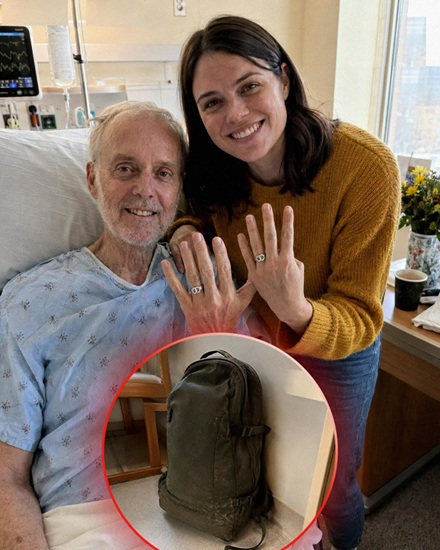
Sarah never imagined that one of the most meaningful relationships of her life would begin in a hospital and last only seven days as a marriage. She had met Thomas while volunteering after the death of her mother, during a period when grief had quietly taken over her routines. She still went to work, answered messages and handled everyday responsibilities, but emotionally she felt as though life had stopped moving. Volunteering at the hospital gave her somewhere to go where sadness did not need to be explained.
Thomas was 72 and seriously ill, but he rarely behaved like someone focused only on his own condition. He seemed far more interested in the people around him. He remembered that a nurse’s grandson had an important driving test, that a housekeeper hummed a song her mother once loved, and that one cafeteria worker always saved peppermint candies for nervous visitors. Sarah once asked how he managed to keep track of so many details, and Thomas simply said that he tried to pay attention when people spoke.
That answer stayed with her.
Thomas also had a faded green backpack that seemed to follow him everywhere. It rested beside his chair, near his hospital bed or against the wall when he sat in the chapel. Sarah assumed it contained ordinary personal belongings. Thomas never explained what was inside, and she never asked.
Their friendship developed slowly. Thomas did not ask Sarah for details about her mother’s final days. Instead, he asked what her mother’s laugh sounded like. Sarah told him that it sounded like someone trying very hard not to laugh. Thomas smiled and told her those were the best kinds of laughs.
For the first time in months, Sarah felt as though someone had asked a question about her mother that did not immediately turn the memory into tragedy.
Then, unexpectedly, Thomas asked Sarah to marry him.
She initially thought he was joking. They had known each other only a short time, there was a significant difference in their ages, and Thomas was approaching the end of his life. But he explained that he was not asking for money, property or a traditional future. He simply did not want to leave the world feeling like an anonymous patient in a hospital record.
After thinking carefully, Sarah agreed.
A hospital chaplain married them two days later. Sarah wore a yellow sweater because Thomas said it made the room look brighter. Thomas wore an old cardigan with one missing button. When the chaplain asked about rings, Thomas removed the pull tab from a soda can and slipped it onto Sarah’s finger.
It was too large, and both of them laughed.
For seven days, Sarah was his wife.
She sat beside him when his breathing became difficult, brought him better tea than the hospital served and adjusted his blankets when he was uncomfortable. They watched television, talked about ordinary things and sometimes simply sat together without speaking. Their marriage did not resemble the future Sarah had once imagined for herself, but it gave Thomas companionship when he needed it most.
Near the end, he opened his eyes and said something Sarah did not understand.
“Don’t mistake stillness for peace.”
She asked what he meant.
Thomas only smiled and told her she would understand later.
He died before he could explain.
Shortly afterward, Thomas’s attorney arrived at the hospital carrying the old green backpack. He placed it in Sarah’s lap and told her that Thomas had wanted her to know the truth about him.
Sarah expected legal documents, family information or perhaps money.
Instead, she found envelopes.
There were dozens of them, each labeled with the name of an ordinary place.
Bus Stop.
Grocery Store.
Airport.
Laundromat.
Park Bench.
Waiting Room.
Hospital Chapel.
At the bottom of the backpack was an old notebook.
Sarah opened the envelope marked Bus Stop first. Inside was an old ticket. On the back, Thomas had written a short note about a teenage boy who had watched several buses leave because he was afraid to go home. Eventually, according to the note, the boy got onto the next one.
The Grocery Store envelope contained a receipt for soup and bread. Thomas had written that an elderly woman had accepted food after initially refusing help.
The Park Bench envelope held a faded photograph of Thomas sitting beside another man. On the back were only a few words explaining that the man had smiled before Thomas left.
Sarah still did not understand what she was looking at.
Then she opened Waiting Room.
Inside was a hospital visitor sticker from nearly a year earlier. On the back, Thomas had written about a woman who described her mother’s laugh as if she were trying not to laugh.
Sarah immediately knew the woman was her.
That night, she took the backpack home.
Eventually, she opened the notebook.
The first page explained that people often thought loneliness meant being physically alone. Thomas believed it was frequently something different: the feeling that nobody noticed you.
The rest of the notebook was filled with short descriptions of people he had encountered over the years.
A nervous father waiting outside a delivery room.
An elderly woman standing silently in a grocery aisle.
A teenager sitting at a bus stop.
A veteran alone in a park.
A widow eating breakfast by herself.
Thomas did not describe dramatic rescues. He did not portray himself as someone who solved their problems.
He recorded only the small changes that happened afterward.
“She called her daughter.”
“He finally went inside.”
“She laughed.”
“He slept.”
Sarah slowly realized that Thomas had been collecting moments when people took one small step back toward life.
A few days later, she returned to his attorney.
She told him that she understood the notebook but still did not understand why Thomas had chosen her.
The attorney asked a simple question.
“What did Thomas ever ask you for?”
Sarah thought about it.
He had never asked for money.
He had never asked her to cancel plans.
He had never demanded that she stay longer.
He had never asked her to spend the rest of her life honoring his memory.
Apart from asking her to marry him, Thomas had demanded almost nothing.
Then the attorney showed her an old newspaper clipping.
A younger Thomas stood outside a community counseling center.
The headline explained that a local grief counselor was retiring after 40 years of work.
Sarah stared at the photograph.
Thomas had spent much of his life helping people cope with loss.
He had never told her.
The attorney explained that Thomas believed people sometimes spoke more openly when they did not feel as though they were being analyzed. Even after retiring, he continued noticing strangers and listening carefully when people needed someone nearby.
Before Sarah left, the attorney gave her one final envelope.
Thomas had asked that it be delivered only after his funeral.
Sarah opened it later that evening in a park near her apartment.
Inside was a list.
Botanical Garden.
Farmers’ Market.
Ice cream on Oakridge Street.
Feed the ducks even if they ignore you.
At the bottom, Thomas had written a single sentence.
“Ordinary Tuesdays are where life quietly hides.”
Sarah looked around the park.
Children were chasing birds.
A man was walking an elderly dog.
Two people nearby were arguing cheerfully over a crossword puzzle.
Life had continued around her.
She realized that, since her mother’s death, she had not truly done the same.
She had remained busy, but being busy was not the same as moving forward.
The following Tuesday, Sarah followed Thomas’s list.
She visited the botanical garden and took her time walking through it.
She stopped at the farmers’ market and bought peaches she did not need.
She drove to the ice cream shop on Oakridge Street and ordered vanilla.
Then she stopped beside a lake and attempted to feed the ducks.
They ignored her completely.
Sarah laughed.
It was not the careful laugh she used around friends to prove she was doing fine. It was spontaneous and loud enough that several strangers turned to look.
For once, she did not care.
Months passed, and Sarah did not suddenly become free of grief. Thomas had never suggested that sadness could simply be removed.
Instead, he had shown her something smaller.
He had taught her that kindness often begins with attention.
Remember someone’s story.
Notice when they are quiet.
Listen without immediately trying to fix them.
Stay for a while.
Sarah kept the green backpack and the soda-can ring.
But what she valued most was the lesson Thomas had quietly left behind.
People do not always need perfect advice.
Sometimes they need another person to notice that they are struggling.
Sometimes the most meaningful thing anyone can do is sit beside someone long enough for them to understand that they are not invisible.
And sometimes an ordinary Tuesday can contain more life than anyone realizes.

