
Lynda Wiesmeier may not have had one of Hollywood’s longest acting careers, but her work remains closely connected with the distinctive entertainment culture of the 1980s. Born Lynda Ann Wiesmeier on May 30, 1963, in Washington, D.C., she became known as a model and actress during a relatively brief period in the spotlight. Decades later, photographs and film scenes featuring Wiesmeier continue to circulate among fans of retro cinema, often attracting attention because of their unmistakable clothing, hairstyles, automobiles and visual atmosphere.
Wiesmeier spent portions of her childhood in different places before eventually becoming associated with Southern California and the entertainment industry. Her family background included a connection to the U.S. Air Force through her father, and accounts of her early life describe the family moving during her childhood. By the beginning of the 1980s, Wiesmeier was pursuing opportunities that would soon bring her much wider public recognition.
Her major modeling breakthrough arrived in 1982. Wiesmeier was selected as Playboy’s Playmate of the Month for July of that year and appeared on the issue’s cover. Photographer Richard Fegley photographed her centerfold. The exposure significantly increased her visibility and led to additional work associated with the magazine, while also coinciding with the beginning of a busy period in her screen career.

Wiesmeier’s filmography stretches across several genres. She had an appearance connected with American Pop in 1981 and subsequently accumulated credits throughout the decade. Among the films associated with her are Joysticks, Private School, Preppies, R.S.V.P., Avenging Angel, Malibu Express, Wheels of Fire, Real Genius and Teen Wolf. Her parts varied considerably in size, and it would be inaccurate to suggest that she was the principal star of those better-known productions.
Nevertheless, the collection of titles places Wiesmeier firmly within the landscape of 1980s entertainment. Movies such as Teen Wolf and Real Genius went on to remain familiar to audiences long after their theatrical releases. Wiesmeier’s appearances in films of that period consequently continue to introduce her to people exploring older movies, even though her own acting career was relatively short.
One of the more unusual productions associated with her is the horror film Evil Town. Wiesmeier played Dianne, and the movie included performers such as Dean Jagger, James Keach, Robert Walker Jr. and Michele Marsh. Its story centers on disturbing experiments intended to reverse the aging process, placing the movie within the science-fiction and horror traditions that frequently overlapped in low-budget filmmaking.
The production history of Evil Town is arguably more unusual than the finished movie. Material used in the film originated with an earlier project from the 1970s. Additional footage was later created and combined with older material, resulting in the movie that eventually circulated under the Evil Town title. Wiesmeier appeared in footage produced during the later phase of the project.
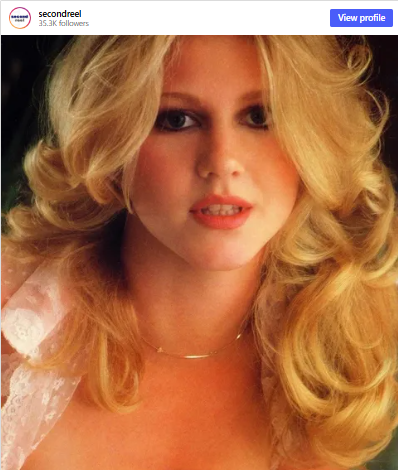
Keith Hefner, the younger brother of Playboy founder Hugh Hefner, also appeared in the film. His involvement, combined with Wiesmeier’s modeling background, created an interesting connection to Playboy within the cast. That detail has sometimes received attention when the film is discussed retrospectively, although it was not the central element of the movie itself.
Evil Town eventually reached audiences in the 1980s, but it did not become a major critical success. Reviews and later assessments frequently focused on its fragmented construction and low-budget qualities. The film’s complicated production history contributed to inconsistencies that viewers could notice in the finished version.
Yet movies do not always need strong reviews to develop a life beyond their original release.
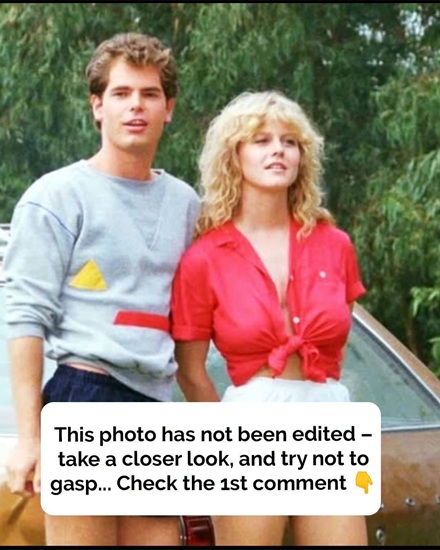
Years later, scenes and still photographs from Evil Town began appearing online among people interested in older films and 1980s culture. One image in particular, featuring Wiesmeier alongside actor Scott Hunter, has attracted attention because it looks almost like an accidental time capsule. The performers’ clothing, the automobile and the overall styling immediately suggest the decade in which the newer material was filmed.
In the frequently shared imagery, Wiesmeier appears in high-waisted light-colored shorts with a bright top, while Hunter’s clothing also reflects casual styles associated with the period. Modern viewers may find the proportions and combinations noticeably different from today’s mainstream fashion. For people who lived through the decade, however, such details can bring back memories of styles that were once completely ordinary.

That nostalgia is part of what makes old photographs interesting. A picture does not need to depict an historically significant event to preserve information about a period. Cars, clothing, hairstyles, buildings and everyday objects can reveal how visual culture changes over time. A promotional photograph or movie still created decades ago can therefore become fascinating for reasons its creators probably never anticipated.
Fashion during the 1980s was particularly varied. Bright colors and prominent accessories became strongly associated with the decade, but there was never a single style worn by everyone. Preppy clothing existed alongside punk, new wave, sportswear, glam-inspired looks and more traditional fashions. High-waisted shorts and distinctive casual clothing were among the trends visible during the period, making photographs such as Wiesmeier’s immediately recognizable as products of their era.
Nostalgia can sometimes lead people to describe an earlier decade as objectively better than the present. That is a personal judgment rather than something an old photograph can prove. What images can genuinely provide is a glimpse of how certain people dressed and how movies presented contemporary fashion. Wiesmeier’s surviving film material works especially well in this respect because so much of her career was concentrated within a recognizable period.
After her busiest years in entertainment, Wiesmeier gradually moved away from acting. Her narrative film credits are largely concentrated in the 1980s, with Evil Town generally listed among the final features associated with her acting career. She continued to have connections with modeling-related projects and later participated in events where fans could meet performers and personalities associated with earlier entertainment.
Some accounts describe Wiesmeier attending autograph and collector conventions, allowing her to maintain contact with fans long after leaving regular film work. Events devoted to entertainment memorabilia provided opportunities for performers whose most prominent work belonged to previous decades to meet people who continued to appreciate their careers.
Wiesmeier also moved toward a more private life after her entertainment career. Various secondary accounts contain details about her marriages, children, employment and places where she lived. Because some of those personal details are not consistently documented by strong independent sources, they should be treated more cautiously than her established modeling and film credits.
What is consistently reported is that Wiesmeier’s life ended far too early.
She died on December 16, 2012, in California at only 49 years old. Biographical sources commonly identify a brain tumor as the cause of her death. Some articles describe the condition more specifically as brain cancer, but without stronger medical documentation, “brain tumor” is the more careful description.
Her death occurred roughly three decades after the modeling appearance that first made her widely recognizable. By that point, entertainment had changed dramatically. The magazines, low-budget genre films and theatrical distribution systems that shaped her early career belonged to a very different media environment.
The internet, however, has created unexpected opportunities for older performers to be rediscovered. Movie databases, streaming platforms, fan communities and social-media posts can introduce decades-old films to audiences who were not alive when they were originally released. A performer who appeared briefly in a movie can suddenly attract renewed interest because a photograph or scene begins circulating again.
That phenomenon helps explain the continuing interest in Wiesmeier.
It would be an exaggeration to describe her as one of the biggest movie stars of the 1980s. Her acting career was relatively brief, and many of her parts were supporting or small roles. But that does not make her story uninteresting. She worked as a professional model, achieved a prominent magazine appearance and accumulated credits in a surprisingly varied collection of films within a short period.
Some of those films have remained recognizable decades later. Real Genius developed an enduring audience as a comedy, while Teen Wolf became strongly associated with 1980s youth entertainment. Malibu Express maintained its own following among fans of genre filmmaking, and Evil Town continues to attract curiosity partly because of its unusual production history.
For Wiesmeier, that collection of projects preserves a particular moment in entertainment history. Her photographs show not only a performer but also the fashion and aesthetics surrounding her. When viewers encounter an image from Evil Town today, they may notice details that seemed entirely unremarkable when the scene was originally filmed.
That is perhaps the most interesting reason the photographs continue circulating.
They do not need an extraordinary hidden story. Sometimes an old photograph becomes compelling simply because time has transformed ordinary details into historical ones. A pair of shorts, a brightly colored shirt or an older automobile can instantly remind viewers how much everyday visual culture has changed.
Lynda Wiesmeier’s life was much larger than any single photograph, of course. She had a modeling career, worked in movies, eventually moved away from the entertainment industry and maintained connections with fans before her death in 2012. Reducing her story solely to one viral image would overlook the broader career that produced it.
At the same time, the renewed interest demonstrates how cultural memory can work in unexpected ways. A film that received little acclaim during its original release can become interesting decades later because it accidentally preserved the atmosphere of its time. Performers who were not major stars can likewise become familiar to new audiences when people begin exploring the movies of a previous generation.
Today, Wiesmeier can be remembered accurately without exaggerating either her fame or the significance of the films in which she appeared. She was the July 1982 Playboy Playmate of the Month, worked as a model and actress, appeared in numerous 1980s productions and remained connected with fans after her most active years in entertainment.
Her story also ended tragically young, with her death from a brain tumor at 49.
More than a decade after her passing, photographs of Lynda Wiesmeier continue to introduce people to her work. For longtime viewers, those images may bring back memories of the 1980s. For younger audiences, they offer a visual glimpse into entertainment and fashion from a period they know only through movies, photographs and stories.
Ultimately, that may explain why a seemingly ordinary scene from a relatively obscure film can continue attracting attention so many years later. It captures a moment that was once contemporary but has since become unmistakably historical. And through those surviving images and films, Lynda Wiesmeier remains one small but memorable part of the visual history of 1980s popular culture.

