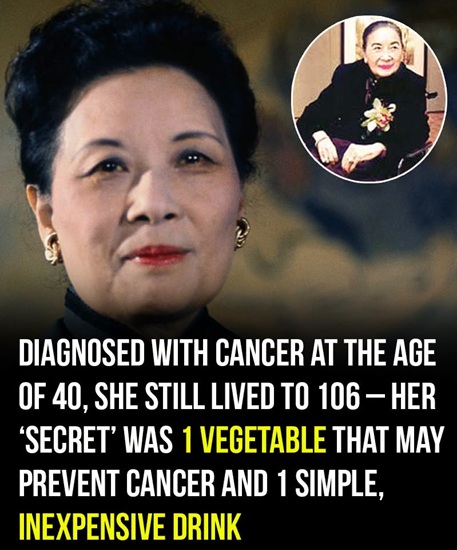
Soong Mei-ling lived through more than a century of extraordinary change.
She witnessed revolutions.
Wars reshaped the country of her birth.
Governments rose and fell.
Technology transformed everyday life.
And throughout much of the 20th century, she was far more than a spectator.
Known internationally as Madame Chiang Kai-shek, Soong became one of the most recognizable Chinese women of her era.
She was educated in the United States.
She spoke fluent English.
She became an influential political advocate, fundraiser and public figure.
And when she died in New York in 2003, she was 105 years old.
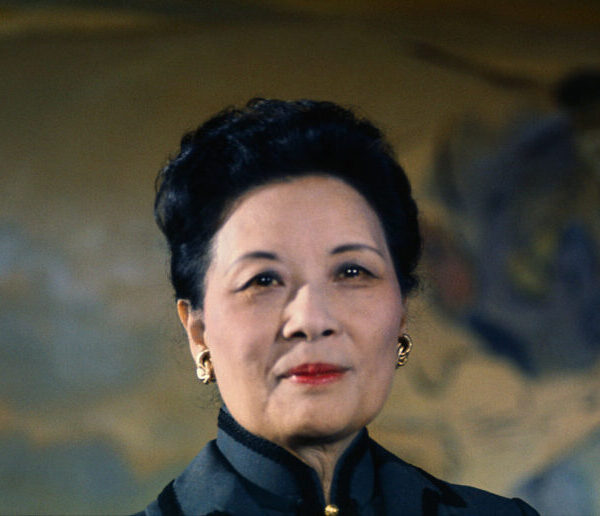
That remarkable age later inspired countless stories about what she ate and how she lived.
But the real story is more complicated.
And far more interesting.
An unusual childhood shaped her future
Soong Mei-ling was born in Shanghai in 1898 into the prominent Soong family.
Her father, Charlie Soong, was a businessman and Christian missionary who ensured that his children received extensive educations.
Mei-ling traveled to the United States while still young.
She eventually attended Wellesley College in Massachusetts.
In 1917, she graduated with honors, studying English literature and philosophy.
Her years in America would prove enormously important later.
She became fluent in English and developed an unusual ability to communicate with American audiences.
At the time, there was no way to know just how valuable that skill would become.
A decade later, her life changed dramatically.
Marriage placed her at the center of politics
In 1927, Soong married Chiang Kai-shek.
Chiang was already one of China’s most important political and military figures and would become leader of the Nationalist government.
Their marriage transformed Madame Chiang into an internationally visible political figure.
But describing her only as a political leader’s wife misses much of her role.
She became an adviser, interpreter and advocate.
She also worked on charitable and social projects.
Among her notable activities was support for children who had lost parents during wartime.
Schools and programs were established for the children of Chinese soldiers, and she became closely associated with relief efforts during the conflict with Japan.
Then World War II placed her on an even larger stage.
America listened when she spoke
In 1943, Madame Chiang traveled through the United States as China continued fighting Japan.
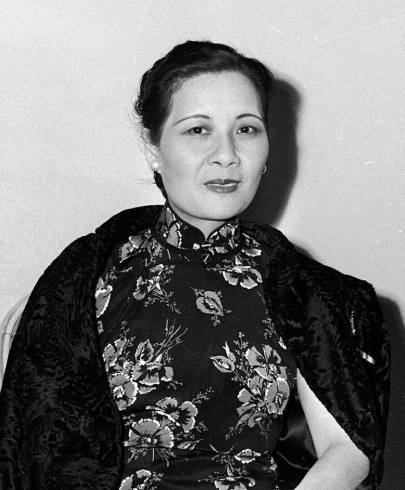
Her mission was clear.
She wanted to strengthen American support for China’s war effort.
Her command of English allowed her to address American audiences directly rather than through an interpreter.
She spoke on radio programs.
She addressed large public gatherings.
She returned to Wellesley.
And on February 18, 1943, she addressed members of the United States Congress.
It was an extraordinary moment.
Few foreign women had ever received such a platform in Washington.
TIME magazine later remembered how effectively she used speeches and public appearances to promote China’s cause.
For several months, she became one of the most visible representatives of wartime China in the United States.
But history would soon change around her again.
War was followed by another conflict
After Japan’s defeat in World War II, China’s civil war resumed between the Nationalist government and Communist forces.
In 1949, Mao Zedong’s Communist Party established the People’s Republic of China on the mainland.
Chiang Kai-shek and the Nationalist government withdrew to Taiwan.
Madame Chiang continued playing a public and political role.
During the Cold War, she became a strong advocate for the Nationalist government and an outspoken opponent of communism.
Her political legacy remains complicated and tied to major historical disputes of the 20th century.
That is important to acknowledge.
She was admired by some as a skilled diplomat and advocate.
Others criticized the Nationalist government with which she was closely associated.
Her life cannot accurately be reduced to a simple heroic story.
But her influence was undeniable.
Then came an unusually long life
Chiang Kai-shek died in 1975.
After his death, Madame Chiang increasingly spent time in the United States.
She eventually lived largely out of public view in New York.
She had experienced health problems and was treated for cancer and other illnesses during her lifetime.
Yet she continued living for decades after many of the political events that had made her famous.
She also maintained an interest in art.
Painting had become one of her pursuits, and examples of her Chinese paintings were exhibited and collected.
Wellesley College, where she had studied as a young woman, holds works and archival materials connected with her life.
Eventually, her age itself became part of her public image.
She had lived through almost the entire 20th century.
Then came the inevitable question.
How had she lived so long?
The problem with “longevity secrets”
Stories about exceptionally old people frequently focus on one food or habit.
A glass of something each morning.
A favorite vegetable.
A particular bedtime.
A special exercise.
Madame Chiang’s life has generated similar claims.
Some online accounts have attributed her longevity to celery, lemon water, small meals or highly specific daily routines.
But reliable historical evidence does not establish that any one of those practices explains why she lived to 105.
Longevity is complex.
Genetics can matter.
Access to medical care can matter.
Nutrition, physical activity, smoking and alcohol habits can matter.
Social circumstances and chance can matter too.
No single food can reliably explain one individual’s lifespan.
That includes celery.
Celery is healthy — but it is not a miracle food
Celery can absolutely be part of a balanced diet.
It contains a large amount of water.
It provides vitamin K, folate and other nutrients.
It also contains plant compounds with antioxidant activity.
That makes celery a nutritious vegetable.
But there is an important difference between calling a food healthy and claiming it prevents or treats disease.
Celery contains a flavonoid called apigenin.
Scientists have studied apigenin because laboratory research suggests it can influence inflammation and several biological processes involving cancer cells.
Some animal studies have also produced interesting results.
But those findings do not prove that eating celery prevents cancer or treats cancer in humans.
That leap would go far beyond the evidence.
Recent systematic reviews of apigenin research emphasize that much of the evidence remains preclinical, meaning it comes from cells or animal models rather than established human treatments.
So celery can be enjoyed as food.
It should not be presented as cancer medicine.
What can actually be taken from her long life?
Madame Chiang’s longevity remains remarkable.
But perhaps the more useful lesson is not to search for a magical ingredient.
Throughout much of her life, she remained intellectually active.
She read.
She painted.
She remained engaged with political and cultural events.
She had access to substantial resources and medical care.
And she survived illnesses that could have shortened her life.
Those facts make for a much more realistic story than claiming that one vegetable carried her past 100.
Healthy habits can contribute to well-being.
A balanced diet matters.
Regular movement matters.
Avoiding tobacco matters.
Medical care matters.
But none of those provides a guarantee of exceptional longevity.
Her historical legacy is bigger than her diet
Soong Mei-ling died on October 23, 2003, in New York.
She was 105.
By then, almost everyone who had stood alongside her during the defining political events of the 1930s and 1940s was gone.
The world she entered as a child in 1898 had changed beyond recognition.
She had gone from a young Chinese student studying in America to one of the most internationally recognizable political women of her generation.
She addressed Congress.
She became a wartime advocate.
She worked with charitable organizations.
She lived through China’s civil war and the Cold War.
And she remained connected to art and public life well into old age.
That history is extraordinary enough without turning her life into a promise about celery.
Madame Chiang’s 105 years cannot be reduced to one breakfast, one vegetable or one health ritual.
Her longevity remains fascinating.
But her true legacy lies elsewhere.
It is found in the extraordinary amount of history she lived through — and the unusually prominent role she played inside it.
