People walking past a shopping mall in eastern China were used to seeing something familiar on its exterior walls. Advertisements.
Products. Brands. Promotions designed to catch the attention of shoppers. But in August 2026, one of those prominent spaces displayed something completely different.
There was nothing to buy. Instead, an enormous portrait of scientist Qian Xuesen appeared on the outside of a shopping center in Shandong Province.
The illuminated display measured approximately 7.8 meters high and 5.6 meters wide.
It was difficult to miss.
And before long, images of it were spreading online.
But the story did not end with one portrait.
An unexpected face above a shopping mall
The display appeared at an Inzone shopping mall in Shanxian County, part of Heze in Shandong Province.
The space had previously been associated with ordinary commercial advertising.
This time, the mall chose to use it for a public-interest display honoring Qian Xuesen.
The image showed the scientist when he was younger and included words associated with perseverance and confidence.
For some people seeing photographs online, the display seemed so unusual that questions emerged about whether it was real.
It was.
The portrait was a physical installation on the building rather than an AI-generated image circulating only on social media.
That alone attracted attention.
But the location made it particularly striking.
Qian’s face was occupying space normally intended to sell something.
Then another development made the story even more interesting.
Other commercial locations began doing something similar.
The idea moved beyond one building
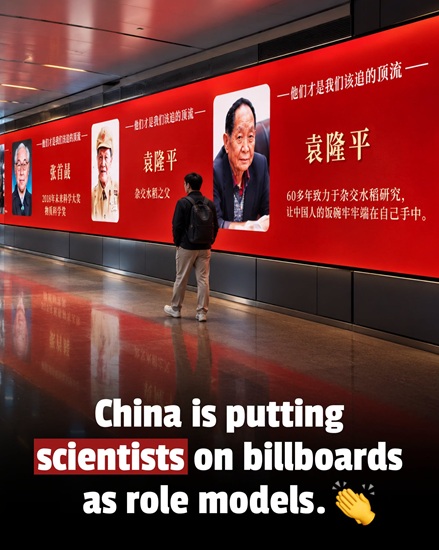
As attention around the Shanxian display grew, additional shopping centers began showing portraits of scientists.
Other locations in Heze participated.
Similar displays appeared elsewhere in Shandong.
Reports subsequently documented comparable displays in places including Anhui and Inner Mongolia.
Some shopping centers used large printed installations.
Others used outdoor digital screens capable of displaying multiple scientists.
The individuals featured were not all from the same field.
One was associated with rockets and aerospace.
Another spent decades researching rice.
One helped transform malaria treatment.
Another devoted years to building an enormous instrument for observing the universe.
Their names were Qian Xuesen, Yuan Longping, Tu Youyou and Nan Rendong.
And each represented a different scientific story.
Qian Xuesen helped develop aerospace technology
Qian Xuesen was born in 1911 and became an important figure in 20th-century aerospace engineering.
He studied in the United States and worked in aerodynamics and rocket-related research, including at the California Institute of Technology.
After returning to China in the 1950s, Qian became deeply involved in the development of the country’s missile, rocket and aerospace programs.
His work made him one of the most prominent scientists associated with China’s early aerospace development.
Qian died in 2009.
More than a decade later, his face was appearing on the side of a modern shopping center.
But another scientist featured in the displays worked on something much closer to everyday life.
Food.
Yuan Longping spent his career studying rice
Yuan Longping became internationally known for pioneering research involving hybrid rice.
His work and that of his research teams contributed to the development of high-yield rice varieties.
The subject may sound less dramatic than rockets or space exploration.
Its practical importance was enormous.
Rice is a staple food for billions of people.
Improving yields can therefore have major implications for agricultural production and food security.
Yuan became one of China’s most recognizable agricultural scientists.
He continued working into old age before his death in 2021.
His portrait was therefore not simply honoring a scientist.
It represented decades of agricultural research.
Then there was Tu Youyou.
Her work would eventually be recognized with one of science’s most prestigious awards.
A discovery that changed malaria treatment
Tu Youyou’s scientific career became closely associated with artemisinin.
During research into potential malaria treatments, Tu and her colleagues examined historical Chinese medical texts alongside modern experimental methods.
That work helped lead to the discovery of artemisinin and its effectiveness against malaria parasites.
Artemisinin-based combination therapies later became central to modern malaria treatment.
The significance of the discovery eventually brought Tu international recognition.
In 2015, she shared the Nobel Prize in Physiology or Medicine for discoveries concerning a novel therapy against malaria.
Her achievement was fundamentally different from Qian’s aerospace work or Yuan’s agricultural research.
Yet all three could now appear on the same kinds of public screens.
And the fourth widely featured scientist looked even farther away.
Into space.
Nan Rendong and a giant telescope
Nan Rendong was an astronomer who played a central role in developing China’s Five-hundred-meter Aperture Spherical Radio Telescope, known as FAST.
The telescope was constructed in Guizhou Province.
Its enormous collecting area allows astronomers to detect faint radio signals from the universe.
FAST has been used for research involving pulsars and other astronomical phenomena.
Nan spent many years helping transform the project from an ambitious scientific proposal into reality.
He died in 2017.
Today, his name remains closely associated with the telescope.
That made the group of scientists appearing on commercial displays remarkably varied.
Aerospace.
Agriculture.
Medicine.
Astronomy.
But the unusual part was not simply who they were.
It was where people were seeing them.
Location changed the meaning
Portraits of scientists are common in universities.
They appear in museums.
Schools display them.
Science centers celebrate their discoveries.
Those locations are expected.
A giant shopping-mall advertisement is different.
Prime commercial spaces have economic value because large numbers of people see them.
Brands pay for that attention.
The goal is normally straightforward.
Promote a product.
Introduce a service.
Encourage someone to enter a store.
The scientist displays temporarily interrupted that familiar pattern.
The screens were still designed to attract attention.
But instead of directing that attention toward something for sale, they directed it toward a person and an achievement.
That simple change created the visual contrast that helped the original display become widely discussed.
It was not a nationwide replacement of advertising
The story can easily become exaggerated online.
One dramatic headline might suggest that China had suddenly replaced advertising with portraits of scientists.
That is not what happened.
Commercial advertising did not disappear from Chinese shopping centers.
There was no nationwide replacement of advertisements with scientific figures.
The documented development was much more specific.
Certain shopping centers and commercial properties voluntarily dedicated prominent spaces to public-interest displays celebrating scientists.
That distinction is important.
And the verified story is already unusual enough without making it larger than it was.
One commercial display became several.
Then more locations joined.
Digital screens made expansion easier
Not every shopping center needed to construct a giant physical portrait like the original installation.
Modern malls already contain large digital displays.
Those screens can change content almost instantly.
Instead of showing one scientist permanently, a digital display can rotate through several people and their achievements.
That made the basic concept easy to reproduce.
One screen might show Qian Xuesen.
A later image could feature Yuan Longping.
Then Tu Youyou.
Then Nan Rendong.
The physical infrastructure had already been built for advertising.
Only the content changed.
And that leads to the larger reason the displays attracted attention.
Public attention is valuable
Advertising works because attention has value.
Businesses compete for it constantly.
A large screen in a busy shopping district may be seen by thousands of people.
That is precisely why the space is commercially desirable.
Normally, the message asks viewers to consider a brand or product.
The scientist displays temporarily used the same attention for another purpose.
Recognition.
Someone walking toward a store might unexpectedly see the face of an agricultural scientist.
Another shopper could encounter the story of a Nobel Prize-winning researcher.
A child might see an aerospace scientist displayed at the scale normally reserved for commercial campaigns.
Whether the viewer stopped to learn more was another question.
But the scientist had entered a space where scientific history is not usually the main attraction.
Fame can come from very different achievements
Modern advertising frequently relies on familiar faces.
Actors.
Musicians.
Athletes.
Online personalities.
Their visibility can help attract attention to whatever is being promoted.
The 2026 displays created an interesting contrast by giving similarly prominent visual space to people known primarily for scientific work.
The scientists were not interchangeable.
Their careers were radically different.
But they shared one characteristic.
Their public recognition came from work that extended beyond entertainment.
Qian worked in aerospace.
Yuan worked in agriculture.
Tu worked in medicine and pharmaceutical research.
Nan worked in astronomy.
Their achievements had already been documented in scientific and historical contexts.
The shopping-mall displays simply placed those stories somewhere unexpected.
A very simple concept
Perhaps the most striking part of the idea is how uncomplicated it was.
The malls did not need to invent new technology.
They did not need an elaborate exhibition.
They already possessed the most important element.
A highly visible space.
All that changed was the person occupying it.
Replace a commercial image temporarily with a scientist.
Add a name.
Include information or a quotation.
Then allow the public to encounter that figure during an ordinary trip to a shopping center.
The simplicity helped make the concept easy for other properties to reproduce.
But it also created a question that extends beyond any particular mall.
Who receives our attention?
The screens were selling nothing
The original 7.8-by-5.6-meter portrait of Qian Xuesen became notable precisely because it appeared where people expected to see an advertisement.
That expectation created the surprise.
A shopper looked up.
There was no clothing brand.
No new smartphone.
No restaurant promotion.
No celebrity campaign.
There was a scientist.
Then similar displays began appearing elsewhere.
The advertising industry did not disappear.
Shopping centers remained commercial spaces.
But for a period, some of their most visible surfaces carried a different message.
They highlighted people associated with rockets, food production, medicine and the exploration of space.
And perhaps that is the simplest way to understand why the images attracted so much attention.
Nothing was being offered at a discount.
Nothing needed to be purchased.
The valuable thing being exchanged was attention itself.
For a few moments, space normally dedicated to selling products was being used to tell people about scientific achievement.
One giant portrait started the conversation.
Then other screens lit up.
And suddenly, in places built around commerce, some very different faces were looking back.
