
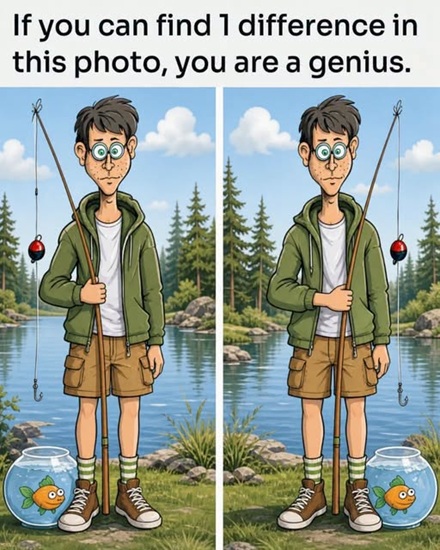
At first, there seems to be no puzzle at all. Two cartoon pictures sit side by side, and almost everything appears to match perfectly.
The same young fisherman is there. His glasses look identical. His hair appears unchanged.
The fishing rod seems to be positioned in exactly the same way.
Even the smaller details around him look familiar.
So where is the difference?
That is where the challenge begins.
Somewhere between the two images is one small change.
It is visible from the start.
Yet finding it can take much longer than expected.
The pictures seem identical for a reason
Spot-the-difference puzzles work because most of the information in both images really does match.
When viewers first look at the pictures, they naturally notice the largest and most recognizable features.
The boy’s face.
His hairstyle.
His glasses.
His clothing.
The fishing equipment.
Once those elements appear identical, it becomes tempting to assume everything else matches too.
But that first impression is exactly what the puzzle relies on.
The difference is much smaller.
And it may be hiding somewhere your eyes have already passed several times.
Start with the obvious details
Most people begin by examining the central character.
Does one pair of glasses look different?
Is something missing from the hair?
Has the expression changed?
What about the boy’s clothing?
At first, those questions seem promising.
But the obvious areas may offer no answer.
So attention moves outward.
The fishing rod is checked.
Then the line.
Then the fish.
Still nothing.
At that point, what looked like a simple puzzle can suddenly become surprisingly stubborn.
And that is usually when viewers start looking much more carefully.
One tiny change can be enough
A good visual puzzle does not need a dramatic difference.
In fact, a major alteration would make the challenge far too easy.
Instead, the mismatch may involve something extremely small.
Perhaps a short line has disappeared.
Maybe one shape has been slightly altered.
A tiny part could be positioned differently.
Or a detail visible in one picture may simply be absent from the other.
Everything surrounding that change remains familiar.
That allows the difference to blend into the image.
Until the right moment.
Looking at the whole picture may not help
When both drawings are viewed as complete scenes, they can continue appearing identical.
A better approach is to stop treating them as complete pictures.
Break them into sections.
Begin at the top of the boy’s head.
Move slowly toward the face.
Compare the glasses.
Then check the clothing.
Look at the hands.
Follow the fishing rod.
Examine the fish.
Finally, inspect the smaller surrounding features.
This kind of systematic search can prevent the eyes from repeatedly returning to the same areas.
And eventually, something may stop matching.
Why viewers can miss something that is clearly visible
Nothing in a spot-the-difference puzzle is actually invisible.
The altered detail is sitting in front of the viewer the entire time.
That may be what makes the experience so interesting.
When two images are overwhelmingly similar, attention can become dominated by everything that matches.
The mind quickly understands the basic scene.
A boy is fishing.
The pictures look alike.
After that, smaller differences may receive less attention.
The viewer sees the picture they expect to see.
Then one small inconsistency finally interrupts that expectation.
Suddenly, it becomes impossible to ignore.
Then comes the strange part
Someone can look directly at the correct area several times without recognizing the difference.
Seconds pass.
The same locations are checked repeatedly.
Nothing appears unusual.
Then, without warning, the detail seems to jump out of the image.
There it is.
Once noticed, it often becomes surprisingly obvious.
And that creates one of the most enjoyable moments in the entire puzzle.
How could something that now looks so clear have remained hidden for so long?
The picture never changed.
But the viewer’s focus did.
A countdown makes everything more difficult
Some versions of these challenges add another rule.
Find the difference within ten seconds.
Suddenly, a relaxed visual puzzle becomes a race against the clock.
That pressure may encourage viewers to search faster.
Sometimes it works.
A quick glance may happen to land directly on the altered feature.
But rushing can also have the opposite effect.
The eyes move across the illustration so quickly that subtle details are never properly compared.
Five seconds disappear.
Then eight.
Then ten.
Still nothing.
But reaching the end of the countdown does not mean the challenge is over.
Taking longer is completely normal
These puzzles are designed to make differences difficult to notice.
There is no meaningful failure in taking longer than an arbitrary time limit.
One person may find the answer in three seconds.
Another may need thirty.
Someone else might stare at the image for several minutes.
Often, the difference simply comes down to where each viewer happens to look first.
A person starting near the hidden change has an obvious advantage.
Someone beginning at the opposite side of the illustration has more territory to inspect.
The important part is the search itself.
And sometimes a slower search is actually more satisfying.
The details begin getting smaller
Once the obvious objects have been eliminated, attention naturally becomes more precise.
Instead of asking whether the entire fishing rod looks correct, viewers begin comparing individual sections.
Instead of looking at the boy’s face as one object, they inspect individual lines.
The same happens with the clothing and surrounding details.
Every matching feature removes another possibility.
The search area becomes smaller.
The answer feels closer.
But it may still refuse to appear.
That tension is one reason people keep looking.
Why it is difficult to simply give up
The solution must be somewhere.
The viewer knows that.
There are only two small pictures to examine.
That creates a persistent feeling that the answer could appear on the very next glance.
So the search continues.
Hair again.
Glasses again.
Hands.
Rod.
Fish.
Clothing.
Background.
Each comparison feels like it could finally reveal the mismatch.
And eventually, one of them does.
Discovery changes the entire image
The moment the difference is found, something interesting happens.
The puzzle stops looking difficult.
The altered detail now attracts attention immediately.
Look away for a moment and return to the image.
It is still easy to see.
Try the puzzle again a few minutes later.
The answer may appear almost instantly.
The challenge has disappeared because the viewer now knows what matters.
That is why the difference can feel obvious afterward even when it seemed nearly impossible beforehand.
Knowledge changes where attention goes.
Random searching versus careful comparison
If the answer still has not appeared, another strategy may help.
Choose one corner of the picture.
Compare only that area.
Then move horizontally or vertically through the illustration.
Do not jump from the face to the fish and then back to the glasses.
Finish one section before moving to the next.
This turns one difficult search into several smaller comparisons.
The approach is simple.
But for puzzles built around tiny details, simple can be effective.
A surprisingly focused few moments
There is another reason these puzzles continue to attract attention.
They ask for only one thing.
No complicated instructions.
No long explanation.
No special knowledge.
Just look.
Compare.
And find what changed.
For a short time, the entire challenge revolves around one very specific goal.
That can make the activity engaging even when the solution is not found immediately.
Every small detail suddenly matters.
The answer has been there all along
That may be the strangest part of all.
The difference does not appear after ten seconds.
It does not move into view.
It was present during the very first glance.
The viewer simply had not recognized its importance yet.
Everything else in the picture made it easier to overlook.
Then attention finally lands in the right place.
And the mystery ends instantly.
Take one more careful look
Return to the two fishermen.
Ignore the complete scene for a moment.
Instead, compare the individual details.
Start with the boy.
Move to the glasses and hair.
Check the clothing and hands.
Follow the fishing equipment.
Then examine every small object around him.
Do not assume that an area matches simply because it looked correct the first time.
One detail is different.
It may be tiny.
It may have escaped several inspections already.
But once you find it, you will probably wonder how you ever missed it.
That is the charm of a good spot-the-difference puzzle.
The solution can hide in plain sight without actually being hidden at all.
All it needs is one careful second of attention.

