
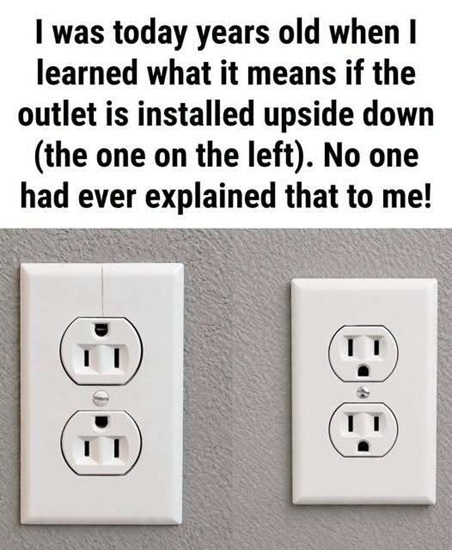
Have you ever walked into a room, plugged in a device, and noticed that one electrical outlet looked different from all the others? Instead of the familiar design with the round grounding hole at the bottom, the outlet was installed with the grounding hole at the top. Many homeowners assume this is simply a mistake made during installation, but in reality, there are several practical reasons why an electrician may intentionally install an outlet in this position.
Although an upside-down outlet often catches people’s attention, its orientation does not automatically indicate a problem. In many homes, especially those built several decades ago, the direction of an outlet may provide a helpful clue about how that electrical circuit was designed. In other situations, the orientation reflects an electrician’s personal preference, a local construction practice, or even additional safety considerations.
One of the most common reasons for installing an outlet upside down is to identify a receptacle connected to a wall switch. In many bedrooms, living rooms, and family rooms, builders did not always install overhead ceiling lights. Instead, they wired one outlet so that a nearby wall switch could control a table lamp or floor lamp. This allowed homeowners to enter the room, flip the switch near the door, and immediately illuminate the space without installing a permanent ceiling fixture.
In some homes, electricians chose to rotate that switched receptacle 180 degrees. The different appearance made it easier for homeowners to recognize which outlet worked with the wall switch. Rather than testing every receptacle in the room, a person could simply plug a lamp into the outlet with the unusual orientation and determine whether the switch controlled it.
It is important to understand that there is no national requirement in the United States requiring switched outlets to be installed upside down. The National Electrical Code does not specify a mandatory orientation for standard residential receptacles. Because of this, two neighboring homes built by different contractors may use completely different installation methods even if their wiring is nearly identical.
Another reason some electricians prefer the ground opening on top involves safety. Imagine that a metal object, such as a picture frame, a screwdriver, or another conductive item, accidentally falls between a partially plugged-in cord and the wall. If the grounding slot is positioned at the top, the metal object is more likely to contact the grounding pin first rather than the energized prongs. Since the grounding conductor is designed to provide a safe path for electrical faults, some electricians believe this orientation offers a small additional layer of protection in rare situations.
While this safety benefit is often discussed among electricians, opinions differ throughout the industry. Many professionals continue installing outlets with the ground opening at the bottom simply because that has become the traditional appearance most homeowners expect. Others install them horizontally in certain locations, while commercial buildings may follow different conventions depending on local practices and project specifications.
Another source of confusion is that only half of an outlet may be controlled by a wall switch. A standard duplex receptacle contains two plug-in locations. In some installations, the upper half is switched while the lower half remains energized all the time. In other homes, the opposite arrangement is used. This allows a lamp to operate from the wall switch while televisions, internet routers, phone chargers, clocks, or other electronics continue receiving constant power.
Many homeowners mistakenly believe an outlet has failed when one half does not provide electricity. In reality, the wall switch may simply be turned off. Before assuming the receptacle is defective, it is worth checking nearby switches and testing both plug openings individually. This simple step often solves the mystery within seconds.
Older homes frequently include switched outlets because they were built before recessed lighting and multiple ceiling fixtures became common. During those years, using portable lamps as the primary source of lighting was an affordable and flexible solution. Even today, many homeowners appreciate switched outlets because they allow comfortable lighting without modifying ceilings or installing additional wiring.
The easiest way to determine whether an outlet is controlled by a switch is through a simple test. Plug a lamp into one outlet opening, then operate every nearby wall switch. If the lamp turns on and off, you have identified a switched receptacle. Repeat the process using the second outlet opening because it may function differently from the first. This approach is safe, straightforward, and usually provides the answer within a few minutes.
Although outlet orientation can provide useful hints, appearance alone should never be considered proof of how an electrical circuit functions. Previous homeowners may have replaced receptacles during remodeling projects, electricians may have followed different installation habits, or renovations may have altered the original wiring over time. The only reliable way to confirm an outlet’s function is through careful testing or inspection by a qualified electrician when necessary.
Understanding these small details can help homeowners make better use of their electrical systems while avoiding unnecessary concern. A receptacle that appears unusual may simply reflect thoughtful planning by the original builder rather than poor workmanship. Learning how switched outlets operate also makes it easier to arrange furniture, position lamps, and troubleshoot common electrical questions around the home.
In the end, an upside-down electrical outlet is usually not something to worry about. Instead, it serves as an interesting reminder that many features inside a home were designed with practical purposes that may not be immediately obvious. Whether it identifies a switched receptacle, follows an electrician’s preferred installation method, or reflects additional safety considerations, the outlet is simply one example of how small construction details can have useful functions that homeowners often overlook.

