
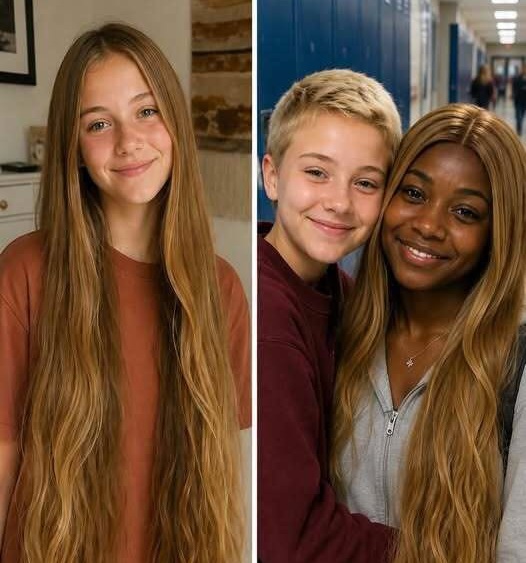
The first thing I noticed was the silence. Our home was usually filled with little sounds after school—the front door closing, a backpack landing on the floor, the family dog running across the hallway, and my daughter calling my name before she even took off her shoes. That afternoon, however, everything felt different. The house was unusually quiet, and the moment I stepped into the kitchen, I sensed that something had happened. When I turned toward the dining room, I saw my nine-year-old daughter, Emma, standing beside a chair.
Long strands of chestnut-colored hair were scattered across the hardwood floor. A pair of small craft scissors rested nearby. Emma held the thick braid she had just cut in both hands, her eyes filled with uncertainty as she waited for my reaction. For several seconds, I couldn’t speak. Emma had always loved her hair. She spent countless mornings asking me to braid it before school, decorated it with colorful ribbons during holidays, and proudly smiled whenever someone complimented its length
. Watching her stand there with uneven hair reaching only to her shoulders felt almost unreal. My heart immediately filled with worry. “Emma,” I asked softly, “what happened?” She lowered her eyes and swallowed. “I wanted to help someone.” At first, I assumed another child had convinced her to cut it. Children sometimes make impulsive decisions without understanding the consequences, and I feared she had become the victim of an unfortunate prank.
Instead, her answer surprised me.
“There is a girl in my class named Sophie,” she explained quietly. “She lost her hair because she’s receiving medical treatment. Some kids laugh at her. They whisper when she walks by, and sometimes she eats lunch alone.”
Emma paused before continuing.
“She told our teacher she wished she could disappear.”
Those words stayed with me.
Emma explained that she had watched Sophie become quieter every week. The cheerful little girl who once loved answering questions in class had slowly stopped raising her hand. She wore colorful hats every day, hoping people would pay less attention to her appearance, but the teasing continued.
My daughter had noticed everything.
She noticed the stares.
She noticed the whispers.
She noticed the lonely walks down the hallway.
Children often see more than adults realize.
“I thought,” Emma whispered, “if Sophie didn’t have hair, maybe I could share some of mine.”
Her explanation was so simple that it almost broke my heart.
She had not been seeking attention.
She had not wanted praise.
She had simply seen another child hurting and wondered how she could help.
I knelt beside her and gently hugged her.
“You should always tell me before making such a big decision,” I said.
“I know,” she replied, tears forming in her eyes. “I was afraid you would say no.”
I smiled through my own tears.
“I’m not upset because you wanted to help someone.”
The next morning, Emma walked into school with her uneven haircut and nervous smile. I worried that she might become the next target of teasing herself. Children can sometimes be surprisingly cruel, even without intending to be.
Just after ten o’clock, my phone rang.
The caller ID displayed the school office.
My stomach tightened immediately.
The principal asked if I could come to the school as soon as possible.
His voice wasn’t angry, but it carried an unusual seriousness that made my imagination race. I wondered whether Emma had gotten into trouble or whether Sophie’s parents had misunderstood what had happened.
By the time I arrived, I had imagined a dozen worst-case scenarios.
Instead, I walked into something entirely unexpected.
Several teachers stood quietly near the office window. The school counselor smiled warmly as she greeted me.
Emma stood beside Sophie.
Sophie’s mother was there as well.
Both girls looked nervous, yet there was something different about Sophie.
For the first time, she was smiling.
Her mother explained that after hearing Emma’s story, several local hairstylists had volunteered their time. One salon had arranged to help create a custom wig using donated hair from multiple contributors, including Emma’s.
It would take time before it was finished, but Sophie had already realized something even more important.
She was no longer facing her challenges alone.
The principal quietly told me that Emma’s kindness had spread through the entire school in less than twenty-four hours.
Teachers began discussing empathy in their classrooms.
Students started writing encouraging notes for Sophie.
Several families contacted local organizations asking how they could donate hair or support children receiving medical treatment.
One simple decision had inspired dozens of others.
Later that afternoon, the school gathered students for a short assembly.
No one singled out the children who had teased Sophie.
Instead, the principal spoke about kindness.
He explained that courage is not always loud. Sometimes courage looks like inviting someone to sit beside you at lunch. Sometimes it means defending a classmate when others remain silent. Sometimes it means giving away something valuable simply because another person needs hope more than you need comfort.
The gymnasium became completely silent.
Many students lowered their heads thoughtfully.
Some quietly wiped away tears.
Over the following weeks, remarkable changes continued to appear throughout the school.
Students organized a fundraiser supporting families receiving cancer treatment.
The student council created a peer-support program to help children who felt isolated.
Teachers introduced classroom discussions about empathy, respect, and inclusion.
Even parents became involved by volunteering their time for community projects.
Sophie’s confidence slowly returned.
She laughed more often.
She joined recess games again.
She stopped hiding beneath oversized hats whenever possible.
Although her medical journey remained difficult, she no longer felt invisible.
Emma never considered herself a hero.
Whenever someone complimented her, she simply shrugged and said, “I just wanted Sophie to know she wasn’t alone.”
That answer reminded me that genuine kindness rarely asks for recognition.
Months later, Emma’s hair had begun growing back.
One afternoon, we visited a local charity event supporting children facing serious illnesses. Families shared stories of resilience, volunteers collected donations, and several professional stylists offered free haircuts to those preparing to donate their hair in the future.
Watching Emma speak with other children, I realized something important.
Acts of compassion rarely end where they begin.
One generous decision encourages another.
One conversation changes another heart.
One brave child gives another child the confidence to smile again.
As we drove home that evening, the setting sun filled the car with warm golden light.
Emma looked out the window before asking quietly, “Do you think Sophie feels happier now?”
I smiled.
“I think she feels something even more important.”
Emma looked at me curiously.
“What?”
“She knows someone cared enough to stand beside her.”
Emma nodded thoughtfully.
Sometimes the greatest gifts are not measured by money or appearance.
Sometimes they are measured by the courage to notice another person’s pain and the willingness to remind them they never have to face it alone.
Years may pass, hair will grow again, and children will eventually become adults with families of their own. Yet the lesson that began with one small haircut will remain far longer than any hairstyle ever could.
Because kindness has a remarkable way of multiplying.
When one person chooses compassion over silence, others often find the courage to do the same.
And in a world where many people quietly carry burdens no one else can see, that simple choice may become the beginning of hope for someone who desperately needs it.

