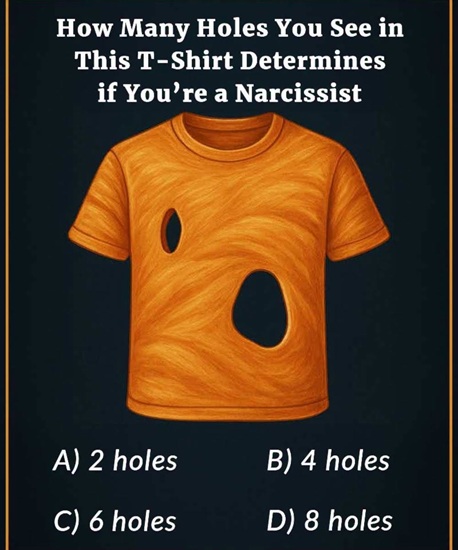
At first glance, the famous orange T-shirt puzzle appears to be nothing more than a simple counting challenge. The image usually shows an orange T-shirt with several visible tears, accompanied by the question: “How many holes are in the shirt?” Thousands of people believe they can answer immediately, only to discover that others have reached completely different conclusions. This seemingly ordinary puzzle has become one of the internet’s most widely shared visual brain teasers because it encourages careful observation while demonstrating how differently people can interpret the very same image.
Unlike mathematical problems that have clearly defined rules, the T-shirt puzzle depends largely on how the question is interpreted. The image itself does not specify exactly what should be counted as a “hole.” As a result, people naturally apply different definitions based on their own reasoning. Some count only the tears visible in the fabric, while others include the neck opening, sleeve openings, and the bottom of the shirt because those are also openings in the garment. Since the instructions never define the word “hole,” multiple logical interpretations become possible.
This is one of the reasons visual puzzles have remained popular for decades. Rather than measuring intelligence, they encourage people to slow down and examine details they might otherwise overlook. Human beings naturally rely on pattern recognition to process information quickly. Most of the time this ability helps us make rapid decisions, but puzzles like this demonstrate that first impressions are not always sufficient when a question depends on careful observation and precise definitions.
Psychologists have long studied how perception influences decision-making. Visual perception is not simply about what our eyes detect—it also involves how the brain organizes information and assigns meaning to what we see. When two people observe the same picture, they may focus on different details depending on previous experiences, expectations, and assumptions. That is why two equally thoughtful individuals can arrive at different answers without either person acting irrationally.
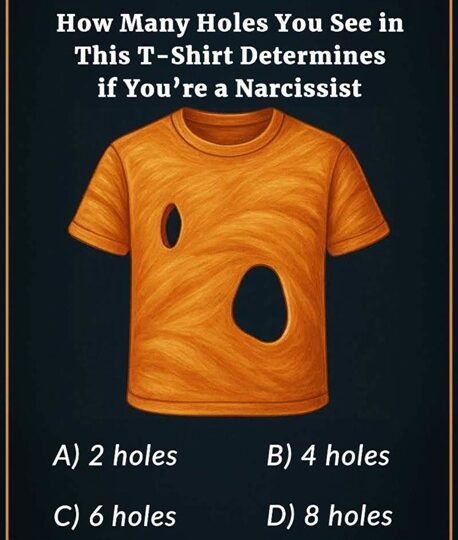
The orange T-shirt puzzle illustrates this concept particularly well because it encourages viewers to make assumptions before examining every detail. Many people immediately focus on the obvious tears visible on the front of the shirt. Others quickly notice that some tears appear to pass completely through the fabric, leading them to count both the front and back openings. Still others consider the normal openings that already exist in every T-shirt, including the neck, the sleeves, and the bottom. Each interpretation follows its own internal logic.
One commonly discussed answer is eight. People who arrive at this number usually count the two visible tears on the front, the matching openings on the back where those tears pass through the fabric, plus the neck opening, the two sleeves, and the bottom opening. Under this interpretation, every opening through which something could pass is counted as a hole. While many puzzle enthusiasts favor this explanation, it depends entirely on accepting that all garment openings should be included in the final count.
Other participants argue that only the accidental tears should count because the question appears to focus on damage rather than the garment’s normal construction. Using this interpretation, answers such as two or four are often suggested depending on whether the tears pass completely through both sides of the shirt. These alternative explanations are also logically consistent because they rely on a different definition of what constitutes a hole within the context of the puzzle.
Rather than proving that one group is more observant than another, the discussion demonstrates how language influences reasoning. Words sometimes appear simple until they are examined closely. Everyday terms often have multiple acceptable meanings depending on context. Without additional instructions, readers naturally interpret questions according to their own understanding, leading to different—but often reasonable—conclusions.
This characteristic has made the orange T-shirt puzzle especially popular on social media. Friends and family members often compare answers, explain their reasoning, and discover that people they know well approach the same question differently. The conversations that follow are usually more interesting than the puzzle itself because they reveal how differently individuals organize information before making decisions.
Educational experts frequently use visual puzzles as examples of critical thinking exercises. Instead of encouraging people to memorize facts, these activities promote careful observation, logical reasoning, and the willingness to reconsider an initial answer after hearing another perspective. They remind participants that confidence alone does not guarantee correctness and that examining evidence carefully often produces better conclusions.
The puzzle also illustrates an important principle found in many scientific and analytical disciplines: clearly defining terms before solving a problem. Researchers, engineers, physicians, and investigators regularly establish precise definitions before beginning an analysis because small differences in terminology can significantly affect the final result. The orange T-shirt puzzle demonstrates this principle in a simple and engaging way that almost anyone can understand.
Ultimately, the enduring popularity of the orange T-shirt puzzle lies not in discovering a single universally accepted answer but in encouraging thoughtful observation and respectful discussion. It reminds us that people can examine the same information while reaching different conclusions when the question itself allows multiple interpretations. Rather than rushing toward an immediate response, the puzzle rewards careful attention, patience, and an openness to considering alternative perspectives before deciding on an answer.
As the orange T-shirt puzzle continued spreading across social media platforms, it became clear that its popularity was not based solely on finding the “correct” answer. Instead, people enjoyed discussing the different ways the image could be interpreted. Friends, family members, teachers, and coworkers often arrived at different conclusions, leading to conversations about observation, logic, and language rather than competition. In many ways, the discussion itself became more valuable than the final number each person selected.
One reason the puzzle has remained so engaging is that it encourages people to slow down before responding. Modern life often rewards quick reactions, especially on social media, where users are accustomed to commenting or answering within seconds. Visual brain teasers remind us that careful observation sometimes reveals details that are easy to overlook during an initial glance. Taking a second look can completely change the way a problem is understood.
Experts who study perception explain that the human brain constantly simplifies information in order to process the world efficiently. Rather than analyzing every detail individually, the brain quickly recognizes familiar shapes and patterns. This ability is extremely useful in everyday life because it allows people to make rapid decisions. However, puzzles intentionally take advantage of this natural tendency by presenting situations in which assumptions may influence the final answer more than the visible evidence itself.
Another interesting aspect of the T-shirt puzzle is that it demonstrates the importance of asking clarifying questions. Before attempting to solve a problem, it is often helpful to understand exactly what is being asked. In professional settings such as science, engineering, medicine, and law, defining terminology is a crucial part of reaching accurate conclusions. The puzzle offers a simple illustration of why precise wording matters whenever people analyze information or solve problems together.
Many educators appreciate visual puzzles because they promote critical thinking rather than simple memorization. Instead of rewarding the fastest response, these activities encourage participants to explain their reasoning step by step. Even when two people disagree, discussing the logic behind each answer often becomes an opportunity to strengthen observation skills and improve communication. This process helps demonstrate that thoughtful reasoning can be just as valuable as reaching a particular conclusion.
The orange T-shirt challenge also highlights the difference between observation and interpretation. Observation involves identifying what is physically visible in the image, while interpretation involves deciding what those details mean. Two viewers may observe exactly the same picture but interpret the word “hole” differently based on personal assumptions or previous experiences. Recognizing this distinction helps explain why multiple answers can appear reasonable when the instructions leave room for interpretation.
Psychologists often note that people naturally rely on mental shortcuts, sometimes called cognitive heuristics, to simplify everyday decisions. These shortcuts usually help individuals navigate complex situations quickly, but they can occasionally lead to different interpretations when information is incomplete or ambiguous. Puzzles like the orange T-shirt challenge provide an enjoyable opportunity to recognize these thinking patterns without any real-world consequences.
Importantly, the puzzle should not be viewed as a scientific personality test or an assessment of intelligence. While many social media posts describe it as revealing hidden personality traits or measuring intelligence, there is no reliable scientific evidence showing that a person’s answer can accurately determine personality, cognitive ability, or psychological characteristics. Instead, the puzzle is best understood as an entertaining visual reasoning exercise that encourages careful observation and discussion.
This distinction is important because internet content sometimes presents ordinary brain teasers with exaggerated claims designed to attract attention. Responsible interpretation means separating verified information from promotional language. The orange T-shirt puzzle can certainly be enjoyable and thought-provoking, but it should not be considered a validated psychological assessment or a diagnostic tool. Enjoying the discussion does not require believing unsupported claims about what the answer reveals.
The continuing popularity of the puzzle demonstrates that simple visual challenges remain an effective way to encourage curiosity and conversation. People often discover that listening to someone else’s explanation helps them notice details they initially overlooked. Rather than proving one person is right and another is wrong, the exercise encourages openness to different perspectives while reinforcing the importance of examining evidence carefully before drawing conclusions.
Ultimately, the orange T-shirt puzzle reminds us that observation is only the first step in reasoning. Careful thinking requires patience, attention to detail, and a willingness to reconsider initial assumptions when presented with new information. These are valuable habits not only for solving puzzles but also for everyday decision-making, learning, and communication.
Whether someone counts two holes, four, six, eight, or another number entirely depends largely on how the question is interpreted and which definition of “hole” is applied. Because the puzzle does not establish a single explicit definition, different logical answers can exist. The real lesson is not about identifying one universally correct number but about recognizing the importance of clear definitions, thoughtful analysis, and respectful discussion when people interpret the same information differently.
In the end, the orange T-shirt remains one of the internet’s most memorable visual brain teasers because it encourages people to pause, observe carefully, explain their reasoning, and appreciate that simple questions can sometimes have more than one reasonable interpretation. That combination of curiosity, careful thinking, and open discussion is what has allowed this classic puzzle to remain popular with audiences around the world.
