
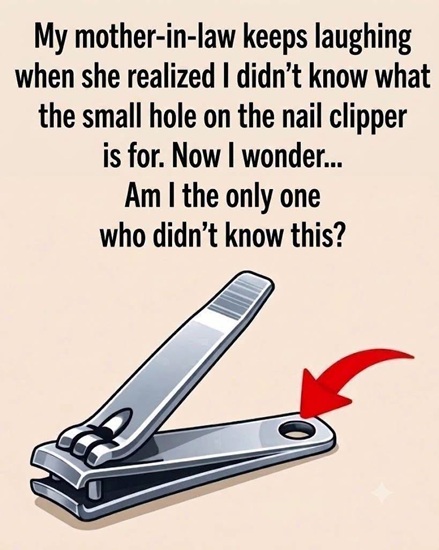
A nail clipper is such a familiar household object that most people rarely stop to examine how it works. The tool is small, inexpensive and usually contains only a handful of visible components, yet its simple appearance hides a surprisingly efficient mechanical design. One feature that frequently creates curiosity is the small circular opening found on many clippers. Depending on the model and the location of the opening, it may be associated with the clipper’s pivot mechanism or serve as a convenient attachment point for a key ring, chain or cord.
That distinction is important because there is no single universal nail-clipper design. Different manufacturers arrange their levers, pins, files, jaws and attachment points in slightly different ways. A round opening close to the operating lever may be connected with the mechanical assembly, while another opening near the blunt end of a clipper may have been deliberately provided for carrying the tool. Understanding which opening is being discussed prevents an ordinary design feature from being turned into an inaccurate internet “secret.”
The familiar lever-style nail clipper works by converting a relatively small amount of pressure from the thumb into enough force to cut a nail. Two metal sections form opposing jaws, with sharpened edges positioned at the front. When the clipper is resting, those cutting edges remain slightly separated. Pressing the operating lever forces the jaws toward one another until the sharpened edges meet and cut through the nail.
The upper handle is essential to this process because it provides mechanical advantage. Instead of attempting to squeeze the two metal jaws together directly, the user presses on the broad end of a lever. The geometry of the lever and its contact with the clipper body concentrates that pressure at the cutting end. This allows a compact tool to generate useful cutting force without requiring an unusually strong grip.
A central post or pivot is also important in many traditional designs. It passes through or interacts with openings in the clipper body and helps keep the components properly positioned. The operating lever attaches to this assembly and must be capable of moving between its storage and working positions. The openings surrounding this mechanism therefore have a genuine structural purpose.
Anyone who uses a traditional nail clipper performs this movement almost automatically. When the clipper is stored, the lever can lie relatively flat against the body. Before trimming a nail, the user lifts the lever and rotates it into the correct orientation. Once positioned, the handle can be pressed downward to operate the jaws.
The ability to rotate the lever is one reason the clipper can remain so compact. A permanently extended handle would make the tool larger and less convenient to carry. By allowing the lever to fold against the body, designers create a tool that takes up very little space when it is not being used.
This also explains why some openings, notches and pins near the lever should not be confused with dedicated carrying holes. They may be part of the mechanism that allows the lever to remain attached while changing position. Adding a thick cord or ring to the wrong opening could potentially interfere with that movement.
Other nail clippers contain a clearly separate opening closer to the rear of the body. On appropriate models, this can be used to attach a small key ring or chain. This function is not merely an improvised internet hack. Nail-clipper patents have specifically described designs containing holes intended to receive key chains or similar attachments.
That carrying feature makes practical sense. Nail clippers are small enough to disappear easily into bathroom drawers, cosmetic bags, backpacks and travel cases. Connecting one to a ring or short chain can make it easier to find and less likely to become separated from the rest of a grooming kit.
Some compact clippers are sold with a chain already attached. Others leave the opening empty so the owner can decide whether to use it. A small ring can also allow the clipper to be connected to another grooming accessory or storage pouch.
The important point is that the location and construction of the hole matter. A dedicated attachment opening should normally remain separate from the movement of the operating lever. If adding a ring prevents the lever from rotating freely or pressing through its normal range, that opening should not be treated as an attachment point.
Certain designs combine functions even more cleverly. Historical patents describe hollow eyelets that participate in the construction of the clipper while also providing space through which a chain or ring can pass. This means that on some products, a component can have both structural and carrying value.
That multifunctional approach is common in efficient product design. When manufacturers can make one small component perform more than one useful task, they reduce complexity without necessarily reducing functionality. Nail clippers are a particularly good example because nearly every piece of metal contributes directly to the operation of the tool.
The body itself often performs multiple functions. It provides the basic structure, holds the cutting edges in alignment and also acts somewhat like a spring. When pressure is removed from the lever, the resilient metal helps the jaws separate again.
That spring-like action is one reason many traditional clippers do not need a separate coil spring. The shape and flexibility of the metal body already provide the restoring force required to reopen the cutting edges after each press.
The cutting surfaces must also be manufactured carefully. They need to meet closely enough to shear through a nail instead of merely bending it. If the edges become badly misaligned or damaged, the clipper may start tearing or crushing nails rather than producing a clean cut.
Alignment depends partly on the central assembly. The pivot, pin and surrounding openings help maintain the relationship between the upper and lower sections. A tiny amount of unwanted movement can noticeably change how the blades meet.
This becomes obvious when an old clipper begins wearing out. The lever may start moving sideways. The jaws may no longer close evenly. The user may find that much more thumb pressure is required to make a cut.
Those problems demonstrate how much work is being performed by components that are easy to ignore when the tool is functioning correctly. A small pin and carefully shaped opening can determine whether the force from the handle reaches the blades efficiently.
The curvature of the blades also serves a purpose. Fingernail clippers commonly use curved cutting edges that correspond reasonably well with the natural shape of fingernails. Larger toenail clippers may use wider jaws or a different cutting profile because toenails can be considerably thicker.
That is why choosing the correct size clipper matters. Trying to force a thick toenail into a very small fingernail clipper can place unnecessary stress on the lever and cutting edges. It can also make the tool more difficult to control.
Using excessive force is generally a sign that the clipper may be unsuitable for the task, damaged or dull. A properly functioning tool should allow the lever system to do most of the mechanical work.
The operating principle is simple but effective. The thumb moves through a relatively comfortable distance at the broad end of the lever. The mechanism transfers that input to the jaws, where a much smaller movement creates enough pressure for cutting.
This is mechanical advantage in an everyday form. The same general principle appears in many tools, from scissors and pliers to bottle openers. Nail clippers package it into an especially compact shape.
The design is so intuitive that most people learn to use the tool without any explanation. Lift the lever, rotate it, position the nail and press. The mechanical relationships remain hidden behind those four simple actions.
That ease of use is one reason the basic design has survived for so long. There is little reason to replace a mechanism that is inexpensive, durable and effective.
Modern manufacturers have certainly introduced variations. Some clippers include larger padded handles for improved grip. Others have clipping catchers designed to contain pieces of nail after they are cut.
There are rotating-head models that allow the cutting jaws to be positioned at different angles. There are specialized clippers for babies, larger versions for toenails and ergonomic models intended for people who find small metal handles difficult to operate.
Some designs also include folding nail files. These files are commonly attached to the clipper body and can be rotated outward when needed.
The attachment area for a file can introduce additional pins or openings, making it even more important not to assume every visible hole serves the same purpose. A feature may be supporting the file, connecting the lever or providing an attachment point.
That is where many viral explanations become unreliable. A photograph may highlight a circle on a nail clipper and claim that someone has discovered its “real hidden purpose.” Without identifying the exact model or looking at the surrounding mechanism, that claim may be impossible to generalize.
The better method is simply to observe the tool.
If a pin passes through the opening and the lever moves around that assembly, the opening clearly participates in the mechanism.
If the hole is positioned at the rear, remains unused during cutting and easily accepts a ring, it may be intended as an attachment point.
If the clipper arrived from the manufacturer with a chain already connected there, the purpose is even clearer.
And if another component such as a file shares the same area, that must also be considered.
Looking at the movement of the surrounding parts is much more reliable than accepting an unusual explanation simply because it sounds surprising.
The genuine mechanical design is interesting enough without inventing a secret function.
Consider how many requirements a nail clipper satisfies with only a few pieces of metal. It must remain small enough to carry easily. Its blades need to stay aligned. The jaws need to reopen automatically after every cut.
The handle must produce enough leverage to cut through a nail while remaining comfortable for the thumb. The lever must also be capable of folding away when the tool is stored.
The pivot assembly must hold those pieces together while still allowing movement.
And on some models, designers have added a hole for attaching a ring or chain without substantially increasing the size of the product.
Achieving all of that in such a small object demonstrates why everyday engineering can be more sophisticated than it initially appears.
Good maintenance can help the mechanism continue working correctly. After trimming, nail fragments should be removed from around the jaws and other areas where debris can collect.
If the clipper becomes wet, drying it before storage is sensible. Moisture can contribute to corrosion, particularly where protective coatings have worn away.
The pivot area should also remain free enough to move normally. Dirt or debris around moving components can make the lever feel less smooth.
A severely loose, rusted or misaligned clipper may be better replaced rather than forced to continue working.
Cleaning also matters because the tool comes into close contact with nails and nearby skin. Sharing personal grooming tools without appropriate cleaning can create unnecessary hygiene concerns.
People with particular medical conditions affecting their feet, circulation or nails may require professional guidance about nail care rather than relying solely on ordinary home trimming.
The key-ring feature, when genuinely present, should also be used sensibly. A small ring or chain is generally enough to keep the clipper attached to another object.
A large or heavy accessory can make the tool awkward to handle.
The attachment should never obstruct the cutting jaws.
It should not prevent the lever from rotating into position.
And it should not force the user to hold the clipper at an unsafe angle.
A short cord can sometimes serve a similar carrying function on a model with an appropriate rear opening. It may also make the clipper easier to retrieve from a bag.
Some people find a loop helpful because polished metal can become slippery. However, this should be regarded as an optional adaptation rather than the original purpose of every clipper hole.
Again, the design of the individual model determines what is appropriate.
This is the most important correction to the popular online explanation.
There is not one mysterious circular hole shared by every nail clipper for exactly the same reason.
There are different openings.
Some are mechanical.
Some are designed for attachments.
Some designs may combine functions.
That more careful explanation may sound less dramatic, but it is more accurate.
Patented nail-clipper mechanisms provide useful evidence. They show pivot pins passing through aligned openings in clipper components and describe how those parts interact with the operating lever.
Other patents specifically describe key-chain holes and even discuss how the design should keep such an opening accessible.
That documentation allows the different purposes to be distinguished rather than guessed.
It also illustrates how product designers have refined nail clippers over many years.
Small improvements can make the lever more stable.
They can reduce unwanted sideways movement.
They can make a key-ring hole easier to reach.
They can improve the alignment of the cutting jaws.
Each improvement may seem minor, but several small refinements together can make an everyday tool noticeably easier to use.
The familiar modern clipper is therefore the result of accumulated mechanical ideas rather than a completely accidental arrangement of metal.
That history helps explain why its basic appearance has remained recognizable.
A successful tool does not necessarily need constant reinvention.
Sometimes the most effective design is one that receives gradual refinements while preserving the principle that already works.
For nail clippers, that principle remains leverage.
The user presses the handle.
The lever transfers force.
The jaws move together.
The sharpened edges cut.
The resilient body then helps the jaws reopen.
The process repeats with the next press.
All of that happens quickly enough that the user rarely notices the individual stages.
The small openings around the mechanism are part of making that simplicity possible.
Meanwhile, a separate carrying hole can add convenience without complicating the cutting process.
That is why identifying the exact opening matters.
Calling every hole a “key-ring hole” ignores the mechanical openings.
Calling every hole exclusively part of the pivot ignores models with deliberate attachment points.
Both statements can therefore be wrong when presented universally.
The accurate explanation depends on the physical design in front of the user.
This principle applies beyond nail clippers as well.
Everyday objects frequently attract viral “hidden purpose” claims because people enjoy discovering features they previously ignored.
Sometimes those claims are correct.
Sometimes an ordinary manufacturing detail is given an invented explanation because the invented version sounds more interesting.
The best way to evaluate such claims is to examine how the component interacts with the object.
Does it move?
Does something pass through it?
Does it hold another component?
Does the manufacturer attach anything there?
Does using the supposed feature interfere with the normal operation of the product?
Those questions often provide a much clearer answer.
With a nail clipper, the mechanism is particularly easy to observe.
Turn the clipper sideways.
Lift the handle.
Rotate it into position.
Watch what happens around the central post.
Press the lever slowly.
The jaws begin moving toward one another.
Release the pressure.
They separate again.
That visible sequence explains far more than an online hack.
If there is another hole at the rear of the clipper, inspect it separately.
A key ring may fit there without affecting the mechanism.
That is a different feature with a different purpose.
Understanding the distinction makes the clipper more interesting, not less.
The tool is a small demonstration of efficient mechanical design.
It uses very little material.
It requires no electricity.
It contains relatively few parts.
It can remain functional for many years.
It multiplies the force of the human hand.
And it can fit into a pocket.
That combination is difficult to improve dramatically, which helps explain why conventional clippers remain common despite the availability of electric grooming devices and more elaborate alternatives.
Their simplicity is an advantage.
There is little setup.
There is little maintenance.
There is no battery to charge.
The tool is ready whenever it is needed.
The folding lever keeps it compact between uses.
The metal body supplies both structure and spring action.
And the small pivot components allow the entire mechanism to remain assembled.
A rear attachment hole, where provided, adds another small convenience.
It can keep the tool connected to a grooming kit.
It can attach it to a travel pouch.
It can make a miniature clipper easier to find.
None of these uses requires inventing a mysterious function.
The real design already explains why the openings are there.
So the next time someone points to the round hole on a nail clipper and claims to have discovered its secret purpose, the most accurate response is to look at the specific clipper first.
If the opening is integrated into the pivot mechanism, it contributes to the operation and assembly of the tool.
If it is a separate hole positioned for attachment, it may be intended for a key ring, chain or cord.
If the construction combines those functions, both explanations may apply.
There is no need to force every model into one answer.
That nuance is the key to understanding the feature correctly.
Nail clippers look simple because good engineering often makes complicated mechanical relationships feel effortless.
The user does not need to calculate leverage.
The user does not need to think about the resilience of metal.
The user does not need to understand the geometry of the pivot.
The tool handles those problems automatically.
All the person has to do is position the nail and press.
Behind that simple movement is a carefully arranged interaction between blades, jaws, lever, pin and openings.
And on some models, there is an extra place for a key ring too.
The real explanation may be less sensational than many viral “life hacks,” but it is more useful.
That small opening is not necessarily an accidental gap.
It may be an essential part of the clipper’s mechanical system, a deliberate carrying feature, or part of a design that combines both ideas.
The only reliable way to know is to examine where the opening sits and what happens around it when the clipper is operated.
Once that is understood, the nail clipper becomes a good reminder that even the smallest household tools can contain thoughtful engineering hidden in plain sight.

