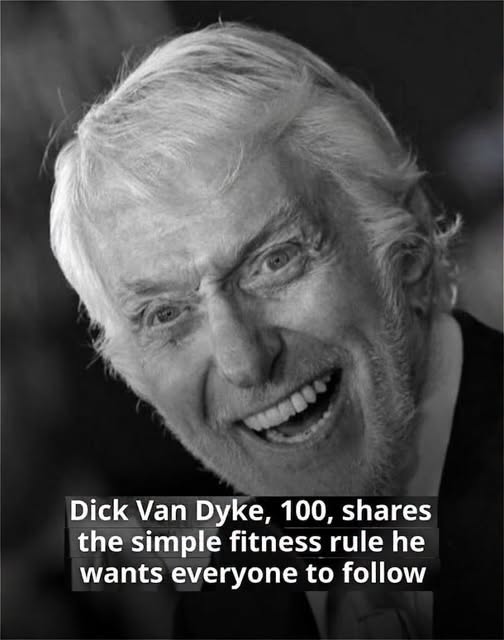
Dick Van Dyke has reached a milestone very few people ever experience. Born on December 13, 1925, the legendary actor, comedian, singer and dancer turned 100 years old in December 2025. In 2026, he remains one of the most recognizable figures from Hollywood’s classic television and musical era. While his career has long been celebrated for comedy, dancing and unforgettable performances, more recent attention has focused on another remarkable part of his life: the fact that he continues to stay physically active at 100.
Van Dyke’s longevity is extraordinary, but he has never presented it as the result of one magical trick. Instead, he has repeatedly spoken about a combination of habits and attitudes that matter to him personally. Regular movement remains one of the clearest parts of that philosophy. He has continued exercising even at an age when many people naturally experience major changes in strength, balance and mobility.
One detail that has attracted particular attention is the consistency of his fitness routine. Reports around his 100th birthday noted that Van Dyke continued going to the gym approximately three times each week. That routine reflects a long-term approach rather than a temporary attempt to become active after reaching old age.
For Van Dyke, exercise has been part of life for decades. His entire career demanded movement, coordination and physical expression. Long before people were discussing his longevity, audiences knew him as someone who could turn dancing, stumbling, jumping and exaggerated body language into entertainment.
That background helps explain why staying active still appears natural to him. Movement is not something that suddenly became important when he turned 90 or 100. It has been woven through both his professional life and his personal routine for much of his adult life.
Van Dyke has spoken about noticing physical stiffness when he goes too long without exercising. That experience has encouraged him to continue using the gym even at an advanced age. His routine reportedly involves different machines rather than relying exclusively on one type of exercise.
He has described moving through a circuit that includes exercises for different parts of the body. While the details of his routine should not be treated as medical instructions for other people, they illustrate how seriously he continues to take the idea of maintaining movement.
A particularly striking example came when Van Dyke appeared using an inversion table at age 100. The equipment allows the body to tilt backward into an inverted position, creating a very different experience from conventional upright exercise.
The video naturally attracted attention because most people do not expect to see a centenarian comfortably using equipment of that kind. Van Dyke’s message surrounding the moment was characteristically simple: keep moving.
That phrase captures much of the philosophy he has expressed for years. Rather than allowing the number attached to his age to define everything he should stop doing, he seems to focus more on what he is still capable of doing safely and comfortably.
It is important, however, not to turn that example into medical advice. An inversion table may be appropriate for one individual and inappropriate for another. Health conditions, balance problems, cardiovascular issues, medications and many other factors can influence whether a particular exercise is safe.
Van Dyke’s routine therefore tells us what works for him personally. It does not create a universal recommendation for older adults or guarantee that anyone following the same routine will experience similar longevity.
That distinction also applies to the broader discussion of why he reached 100. Human lifespan depends on many factors. Genetics, healthcare, lifestyle, environment, disease history, social conditions and chance can all contribute.
For that reason, it would be misleading to claim that exercise alone caused Van Dyke to live for a century. A more accurate description is that he personally credits staying physically active as one part of the lifestyle that has helped him continue feeling engaged with life.
His emotional outlook appears equally important to him.
Van Dyke has spoken about trying not to hold onto hatred, resentment or unnecessary anger. He has described a preference for moving forward rather than allowing old frustrations to define his daily life.
That philosophy is not a scientific guarantee of longevity either. Still, it provides insight into the way Van Dyke thinks about well-being.
For him, staying healthy is not only about muscles, joints or cardiovascular fitness. It also appears to involve maintaining curiosity, humor and an emotional attitude that does not remain permanently trapped in bitterness.
Living for 100 years inevitably means experiencing a great deal of change.
Van Dyke has witnessed enormous transformations in entertainment, technology and society. He has also lived through personal challenges, losses and the ordinary difficulties that come with a long life.
Despite those experiences, optimism has remained one of the qualities most closely associated with him.
That optimism is visible in the way he talks about growing older. Instead of describing aging only in terms of decline, he often discusses the importance of continuing to participate in life.
His approach does not deny that the body changes.
It simply rejects the idea that every birthday should automatically remove another activity from a person’s life.
For Van Dyke, movement has always been connected with joy.
That was true during his career as well.
His performances relied heavily on physical energy. On The Dick Van Dyke Show, comedy often came from movement as much as dialogue. A carefully timed stumble or exaggerated physical reaction could become as memorable as a written joke.
His movie career reinforced the same image.
In Mary Poppins, Van Dyke performed musical numbers that required significant dancing and coordination. In Chitty Chitty Bang Bang, audiences again saw the combination of comedy, music and physical movement that had become part of his identity.
Those performances helped establish him as one of entertainment’s most energetic stars.
Decades later, watching him continue to exercise carries a particular emotional significance for longtime fans.
The man they remember dancing across movie sets is obviously much older now.
Yet some of the same enthusiasm remains visible.
That continuity is part of what makes his story compelling.
Van Dyke has not become active because people suddenly became interested in his age.
He has remained active because movement has always been part of the way he experiences life.
Reports about his gym routine reinforce that point.
Rather than focusing exclusively on light walking, he has continued using various pieces of fitness equipment and maintaining a structured routine several times a week.
That level of consistency at 100 is unusual.
It also shows why the phrase “keep moving” has become closely associated with the way Van Dyke discusses aging.
Consistency seems more important to his approach than extremes.
He is not presenting himself as someone who spends every waking hour exercising.
A three-times-a-week routine is notable precisely because it reflects something sustainable within his own life.
The goal appears to be continued use of the body rather than constant competition.
That philosophy may also help explain why he has kept movement enjoyable.
For Van Dyke, exercise is connected with dancing, music and humor rather than being framed entirely as punishment or obligation.
That emotional connection to movement may be one reason he has continued with it for so long.
His longevity story also includes changes he made earlier in life.
Van Dyke has spoken publicly about giving up smoking and alcohol.
Those decisions are another reminder that his life was not built around a perfect health routine from childhood onward.
Like many people, he made choices at different stages and later changed habits he believed were no longer helping him.
That makes his story more realistic.
It would be inaccurate to portray Van Dyke as someone who followed an ideal anti-aging program for 100 years.
He has instead lived a long and complicated life while continuing to make adjustments.
His willingness to laugh at himself is also part of that story.
Before turning 100, Van Dyke joked about the milestone and about the idea of reaching such an extraordinary age.
Humor has remained one of the defining features of his personality.
That ability to find comedy in aging may help explain why his public discussions of longevity rarely sound fearful or overly serious.
He recognizes that reaching 100 is extraordinary.
But he still approaches the subject with the same lightness audiences have associated with him for decades.
Relationships have also remained important.
Van Dyke married Arlene Silver in 2012, and he has spoken warmly about their life together.
He has often credited companionship, music and shared humor as important parts of his happiness.
Again, none of these things can be claimed as scientifically proven explanations for his lifespan.
They are simply parts of the life he himself describes as meaningful.
That distinction matters whenever celebrity longevity stories become popular online.
People naturally want simple answers.
A headline suggesting that one food, one workout or one emotional habit explains why someone reached 100 can attract attention.
But real life is more complicated.
Van Dyke’s own public comments actually support a more balanced interpretation.
He believes staying active matters.
He believes maintaining optimism matters.
He values laughter and relationships.
He has changed unhealthy habits.
And he continues finding reasons to participate in life.
Taken together, those choices describe a lifestyle rather than a miracle formula.
His 100th birthday also gave him an opportunity to reflect on everything he had experienced.
A century of life represents an enormous span of history.
Van Dyke was born long before television became the dominant form of entertainment it would later become.
His career began before modern celebrity culture developed into what audiences recognize today.
He worked in radio, live entertainment, Broadway, television and movies.
He then lived long enough to see his performances rediscovered through streaming platforms, online videos and social media.
Very few performers have remained recognizable across so many generations.
Some audiences first encountered him during the original broadcasts of The Dick Van Dyke Show.
Others grew up watching Mary Poppins repeatedly.
A younger generation may recognize him from later appearances, interviews or viral videos celebrating his continued dancing and exercise.
That multigenerational connection is unusual.
It means that a simple video of Van Dyke exercising at 100 can resonate with people whose grandparents may also have watched him perform.
His longevity has therefore become part of his public legacy.
But it has not replaced the personality that made him famous.
People are still drawn to his humor.
They still recognize his smile.
They still associate him with dancing and movement.
That is why stories about his exercise routine feel like a natural continuation of his career rather than an entirely separate subject.
The gym has replaced the movie set in some of these recent moments, but the underlying message is similar.
Keep moving.
Stay curious.
Find enjoyment in what the body can still do.
Van Dyke has also shown that advanced age does not need to erase a person’s sense of identity.
Turning 100 did not suddenly make him stop seeing himself as an entertainer.
It did not remove his interest in music or humor.
And it did not convince him that physical activity belonged only to younger people.
That does not mean he ignores aging.
He has acknowledged the physical realities that come with living so long.
The important difference is that he does not appear to let those realities completely determine his outlook.
He works with the abilities he still has.
That is a far more realistic message than pretending aging can be defeated.
Nobody defeats aging.
The body changes.
Strength changes.
Recovery changes.
What Van Dyke demonstrates is that adapting to those changes does not necessarily require surrendering everything that once brought joy.
His continued exercise reflects adaptation rather than denial.
The same is true of his emotional philosophy.
Avoiding resentment does not mean pretending painful experiences never happened.
It means deciding how much space those experiences should continue occupying.
Van Dyke has spoken about not wanting hatred to control his life.
That approach aligns with the optimism that has appeared repeatedly in interviews and reflections on his longevity.
For him, emotional lightness seems to complement physical movement.
Both involve refusing to remain stuck.
The body continues moving forward.
The mind tries to do the same.
That combination may be why so many people find his story inspiring.
The inspiration does not come from proving that everybody can reach 100.
No one can make that promise.
It comes from seeing someone at 100 still engaged with his own life.
Van Dyke continues to work with the abilities available to him rather than comparing every day with what he could do at 25.
That distinction is important.
Aging well does not require recreating youth.
It can mean maintaining independence, interest and enjoyment in ways appropriate to the person’s current condition.
Van Dyke’s routine is his own example of that idea.
His inversion-table video became dramatic because of his age.
But the message behind it was simple.
He was still moving.
He was still interested in using his body.
And he was still willing to share that enthusiasm with the public.
The same philosophy appears in his gym routine.
Three workouts a week may sound ordinary for a younger person.
At 100, maintaining that consistency becomes extraordinary.
Yet Van Dyke does not seem interested in presenting himself as extraordinary every time he exercises.
Movement appears to remain a normal part of his week.
That normalization may be the most useful part of the story.
Exercise is not treated as an emergency response to aging.
It is simply something he continues doing.
That long-term consistency matters more than the novelty of any one workout.
The public should also be cautious about copying his routine without considering individual circumstances.
A person with medical conditions or mobility limitations may require a completely different type of movement.
Some older adults may benefit more from walking, balance work, supervised strength training or physical therapy.
Van Dyke’s example shows the value he places on activity.
It does not prescribe one specific activity for everyone else.
That same responsible perspective should apply to emotional health.
His refusal to carry hatred is meaningful as a personal philosophy.
It should not be turned into a claim that anyone who experiences anger is shortening their life.
Human emotions are more complicated than that.
People experience grief, frustration and resentment for understandable reasons.
Van Dyke’s message is about the way he chooses to respond to those feelings.
He tries not to make them permanent.
That is a personal outlook, not a medical treatment.
His story is therefore most accurate when described in his own terms.
Dick Van Dyke believes movement matters.
He believes optimism matters.
He values humor.
He values companionship.
And he continues doing things that keep him connected with life.
Those are the habits and attitudes he has chosen to emphasize.
They are not a guarantee.
They are a reflection of the way one remarkable centenarian has chosen to live.
At 100, Van Dyke also represents something rare in Hollywood.
Most careers do not remain culturally visible for more than seven decades.
His has.
The longevity of the career makes the longevity of the man even more striking.
People remember him young.
They remember him middle-aged.
They remember him in later television roles.
And now they see him at 100.
That creates an unusual public timeline.
The same performer has existed in the memories of several generations at once.
It also means his physical activity carries symbolic weight.
Movement helped define him when he was young.
Movement remains important to him now.
The speed and intensity have changed.
The underlying enjoyment appears not to have.
That continuity is perhaps a better description of his longevity philosophy than any dramatic headline about a secret.
There is no single secret proven to explain why Dick Van Dyke reached 100.
There is a long life filled with choices.
Some were healthy.
Some were changed later.
There was exercise.
There was work.
There was laughter.
There were relationships.
There was optimism.
And there was a continuing refusal to stop participating simply because another year had passed.
As he moves through age 100 and toward his 101st birthday, Van Dyke remains a reminder that longevity is about more than a number.
The number is remarkable.
But the way someone lives inside those years is what people actually notice.
For Van Dyke, that continues to include exercise.
It continues to include humor.
It continues to include music and movement.
And, by his own account, it includes an effort not to spend too much of life carrying anger that no longer serves a useful purpose.
Those principles cannot promise anyone a century.
They cannot replace medical care.
They cannot erase genetics or chance.
But they do explain something important about the way Dick Van Dyke views his own life.
He keeps moving because movement has always been part of him.
He keeps laughing because humor has always been one of the ways he engages with the world.
And he keeps looking forward rather than treating his past accomplishments as the only part of his story worth celebrating.
For a performer who has already lived through a full century, that may be the most fitting message of all.
He is not claiming to have discovered a cure for aging.
He is simply continuing to live according to habits that have mattered to him for decades.
At 100 years old, Dick Van Dyke is still moving.
And he still seems determined to enjoy the fact that he can.
