
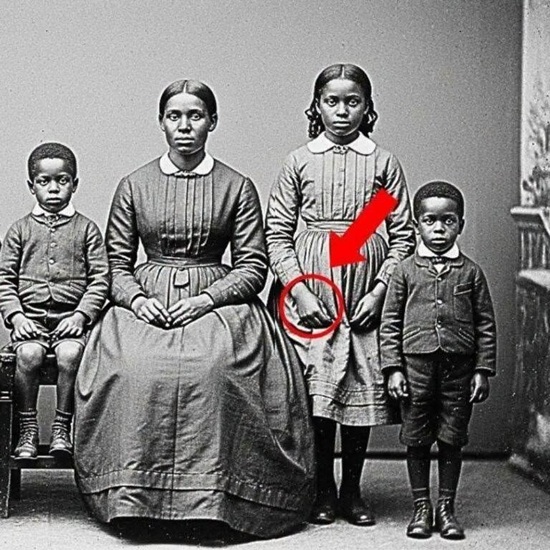
At first glance, the old family portrait appears to contain nothing particularly unusual. A mother sits with her children in the formal manner commonly associated with nineteenth-century studio photography, while everyone faces the camera with the serious expressions frequently seen in surviving portraits from that period. The clothing, careful positioning and restrained poses all fit what modern viewers have come to expect from historical photographs. Yet after looking at the image for a little longer, attention tends to shift toward one small area.
Near one of the older children, a shape resembling an additional hand appears where viewers do not immediately expect another hand to be. That visual detail has helped the photograph attract attention online. People studying reproductions of the image have enlarged the suspicious area, followed the visible arms and compared the position of the apparent fingers with the bodies in the portrait. Some viewers interpret the shape as something mysterious, while others believe it is more likely to be an ordinary result of nineteenth-century photography, overlapping clothing or the way people were arranged during the sitting.
Without the original photographic material and supporting records, however, the precise explanation cannot be established simply by examining a modern online copy. That uncertainty is important because old photographs are especially vulnerable to dramatic reinterpretations. A strange patch of light, an unusually positioned sleeve or a blurred hand can look far more significant once somebody describes it as an unexplained figure. The viewer then begins looking specifically for evidence that supports that interpretation. In many cases, a photograph that originally appeared ordinary can start looking mysterious simply because attention has been directed toward one ambiguous section of the image.
Photography during the nineteenth century also worked very differently from the instant pictures people take today. Photographic materials were less sensitive to light than modern digital sensors, and portrait photographers often needed their subjects to remain still for considerably longer than someone posing for a smartphone photograph. The exact exposure time depended on the photographic process, lighting, equipment and period, so it would be inaccurate to assume that every portrait required the same amount of time. What is certain is that unwanted movement could create unusual visual effects.
A person who moved a hand, shifted position or turned slightly during an exposure could sometimes produce blur or other distortions in the finished image. Depending on the process being used, portions of a moving subject could appear less clearly defined than surrounding areas. When such imperfections survive in a photograph for more than a century, later fading, copying and digital reproduction can make them even harder to interpret.
Hands are particularly interesting in old portraits because they can be difficult to distinguish when positioned against clothing of a similar tone. Fingers may overlap. One person’s hand may rest partly behind another person’s arm. A sleeve can create a shape that looks surprisingly anatomical when the contrast is strong enough. Once image quality deteriorates, determining exactly where one limb ends and another object begins can become difficult.
The elaborate clothing worn in many nineteenth-century portraits adds another layer of uncertainty. Dresses could contain folds, gathered fabric, decorative trim and large sleeves. Dark fabric placed beside pale hands could create strong boundaries, while similar shades could cause separate objects to visually merge. A fold in a dress does not normally resemble a hand when seen clearly, but fading and low-resolution reproduction can transform small patterns in unexpected ways.
Studio furniture can create similar confusion. Photographers frequently arranged subjects around chairs, tables, curtains or other props to create a balanced composition. Part of an arm resting behind another person might therefore disappear into the furniture or clothing while the hand remained visible. Without seeing a higher-quality original, modern viewers may have difficulty determining to whom the visible hand actually belonged.
Another historical detail sometimes mentioned when discussing unusual Victorian portraits is the use of posing supports. Nineteenth-century studios sometimes employed stands and braces to help subjects remain comfortably positioned during a photographic sitting. These devices were normally arranged so that they would not become obvious parts of the finished portrait. Their existence is well documented historically, but that does not mean every unexplained shape in every old photograph must be a posing stand.
That distinction matters when considering this particular image. A support is one possible category of explanation, but identifying the strange shape specifically as a hidden brace would require clearer evidence. Without the original plate, a high-resolution print or information about the studio setup, it remains an interpretation rather than an established conclusion.
Multiple exposure or other photographic processing effects are sometimes suggested as explanations for strange figures in historical images as well. Photographic plates and negatives could produce unexpected results if they were reused, mishandled or exposed in unusual circumstances. However, simply seeing what appears to be an extra hand does not prove that a double exposure occurred. Evidence would normally be needed elsewhere in the photograph, such as additional overlapping forms or inconsistencies that support that explanation.
Another possibility is much more straightforward: the apparent extra hand may actually belong to someone already visible in the portrait. Family groups were often arranged closely together to fit everyone within the frame and create a visually unified composition. Arms could cross behind bodies, children could lean against adults and hands might be placed on shoulders or furniture in positions that are difficult to reconstruct from a two-dimensional photograph.
The problem becomes more difficult when only a compressed online image is available. Each time an old photograph is scanned, resized, sharpened or compressed, some information can change. Fine edges may disappear, while areas of contrast can become stronger than they were in the original print. Digital sharpening can make a faint line look more defined, potentially creating the impression of fingers or an outline that was less obvious on the physical photograph.
Cropping can influence interpretation as well. An original portrait may have contained additional space around the subjects that helped explain the position of an arm or piece of furniture. If a later version removes part of the frame, viewers lose that context. What looks like an unexplained object in a cropped reproduction might have been easier to understand in the complete photograph.
Changes in brightness and contrast are another consideration. Historical photographs are frequently digitally adjusted to make faces and clothing easier to see online. These adjustments can reveal genuine details that had faded, but they can also make scratches, shadows and transitions between fabrics appear more prominent. A mysterious-looking feature should therefore be examined cautiously when the history of the digital reproduction is unknown.
Human perception contributes to the mystery too. People are remarkably good at identifying familiar objects even when visual information is incomplete. This ability is useful in everyday life, but it can also cause viewers to recognize meaningful shapes in ambiguous patterns.
The phenomenon is commonly known as pareidolia. It helps explain why people recognize faces in clouds, human figures in shadows or familiar objects in random textures. The brain is constantly organizing visual information into recognizable patterns, and hands are shapes humans identify particularly quickly.
Once somebody labels an ambiguous group of marks as an “extra hand,” it becomes difficult not to see a hand there. Fingers seem to emerge from lines that previously looked meaningless. Shadows begin looking like joints, and nearby fabric appears to form a wrist. Another viewer who has not been given the suggestion might interpret exactly the same area very differently.
This does not mean that everyone noticing the apparent hand is imagining something that is not there. There may indeed be a real hand visible in the photograph. The question is whether it belongs to a person whose arm is difficult to trace, whether movement or clothing created the appearance, or whether another photographic effect is involved. Pareidolia becomes relevant because it reminds viewers that recognizing a shape is not the same as determining its cause.
The claimed date of 1872 should also be treated carefully unless the photograph has a documented provenance establishing that year. Online descriptions of historical photographs sometimes repeat dates that originated from captions on earlier websites rather than museum records, archives or inscriptions on the original object. Repetition across many webpages can make a claim appear well established even when all of those sites ultimately copied the same unsupported source.
The same caution applies to the people pictured. Unless the family members have been identified through reliable records, it is better to describe them simply as the subjects of the portrait rather than inventing names, relationships or dramatic stories about them. An image showing an adult woman and younger people may strongly suggest a family group, but even apparently obvious relationships should not be embellished without documentation.
What can be discussed confidently is the photographic context. Formal portraits became increasingly important during the nineteenth century as photographic technology made it possible for families to preserve visual records of themselves. Having a photograph taken could represent a meaningful occasion, particularly during periods when photography remained much less casual than it is today.
Subjects generally prepared carefully for studio portraits. Clothing was selected deliberately, people were arranged by the photographer and the resulting image could become an important family possession. That helps explain the formal atmosphere seen in many surviving photographs from the period.
The serious expressions commonly associated with nineteenth-century portraits have also generated their own myths. It is sometimes claimed that people never smiled simply because exposures were extremely long, but the historical reality was more complicated. Portrait conventions, cultural expectations and the practical difficulty of holding a natural-looking smile all contributed to formal expressions. Photographic technology mattered, but it was not the only reason people often appeared serious.
Understanding those conventions gives the mysterious portrait more historical interest. Instead of seeing only an unexplained hand, viewers can also consider the effort involved in creating the photograph. The subjects had to travel to or arrange a photographic sitting, prepare themselves and remain positioned while the photographer worked with equipment that was far more cumbersome than modern cameras.
The photographer also had to control lighting and composition without immediately reviewing the result on a digital screen. Mistakes could be expensive and inconvenient. That environment encouraged careful posing, which may partly explain why arms and hands were sometimes positioned in ways that look unnatural to modern viewers.
Furniture and physical supports could help maintain a pose. Children were particularly challenging photographic subjects because remaining completely still is difficult even for adults. A photographer might therefore position younger subjects close to a parent or older sibling to reduce movement and create a stable composition.
That possibility is relevant when trying to trace the mysterious hand. An apparently impossible position may make more sense if one child was leaning into another person or if several arms were overlapping. A photograph captures only the visible surfaces facing the lens; it does not reveal how limbs are positioned behind bodies.
Depth is flattened dramatically in a two-dimensional image. Two hands separated by several inches in real space may appear to touch when photographed from the front. Conversely, a hand belonging to someone behind another person may appear to emerge directly from that person’s clothing.
Modern viewers are accustomed to photographs taken from many angles and often have several images from the same event available for comparison. Historical portraits usually do not provide that luxury. Sometimes a single surviving photograph is all that remains from a sitting.
Without an alternative angle, reconstructing the three-dimensional arrangement becomes speculative. A second photograph taken moments later might immediately reveal the ownership of the mysterious hand, but no such comparison may be available.
This is one reason a definitive supernatural explanation is especially unjustified. An unusual visual feature alone does not demonstrate anything beyond the fact that the photograph contains something difficult to interpret. Extraordinary explanations require evidence beyond ambiguity.
The history of photography is filled with images that have been described as ghost photographs or evidence of unexplained phenomena. During the nineteenth century, some photographers even deliberately created supposed spirit photographs by using photographic techniques that produced transparent human figures. These images became part of a broader cultural fascination with spiritualism.
That history can influence the way viewers interpret any strange Victorian photograph today. When an unexpected hand or face appears, people may immediately associate it with supernatural photography. Yet deliberately produced spirit photographs normally involved specific photographic manipulation or multiple-exposure techniques, and there is no basis for automatically placing every ambiguous family portrait into that category.
A technical explanation does not need to be identified with certainty to remain more plausible than a supernatural conclusion. Movement, overlap, damage, copying artifacts and ordinary positioning are all known features of photography. Each can be investigated without assuming something impossible occurred.
At the same time, responsible analysis should not replace one unsupported certainty with another. Saying “this is definitely motion blur” would be no more justified than saying “this is definitely a ghost” unless the visual evidence clearly establishes the cause.
The correct conclusion may simply be that the surviving reproduction does not contain enough information.
That uncertainty is part of what keeps the photograph interesting.
People naturally enjoy unresolved visual puzzles. The image invites the viewer to slow down and inspect an object that would otherwise appear to be an ordinary nineteenth-century portrait.
The first viewing focuses on the faces and clothing.
The second focuses on the hands.
Then the viewer begins tracing arms and comparing shadows.
That process transforms an otherwise quiet family image into a visual mystery.
Yet the historical importance of the photograph does not depend on solving that mystery.
Even without the unexplained detail, portraits of ordinary people from the nineteenth century provide valuable glimpses into clothing, family presentation and photographic culture.
Small details can reveal how people wanted to be remembered.
The subjects probably had no reason to imagine strangers discussing their photograph more than a century later.
For them, the image may simply have been a record of themselves at a particular moment.
That makes the modern fascination slightly ironic.
The smallest and possibly most accidental feature may now attract more attention than everything the subjects deliberately prepared for the photograph.
Their clothing was chosen carefully.
Their positions were arranged.
Their expressions were captured.
Yet generations later, viewers are studying a tiny shape near a hand.
That difference between intention and interpretation is one of the most fascinating things about historical photographs.
An image survives after its original context disappears.
Future viewers then attempt to reconstruct meaning from the limited information that remains.
Sometimes documentation survives alongside the photograph.
Sometimes names are written on the back.
Sometimes photographers’ records identify the studio and date.
But when those sources are missing, a photograph can gradually become detached from its original story.
Online circulation can deepen that problem.
A picture may be copied from one website to another while captions become increasingly dramatic.
A tentative date can become a definite date.
A possible family can become a named family.
An unexplained visual artifact can become a “secret hidden for 150 years.”
Eventually, later readers may have no idea which part of the story came from historical evidence and which part was added online.
That is why careful wording matters.
If the portrait is commonly described online as dating from 1872 but independent provenance has not been established, the safest formulation is that it is “described as an 1872 portrait” rather than claiming the date has been definitively authenticated.
If the strange feature resembles a hand, it should be called an “apparent extra hand” rather than an actual additional hand.
And if its cause remains unknown, that uncertainty should remain visible in the article.
This does not make the story less interesting.
In fact, uncertainty creates the mystery honestly.
Readers can examine the evidence themselves without being told that one speculative explanation is established truth.
A careful analysis might start with the apparent fingers.
Are their edges as sharp as the clearly visible hands?
Do they have the same contrast?
Does the lighting fall across them in a physically consistent direction?
Those questions can provide clues.
The viewer can then trace the suspected wrist.
Does it connect naturally to an arm?
Does that arm disappear behind another subject?
Could a sleeve or clothing fold account for the shape?
Nearby furniture should also be examined.
A carved chair arm or padded support could potentially produce rounded shapes that resemble anatomy when partially obscured.
The background matters too.
Scratches, fading or stains on an old print can cross the body and make existing forms appear divided.
Digital artifacts should be considered last but not ignored.
Compression often produces blocky transitions around sharp edges.
Repeated saving of a low-quality JPEG can reduce fine detail further.
Artificial sharpening may exaggerate outlines.
None of these processes necessarily created the original mystery, but they can make it much harder to analyze accurately.
The ideal evidence would therefore be the original photographic plate or an early-generation print examined at high resolution.
Information about the photographer would also help.
Knowing the studio could reveal which photographic process and posing equipment were normally used.
Other portraits produced by the same photographer might contain similar artifacts.
Family records could establish who was present.
Unfortunately, viral historical photographs often circulate without that level of documentation.
That leaves responsible viewers with probabilities rather than certainty.
The apparent hand could be an overlapping real hand.
It could involve movement.
It could be related to clothing.
It could involve a support or studio object.
It could be affected by damage or reproduction.
There may even be an explanation not immediately obvious from the surviving image.
What the photograph cannot responsibly prove on its own is a supernatural event.
Nothing visible in a single ambiguous reproduction establishes that conclusion.
That is an important distinction between enjoying mystery and spreading misinformation.
A person can find an image eerie without claiming that its unexplained element proves something paranormal.
Likewise, an article can describe competing explanations without pretending one has been conclusively demonstrated.
That approach respects both readers and the historical object.
It also makes the story more educational.
Instead of presenting another simple “ghost photograph,” the image becomes a way of exploring how early photography worked.
It encourages discussion of exposure, movement, posing, clothing and perception.
It also demonstrates how easily context can be lost when historical material circulates online.
The mystery therefore exists on two levels.
There is the visual question: what exactly are we seeing near the child’s hand?
Then there is the historical question: what do we actually know about the photograph itself?
The second question may be even more important than the first.
Without reliable provenance, details repeated in captions should remain provisional.
A compelling online story is not automatically a historical record.
That principle applies to thousands of old photographs shared on social platforms.
The images themselves may be authentic while the stories attached to them are partly inaccurate.
A genuine nineteenth-century portrait can accumulate a fictional date.
A real unidentified woman can acquire a name.
A photographic artifact can acquire a paranormal explanation.
Separating those layers requires caution.
That does not mean becoming cynical about every old photograph.
It simply means matching confidence to evidence.
Where documentation is strong, facts can be stated clearly.
Where evidence is incomplete, possibilities should be described as possibilities.
The portrait at the center of this story deserves exactly that approach.
There appears to be something unusual near one of the subjects.
Many viewers interpret the shape as an extra hand.
Several ordinary photographic or visual explanations could potentially account for it.
But the available reproduction does not establish which explanation is correct.
That is the most accurate conclusion.
And perhaps it is also the most interesting one.
The photograph has survived long enough for people living in a completely different technological world to examine it pixel by pixel.
The original subjects could never have anticipated that possibility.
Photography itself was still relatively young compared with the digital world people know today.
A nineteenth-century family might have regarded a portrait as a precious physical object.
Modern viewers can copy it instantly, enlarge it and distribute it around the world.
That technological distance changes the way photographs are experienced.
A physical print is viewed as a complete object.
A digital reproduction invites zooming.
Every tiny mark becomes available for inspection.
That can reveal genuine historical details.
It can also make meaningless imperfections appear significant.
The apparent extra hand sits directly at the intersection of those two possibilities.
It may preserve a real clue about the original sitting.
Or it may be a visual accident whose importance exists largely because modern viewers have isolated and enlarged it.
Without stronger evidence, both possibilities deserve consideration.
What remains certain is that the image succeeds in making people look closely.
That alone separates it from countless other anonymous historical portraits that have faded from public attention.
The strange detail encourages viewers to think about how photography records reality.
A photograph feels objective because light physically records a scene.
But the final image is influenced by technology, timing, positioning, processing and later reproduction.
The camera records something real, yet that does not guarantee later viewers will interpret every part correctly.
Old photographs make this especially obvious.
Information disappears over time.
Colors fade.
Contrast changes.
Names are forgotten.
Context vanishes.
Then interpretation begins filling the gaps.
The best historical approach is therefore a balance between curiosity and restraint.
Look carefully.
Ask questions.
Compare possibilities.
But do not turn uncertainty into certainty simply because the dramatic explanation is more entertaining.
The mysterious family portrait does not need a ghost story to remain fascinating.
Its age, formal composition and unresolved visual detail already give it enough intrigue.
It captures people from another century who were trying to preserve their likenesses.
It also preserves an ambiguity they probably never intended anyone to notice.
Whether that apparent hand ultimately belongs to an obscured family member, a movement artifact, clothing, studio equipment or something created during reproduction may never be known.
That possibility should not be treated as a failure.
Sometimes the historically responsible answer is simply that the surviving evidence is insufficient.
The image can remain mysterious without becoming misleading.
It can invite speculation without presenting speculation as fact.
And it can remind viewers that photographs, even very old ones, should be examined in context rather than interpreted entirely through what appears unusual at first glance.
More than a century after the portrait was supposedly created, its smallest detail continues attracting the greatest attention.
The reason is understandable.
Human beings naturally want to resolve visual contradictions.
When the eye sees what appears to be a hand without an obvious arm, the mind immediately searches for an explanation.
That search is what gives the image its enduring appeal.
But until stronger historical or photographic evidence emerges, the most accurate conclusion remains modest.
There is an unusual shape.
It resembles an additional hand to many viewers.
There are several plausible photographic and visual explanations.
And there is not enough reliable evidence in the circulating reproduction to determine exactly which one is correct.
The mystery can therefore remain exactly what it is: an intriguing feature in an old portrait, rather than proof of a supernatural event or a forgotten historical secret.

