

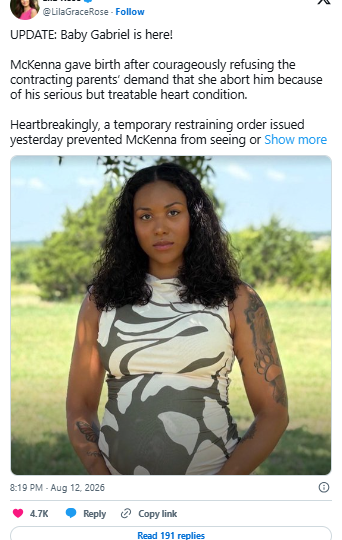
A complex surrogacy dispute involving Alaska nurse McKenna West, intended parents Nausheen Gilkar and Omar Ahmed, and a newborn diagnosed with hypoplastic left heart syndrome (HLHS) has continued to unfold through several court proceedings. The disagreement began during West’s pregnancy after doctors discovered the serious congenital heart defect and the intended parents sought termination of the pregnancy. West refused to undergo an abortion and ultimately traveled to Texas, where the child was born in Dallas on August 12, 2026.
Since then, attention has shifted from decisions surrounding the pregnancy to the newborn’s medical treatment, legal parentage and authority to make decisions on his behalf. West had entered into a gestational-surrogacy arrangement to carry a child for Gilkar and Ahmed, a California couple. During the earlier stages of the pregnancy, medical testing had not revealed the heart condition that would later become central to the dispute. Around the midpoint of the pregnancy, however, additional examinations showed that the developing baby’s heart had a major abnormality
Doctors subsequently diagnosed hypoplastic left heart syndrome, a rare and potentially life-threatening congenital condition affecting development of structures on the left side of the heart. HLHS requires specialized medical care beginning very soon after birth. In a baby with the condition, the left side of the heart cannot adequately perform its normal role of pumping oxygen-rich blood throughout the body. Modern pediatric cardiac treatment has made survival possible for many children born with HLHS, but the condition remains extremely serious. Treatment typically involves several staged surgical procedures and long-term monitoring rather than a single operation that permanently restores a normal heart.

After learning about the diagnosis, Gilkar and Ahmed decided that they wanted the pregnancy terminated. Their legal representatives have maintained that this decision followed discussions concerning the baby’s prognosis, possible suffering and future medical needs. Reports about the dispute also indicate that the surrogacy agreement contained provisions addressing termination under certain circumstances involving significant fetal abnormalities. Exactly how those contractual provisions apply has become one of several contested legal issues.
West reached a different conclusion.
She has said publicly that she could not agree to terminate the pregnancy after learning about the baby’s condition. Although she understood that HLHS could create serious medical challenges, she believed the child should have an opportunity to receive available treatment after birth. Her decision created a fundamental disagreement with the intended parents and eventually transformed what had begun as a private reproductive arrangement into an interstate legal dispute.
The two sides have offered different accounts of some events that occurred after the diagnosis. The intended parents have reportedly argued that West initially indicated she would proceed with termination before later changing her decision. West has described feeling pressured to undergo a medical procedure she no longer wanted. Because these details remain disputed, neither side’s description should be presented as an established judicial finding unless and until the relevant issues are resolved in court.
An important distinction also exists between decisions made during pregnancy and decisions concerning a newborn after delivery. During pregnancy, any proposed abortion would necessarily have involved a medical procedure performed on West’s body. Once the baby was born, however, separate legal questions emerged involving parentage, custody and who possesses authority to make medical decisions for the child. Those different legal interests help explain why the case has become considerably more complicated than a straightforward contractual disagreement.
The dispute eventually crossed several state boundaries. West lives in Alaska, the intended parents reside in California, and the child was ultimately delivered in Texas. Surrogacy and parentage laws are not uniform throughout the United States, meaning that state borders can significantly affect legal proceedings. Courts have therefore had to consider not only what the parties agreed to but also questions about jurisdiction and which state’s legal framework applies to particular aspects of the case.
West traveled to Texas before giving birth, and legal proceedings there soon became an important part of the dispute. Texas Attorney General Ken Paxton intervened and requested emergency protections concerning the baby’s medical treatment after delivery. His office sought an order requiring healthcare providers to supply medically indicated stabilizing and life-sustaining care and preventing others from obstructing or delaying such treatment.
A Texas court granted emergency protections related to the newborn’s care. The order required medically indicated stabilizing and life-sustaining treatment and placed restrictions on removing the baby from the hospital or taking him outside Texas without additional court authorization. The ruling was an important development, but it should not be interpreted as a final judgment resolving every question concerning parentage, custody or the surrogacy agreement.
Paxton publicly welcomed the order and described his office’s intervention as an effort to protect the child’s life and well-being. Texas officials and West have referred to the child as Gabriel. Their statements reflect their position in an ongoing dispute and have received substantial attention because of the broader political and legal questions surrounding reproductive rights and surrogacy.
The intended parents have challenged important aspects of that portrayal.
Gilkar and Ahmed’s attorneys have said that the couple is focused on their son’s health and is following recommendations from his medical team. They have disputed suggestions that they currently intend to prevent medically appropriate treatment. They also refer to their son as Rumi, rather than Gabriel. Because the adults involved use different names, a neutral account should acknowledge that disagreement instead of implying that one name has been universally accepted.
The disagreement over the baby’s name reflects a much larger conflict about parental authority. West carried and delivered the child, while Gilkar and Ahmed entered the arrangement intending to become his parents. Courts are now dealing with legal questions that arose when the gestational carrier and intended parents stopped agreeing about fundamental decisions before birth.
Separate legal developments have also affected West’s ability to exercise authority over the newborn. Around the time of the birth, the intended parents obtained a temporary restraining order addressing their parental rights and West’s contact with the child. Reporting on the proceedings indicated that Gilkar and Ahmed were able to be with their son while West faced restrictions under the relevant court order.
These rulings demonstrate why describing the Texas medical order as a complete legal “victory” for either side would oversimplify the situation. West and Texas officials obtained protections concerning medical treatment, while the intended parents separately obtained orders supporting aspects of their asserted parental authority. The broader litigation remains active, and temporary court orders do not necessarily determine the final outcome.
At the center of everything is a newborn facing a genuinely serious medical condition.
HLHS affects normal blood circulation because important structures on the left side of the heart are underdeveloped. Without appropriate intervention, the condition can be fatal. Specialized pediatric cardiac centers have developed treatment strategies that have significantly improved outcomes, but treatment remains medically demanding and individual prognoses vary.
One commonly used approach involves a series of three major operations. The first, known as the Norwood procedure, is generally performed during the newborn period. Later stages commonly include the Glenn and Fontan procedures as the child grows. These operations redirect blood circulation so that the functioning portions of the heart can support the body despite the underdeveloped left side.
Describing HLHS as simply “treatable” can therefore create an incomplete impression. Treatment exists, and many children survive with specialized care, but the condition can involve major surgeries, ongoing cardiac monitoring and possible complications throughout life. Likewise, describing the diagnosis as automatically hopeless would also be inaccurate. The actual prognosis for any individual child depends on medical details that should be assessed by the specialists providing care.
Those medical realities were central to the original disagreement. West believed the existence of treatment justified continuing the pregnancy and allowing the child an opportunity to receive care. The intended parents have said their earlier decision to seek termination followed medical consultation and consideration of their son’s prognosis and possible quality of life. Presenting either decision as though it arose without serious considerations would fail to capture the complexity of the dispute.
The intended parents have also reportedly pursued legal claims involving the surrogacy agreement. Their position includes allegations that West violated obligations established before the pregnancy. West has responded through her own legal proceedings and has maintained that she could not be compelled to undergo an abortion against her wishes.
That disagreement raises difficult questions about the limits of surrogacy contracts.
A contract can establish numerous responsibilities between a gestational carrier and intended parents, but provisions involving medical decisions during pregnancy can raise additional questions about bodily autonomy and enforceability. Courts considering such disputes may have to distinguish between financial or contractual consequences and whether a particular medical procedure could ever be compelled.
Once the child was delivered, another legal framework became relevant. The question was no longer whether West could be required to terminate a pregnancy. Instead, courts had to consider who legally possesses parental authority and who can make medical decisions for an independent newborn. That transition is one reason several different court orders can exist without necessarily contradicting one another.
The involvement of multiple states makes the situation still more unusual. California has an established legal framework governing gestational-surrogacy agreements. Alaska and Texas have their own laws and judicial procedures. When people participating in a surrogacy arrangement live in different states and the birth occurs somewhere else, determining which court has authority can become a substantial issue in its own right.
Public discussion of the case has also become connected with broader political debates. Paxton’s office has framed its intervention around protecting the newborn’s life. The intended parents and their representatives have objected to aspects of the state’s involvement and public characterization of their intentions. Those positions should be clearly attributed rather than presented as neutral conclusions.
A factual account does not need to decide the broader political debate surrounding abortion or reproductive policy in order to explain what happened.
The essential sequence is already complicated enough. A gestational carrier became pregnant under a surrogacy agreement. Doctors later diagnosed the fetus with HLHS. The intended parents sought termination, while West ultimately refused. The disagreement led to litigation, West traveled to Texas, and the baby was subsequently born there.
After birth, a Texas court ordered medically indicated stabilizing and life-sustaining treatment. Other proceedings have addressed parental authority and contact with the newborn. The intended parents say they are following their son’s medical team’s recommendations, while West continues to pursue her position through the legal system.
It is also important not to assume that the court ordering medical care means doctors had otherwise planned to withhold appropriate treatment. Court orders can be sought to establish legal certainty when parties disagree about authority. The existence of an emergency order establishes what the court required; it does not automatically prove every allegation made by the party requesting that order.
Likewise, the intended parents’ earlier request for termination during pregnancy should not automatically be treated as proof of what they would choose after birth. Pregnancy termination and medical treatment of a newborn are legally and medically distinct situations. Their attorneys have specifically stated that the couple is now following the treating physicians’ recommendations.
West’s position also deserves precise language. She did not simply “save” a child in a legally established sense, because that framing assumes what would otherwise have happened and adopts one side’s interpretation of the dispute. What can be stated factually is that she refused to terminate the pregnancy and continued carrying the baby until delivery despite the intended parents’ request.
The child’s current needs remain more immediate than many of the legal questions surrounding him. HLHS treatment follows a demanding medical timeline, particularly during the newborn period. Cardiologists and surgeons must evaluate his individual anatomy and overall condition to determine the most appropriate interventions.
Meanwhile, lawyers can continue addressing contracts, jurisdiction, custody and parental authority.
Additional court proceedings are expected to clarify those issues. Until final rulings are issued, temporary restraining orders and emergency medical-care orders should be described according to their limited legal purpose. Neither side can accurately claim that every aspect of the dispute has already been conclusively resolved.
The case is likely to remain closely watched because it brings together several difficult areas of law and medicine that rarely appear in one dispute. Surrogacy agreements involve contractual expectations and intended parenthood. Pregnancy involves the gestational carrier’s body and medical autonomy. Birth introduces the independent legal and medical interests of a newborn. Interstate litigation adds another layer of jurisdictional complexity.
There are also significant privacy considerations.
The baby is not responsible for the disagreement surrounding his birth. Although court proceedings have made aspects of his medical condition public, unnecessary speculation about his future should be avoided. HLHS outcomes vary, and public observers do not possess the same medical information as the specialists treating him.
The same caution applies when describing the adults. West has publicly explained why she continued the pregnancy. Gilkar and Ahmed have explained their position through legal representatives and court filings. Those statements provide useful information, but contested claims remain contested until courts determine otherwise.
For now, several facts can be stated with confidence. McKenna West carried the pregnancy as a gestational surrogate for Nausheen Gilkar and Omar Ahmed. The fetus was diagnosed with hypoplastic left heart syndrome. The intended parents sought termination of the pregnancy, while West ultimately refused. She later traveled to Texas and gave birth to the boy in Dallas on August 12, 2026.
A Texas court has ordered that the newborn receive medically indicated stabilizing and life-sustaining treatment. Other legal proceedings concern parentage, custody and decision-making authority. The intended parents say they are currently following medical recommendations for their son.
What cannot yet be stated is who has definitively prevailed in the broader legal dispute.
Emergency and temporary rulings address immediate circumstances rather than necessarily resolving every issue permanently. Further judicial proceedings will determine how competing claims involving the surrogacy agreement and parental rights are ultimately handled.
The situation therefore remains an ongoing medical and legal case rather than a completed story with a clear winner and loser. The newborn is receiving specialized care for a severe congenital heart condition while courts continue addressing the consequences of a surrogacy arrangement that broke down after an unexpected diagnosis.
Whatever the eventual legal outcome, accuracy requires separating documented facts from the arguments made by each side. West’s refusal to terminate the pregnancy is documented. The intended parents’ request for termination is documented. The baby’s HLHS diagnosis and birth in Texas are documented, as are the emergency proceedings concerning medical care.
The remaining questions belong to the courts and medical professionals directly involved.
Until those questions are resolved, the most responsible description is straightforward: a serious prenatal diagnosis led to an extraordinary disagreement between a gestational surrogate and intended parents, and after the baby’s birth, the dispute shifted toward medical treatment, parentage and legal authority. The child is now at the center of specialized medical care, while the adults involved continue pursuing their competing legal positions through the appropriate courts.

