
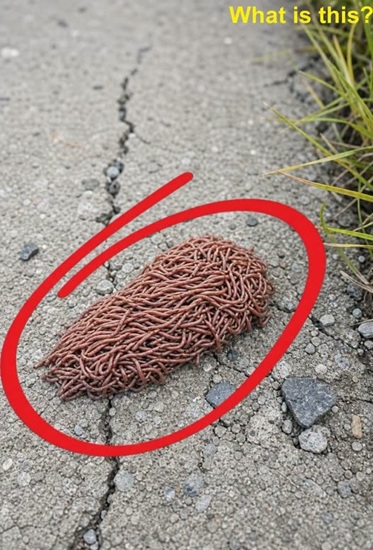
At first glance, a strange moving heap on wet ground can look almost impossible to identify. From a short distance, the surface may resemble a tangled pile of leaves, roots, or discarded material rather than something alive. The confusion increases when the whole mass begins to shift slowly instead of moving like one clearly recognizable animal. What appears to be a single pulsing object can actually be a large number of small creatures packed tightly together. In situations like this, the most useful step is careful observation rather than immediate assumptions.
A closer look often turns something unsettling into a much more ordinary natural phenomenon. One possible explanation for a moving cluster like this is a large gathering of earthworms. Earthworms normally spend most of their lives in or very close to the soil, which is why people usually encounter them one at a time. Rain can suddenly make them much more visible. After periods of wet weather, worms are commonly seen on lawns, paths, driveways, and other surfaces where they are normally absent.
When many appear in one small area at the same time, their bodies can overlap so heavily that the group no longer resembles the familiar image of an individual earthworm. This visual effect can be surprisingly dramatic. Each worm moves independently by contracting and relaxing different parts of its segmented body. When dozens of worms are pressed together, those individual movements combine into a larger pattern. One worm may slide over another while a different one curls beneath the group.
From a distance, the entire cluster can seem to expand, contract, or ripple as though it were one living organism. That illusion becomes stronger when the worms are wet. Earthworms naturally have moist skin because they exchange gases through the body surface. Rain and wet soil make their bodies appear even more reflective. Under certain lighting, dozens of overlapping worms can produce a shiny surface that hides the boundaries between individual animals.
This is one reason such a cluster can initially look unfamiliar even to someone who has seen earthworms many times before. A single worm is easy to recognize. A dense moving mass made up of many worms creates a completely different visual pattern. The animals themselves are ordinary, but their arrangement can make them look almost unrecognizable.
Rain is closely connected with this behavior, but the explanation is more complicated than the common idea that worms simply come to the surface because they are drowning. Very wet soil can become low in oxygen, and that can influence earthworm movement. At the same time, scientists have also proposed that wet surfaces make it easier for some worms to travel without drying out.
Earthworms require moisture because their skin must remain damp for respiration. Dry surfaces can quickly become dangerous for them because excessive moisture loss interferes with their ability to exchange gases. Rain therefore creates conditions in which surface movement becomes much safer than it would be on a hot, sunny day.
This helps explain why worms are frequently seen after storms. Wet grass, pavement, and soil allow them to remain moist while moving above ground. Some species may use these conditions to travel farther than they could easily move through compact soil. Others may be responding to underground conditions that have changed because of heavy rainfall.
The exact reason can vary depending on the species and environment. Soil type, drainage, temperature, rainfall intensity, and available oxygen can all influence how earthworms behave. That means a photograph or video by itself usually cannot prove exactly why a particular group appeared in one location.
This distinction is important because viral descriptions sometimes turn uncertainty into dramatic certainty. A cluster may be described as worms “desperately clinging together” or “suffocating after the rain.” Those phrases sound vivid, but they are not always supported by enough evidence. A safer explanation is that wet conditions brought many worms to the surface and that their close proximity created the unusual moving mass.
The cluster does not need an exaggerated explanation to remain interesting. The basic biology is already enough to explain why the scene looks so strange. Many earthworms emerged into the same area. Their bodies overlapped. Their combined movements created the appearance of one larger living object.
That is a good example of how ordinary animals can appear unfamiliar when they are seen in a different context. People are used to recognizing wildlife in expected shapes and numbers. A bird alone on a branch looks ordinary, while thousands of birds moving together can create a dramatic pattern in the sky. The same principle applies to fish in large schools or insects in dense swarms.
Earthworms can produce a similar effect at ground level. The movement is slower, but the visual result can still be striking. A large concentration makes it difficult for the eye to separate one body from another. The group becomes the first thing the observer notices.
The location also contributes to the surprise. A familiar yard usually feels predictable because people walk through it without paying close attention to the soil. Most of the biological activity underneath remains invisible. Rain can suddenly reveal that hidden activity by bringing animals to the surface.
The same patch of ground that seemed completely ordinary the previous day can therefore look very different after a storm. Worms, insects, fungi, and other signs of life may become visible in places that normally appear empty. Nothing mysterious has necessarily arrived from somewhere else. Weather conditions have simply made existing organisms easier to see.
Earthworms are especially easy to overlook because so much of their activity occurs underground. They tunnel through soil and consume organic material while influencing soil structure. Their burrows can create spaces that help air and water move through the ground. They also contribute to the breakdown and recycling of organic matter.
In many garden and agricultural settings, these activities can improve soil structure. Earthworm tunnels help create channels through which water can move, while their casts contain processed organic material and soil. Their presence is often associated with biologically active ground.
However, it is also important not to assume that every earthworm species is equally beneficial in every ecosystem. Some regions contain introduced or invasive earthworm species that can alter natural forest soils. The ecological impact depends on the species and environment.
This means that identifying worms beyond the general category of “earthworm” can sometimes matter. Certain invasive species behave differently from familiar garden worms. Asian jumping worms, for example, are known for vigorous thrashing movements when disturbed. They can also appear on the surface after rain.
That does not mean every energetic or clustered worm is a jumping worm. Species identification requires more detail than most distant videos provide. Features such as color, body size, movement, and the appearance of the clitellum can help specialists distinguish species.
If an unusual worm appears in an area where invasive species are being monitored, clear photographs can be useful. Images showing the whole body and a close view of the band around the body provide more information than a distant shot of a moving heap. Local agricultural or university extension services may also be able to assist with identification.
For an ordinary cluster of common earthworms after rain, however, intervention is often unnecessary. If the worms are in a safe location, conditions may change naturally as the ground dries or as the animals move back toward suitable soil. They do not automatically need to be removed simply because their appearance is unpleasant.
Using pesticides simply because worms have surfaced is generally not a good response. Many common earthworms play useful roles in lawns and gardens. Treating the visible animals without understanding why they appeared can also miss the actual environmental cause.
If large numbers repeatedly emerge in the same place, drainage may be worth examining. Saturated ground can indicate poor drainage, excessive irrigation, compacted soil, or other environmental conditions. Improving the soil environment may be more appropriate than targeting the worms.
Soil contains small spaces that normally hold both air and water. Heavy rain can fill many of those spaces with water. As air-filled spaces disappear, oxygen availability may decline. This can affect organisms living underground.
Earthworms are especially sensitive to moisture and oxygen because they breathe through their skin. They need moisture, but they also need access to oxygen. Too little water can cause dehydration, while extremely waterlogged soil may create stressful conditions.
Still, earthworms do not instantly drown simply because the soil becomes wet. Some species can survive submerged for long periods when enough dissolved oxygen is present. This is one reason scientists do not explain all rainy-weather surface activity with a single mechanism.
Surface travel is another possible reason. Moving through dense soil requires energy. A wet surface may allow a worm to cover a greater horizontal distance more easily. Rain also reduces the risk of drying out during that movement.
This may help worms reach new areas of suitable soil or organic material. It may also explain why they are found on sidewalks and driveways, where they later become trapped when conditions dry. In those cases, the danger may come after the rain stops rather than during the rainfall itself.
A worm stranded on hot pavement can lose moisture quickly. That is why large numbers of dead or dried worms are sometimes seen after a storm. They may have surfaced while conditions were safe and then failed to return to moist soil before the surface dried.
A dense cluster can also form simply because many worms emerge from nearby soil at once. If they encounter the same obstacle or favorable patch of moisture, they may become concentrated in one place. Physical crowding can then create the tangled appearance.
This does not necessarily mean the worms are intentionally forming a cooperative survival structure. Earthworms can show forms of aggregation behavior, but assigning a specific social purpose to one random cluster requires more evidence than a visual impression.
A careful article should therefore distinguish what can be seen from what can only be guessed. The visible facts may include dozens of worms, wet ground, overlapping bodies, and continuous movement. The reason they emerged may involve rain and soil conditions, but the exact motivation of each worm remains uncertain.
That approach keeps the explanation accurate without making it boring. In fact, the uncertainty adds interest. A familiar animal is reacting to changes in its environment in ways that scientists continue to study.
The cluster also demonstrates how easily the human brain can misinterpret unfamiliar visual patterns. When individual shapes overlap, the eye often treats the group as one object. Movement strengthens that effect because the outline keeps changing.
This is why the heap may appear to “breathe.” It is not actually one body expanding and contracting. The effect comes from many smaller bodies changing position at slightly different times.
Once that is understood, the strange movement becomes much easier to explain. One worm stretches forward. Another contracts. Several push against neighboring bodies. The edges of the cluster change shape continuously.
From farther away, those small movements blend together. The result looks rhythmic even if the individual animals are not moving in perfect coordination.
This kind of visual confusion is common in nature. Large groups often create patterns that are difficult to understand from a distance. A flock, swarm, school, or cluster can seem to behave like one organism even though it contains many individuals.
The earthworm mass is a slower and less dramatic version of the same effect. It shows how scale can change perception.
The emotional reaction can remain strong even after identification. Knowing that the mass is made of ordinary worms does not necessarily make it pleasant to watch. Some people naturally find dense clusters of moving invertebrates uncomfortable.
That reaction does not mean the worms are dangerous. Earthworms are not aggressive animals and do not pose a threat simply because they are gathered together. The discomfort is mainly visual.
This distinction can prevent unnecessary fear. A strange-looking natural event does not automatically mean there is a hazardous animal present. Careful identification usually provides a much more useful response than panic.
If a moving mass cannot be identified safely, photographing it from a reasonable distance is a sensible option. A picture can be examined later without touching the animals. It can also be shared with a reliable expert if necessary.
Online searches can help, but they should be used carefully. Low-quality images can make unrelated animals look similar. Viral posts can also repeat incorrect explanations until they appear to be established facts.
University extension services, government agriculture agencies, museums, and established natural-history organizations are usually better sources for biological information. These organizations often provide guidance about local species and unusual sightings.
In the case of ordinary earthworms, one of the most reliable observations is simple: they commonly become more visible during or after wet weather. This has been documented repeatedly in agricultural and extension literature.
The exact explanation may involve several factors rather than one. Saturated soil and reduced oxygen are possible influences. Easier movement across moist ground is another. Temperature and species behavior also matter.
That makes the phenomenon more complex than the old idea that every worm is fleeing certain drowning. Nature often works through several interacting factors.
The same complexity applies to the cluster itself. A large group may look purposeful even if it formed through environmental pressure and chance movement. Humans naturally search for intention in patterns, but not every pattern is planned by the animals creating it.
Understanding this can make the scene more interesting rather than less. The worms are responding to environmental conditions with simple biological behaviors, and those behaviors produce a surprisingly dramatic visual result.
A yard after rain is therefore not just wet ground. It can briefly become a window into an ecosystem that is normally hidden.
Below the surface are worms, roots, microorganisms, fungi, insects, and countless other forms of life. Most remain invisible during ordinary daily routines.
Rain changes the balance.
Animals emerge.
Soil structure changes.
Moisture moves through different layers.
What was hidden becomes visible.
That is why an ordinary yard can suddenly feel unfamiliar.
The discovery also encourages closer observation in the future. Once someone notices unexpected wildlife in a familiar place, it can become difficult to return to walking through the area without looking down.
That new awareness does not mean the yard has become more dangerous. It simply means the observer now recognizes how much activity was always present.
The ground is not an empty surface.
It is a habitat.
Most of the time, people see only the grass, soil, stones, or pavement.
After rain, another layer can briefly appear.
Worms crossing a path may seem ordinary when only one or two are present.
A dense cluster changes the scale completely.
The same animal suddenly produces a much stronger reaction.
This is one reason photographs of worm masses can spread widely online. They look unfamiliar enough to make people ask what they are seeing.
The answer is often simpler than expected.
What appears to be one strange creature may be many ordinary earthworms.
The movement is real, but the “single organism” is an illusion.
The wet appearance is real, but it does not automatically mean the worms are drowning.
The gathering is real, but its exact cause may not be possible to determine from a video alone.
Keeping those distinctions clear is important for accurate nature writing.
It prevents ordinary wildlife from being turned into something falsely mysterious.
It also avoids presenting speculation as established science.
The most reliable explanation is therefore straightforward.
Rain changed the conditions in or above the soil.
Earthworms became visible.
A large number occupied the same small area.
Their bodies overlapped.
Their separate movements created the appearance of one shifting mass.
That explanation accounts for the strange sight without inventing a dramatic story.
It also shows why the scene can still be memorable.
People rarely see familiar animals arranged in such an unfamiliar way.
The discovery turns an everyday patch of ground into something worth examining.
Once the individual worms are recognized, the mystery disappears.
But the experience can still change how the environment is perceived.
A yard that once seemed empty can suddenly feel biologically active.
A patch of soil that looked lifeless can become evidence of an entire hidden ecosystem.
The most surprising part may not be the worms themselves.
It may be realizing how easily they were overlooked before the rain.
That is one of the simplest lessons such a discovery can offer.
Nature does not have to be rare to be interesting.
It only has to appear in a way people do not expect.
A moving heap after rain can look mysterious for a few moments.
Then closer observation reveals something familiar.
Earthworms.
Ordinary animals.
Unusual circumstances.
And a reminder that even the most familiar ground can contain far more life than it first appears to.

