
A routine visit to the neighborhood grocery store is one of those everyday activities that rarely deserves a second thought. People move calmly through bright, refrigerated aisles, selecting packaged meats, cheeses, and processed foods with quiet confidence. There is an unspoken trust placed in modern food systems, from industrial packaging to standardized labeling, all designed to reassure shoppers that what they are buying is clean, regulated, and safe to consume.
Yet for one ordinary customer, an otherwise simple breakfast plan turned into an unsettling and unforgettable experience that challenged that sense of trust. It started like any normal afternoon. After stopping at the supermarket, the shopper returned home, unpacked the groceries, and began preparing a quick meal. A sealed pack of bacon was taken from the refrigerator and opened without hesitation. At first, everything looked completely normal—thin, striped slices of cured pork arranged neatly inside the plastic tray.
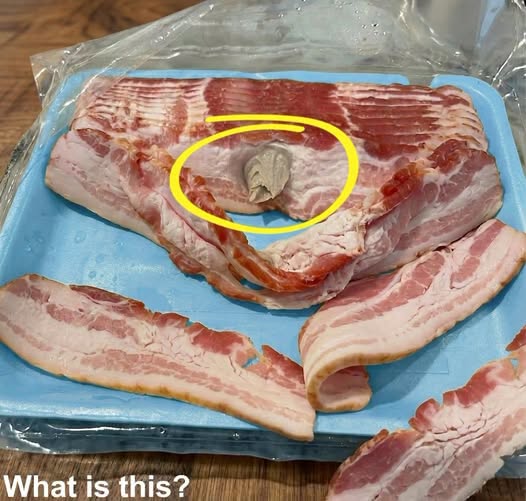
But the moment the packaging was opened fully, something immediately felt wrong. Hidden among the layers of meat was an unexpected, pale and firm object that did not resemble anything typically found in a processed food product. The shopper paused, staring at the unusual piece embedded within the bacon. It looked dense, oddly textured, and out of place compared to the surrounding meat and fat.
Its appearance triggered confusion and discomfort, as the mind instinctively searched for explanations. In that moment, worst-case thoughts began to form—concerns about contamination, manufacturing errors, or foreign materials accidentally introduced during processing. The ordinary kitchen environment suddenly felt unfamiliar, as uncertainty replaced routine comfort.
As the inspection continued, the feeling of unease grew stronger. The object did not match the soft, layered structure of the bacon around it. Its firmness and irregular shape made it difficult to identify visually, especially under bright kitchen lighting. Like many consumers confronted with something unexpected in their food, the shopper’s thoughts turned to industrial processing lines and the possibility of mechanical failure or packaging contamination. The uncertainty alone was enough to remove any appetite that had existed moments earlier.
Instead of discarding the product immediately, the shopper attempted to understand what they were seeing. A quick search online led to a range of possible explanations, from rare processing anomalies to naturally occurring animal tissue. After comparing similar reports and informational sources, a clearer answer eventually emerged. The mysterious object was not a foreign contaminant, but rather a piece of natural cartilage—connective tissue that exists in animals and can occasionally remain in meat during industrial slicing and preparation.
Although the explanation was far less alarming than initially feared, the experience still left a lasting impression. Knowing the object was natural did not completely erase the discomfort it caused. Instead, it highlighted how distant most consumers are from the origins of the food they regularly consume. In modern food production, meat is heavily processed, trimmed, packaged, and standardized, creating products that look uniform and familiar while concealing much of their biological complexity.
This moment served as a reminder of how industrial food systems shape perception. Most people rarely encounter raw anatomical structures in their meals because processing plants are designed to remove or hide them. When something unusual appears, it disrupts that expectation and forces a brief confrontation with the reality behind mass-produced food. Even when harmless, such discoveries can feel unsettling simply because they break the illusion of complete uniformity.
In the end, the bacon itself was not dangerous or defective. There was no health risk involved, and the product remained within normal safety standards. However, the experience changed the shopper’s perspective in a subtle but lasting way. What was once a routine, thoughtless purchase became something viewed with greater awareness and curiosity. The incident faded quickly, but the awareness it created remained—an example of how even the smallest unexpected detail in everyday life can reshape how people see the world around them.

