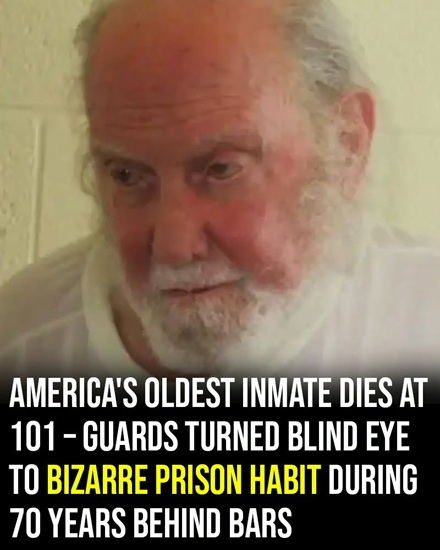
Francis Clifford Smith, a Connecticut man whose extraordinary time in the correctional system stretched across more than seven decades, died in June 2026 at the age of 101. His life attracted renewed attention because of the remarkable length of time he spent in state custody and the enormous changes in American society that occurred during those years. Smith entered prison as a young man following a murder conviction and lived long enough to become known as one of the longest-serving prisoners in the United States.
By the final years of his life, however, he was no longer living inside a traditional prison and had been paroled to a secure nursing facility. Smith’s story began long before his case became an unusual piece of American criminal-justice history. Born in 1924, he was still in his twenties when his life changed permanently. At the age of 25, Smith was convicted of first-degree murder in connection with the killing of Grover Hart, a night watchman at a yacht club in Greenwich, Connecticut.
The crime occurred during a robbery in 1949, and Smith was subsequently prosecuted and convicted. His punishment reflected an era when Connecticut still used capital punishment. Following his conviction, Smith was sentenced to death. According to reports about his case, he came extraordinarily close to execution on multiple occasions. Eight execution dates were reportedly scheduled for him, and preparations reached the point at which he was served what was supposed to be his final meal.
Each time, however, the execution was stopped. That sequence of events became one of the most striking details of his long incarceration and demonstrated how dramatically the course of a criminal case can change through legal proceedings and official decisions. Smith ultimately did not receive the death penalty. In 1954, after his eighth scheduled execution, his death sentence was commuted to life imprisonment. The decision meant that instead of facing execution, he would remain within Connecticut’s correctional system.
What nobody could have known at the time was just how long that period would eventually become. Smith would remain under state correctional supervision for most of the rest of his life, witnessing generations of prisoners and correctional employees come and go. The world outside prison changed almost beyond recognition during Smith’s years in custody.
When he entered the correctional system, television was still relatively new in American homes, commercial air travel was very different from what it would later become, and technologies such as personal computers, smartphones and the internet belonged to the distant future. Smith remained in custody through the second half of the twentieth century and well into the twenty-first. That enormous passage of time is one reason his case drew international attention.
His decades in custody were not entirely uninterrupted by attempts to leave prison. In 1967, Smith escaped from custody, but his freedom was short-lived and authorities apprehended him. Reports about his history also note that he spent limited periods outside prison under forms of release but was returned to custody after violating release conditions. Those episodes formed part of a complicated correctional history that extended far beyond the original conviction.
As the decades passed, Smith became a familiar figure within Connecticut’s prison system. His advanced age eventually distinguished him from the overwhelming majority of other inmates. People who worked around him also came to know him for something far removed from the crime that had originally put him behind bars: his affection for birds. That habit eventually contributed to the unusual nickname “The Birdman of Osborn,” a reference to the Osborn Correctional Institution in Connecticut.
Andrius Banevicius, a public information officer for the Connecticut Department of Correction, described how Smith would collect bread so that he could feed birds. According to accounts published after Smith’s death, he would put significant amounts of bread inside his clothing. Correctional staff understood what he was doing and reportedly did not make an issue of the behavior because the bread was intended for the birds. It became one of the small routines associated with Smith during his later years in custody.
The story provides a glimpse into the ordinary habits that can develop during an extraordinarily long period of incarceration. After decades in an institution, routines that might appear insignificant to an outsider can become important parts of everyday life. Feeding birds was one of the activities for which Smith became remembered by people familiar with him. It also created a striking contrast with the circumstances that had originally brought him into the correctional system as a young man.
Smith himself rarely presented his life in dramatic terms when speaking publicly in his later years. In a 2023 interview reported by The Boston Globe, he summarized his circumstances in remarkably simple language. “I’ve been locked up all my life,” Smith said. He added that he went from one day to the next depending on the circumstances that presented themselves. After spending such a large portion of his life under correctional supervision, institutional life had effectively become the environment he knew best.
By the time Smith reached his nineties, questions surrounding his age and care had become increasingly significant. Maintaining very elderly people in conventional correctional environments presents practical challenges because they may require medical treatment, mobility assistance and long-term nursing services. Smith’s circumstances eventually changed substantially in 2020, when he was granted parole to a secure nursing home rather than remaining inside a conventional prison facility.
The facility was 60 West, a nursing center in Rocky Hill, Connecticut, that has cared for people with complex medical and behavioral needs, including individuals transferred or paroled from correctional settings. Smith spent the final years of his life there. Although he remained subject to the conditions associated with his parole, his daily surroundings were very different from the prison environment where he had spent so many decades.
This distinction is important when describing Smith as one of America’s longest-serving prisoners. Although his overall history under Connecticut correctional supervision exceeded 70 years, the final portion of his life was spent at a secure nursing facility after parole rather than inside a standard prison cell. Describing that distinction helps provide a more accurate picture of the final chapter of his life and avoids suggesting that his circumstances remained unchanged from the 1950s until his death.
Smith reached his 100th birthday in 2024, an exceptionally uncommon milestone for anyone and particularly remarkable considering how young he had been when his incarceration began. By then, his story had attracted attention well beyond Connecticut. News organizations reported on his age, the length of his time in custody and his unusual position in the history of the American correctional system. His case was remarkable because it connected two vastly different periods of American history through the life of a single individual.
When Smith was first incarcerated, Harry Truman was president of the United States. By the time Smith reached the final years of his life, more than a dozen presidential administrations had come and gone. The country had experienced the Korean War, the civil rights movement, the Vietnam era, the Moon landing, the end of the Cold War, the arrival of the internet and countless other social and technological transformations. Smith’s extraordinary longevity meant that nearly all of those developments occurred while he remained under correctional supervision.
His case also spanned major transformations within the American criminal-justice system itself. Laws, sentencing practices, prison conditions and attitudes toward capital punishment evolved significantly during the decades following his conviction. Connecticut eventually abolished the death penalty for future offenses in 2012, and the Connecticut Supreme Court later ruled against carrying out remaining death sentences. Smith, meanwhile, had escaped execution more than half a century earlier when his own sentence was commuted.
Smith died in June 2026 while still living at 60 West. David Skoczulek, a representative of the facility, said that Smith had essentially died from causes associated with old age. At 101, he had reached an age that only a small percentage of people ever experience. His death closed a correctional history that had begun when he was just 25 years old and continued, in different forms, for most of the following three-quarters of a century.
According to Skoczulek, Smith had relatively little family involvement around the time of his death. Staff at the facility nevertheless worked to ensure that the arrangements surrounding his death were handled appropriately and with dignity while respecting his wishes. Skoczulek also observed that Smith had done remarkably well in terms of longevity. Those comments provided one of the few public glimpses into Smith’s circumstances during his final days.
Reports following his death stated that there was no funeral service and that Smith’s remains were cremated. It was a quiet ending to a life that had become notable largely because of its extraordinary duration within the correctional system. His death generated headlines not because he had become a celebrity in the conventional sense, but because very few documented prisoners had experienced anything comparable to his lengthy history in custody.
The numbers alone make that history difficult to comprehend. Smith was approximately 25 when his imprisonment began and 101 when he died. Entire generations were born, grew into adulthood and reached retirement age during the period between his conviction and death. Correctional officers who had not even been born when Smith entered prison could have completed entire careers while he remained within the system. That scale of time explains why his story repeatedly attracted journalists interested in long-term incarceration.
At the same time, the extraordinary length of Smith’s imprisonment should not obscure the reason his sentence began. His incarceration followed his conviction for the murder of Grover Hart. Hart was a night watchman, and his death was the central event behind the criminal case that determined the direction of Smith’s adult life. Any account of Smith’s longevity in custody needs to retain that context rather than treating his imprisonment simply as an unusual record or curiosity.
The case therefore contains several very different human stories. There is the story of Hart and the violent crime that led to Smith’s conviction. There is the story of a young defendant who was sentenced to death and repeatedly came close to execution before receiving a commuted sentence. There is also the story of an elderly prisoner whose life eventually became defined by routines, institutional familiarity and the remarkable amount of time he had survived within the correctional system.
Smith’s eight scheduled executions are among the most unusual aspects of that history. The idea of preparing for execution repeatedly and then having each scheduled death stopped is difficult to imagine from an ordinary perspective. After the eighth scheduled execution, the 1954 commutation permanently changed his legal fate. Instead of becoming another person executed during the capital-punishment era of the mid-twentieth century, Smith lived for more than seven additional decades.
His later reputation as the “Birdman of Osborn” added another unexpected dimension to the story. The nickname was not connected to an escape attempt, confrontation or criminal activity. It grew from the simple practice of feeding birds. Staff reportedly understood why Smith was concealing bread in his clothing and generally tolerated the behavior. After so many years of incarceration, that quiet routine became one of the personal details remembered by people who encountered him.
There is a broader historical significance to cases involving prisoners who reach extremely advanced ages. Long sentences can eventually create circumstances that would have been almost impossible to anticipate when punishment was first imposed. Someone incarcerated in good physical condition at 25 can eventually require extensive medical and nursing assistance at 80, 90 or 100. Smith’s eventual move to a secure nursing facility illustrates one approach used in Connecticut for dealing with those changing circumstances.
His 2020 parole did not erase his conviction or the many decades he had already spent incarcerated. Instead, it changed where he lived while allowing him to receive a level of care appropriate for his age. By then, Smith was in his mid-nineties. He would survive for approximately another six years, eventually becoming a centenarian and continuing to attract occasional media attention because of the extraordinary length of his correctional history.
Smith’s comments to journalists suggest that he had developed a highly immediate way of thinking about life. Rather than describing elaborate plans for the future, he spoke about moving from one day to the next. Such a perspective is understandable in the context of a person who had spent the overwhelming majority of his adult life inside institutions where schedules, movement and daily activities were heavily structured by others.
His story does not require exaggeration to be remarkable. The verified outline is extraordinary on its own: a murder conviction as a young man, a death sentence, repeated scheduled executions that did not take place, a commutation to life imprisonment, an escape and recapture, periods of release followed by returns to custody, decades of incarceration, parole to a nursing facility, and finally death at 101. Few correctional histories cover such an enormous span of time.
It is also important to distinguish factual reporting from assumptions about what Smith thought or felt during those decades. No outside observer can accurately reconstruct his private emotions across more than 70 years. His own recorded comments provide some insight, but they do not justify inventing remorse, regret, fear, happiness or other feelings that he did not publicly express. The documented events themselves provide enough material to explain why his case became so widely reported.
For the same reason, Smith’s story should not automatically be presented as an argument either for or against a particular criminal-justice policy. It can instead be reported as an unusual historical case involving punishment, longevity, aging and changing correctional circumstances. Readers can form their own conclusions about the larger issues raised by extremely long periods of incarceration.
The passage of time remains perhaps the most striking element of Smith’s life. The young man sentenced during the middle of the twentieth century eventually became an elderly resident of a specialized nursing facility in the digital age. The institutions surrounding him changed, the laws changed, generations of staff changed, and American society changed dramatically. Yet his original conviction remained the event that shaped virtually his entire adult life.
Francis Clifford Smith’s death at 101 brought that exceptionally long story to an end in June 2026. He will likely continue to be remembered in accounts of unusually lengthy American incarcerations, as well as for the strange sequence of eight scheduled executions that never occurred and the bird-feeding habit that followed him into old age. His story is simultaneously a record of extraordinary longevity and a reminder of the serious crime that began his decades in custody.
Ultimately, Smith’s life cannot be reduced to a nickname or a record-breaking number of years. His history stretched from a 1949 murder case through more than seven decades of changing American life, and its documented details are unusual enough without embellishment. From his death sentence and eventual commutation to his final years at 60 West, the case remains one of the more remarkable examples of extreme longevity within the United States correctional system. When Smith died at 101, a story that had begun when he was only 25 finally reached its conclusion.
