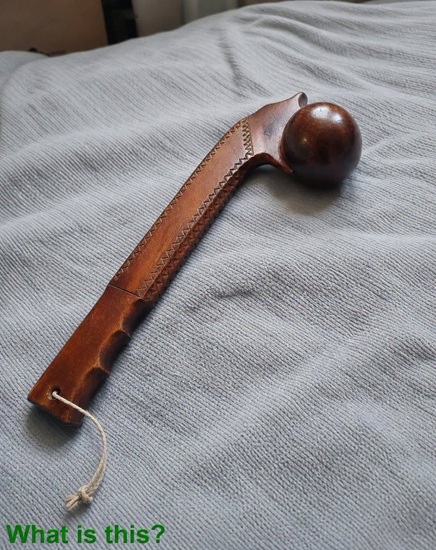
Antique shops are unusual places because many of the objects sitting on their shelves have survived far longer than the people who originally manufactured, sold, repaired, or used them. A tool that would have been instantly recognizable several generations ago can look completely mysterious today once it has been separated from the machine or household device it belonged to. That was reportedly the situation when a shopper noticed a small but surprisingly heavy metal object during a visit to an antique store.
It was only about ten centimeters in size, yet there was something unusual enough about its construction to attract his attention. The object did not look like an ordinary household tool. There was no obvious handle, readable label, conventional button, or clear opening that explained how someone was supposed to use it. Around its center was a circular feature that appeared important, although its purpose was impossible to determine simply by looking at it.
Even the seller reportedly could not provide a definite explanation of what the object had once been used for. Instead of discouraging the buyer, the uncertainty made the little piece of metal considerably more interesting. Because it cost less than five euros, taking the object home was not a major financial decision. The buyer was essentially paying for a mystery rather than purchasing something he knew he could use.
Without instructions, packaging, or information about where it originally came from, the metal piece offered very little evidence about its history. It soon found a place on a desk while its new owner began trying to understand why somebody had manufactured such a strangely shaped and unexpectedly heavy object.
The first logical step was searching for visually similar items online. Different descriptions of the object’s shape, approximate dimensions, material, and circular center produced numerous possibilities. Some results resembled pieces of old machinery, while others looked like components from locks, measuring equipment, industrial hardware, or mechanical systems. At first glance, several examples appeared promising. Closer inspection, however, usually revealed important differences that prevented an easy identification.
Some comparable objects had mounting holes that were missing from the antique-shop find. Others had handles, threaded sections, electrical connections, or moving parts that did not appear on the mystery object. Some were also constructed from noticeably lighter materials. These differences matter because two mechanical components can have similar outlines while performing entirely unrelated jobs. Visual resemblance can therefore provide a useful starting point, but it is rarely enough by itself to establish exactly what an unidentified antique was designed to do.
Weeks reportedly passed without a convincing answer. Friends contributed their own theories, suggesting everything from decorative hardware to a component from agricultural or industrial equipment. None of those ideas could be confirmed because the object lacked the context normally needed for identification. There was no known manufacturer, original machine, instruction manual, or reliable history explaining where it had been used. Without those clues, every explanation remained a possibility rather than a documented conclusion.
This problem is common with old mechanical equipment. People usually recognize complete machines rather than every component hidden inside them. Someone may immediately identify an antique clock while having no idea what one of its internal pieces would look like if placed separately on a table. The same applies to old vehicles, alarms, factory machines, household appliances, agricultural tools, and communication equipment. Once an individual component becomes separated from the complete system, much of the information provided by its original surroundings disappears.
Manufacturer markings can sometimes solve such mysteries quickly. A company name, model number, patent number, logo, or stamped symbol can lead researchers to historical catalogs and technical drawings. Unfortunately, many internal machine components were never individually labeled because their manufacturers never expected customers to encounter them separately. If the mystery object was originally installed inside a larger mechanism, the absence of identifying information would therefore not be particularly surprising.
Physical details can nevertheless provide important evidence. The exact dimensions of an object are more useful than simply describing it as small or large. Its weight can indicate whether it is solid or hollow and can sometimes help distinguish between different metals. Screw holes can reveal how something was mounted, while threads suggest that another component may once have been attached. Scratches and polished areas can even show where moving pieces repeatedly made contact over years of use.
The material itself may provide additional clues. Cast iron, brass, steel, aluminum, and other metals have been used for different purposes and became common in different products and periods. Manufacturing marks can sometimes indicate whether an object was cast, forged, stamped, or machined. None of these characteristics automatically identifies an item, but together they can gradually narrow the possibilities. Antique identification is often less about discovering one dramatic clue and more about assembling several smaller pieces of evidence.
According to the account surrounding this particular object, however, the most revealing clue appeared unexpectedly. The piece happened to be nearby during an unrelated repair when it was accidentally struck with a hammer. Instead of producing only the dull metallic sound someone might expect, it reportedly responded with a surprisingly sharp and piercing noise. The sudden sound startled the people nearby and immediately changed how the object was being interpreted.
The reaction suggested that the circular section might not have been merely decorative. The object’s shape and material appeared capable of producing or amplifying a strong sound when subjected to mechanical force. That observation reportedly led the investigation toward older warning or signaling equipment. The original account describes the item as being associated with a mechanical alarm system, a type of technology that could create an audible warning without relying on the digital electronics found in modern security equipment.
Mechanical warning systems are certainly not unusual historically. Long before microprocessors, wireless sensors, smartphone applications, and electronic control panels became available, engineers created effective alarms using springs, bells, gongs, strikers, levers, and other mechanical components. Stored mechanical energy could be released when a door moved or when another triggering event occurred. A striker could then hit a resonating metal surface, producing a sound loud enough to attract attention.
However, an important distinction should be made when discussing any unidentified antique. A loud sound after an impact does not, by itself, prove that an object belonged to a particular alarm system. Many pieces of metal can resonate strongly when struck, including bells, gongs, machine components, and objects designed for entirely different purposes. Confirming a precise identification normally requires additional evidence such as a manufacturer’s catalog, patent drawing, known example, or examination by someone familiar with that specific type of equipment.
For that reason, the safest description is that the object’s reported behavior and the account surrounding it point toward an older mechanical signaling or alarm-related function. Unless the exact model and manufacturer have been independently documented, more specific claims should be treated cautiously. Preserving that uncertainty does not make the story less interesting. In fact, it illustrates an important part of researching antiques: sometimes the evidence identifies a general purpose while leaving the exact origin unresolved.
Older alarms can be particularly difficult for modern observers to recognize because they often look nothing like the alarm systems people use today. A contemporary home-security device may contain LEDs, buttons, wires, cameras, sensors, speakers, or a plastic control panel. Its function is often apparent before anyone reads the instructions. A mechanical alarm component removed from a nineteenth- or twentieth-century installation might instead look like nothing more than an oddly shaped piece of metal.
The difference comes from how those systems were designed. An older alarm could be integrated directly into a door, window, cash box, clock, workshop device, or piece of industrial machinery. Only one small portion of the mechanism might have been visible during normal use. Once dismantled, its individual parts would no longer resemble an alarm to someone unfamiliar with the original system. The surrounding equipment provided context that the isolated component simply cannot reproduce.
A mechanical bell provides an easy example. Everyone recognizes a complete traditional alarm clock because its face, hands, bells, and winding controls immediately communicate its purpose. Remove one internal lever or striker and place it by itself in an antique shop, however, and very few people would identify it correctly. The component has not changed, but all of the information provided by the complete device has disappeared.
That principle applies to the mysterious metal object as well. If it once belonged to a warning mechanism, the rest of that mechanism would have explained how it operated. There may have been a spring, mounting bracket, trigger, striker, enclosure, or another component that is now missing. Without those parts, the remaining piece becomes much harder to interpret. What seems mysterious today may have been completely ordinary to the technicians who originally installed or maintained it.
The reported accidental impact also highlights a broader lesson about unidentified antiques, although not in the way someone might initially expect. Striking an unknown object should never be used deliberately as an identification method. In this case, the impact was described as accidental. Repeating such an experiment intentionally could be dangerous because an unfamiliar object may contain materials or mechanisms that cannot be identified safely from its exterior.
Some vintage equipment contains powerful springs capable of releasing stored energy unexpectedly. Other objects can contain brittle metal, sharp internal components, old electrical parts, chemical residues, or sealed materials. Historical switches and scientific equipment may even contain mercury. Old painted surfaces can contain substances that require careful handling. Industrial components can retain lubricants or chemicals many years after they were removed from service.
Items that could have a military origin deserve even greater caution. Old ammunition, detonators, ordnance, and related equipment can sometimes resemble harmless pieces of machinery after decades of corrosion. An unknown object found around a former military site or battlefield should never be struck, drilled, heated, opened, or dismantled. When there is a reasonable possibility that an item could contain explosive material, appropriate authorities or qualified specialists should handle the situation.
Connecting electricity to an unidentified vintage component is also inappropriate. Even if terminals or wires are visible, the original voltage and electrical requirements may be unknown. Aging insulation can fail, and internal components may have deteriorated. Applying power can damage a historically interesting item and potentially create an electrical or fire hazard. Research should therefore come before any attempt to make an unfamiliar old device operate.
The safest identification process begins with observation. Clear photographs should be taken from several angles without dismantling the object. Including a ruler or measuring scale in at least one photograph helps establish its dimensions. Recording the weight can also be useful. Close-up images should capture every number, letter, symbol, seam, fastener, unusual surface, and area of wear that might contain information.
Lighting is surprisingly important when examining old metal. Very shallow stamped characters can disappear under direct illumination but become visible when light reaches the surface from the side. Casting marks can also emerge more clearly in close photographs. Magnification may reveal tiny symbols or manufacturing patterns that are impossible to see during an ordinary inspection. These details can sometimes turn an unsuccessful internet search into a straightforward identification.
Aggressive cleaning should generally be avoided until the object’s nature and possible historical value are understood. Dirt and corrosion can obscure important details, but improper cleaning can remove original finishes, paint, labels, plating, or other evidence. A shiny surface is not necessarily more useful to a researcher than an untouched one. When an object appears potentially significant, a conservator or specialist collector may be able to recommend a safer approach.
Information about where an antique was found can be equally important. An object discovered in a box of old clockmaker’s tools has a very different likely history from something recovered from a tractor workshop. Railway equipment, maritime hardware, automotive components, household devices, and factory machinery each have distinctive features. Even knowing the profession of the previous owner can dramatically narrow the search.
Unfortunately, antique shops frequently contain objects whose provenance has already disappeared. Estates are divided, boxes are mixed together, and individual items pass through multiple owners. By the time a curious shopper discovers something on a shelf, nobody may remember whether it came from a farmhouse, factory, vehicle, commercial building, or private workshop. Once that information is lost, researchers must depend much more heavily on the physical evidence.
Specialist communities can be invaluable in these situations. Collectors and restorers sometimes possess knowledge that is difficult to find through a general internet search. Someone who spent decades repairing locks, clocks, railway equipment, industrial machinery, or agricultural tools may recognize a component immediately. What looks mysterious to thousands of people can be routine to the one person who once worked with the complete device.
Historical catalogs provide another powerful resource. Manufacturers often published detailed illustrations of their products and replacement components. Many of these documents have been digitized by libraries, museums, collectors, and historical organizations. Patent drawings can also show internal mechanisms in considerable detail. When a suspected identification can be matched to a documented illustration with the same dimensions and structural features, confidence in the conclusion increases substantially.
Museums can sometimes help as well. Institutions specializing in technology, transportation, agriculture, industry, or local history maintain collections containing ordinary objects that rarely receive public attention. A railway museum may recognize a signaling component, while an agricultural collection may identify a piece of equipment associated with a particular machine. Historical societies can also provide knowledge about industries that once operated in their region.
The key is to separate identification from speculation. Saying that an object resembles an old alarm component is different from claiming that it unquestionably came from a particular alarm model. Responsible historical research makes that difference clear. An interesting theory should remain a theory until enough independent evidence exists to support a stronger conclusion.
This distinction becomes particularly important when mysterious-object stories spread through social media. A surprising explanation can be copied from one page to another until its original uncertainty disappears. After enough repetitions, readers may encounter a speculative identification presented as established historical fact. Checking reliable documentation before repeating those claims helps prevent a harmless mystery story from becoming misinformation.
The same care should be applied to dramatic details about how an object was discovered. Unless there is independent documentation, readers should understand that an anecdotal account describes what was reported rather than providing scientific verification. The accidental hammer strike in this story is interesting because it reportedly revealed the object’s acoustic properties. It should not be interpreted as a recommended experiment or as proof of every claim made about the item’s original purpose.
If the object was indeed associated with a mechanical warning system, its ability to produce a strong sound after many years would demonstrate one advantage of simple mechanical engineering: durability. A resonating piece of metal does not require a battery, software update, internet connection, or electronic processor to retain its fundamental physical properties. Unless corrosion or damage changes its structure, it can potentially continue resonating for an extremely long time.
This does not mean historical mechanical alarms were necessarily superior to modern systems. Contemporary security technology offers capabilities that earlier engineers could not realistically provide. Electronic sensors can detect different conditions, send remote notifications, record events, communicate wirelessly, and integrate with larger monitoring networks. Mechanical devices were designed for another technological environment and solved problems using the materials and knowledge available at the time.
Understanding those solutions is part of what makes ordinary antiques historically valuable. History is not preserved only in expensive artwork, famous documents, or objects connected with well-known individuals. Everyday tools and machine components can reveal how people worked, protected property, communicated, traveled, cooked, repaired equipment, and organized their surroundings. Even a cheap piece of metal can preserve evidence of engineering decisions made decades earlier.
A mechanical warning device, for example, reflects a very practical problem: how can an event produce enough noise to attract someone’s attention? Engineers could answer that question with stored spring energy, a trigger, a striker, and a resonating surface. The individual parts might look simple, but the complete arrangement transformed mechanical movement into a useful warning. Studying those systems helps explain the technological steps that eventually led to modern electronic alarms.
The mystery also demonstrates how quickly practical knowledge can disappear. A technician from the period when a device was widely used might recognize one of its components immediately. Once the technology is replaced, fewer people continue repairing it. Manuals disappear, manufacturers close, and replacement parts stop being produced. Within a few generations, an object that once had an obvious purpose can become difficult even for experienced collectors to identify.
The internet has made recovering that lost knowledge considerably easier. A person can now photograph an unknown object and share it with specialists around the world within minutes. Digitized catalogs make it possible to search products manufactured by companies that disappeared many decades ago. Online museum databases provide access to collections that once required an in-person visit. Historical newspapers and patent archives can reveal advertisements and technical descriptions unavailable to previous generations of collectors.
Yet technology does not eliminate the need for careful reasoning. Image-recognition systems can suggest visually similar objects, but they can also return convincing false matches. Two metal components may share the same general shape because that shape is mechanically useful, not because they perform the same job. Dimensions, construction, provenance, and documented examples remain essential for distinguishing resemblance from genuine identification.
The buyer’s experience therefore represents a familiar kind of historical puzzle. He reportedly began with almost no information beyond the object’s physical appearance. Online comparisons failed to produce a convincing match. Friends supplied possibilities without enough evidence to confirm them. Then an unexpected event revealed that the object could produce a powerful sound, providing a new clue and directing attention toward mechanical signaling technology.
Even after such a clue appears, however, good research continues rather than immediately stopping. The next questions should concern how the object would have been mounted, what would normally have struck or activated it, and whether documented alarm mechanisms share the same construction. Finding an identical catalog illustration or surviving complete example would provide much stronger evidence than the sound alone. If no such documentation exists, uncertainty should remain part of the final description.
That uncertainty does not reduce the object’s appeal. Quite the opposite, an incomplete identification can encourage additional research. Someone may eventually recognize a manufacturing technique, discover an old catalog, or locate another example still attached to its original mechanism. Antique mysteries are sometimes solved years after the first photographs are circulated because the right piece of evidence finally becomes available.
For collectors, this is often more satisfying than simply learning an object’s market price. Many unidentified antiques are not financially valuable at all. Their appeal comes from reconstructing their forgotten purpose. Discovering how something worked can reveal details about an occupation, industry, or household practice that has almost disappeared from everyday life.
In this case, the small metal object reportedly changed from an anonymous curiosity into a possible surviving component of an earlier warning system. The physical item itself had not changed. What changed was the interpretation surrounding it. A circular feature that initially seemed decorative suddenly appeared potentially functional once the object’s acoustic behavior became apparent.
That shift illustrates a central feature of historical investigation. Objects do not explain themselves; researchers build explanations from evidence. Sometimes a scratch, stamped number, unusual sound, or manufacturing mark changes the entire direction of an investigation. But each new clue must still be tested against other evidence before becoming part of a confident conclusion.
The story also provides a useful reminder that old technology was often remarkably ingenious despite appearing simple today. Engineers worked without the inexpensive electronic sensors and processors now available to manufacturers. They instead relied on mechanical relationships between force, motion, tension, vibration, and sound. Understanding those principles can make an apparently primitive object seem considerably more sophisticated.
Simple mechanical devices also have a tactile quality that modern electronics often conceal. A person can frequently see a lever move, watch a spring compress, or hear a striker hit a bell. The relationship between cause and effect is physically visible. That transparency is one reason antique mechanical equipment remains fascinating to collectors, engineers, restorers, and museum visitors.
At the same time, nostalgia should not replace accuracy. Not every old object was brilliantly designed, rare, valuable, or historically important. Some mysterious antiques are simply ordinary components whose surrounding machines disappeared. Their lack of recognition today does not automatically make them exceptional. What makes them interesting is the opportunity they provide to reconstruct a small part of technological history.
