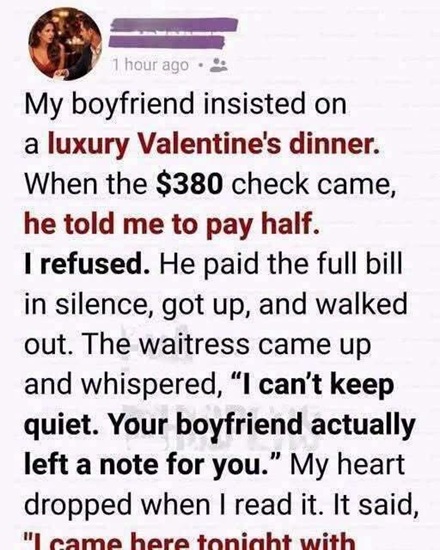
After seven years in a relationship, she believed she and her boyfriend had reached the point where marriage was no longer a distant possibility. They had shared holidays, family events, arguments, reconciliations, ordinary routines, and enough memories to make the relationship feel deeply established. When he told her that he had planned a special Valentine’s Day dinner, she naturally wondered whether the evening might finally end with a proposal.
The restaurant immediately felt different from the places they usually visited together. It was more elegant, noticeably more expensive, and clearly chosen with care. Her boyfriend had handled the reservation and presented the entire evening as something he wanted to arrange for them. Because of that, she did not expect to be involved in planning the cost or deciding how the bill would be divided.
She tried not to assume too much, but the possibility of an engagement remained in the back of her mind throughout dinner. After seven years, it did not seem unreasonable to imagine that a carefully planned Valentine’s evening could be connected with marriage. Every small gesture felt slightly more meaningful because she believed the night might represent an important turning point.
The meal itself was enjoyable. They talked, laughed, and ordered food that was more expensive than what they would normally choose on an ordinary date. Since he had selected the restaurant and described the evening as his surprise, she assumed the cost was part of the plan he had made.
Everything changed when the server brought the check.
The total was around $380.
Instead of reaching for the bill, her boyfriend moved it toward the center of the table and told her they should split it equally.
That meant her share would be about $190.
The request surprised her immediately.
There is nothing inherently wrong with couples splitting the cost of dinner. Many couples divide expenses equally, alternate payments, or agree on another system that works for them. The problem was not the idea of sharing expenses itself.
The problem was that there had been no discussion beforehand.
He had chosen the expensive restaurant.
He had made the reservation.
He had presented the evening as something he had planned.
And only after the meal was finished did he tell her she was expected to pay nearly $200.
She refused.
From her perspective, she had never agreed to spend that amount. If he had told her before the date that they would each be responsible for half, she could have decided whether she was comfortable with the expense.
She might have agreed.
She might have suggested another restaurant.
She might have told him that almost $200 for one dinner was outside the amount she wanted to spend.
Any of those outcomes would have involved a real conversation.
Instead, the decision had effectively been made for her.
Her boyfriend was disappointed by her refusal.
He argued that people who were serious about building a future together should be willing to share financial responsibilities.
She did not necessarily disagree with that principle.
A long-term relationship does involve financial responsibility.
Marriage can include rent or mortgage payments, utilities, food, insurance, transportation, medical expenses, savings, debt, childcare, vacations, and countless other costs.
But sharing financial responsibility also means making financial decisions together.
It does not mean one person deciding how much money the other will spend and revealing the expectation only after the money has effectively already been spent.
Eventually, her boyfriend paid the entire bill.
By then, the atmosphere of the evening had changed completely.
The romantic anticipation she had carried into the restaurant disappeared.
The proposal she had quietly imagined never happened.
Later, however, she learned something that made the dinner far more significant than a disagreement about who should pay.
Her boyfriend left her a note.
In it, he explained that the dinner had been a test.
According to him, he had been thinking about proposing.
But before taking that step, he wanted to know whether she was willing to share financial responsibilities.
The expensive Valentine’s dinner had therefore been designed to measure her response.
She had not known that.
There had been no warning.
There had been no conversation.
And according to his explanation, she had failed.
That was the part she found most disturbing.
The issue was no longer $190.
It was the fact that she had unknowingly been placed inside a test with rules that only one person knew.
A real discussion about money requires both partners to understand that money is what they are discussing.
One person might have concerns about spending.
The other might have different expectations about splitting expenses.
Those differences are normal.
But they cannot be resolved if one person hides the real question.
A secret test creates an imbalance from the beginning.
The person designing it controls the circumstances.
They decide what counts as success.
They decide what counts as failure.
The other person reacts without knowing how the reaction will later be interpreted.
That makes the result unreliable.
Her refusal to pay $190 did not prove that she would never contribute financially to a marriage.
It did not show that she expected her boyfriend to pay every household bill.
It did not prove that she was irresponsible with money.
It only showed that she did not want to pay half of an unexpectedly expensive dinner that someone else had chosen without consulting her.
Those are very different things.
If the question was really whether they were financially compatible, there were much better ways to find out.
They could have discussed their incomes.
They could have talked about savings.
They could have discussed debt.
They could have compared their spending habits.
They could have talked about whether they wanted joint accounts.
They could have discussed how rent or mortgage payments would be divided.
They could have talked about emergencies.
They could even have discussed how they preferred to handle restaurant bills.
After seven years together, those conversations should not have required a secret experiment.
The test was also questionable because one restaurant bill tells very little about how someone would manage long-term financial responsibilities.
A person can refuse an unexpected $190 expense and still be excellent at saving money.
Someone can prefer advance notice for large purchases while willingly contributing to household expenses.
Someone can dislike surprise costs while still believing strongly in financial equality.
One reaction in one unusual situation cannot accurately summarize an entire approach to money.
The context matters.
If she had planned an expensive weekend trip, chosen a luxury hotel, and only at checkout told him that he owed half, he might also have objected.
That objection would not automatically make him selfish.
It might simply mean he believed people should be consulted before significant financial commitments were made on their behalf.
The same logic applied to her.
The proposal element made the situation even harder to accept.
By telling her that marriage had supposedly depended on how she handled the bill, he turned commitment into a reward controlled by him.
He knew the condition.
She did not.
He decided the test.
He decided the result.
He decided whether she had earned the next stage of the relationship.
That dynamic raised questions much larger than dinner.
If they married, would other important issues also involve hidden evaluations?
Would he test whether she handled household responsibilities correctly?
Would he create situations to see whether she supported his career enough?
Would he quietly judge how she handled family disagreements?
Would ordinary mistakes become evidence that she had failed another standard she had never known existed?
Those questions were painful because marriage requires trust.
People do not need to agree on everything.
They do need to believe that disagreements are real conversations rather than hidden examinations.
Once secret testing enters a relationship, even ordinary moments can become difficult to interpret.
A surprise may not simply be a surprise.
A disagreement may not simply be a disagreement.
One partner may begin wondering whether they are always being evaluated.
That kind of uncertainty can damage emotional safety.
Seven years together made the situation especially difficult.
A relationship of that length contains far more than one bad evening.
There are memories.
There are shared traditions.
There are birthdays and holidays.
There are people in each other’s families who have become familiar.
There are plans that may have been discussed for years.
That history can make someone feel obligated to preserve the relationship no matter what happens.
But time already invested does not automatically determine what should happen next.
Seven years can be meaningful without guaranteeing that marriage is the right decision.
Past memories do not erase present concerns.
And the fact that a relationship has lasted a long time does not make every behavior acceptable.
The dinner forced her to think about the difference between love and trust.
She could still love him.
She could still value the years they had spent together.
But she also had to ask whether she trusted the way he handled important issues.
Those questions were separate.
Someone can care deeply for another person and still realize that their communication style is not healthy enough for marriage.
The boyfriend’s concerns about financial responsibility may have been understandable.
He might have worried that marriage would leave him paying for everything.
He may have wanted reassurance that his partner viewed finances as a shared responsibility.
Those fears are legitimate subjects for discussion.
The problem was not that he had concerns.
The problem was how he chose to address them.
He could simply have asked.
A direct conversation might have started with something as simple as explaining what financial equality meant to him.
She could then have explained her own expectations.
Perhaps their ideas would have been very similar.
Perhaps they would have discovered important differences.
Either result would have been useful.
The difference is that both people would have known what conversation they were having.
That is how compatibility is actually tested.
Through honesty.
Not traps.
The Valentine’s dinner also highlighted the importance of discussing expectations before expensive plans are made.
For one person, $190 may be an ordinary amount to spend on a special dinner.
For someone else, it may represent a significant part of their weekly budget.
Neither perspective is automatically wrong.
But the amount becomes a problem when one person assumes the other person will spend it without asking.
Romantic occasions do not remove financial boundaries.
Valentine’s Day does not make budgets disappear.
If anything, special events are a good reason to communicate more clearly because expectations may already be emotionally heightened.
A simple conversation before the reservation could have prevented everything.
He could have said that he wanted to try an expensive restaurant and asked whether she was comfortable splitting the cost.
That would have given her a choice.
If she agreed, there would have been no problem.
If she declined, they could have selected somewhere else.
Neither person would have needed to feel embarrassed.
And neither person would have been secretly judged.
That is a much healthier model of partnership.
The problem with secret tests is that they often reveal more about the person creating them than about the person taking them.
Her boyfriend wanted to know whether she was willing to share responsibility.
But the method he chose showed that he was comfortable making a significant decision without her input.
He wanted evidence of equality.
Yet the test itself was unequal.
One person had all the information.
The other had none.
That contradiction became difficult for her to ignore.
The same issue applied to the proposal.
A marriage proposal can certainly contain an element of surprise.
The exact timing can be unexpected.
The setting can be a surprise.
The ring can be a surprise.
But whether both people generally want marriage should not be a mystery.
Ideally, the commitment has already been discussed in some form.
The proposal marks the moment.
It should not function as a prize that one person receives after passing a hidden test.
That kind of arrangement turns partnership into approval.
One person becomes the judge.
The other becomes the person being judged.
That is not the kind of equality she wanted.
She also realized that refusing to pay the bill may have demonstrated something important about her own boundaries.
Saying no can be uncomfortable.
It can create tension.
But healthy relationships require both people to be able to disagree.
A partner should be able to say that an expense is too high.
They should be able to question a decision.
They should be able to decline something without fearing that the relationship itself will be withdrawn as punishment.
If every disagreement becomes evidence of failure, genuine communication becomes nearly impossible.
People start performing the answer they think their partner wants instead of speaking honestly.
That may create temporary peace.
It does not create trust.
Money is one of the areas where this matters most.
Couples often have very different financial histories.
One person may have grown up in a household where money was always scarce.
Another may have grown up where expenses were rarely discussed.
One may be highly cautious.
The other may be comfortable spending freely.
Those differences can affect everything from restaurants to housing.
The solution is not to discover them through traps.
It is to discuss them openly.
A couple considering marriage might talk about how much each person earns and whether income should remain private or become shared.
They might discuss existing debt.
They might discuss credit cards.
They might talk about emergency savings.
They might decide whether large purchases require agreement from both partners.
They might discuss helping relatives financially.
They might talk about retirement.
Those conversations may feel uncomfortable.
But discomfort is not a sign that the conversation is unhealthy.
Sometimes the most important conversations are uncomfortable.
The key difference is honesty.
Both people know what is being discussed.
Both people can ask questions.
Both can explain themselves.
Neither is secretly grading the other.
That is why the Valentine’s dinner became a turning point.
It was not because a couple disagreed about splitting a bill.
Couples disagree about money every day.
The real problem was the discovery that the disagreement had been deliberately created as a test.
That changed the meaning of the night.
What she thought was romance had partly been an evaluation.
What she thought was a surprise contained hidden conditions.
And what she thought might become a proposal was apparently dependent on a rule she had never been told.
That was difficult to reconcile with her idea of marriage.
Marriage would involve decades of shared decisions.
Some would be easy.
Others would be stressful.
There might be periods when one person earned more.
There might be periods when one person could contribute less.
Illness could change plans.
Children could change finances.
Job loss could change everything overnight.
Those circumstances require flexibility.
They require trust.
They require communication.
A single rigid test cannot predict how someone will behave through all of those situations.
The $190 therefore proved far less than her boyfriend believed.
It did not reveal whether she would pay half a mortgage.
It did not reveal whether she would contribute to retirement.
It did not reveal whether she would support him during unemployment.
It did not reveal whether she would hide debt.
It did not reveal whether she would be financially responsible with children.
It revealed only her reaction to an unannounced restaurant expense.
That was all.
The fact that he attached a much larger meaning to it was his interpretation.
She did not have to accept it.
The evening also showed how easily money can become emotional leverage.
Once he connected the bill with a proposal, refusing to pay became connected with losing the possibility of marriage.
That creates pressure.
A financial decision should not require someone to prove love by spending money.
Likewise, a person should not have to accept an unexpected expense because saying no might threaten commitment.
That is not an equal financial discussion.
It is emotional pressure attached to money.
The healthier alternative is straightforward.
Talk before spending.
Ask instead of assuming.
Explain concerns directly.
Allow the other person to disagree.
And do not treat disagreement as betrayal.
Those principles are much less dramatic than a Valentine’s Day test.
They are also much more useful in a real marriage.
The seven years they had already spent together still mattered.
The good memories were still real.
The relationship was not suddenly meaningless because of one dinner.
But the dinner provided information about an issue that may have been hidden before.
That information deserved attention.
Ignoring it simply because of the years already invested would not make the problem disappear.
Instead, she had to decide whether the behavior represented one poor decision that could be repaired or a deeper pattern she could no longer overlook.
That answer would depend on what happened next.
Would he acknowledge that the test was unfair?
Would he understand why advance communication mattered?
Would he be willing to discuss finances openly?
Would he continue insisting that she had simply failed?
Those responses would reveal far more about their future than the bill ever did.
A relationship can survive mistakes when both people take responsibility.
It becomes much harder when one person refuses to recognize why the mistake was damaging.
If he genuinely wanted a financially equal marriage, the next step should have been conversation.
Not another test.
If she genuinely wanted marriage with him, she also needed to be willing to explain her expectations clearly.
Both sides would need honesty.
That was the only way forward.
The irony of the situation was difficult to miss.
Her boyfriend had designed the dinner to learn whether she was suitable for marriage.
Instead, the evening gave her information about whether his approach to marriage was suitable for her.
The evaluation moved in both directions.
He learned that she would not automatically accept an unexpected expense.
She learned that he was willing to create a hidden test around a major emotional milestone.
Both facts mattered.
The lesson was not that women should never split restaurant bills.
It was not that men must always pay on Valentine’s Day.
It was not that expensive dinners are inherently wrong.
The lesson was communication.
If a couple wants to split costs, that can be completely reasonable.
If one person wants to treat the other, that can also be reasonable.
If they want to alternate, that works too.
There is no universal rule.
The important thing is that the people involved know what the arrangement is.
Fairness requires agreement.
It does not come from surprise.
That is especially true when the cost is much higher than normal.
A $380 meal is not a trivial amount for many people.
Expecting someone to pay $190 without warning can place them in an uncomfortable situation even if they normally believe in splitting expenses.
The ability to pay and the willingness to pay are not the same thing.
Someone may have enough money in a bank account and still believe the expense was not theirs to approve.
Financial boundaries are still boundaries.
The dinner helped her see that clearly.
The proposal she imagined might have been romantic.
But a healthy marriage required something more important than romance.
It required the ability to make difficult decisions together.
It required transparency.
It required respect for each other’s choices.
And it required confidence that neither person was secretly setting traps.
Those qualities matter long after Valentine’s flowers disappear.
They matter when bills arrive.
They matter when salaries change.
They matter when emergencies happen.
They matter when people disagree.
A strong relationship cannot depend on one partner constantly guessing the correct answer.
It depends on both partners knowing the question.
That was what the Valentine’s dinner ultimately revealed.
The real problem was never the $380 bill.
It was not even the missing proposal.
The larger issue was the belief that commitment could be decided by a hidden pass-or-fail test.
For her, that was not what partnership meant.
Partnership meant discussing the rules before expecting someone to follow them.
It meant making major decisions together.
It meant allowing each other to say no.
And it meant trusting that love did not need to be proven through a surprise financial challenge.
Seven years had brought them to an important crossroads.
Perhaps they would eventually repair what happened.
Perhaps they would not.
But whatever came next, she understood something more clearly than before.
Time together does not automatically create healthy communication.
Marriage does not fix problems that have never been discussed.
And equality cannot be measured by secretly testing whether someone will pay half of a dinner they never agreed to buy.
A future together has to be built openly.
Anything else leaves one person guessing.
And no lifelong commitment should begin with hidden rules.
