
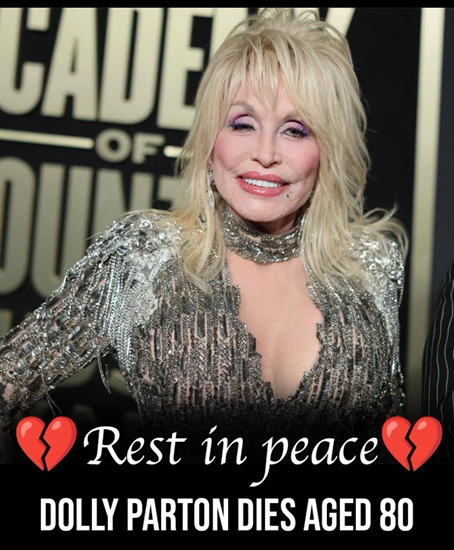
Country music legend Dolly Parton has died at the age of 80, bringing to a close an extraordinary career that spanned generations and made her one of the most recognizable entertainers in the world. Her death was announced on Tuesday, August 25, 2026, by her nephew Bryan Seaver, who delivered the news on behalf of the Parton and Owens families. Seaver, who also served as Parton’s longtime head of security, shared the announcement through a video posted on her official social media account.
Parton’s representatives also confirmed her death, and major news organizations subsequently reported the news. She died in Nashville following a brief battle with cancer, according to a statement from her team. In the family announcement, Seaver explained that Parton had asked him years earlier to deliver a message to the public when the time eventually came. He described the responsibility as both an honor and an emotionally difficult moment, reflecting on his decades working closely with his aunt.
Seaver is the son of Parton’s sister Cassie, and his father, Larry, had previously worked in security for the singer. His connection to Parton therefore extended beyond professional responsibilities and deep into their family history. The announcement emphasized the importance Parton placed on her family, faith, career and the people who had supported her throughout her remarkable life. Parton’s journey to international fame began far from the glamorous stages and television studios that would later define her public image.
She was born Dolly Rebecca Parton on January 19, 1946, in rural Tennessee and grew up as one of 12 children in a family with limited financial resources. Music became an important part of her childhood, and she began performing while she was still young. Her upbringing in the Great Smoky Mountains would eventually provide inspiration for many of her songs, which frequently explored family, hardship, love, faith and perseverance. Those personal themes helped Parton establish an unusually strong connection with audiences over the decades.
After finishing high school, Parton moved to Nashville to pursue music professionally. Her breakthrough came during the 1960s, particularly after she joined entertainer Porter Wagoner’s television program in 1967. Their professional partnership introduced Parton to a much larger country music audience and helped establish her as an important new voice in Nashville. Eventually, however, she wanted to build an independent career and pursue her own creative direction. Her decision to leave Wagoner’s program became another turning point in a career that would repeatedly demonstrate her ability to take risks and reinvent herself while maintaining her distinctive identity as a songwriter and performer.
Songwriting remained at the heart of Parton’s work throughout her life. She wrote thousands of songs and created a catalog that includes some of the most recognizable compositions in country and popular music. “Jolene,” “Coat of Many Colors,” “9 to 5” and “I Will Always Love You” became particularly enduring examples of her songwriting. Her songs often combined accessible melodies with storytelling drawn from personal experiences and observations about everyday life. That ability to communicate complicated emotions through relatively direct lyrics became one of the defining characteristics of her work and helped her music reach listeners far beyond the traditional country audience.
“I Will Always Love You” became especially significant in Parton’s career. She originally wrote and recorded the song decades before Whitney Houston transformed it into a worldwide pop phenomenon with her version for The Bodyguard. The enormous success of Houston’s recording introduced Parton’s songwriting to another generation of listeners and demonstrated how easily her compositions could cross musical genres. Parton remained widely respected not only for performing her own hits but also for understanding the business side of songwriting and maintaining control over important parts of her creative work. Her career ultimately became an example for generations of singers and songwriters who followed her.
Her commercial achievements were equally remarkable. Parton sold more than 100 million records during her career and collected numerous major honors, including 11 Grammy Awards and a Grammy Lifetime Achievement Award. Her influence extended across country, pop, rock and other areas of popular music, while her distinctive voice and songwriting remained immediately recognizable. She continued releasing music and participating in major projects long after many performers of her generation had retired. Her longevity was particularly unusual in an entertainment industry where careers can change rapidly, allowing several generations of listeners to discover her work at different stages of their lives.
Parton also created memorable collaborations with other major performers. Among the best known was “Islands in the Stream,” her enormously successful duet with Kenny Rogers. The song became one of the signature recordings associated with both artists, and Parton and Rogers maintained a friendship and professional relationship for decades. Just days before her death, Parton’s social media presence had commemorated the anniversary of the famous duet, another reminder of the lasting popularity of the music they made together. Rogers died in 2020, and Parton had previously spoken warmly about their friendship and the many years they spent performing together.
Her ambitions were never limited to recording studios and concert stages. Parton became a successful actress and appeared in several well-known films, most famously the 1980 comedy 9 to 5, alongside Jane Fonda and Lily Tomlin. The movie became a major cultural success, while Parton’s title song developed a life of its own as one of her most recognizable recordings. She later appeared in movies including Steel Magnolias, further establishing herself as a performer capable of reaching audiences outside music. Her personality, comedic timing and unmistakable public image helped make the transition from country singer to mainstream entertainment figure unusually successful.
Parton was also a highly successful businesswoman. One of the most visible examples of her business legacy is Dollywood, the Tennessee theme park closely associated with her name and Appalachian roots. Rather than distancing herself from the region where she grew up, Parton repeatedly incorporated her Tennessee heritage into her public identity and business activities. Dollywood became an important attraction in the region and helped connect Parton’s international celebrity with the culture and landscape that influenced her childhood. Her business achievements added another dimension to a career already distinguished by songwriting, recording, touring, television and film.
For many people, however, Parton’s philanthropic work became just as important as her entertainment career. Her Dollywood Foundation launched the Imagination Library in 1995, initially serving children in her home county in Tennessee. The program sends free books to young children and later expanded far beyond its original community. It grew into an international literacy initiative that has distributed millions of books to children. Parton frequently emphasized the importance of reading and education, and the program became one of the most recognizable charitable projects associated with any major entertainer.
Her philanthropy extended into other areas as well. Parton donated money to communities affected by disasters and supported educational, medical and humanitarian causes. During the COVID-19 pandemic, she donated $1 million to research at Vanderbilt University Medical Center, funding that contributed to research connected with the Moderna vaccine. She often approached such contributions without presenting herself as a political figure, instead emphasizing helping people where she believed assistance could make a difference. That approach contributed to her unusual ability to remain admired by people from a wide range of cultural and political backgrounds.
Away from the spotlight, one of the most important relationships in Parton’s life was her marriage to Carl Dean. The two met when Parton was young and married in 1966. Dean famously avoided celebrity life and rarely appeared publicly alongside his wife, while Parton frequently spoke about their relationship with humor and affection. Their decision to keep much of their marriage private stood in contrast to the enormous public attention surrounding Parton’s career. They remained married for nearly six decades, until Dean died in March 2025 at the age of 82.
Parton spoke openly about how difficult the loss of her husband had been. In interviews during the final period of her life, she discussed grief as well as health challenges she had experienced while continuing to work on creative projects. Even as she dealt with those difficulties, she remained involved in music and plans connected with her life story and career. Her public comments reflected the attitude she had displayed for decades: acknowledging hardship while continuing to focus on work, humor, faith and the people around her.
Her influence on younger performers is difficult to measure simply through awards or record sales. Generations of country musicians have cited Parton as an inspiration, while artists working far outside traditional country music have recorded her songs or celebrated her songwriting. Her ability to move comfortably between country music and mainstream popular culture helped expand perceptions of what a Nashville performer could accomplish. At the same time, she retained the Appalachian identity and storytelling traditions that had shaped her earliest music rather than abandoning them as her audience became international.
Parton’s public persona was equally distinctive. Her elaborate costumes, rhinestones, blonde hairstyles and quick sense of humor became instantly recognizable elements of her image. She frequently joked about her appearance and understood the difference between her public character and her private life. Behind that carefully constructed image was a songwriter and businesswoman who maintained considerable control over her career. That combination of humor, creative independence and self-awareness helped Parton navigate decades of changes in the entertainment industry while remaining recognizable to audiences around the world.
The scale of her career is reflected in the breadth of recognition she received throughout her lifetime. Parton earned major music awards, industry honors and recognition for her humanitarian contributions. Yet her cultural significance extended beyond formal accolades. Songs written decades ago continued to find new audiences, while her charitable programs created a tangible legacy outside entertainment. She became one of the relatively rare celebrities whose name could represent several different things simultaneously: country music, songwriting, movies, business, childhood literacy and philanthropy.
News of Parton’s death prompted tributes and remembrances focused on the many different parts of her life. For longtime country music listeners, she represented one of the genre’s most important songwriters and performers. For others, she was the actress from films such as 9 to 5 or the instantly recognizable personality who appeared on television for decades. Families who received books through the Imagination Library may remember her primarily for supporting childhood literacy. Those different connections illustrate how widely her influence had spread during a career that lasted for roughly seven decades.
Parton’s death also marks the end of one of the most remarkable journeys in American entertainment history. A child raised in a large family with limited financial means in rural Tennessee eventually became an internationally known singer, songwriter, actress, entrepreneur and philanthropist. Yet the stories of her childhood and family never disappeared from her work. Instead, they became part of the foundation upon which she built her career, giving audiences an understanding of where she came from even as her fame expanded around the world.
Ultimately, Dolly Parton leaves behind far more than a collection of successful recordings. Her songs will continue to be performed and rediscovered, her films remain part of popular culture, and the businesses and charitable initiatives associated with her name continue the work she began during her lifetime. Most significantly, the Imagination Library ensures that her commitment to helping children discover books has a legacy independent of the entertainment industry. Her life demonstrated how artistic success could be combined with entrepreneurship and sustained charitable work on an extraordinary scale.
Dolly Parton died at 80 after spending most of her life creating music, entertaining audiences and supporting causes she cared about. From the mountains of Tennessee to stages around the world, her journey became one of country music’s defining stories. Her death closes an extraordinary chapter in popular culture, but the enormous body of music she created and the programs she established remain. For millions of listeners who grew up with songs such as “Jolene,” “9 to 5,” “Coat of Many Colors” and “I Will Always Love You,” her voice and songwriting will remain a lasting part of music history.

