
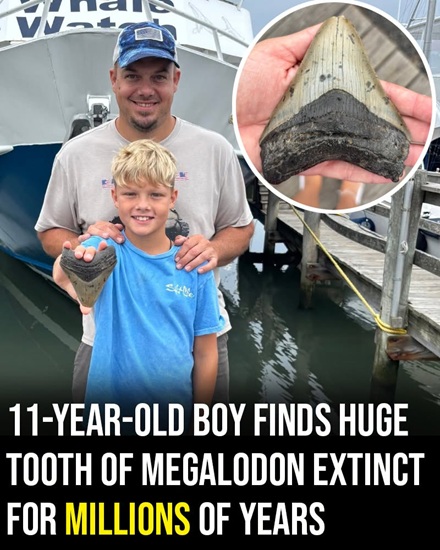
A family vacation along the New Jersey coast turned into an unforgettable encounter with prehistoric history when an 11-year-old boy discovered a large fossilized megalodon tooth. Bo Bowers was visiting Sea Isle City with his family when he and his father, Mike Bowers, spent some time exploring the beach and looking around the rocks. During their search, they noticed an unusual object lodged inside a narrow opening. Mike could see it but was unable to reach far enough into the gap. Bo’s smaller hand, however, fit inside, allowing him to carefully retrieve the mysterious object.
What Bo pulled from between the rocks was much more remarkable than an ordinary shell or stone. The object was a fossilized shark tooth measuring approximately four inches long. The size, shape and appearance immediately caught the family’s attention, although they still needed experts to determine exactly what they had found. Bo later described experiencing a combination of shock and excitement after realizing the significance of the discovery. For a child who had simply been exploring the shoreline with his father, finding something connected to an animal that lived millions of years ago was an extraordinary surprise.
Mike was equally amazed by the discovery. He later explained that he never expected a casual search around the beach to produce anything so unusual. The father and son had been enjoying an ordinary vacation activity when the fossil appeared in a place that could easily have gone unnoticed. Had Bo not been able to fit his hand into the narrow opening, the tooth might have remained hidden among the rocks. Instead, a few moments of curiosity resulted in the family taking home a remarkable piece of Earth’s prehistoric past.
Rather than relying only on their own assumptions about the object, the family sought professional assistance. The fossil was taken to experts associated with the Cape May Whale Watch and Research Center and the New Jersey State Museum. Specialists who examined the specimen confirmed that it was a genuine megalodon tooth. The confirmation established that Bo had discovered evidence from an enormous extinct shark that once inhabited ancient oceans. It also made the find particularly notable because megalodon teeth are not commonly discovered along New Jersey’s coastline.
Experts familiar with the specimen were impressed by both its size and its condition. Daniel Iovino of the Cape May Whale Watch and Research Center described the discovery as an amazing find and noted how fortunate the family had been. Only a small number of megalodon teeth have been recorded along the New Jersey coast. Another expert associated with the center, Matt Remuzzi, was especially impressed by how well preserved the fossil appeared. He described it as the best-condition megalodon tooth he had personally seen, emphasizing just how unusual Bo’s discovery was.
Dana Ehret, natural history curator at the New Jersey State Museum and an expert on fossil sharks, has also discussed the rarity of megalodon teeth in New Jersey. The geological conditions needed to make these fossils easily accessible are not common at the surface in the state. That helps explain why finding a substantial and well-preserved specimen on a beach is so noteworthy. Fossils exposed to water and movement can also become worn or damaged over time, making the condition of this particular tooth another interesting aspect of the discovery.
The circumstances surrounding the find made the story even more unusual. Mike had been examining the area around the rocks when he noticed something inside a small opening. Because his hand was too large to reach the object, he asked Bo to try. The boy reached into the space and successfully pulled it free. Neither of them initially expected that the object would turn out to be a fossil connected to one of the largest marine predators known from the fossil record. Their ordinary search for interesting objects on the beach had suddenly become something far more memorable.
The family was also surprised by the physical weight of the tooth. Mike said it felt considerably heavier than they expected once they were able to examine it properly. At approximately four inches in length, the fossil provides an impressive indication of the size of the shark that once carried teeth like it. Megalodon teeth are among the most important and recognizable fossils associated with the species because shark skeletons consist largely of cartilage, a material that generally does not fossilize as readily as teeth.
Scientists therefore rely heavily on fossilized teeth when studying megalodon. These remains can provide information about the animal’s approximate size, feeding behavior and evolutionary history. Thousands or even millions of years of environmental changes can affect fossils after an animal dies, but teeth are particularly durable structures. Their preservation has allowed paleontologists to learn considerably more about megalodon than would otherwise be possible. Bo’s specimen represents one small part of that much larger fossil record.
One noticeable feature of the tooth is a damaged area near its end. The family said they were told the chip may have resulted from the shark striking something hard while feeding, possibly bone. It is impossible to directly observe the event that damaged an individual tooth millions of years ago, so such an explanation should be considered a possibility rather than a certainty. Nevertheless, damage visible on fossil teeth can sometimes provide researchers with clues about the feeding lives of prehistoric predators.
Scientists have extensive evidence showing that megalodon was a powerful carnivorous shark capable of feeding on large marine animals. Fossil evidence associated with megalodon and its potential prey has helped researchers investigate how the species hunted and interacted with ancient marine ecosystems. Its enormous teeth were adapted for cutting into substantial prey, and its position near the top of the marine food chain made it one of the most formidable predators of its time.
There is also an interesting theory about how the fossil may have reached the area where Bo discovered it. Researchers have suggested that beach-replenishment work could have played a role. During these projects, material is dredged from offshore locations and transported onto beaches to replace sand lost through erosion. A fossil buried offshore can potentially be moved along with that material. Experts have therefore raised the possibility that the megalodon tooth was brought closer to shore during recent replenishment work before eventually becoming trapped among the rocks.
That explanation remains a possibility rather than a confirmed reconstruction of the tooth’s journey. No one observed exactly where the fossil was located before the replenishment work or how it moved over time. Still, the theory provides a reasonable explanation for why such an uncommon prehistoric specimen could suddenly become accessible on a modern beach. It also demonstrates how geological material that has remained hidden for extremely long periods can occasionally be exposed through natural processes or human activity.
The animal behind the tooth is one of the most famous prehistoric marine predators ever studied. Megalodon, commonly identified scientifically as Otodus megalodon, lived millions of years before modern humans appeared. Its fossils have been discovered in various regions around the world, showing that the species inhabited a broad range of ancient marine environments. Although megalodon is often compared with the modern great white shark, scientists caution against simply imagining it as a much larger version of a great white.
Reconstructing the exact appearance of megalodon is difficult because researchers do not have a complete fossilized skeleton. Sharks have skeletons composed primarily of cartilage rather than dense bone, and cartilage rarely survives fossilization as well as teeth. Scientists consequently use teeth, some preserved vertebral material and comparisons with living and extinct shark species when developing estimates of megalodon’s body proportions. As new research becomes available, scientific reconstructions of the animal can change.
Its maximum size has been the subject of extensive scientific research. Different methods have produced different estimates, particularly because scientists cannot simply measure a complete adult skeleton. Recent research has suggested that exceptionally large individuals could potentially have reached more than 20 meters in length, although estimates vary depending on the reconstruction method being used. What is clear across the research is that megalodon was enormous and ranks among the largest predatory fish known from the fossil record.
The shark’s teeth provide particularly striking evidence of its scale. Large megalodon teeth can measure several inches long, and some known examples are considerably larger than the specimen Bo discovered. Their triangular form and serrated edges were suited to a predator feeding on substantial marine prey. The name “megalodon” itself is associated with the meaning “large tooth,” reflecting the impressive fossils for which the animal has become famous.
Research has also helped scientists investigate the feeding capabilities of the giant shark. Studies using anatomical reconstruction and computer modeling suggest that megalodon required enormous quantities of food and could attack very large prey. Research published in Science Advances examined the animal’s body size, movement and feeding ecology, offering scientists a clearer picture of how such an enormous shark may have functioned. These findings are scientific reconstructions based on available evidence rather than observations of living megalodons.
Megalodon lived during a period when oceans contained a variety of marine mammals and other large animals that could serve as prey. Fossil evidence indicates that the shark fed on marine mammals, and researchers have studied bite marks found on fossilized bones to better understand these interactions. As an apex predator, megalodon likely played an important role in shaping the ecosystems it inhabited. Understanding its diet and behavior can therefore provide information not only about the shark itself but also about ancient ocean environments.
Scientists continue to investigate why such a successful predator eventually disappeared. Megalodon is generally believed to have become extinct approximately 3.6 million years ago. Researchers have examined several potential factors, including changing ocean temperatures, shifts in prey populations, competition with other marine predators and changes in suitable habitats. Its extinction probably involved complex ecological changes rather than a single simple event, and research into the subject continues.
Despite fictional movies, internet stories and occasional speculation claiming that megalodon could still exist somewhere in the deep ocean, there is no credible scientific evidence supporting the survival of the species today. The fossil record indicates that megalodon disappeared millions of years ago. Modern oceans are extensively studied using ships, satellites, underwater instruments and biological surveys, yet no reliable evidence of a living megalodon population has been documented. The animal belongs to Earth’s prehistoric past.
That enormous timescale makes Bo’s discovery especially fascinating. The tooth existed long before recorded human history and survived geological processes over millions of years before eventually appearing where a child could reach it. While scientists cannot determine every detail of the fossil’s journey from the ancient ocean to a modern New Jersey beach, its identity has been professionally examined and confirmed. The object provides a physical connection between today’s coastline and marine ecosystems that existed millions of years ago.
The story also highlights the value of professional verification when people discover objects they believe could be fossils. Unusual rocks, shells and modern animal remains can sometimes resemble ancient specimens. Conversely, authentic fossils may not always be obvious to someone without specialized knowledge. By bringing the tooth to qualified experts, the Bowers family was able to obtain a reliable identification rather than relying solely on photographs, speculation or information circulating online.
For Bo, however, the scientific background is only one part of what makes the discovery special. The fossil is also connected to a memorable experience shared with his father during a family vacation. They were not conducting a scientific expedition or deliberately searching for an exceptionally rare specimen. They were simply exploring the shoreline together when curiosity led them to something neither expected to find. That unexpected nature makes the story particularly memorable.
Mike described the discovery as the type of experience that belongs on a bucket list. Considering how uncommon such fossils are along the New Jersey coastline, the family’s excitement is understandable. Many people can spend years searching for fossils without encountering a specimen of comparable size and condition. Bo managed to find one during an ordinary vacation, in a narrow space that his father could not even reach.
The family plans to keep the tooth, giving Bo a lasting reminder of the unusual day. Rather than becoming just another object collected from the beach, it now carries both personal and scientific significance. It represents an extinct animal that once dominated ancient marine environments while simultaneously preserving the memory of a father and son exploring the shoreline together.
For visitors, the beaches of the Jersey Shore are generally associated with swimming, relaxation, shells and family vacations. Bo’s discovery demonstrates that coastlines can occasionally reveal evidence from a much more distant past. Sand, rocks and sediments can contain geological material originating from periods far older than the landscapes people see today. Most visitors will never encounter a megalodon fossil, which is precisely why discoveries such as this attract so much attention.
The find does not mean that megalodon fossils have suddenly become common in New Jersey, nor does it suggest anything unusual about sharks currently living near the coastline. The specimen is evidence of an extinct species from millions of years ago. Keeping that distinction clear is important because dramatic prehistoric discoveries can sometimes generate misleading claims online. In this case, the genuine story is remarkable enough without exaggeration: an 11-year-old found a large, professionally identified megalodon tooth during a family trip.
The discovery also offers an accessible reminder of how paleontology connects ordinary places with Earth’s deep history. Museums contain spectacular fossils collected through carefully organized scientific work, but important specimens can occasionally be discovered unexpectedly. Beaches, construction sites, riverbanks and exposed rock formations have all produced fossils under the right geological circumstances. When unusual objects are discovered, responsible identification by qualified specialists helps separate genuine scientific finds from mistaken assumptions.
For Bo and his family, a simple moment of exploration became an experience they are unlikely to forget. A small opening between rocks concealed an object that had survived for millions of years, and Bo happened to be the person capable of reaching it. Experts later confirmed what the family could scarcely believe when they first saw it: the large object was a tooth from a megalodon.
The story ultimately requires little embellishment. An 11-year-old boy exploring a New Jersey beach with his father recovered a roughly four-inch fossilized tooth belonging to one of the most famous prehistoric marine predators. Specialists confirmed its identity and commented on both the rarity of such finds in New Jersey and the impressive condition of the specimen. The family intends to preserve the fossil, turning an unexpected vacation discovery into a lasting connection with a world that existed millions of years before humans walked the Earth.

