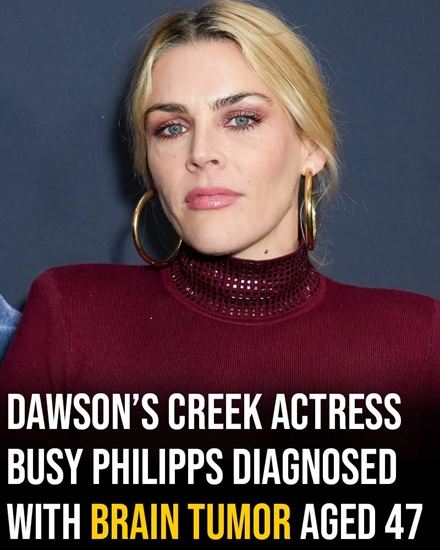
Busy Philipps has spoken publicly about an unexpected health experience after doctors discovered a tumor in her brain. The actress, known for roles in television series including “Dawson’s Creek,” discussed the diagnosis in an interview with People, describing the previous several months as among the strangest of her life. According to Philipps, the discovery was particularly surprising because she had not been experiencing symptoms that made her suspect she had a brain tumor. Instead, the process began after she decided to undergo a full-body MRI scan.
Philipps explained that there was no specific medical symptom that initially motivated her to have the scan. She had encountered information about full-body imaging on social media and decided that she wanted to undergo one herself. At the time, she did not know that the decision would lead to a significant medical discovery. The scan detected a lesion in her brain, turning what had begun as a personal decision to obtain additional health information into a much more serious situation requiring further evaluation by medical professionals.
After the abnormality was identified, Philipps underwent additional medical assessment. She recalled being told that doctors were dealing with an actual tumor inside her brain and that it needed to be removed. The news understandably came as a major shock. Philipps described struggling to control her breathing as she processed what doctors were telling her. Until that point, she had been living without the symptoms she might have associated with such a diagnosis, making the discovery even more unexpected.
One of the most difficult parts of the experience involved discussing the situation with her family. Philipps is the mother of two children, and she described the emotional challenge of telling her older child, Birdie, what doctors had found. Faced with the fear that can accompany the words “brain tumor,” Philipps attempted to reassure her daughter that the diagnosis did not automatically mean the worst possible outcome. Her comments reflected the difficult balance between being truthful about a serious medical situation and trying to prevent fear from overwhelming her family.
Philipps ultimately underwent brain surgery to remove the mass. According to the information she shared with People, doctors removed a tumor measuring approximately 2.6 centimeters. Testing subsequently identified it as a grade 2 oligodendroglioma. Oligodendrogliomas are tumors that develop from cells in the brain, and their characteristics, treatment and expected course can differ depending on factors specific to each patient and tumor. Philipps’ physicians were therefore central to determining what the diagnosis meant in her particular case.
Dr. Alexandra Miller, a neuro-oncologist at NYU Langone who was identified by People as Philipps’ doctor, provided additional context about the diagnosis. Miller explained that the tumor is considered malignant but described this particular category as having a comparatively favorable prognosis among malignant gliomas. She also explained that its classification as cancerous relates significantly to its ability to grow again over time. That distinction provides important context because the word “malignant” can otherwise lead readers to make assumptions that may not accurately describe an individual patient’s circumstances.
The diagnosis did not mean that every question about Philipps’ future could immediately be answered. Brain tumors are complex medical conditions, and prognosis depends on numerous clinical factors that cannot be determined from a celebrity interview alone. Philipps’ medical team had access to her imaging, pathology and other information necessary to guide her care. Her publicly shared experience describes her individual medical journey and should not be interpreted as a prediction for other people who may receive a similar diagnosis.
Following surgery, Philipps appeared eager to begin moving again. She recalled walking around the hospital during her recovery. Some members of the nursing staff reportedly expressed concern that she might be inclined to resume normal activity too quickly. Philipps remembered nurses suggesting that patients who appear energetic after a major procedure can sometimes make medical staff nervous because they may have difficulty giving themselves enough time to slow down and recover.
That tendency soon became relevant as Philipps returned to professional responsibilities. Not long after her operation, she resumed work on “Cupertino.” Returning to a production after brain surgery represented another unusual chapter in an already unexpected period of her life. Although she was able to get back to work, her medical experience was not completely finished. A separate problem involving her surgical incision would eventually require additional attention and another procedure.
The issue was noticed unexpectedly during an appointment with her dermatologist. Philipps said she was receiving Botox when the dermatologist observed that the area around her surgical incision did not appear normal. Rather than ignoring the change, Philipps contacted her medical team and sent them an image of the incision. According to her account, her doctors agreed that its appearance was concerning and needed to be evaluated.
Doctors subsequently determined that the incision had developed a staph infection. Fortunately, Philipps said the problem was discovered before it became a deep infection. Nevertheless, it was serious enough to require another surgery. That meant returning to medical treatment after she had already gone through the emotional and physical demands of the original brain operation. The complication added another difficult stage to what she had already described as an extraordinarily strange six months.
Philipps nevertheless emphasized gratitude when discussing what happened. Rather than focusing exclusively on the frightening aspects of the diagnosis and surgeries, she described herself as extraordinarily fortunate. The tumor had been discovered despite the absence of symptoms that had specifically pointed toward it, and she had access to physicians who could evaluate and treat the condition. The later infection was also recognized before it progressed into a deeper problem.
Her description of feeling like “the luckiest girl in the world” reflected that perspective. The statement did not minimize the seriousness of undergoing brain surgery or dealing with a postoperative infection. Instead, Philipps appeared to be acknowledging how differently the circumstances might have unfolded. Early detection in her individual case gave her doctors an opportunity to evaluate the tumor and determine an appropriate treatment strategy.
The experience also changed the way Philipps talked about obtaining medical information. She encouraged people to pay attention to their concerns and emphasized that having information can sometimes feel empowering. Her comments came from her personal experience of receiving significant medical information unexpectedly. However, her particular path to diagnosis should not be treated as a universal screening recommendation for people without symptoms.
Full-body MRI screening in people who do not have symptoms is a subject that requires medical context. Incidental findings can sometimes identify significant conditions, as happened in Philipps’ case, but scans can also uncover abnormalities that are harmless or uncertain and may lead to additional tests or anxiety. Whether any particular screening procedure is appropriate depends on a person’s health history, risk factors and medical circumstances. Decisions about testing are best discussed with qualified healthcare professionals rather than based solely on another person’s experience.
Philipps’ story is therefore most accurately understood as an account of what happened to one individual rather than evidence that everyone should follow exactly the same path. She underwent imaging, an abnormality was discovered, specialists investigated it, and surgery followed after doctors determined that treatment was necessary. Her subsequent complication was also evaluated by medical professionals rather than diagnosed from an image alone.
Another important element of her account is that she did not describe experiencing obvious warning signs before the discovery. That detail contributed significantly to her surprise. Many medical conditions can produce different symptoms in different people, and the absence or presence of a particular symptom cannot independently establish whether someone has a brain tumor. Anyone concerned about neurological symptoms or other changes in health should seek individualized medical evaluation rather than comparing symptoms with those described by a public figure.
For Philipps, the psychological impact appears to have been substantial even though she maintained an energetic approach to recovery. Learning unexpectedly that something was growing inside her brain forced her to confront possibilities she had not anticipated. Her recollection of hyperventilating after receiving the news illustrates the immediate fear she experienced. Her concern then extended beyond herself to her children and how they would process what was happening.
Her conversation with Birdie was particularly emotional. Philipps attempted to frame the diagnosis in language that would reassure her daughter rather than allow fear to determine how the family understood the situation. She told Birdie that she was not living through a story in which her mother would die during her senior year of high school. The wording reflected Philipps’ background as an actress while also revealing the very real concerns confronting a parent who must explain a frightening diagnosis to a child.
The situation also demonstrates why medical terminology requires careful explanation. Hearing that a tumor is malignant can immediately create understandable fear, but different tumors can behave differently. Dr. Miller’s comments supplied context about the characteristics of Philipps’ oligodendroglioma and why its prognosis could differ from that of other malignant gliomas. Such distinctions are best explained by specialists familiar with an individual patient’s diagnosis.
Oligodendroglioma is not simply another name for every type of brain cancer. It represents a specific tumor diagnosis, and modern classification also takes molecular characteristics into consideration. Treatment and follow-up decisions can therefore vary substantially between patients. Philipps’ diagnosis, tumor size and treatment should not be generalized to another person without appropriate medical assessment.
The successful removal of the mass also did not mean Philipps could simply forget about what had happened. Her doctors will determine the appropriate monitoring and follow-up based on the characteristics of her tumor and her individual situation. The possibility of recurrence is one reason long-term medical supervision can be important with this type of condition. Details about future treatment should come from Philipps and her medical team if and when they choose to make that information public.
The postoperative infection created a different type of challenge. Surgical wounds require monitoring because infections can occur even when an operation itself has gone according to plan. In Philipps’ case, another healthcare professional noticed that something about the incision did not look right. She then contacted the doctors responsible for her care, allowing them to assess the problem and intervene.
Philipps’ account of returning to work soon after surgery also reflects her personal circumstances rather than a recommended recovery timetable. Recovery from neurosurgery can vary considerably depending on the procedure and the individual. Some patients may require substantially more time before returning to normal activities. Her nurses’ comments about slowing down illustrate that even someone who feels energetic after surgery still needs to follow the guidance provided by the medical team overseeing recovery.
Throughout the experience, Philipps maintained the sense of humor and directness that audiences have associated with her public personality. She has spent decades working in entertainment and has frequently spoken openly about different parts of her life. This time, however, the subject involved an unexpectedly serious medical diagnosis. Sharing the experience publicly allowed her to explain what had happened in her own words rather than leaving the circumstances open to speculation.
Philipps first became widely familiar to television audiences through roles in series including “Freaks and Geeks” and “Dawson’s Creek.” She later appeared in numerous television and film projects, including “Cougar Town,” which earned her additional recognition. Her career has continued across acting, hosting, writing and other entertainment projects. The brain tumor diagnosis therefore emerged during an active period of her professional and family life rather than after she had withdrawn from public work.
That background helps explain why her rapid return to activity was unsurprising to people familiar with her personality, even though members of her medical team reportedly encouraged caution. Philipps has built a reputation for being energetic and candid. Yet her experience also demonstrates that determination cannot substitute for medical monitoring. The discovery of the infection required professional treatment despite how capable she may have felt after the original operation.
Perhaps the strongest theme in Philipps’ account is the contrast between fear and gratitude. She experienced the shock of unexpectedly learning she had a brain tumor, faced the emotional challenge of discussing it with her family and underwent major surgery. She then encountered an infection that required another procedure. At the same time, she repeatedly returned to the idea that she had been fortunate to discover the tumor and to have access to a medical team capable of treating her.
Her comments about trusting personal instincts should likewise be understood within that context. Philipps believes seeking additional information proved extremely important in her own situation. That is a description of her experience, not proof that a specific medical test is necessary for everyone. Responsible health decisions involve balancing potential benefits, limitations and risks with guidance from qualified professionals.
The distinction matters because stories involving celebrities can influence how readers think about their own health. A dramatic diagnosis discovered through an elective scan may understandably encourage others to wonder whether they should undergo the same test. However, medical screening recommendations are developed by considering evidence across large groups of people rather than a single unusual case. Individual health concerns should therefore be discussed with a healthcare professional who can evaluate personal circumstances.
Philipps has not presented herself as a medical expert. She has instead described what happened to her and how it changed her perspective. Her doctors provide the clinical context, while Philipps provides the personal experience of unexpectedly becoming a patient. Keeping those two roles separate helps prevent an individual story from being transformed into unsupported medical advice.
Her story also highlights how quickly an ordinary period of life can change after an unexpected medical finding. Philipps went into the scan without symptoms specifically suggesting a brain tumor. She emerged from the process facing specialist appointments, surgery and difficult conversations with her children. Months later, she could look back on those events with gratitude, but that perspective came after significant uncertainty and treatment.
The emotional experience should not be overlooked simply because her prognosis was described positively compared with other malignant gliomas. Receiving any brain tumor diagnosis can be frightening. Philipps’ description of struggling to breathe when doctors explained the situation gives a glimpse into that fear. Her later optimism exists alongside that experience rather than erasing it.
Her family also became part of the journey. As a mother, Philipps had to process her own concerns while thinking about how much information to give her children and how to reassure them. Her conversation with Birdie demonstrates how serious illness can affect an entire family even when only one person is receiving treatment. Emotional support can therefore become an important part of navigating major medical events.
There was also uncertainty after the initial operation. The discovery of a staph infection showed that recovery is not always a straight path from surgery to normal life. Philipps had already resumed professional activities when another medical issue appeared. Fortunately, according to her account, the infection was recognized before becoming deeper, and doctors were able to address it surgically.
Looking back, Philipps has chosen to focus substantially on how fortunate she feels. She had access to imaging that identified the tumor, specialists who could evaluate it, surgeons who removed it and medical professionals who responded when the incision became infected. Those circumstances shaped her description of herself as exceptionally lucky despite everything she endured.
The experience has also left her more convinced that people should feel comfortable asking questions about their health. Patients can advocate for themselves by describing symptoms accurately, asking for explanations and seeking appropriate professional guidance when they remain concerned. At the same time, self-advocacy does not require assuming the worst or pursuing every available medical test without considering its benefits and limitations.
Philipps’ case is unusual precisely because a significant finding emerged when she was not reporting symptoms that made her suspect a brain tumor. It is therefore understandable that her story has attracted considerable attention. Yet the most useful way to discuss it is without sensationalizing the diagnosis or suggesting that her experience predicts what will happen to others.
For now, the information Philipps has chosen to make public provides a remarkable account of an unexpected diagnosis and recovery process. A voluntary scan led to the discovery of a brain lesion, further evaluation identified a tumor, and surgery removed a 2.6-centimeter mass that was diagnosed as a grade 2 oligodendroglioma. A subsequent infection of the surgical incision required another operation, adding another challenge to her recovery.
Through all of it, Philipps has emphasized gratitude for the circumstances that allowed the tumor and later infection to be addressed. She has also spoken candidly about fear, motherhood and the difficulty of slowing down after surgery. Those details make her story more than a simple celebrity health announcement. They show the emotional complexity that can accompany an unexpected diagnosis even when doctors can offer reasons for optimism.
Her experience ultimately carries a straightforward message without requiring exaggerated conclusions. Philipps encountered a serious and unexpected medical problem, received specialist treatment and experienced a complication that required additional care. She has chosen to share that journey publicly while expressing appreciation for the people who treated and supported her.
For readers, the responsible takeaway is not that everyone will share Philipps’ medical experience or should automatically pursue the same testing. Instead, her story illustrates the importance of communicating concerns, obtaining reliable medical information and working with qualified professionals when health questions arise. Philipps can tell people what happened to her; individual doctors remain the appropriate source for determining what another person should do about their own health.
After an extraordinary period involving an unexpected brain tumor diagnosis, major surgery, a postoperative infection and a second procedure, Philipps has emerged speaking with gratitude rather than presenting herself solely through the fear of what happened. Her description of feeling extraordinarily lucky captures the perspective she has chosen to take from the experience. It acknowledges both the seriousness of the diagnosis and her appreciation that medical professionals were able to identify and treat the problems she faced.
