
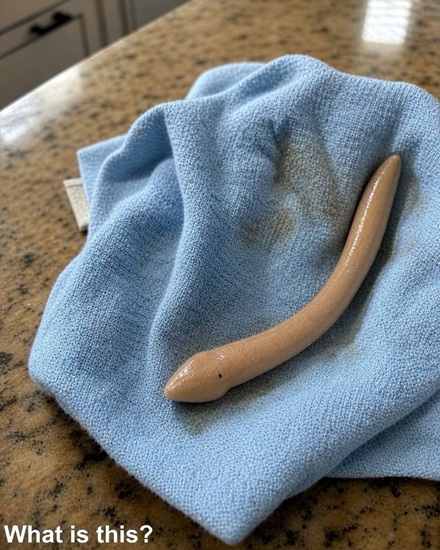
What first looked like an ordinary piece of debris on a bathroom floor quickly became something far more unusual. According to the account, a dark and irregular object was noticed lying off to one side of the room where the light was not especially strong. From a distance, it looked harmless and easy to ignore. It could have been a piece of rubber, torn packaging, or some small object that had fallen unnoticed. Bathrooms often collect bits of lint, hair, wrappers, and other small items around cabinets, drains, and corners.
At first, there seemed to be no reason to think this was anything different. A second look, however, made the object seem less ordinary. Its surface did not appear flat or rigid like plastic. Instead, it looked thick, uneven, and strangely organic. The shape seemed more like a small body than a manufactured object. That difference was subtle, but it was enough to make the observer hesitate. Rather than simply picking it up and throwing it away, the person began watching it more carefully.
The bathroom suddenly became the focus of a quiet search. The area near the toilet was checked first, followed by the space under the sink and around the visible pipes. The observer also looked near the shower, along the walls, and into the darker corners of the room. Nothing else appeared unusual. There was no obvious broken object that could explain what was lying on the floor. The lack of an easy explanation made the situation more puzzling.
Then came the moment that changed the interpretation completely. The object appeared to move. At first, the observer reportedly wondered whether the movement had been imagined. Changes in light, perspective, or even a slight shift in position can sometimes make a stationary object look different. For a few seconds, it was still possible to believe that nothing had actually happened. But when another small movement was noticed, the explanation involving trash became difficult to maintain.
The object was apparently alive. That realization transformed the situation from a minor household mystery into an encounter with an unidentified animal. Rather than moving closer or attempting to touch it, the observer stepped back. That was a sensible choice because an unfamiliar creature should not be handled until its identity and condition are better understood. Some animals are harmless, while others can bite, sting, irritate skin, or simply be difficult to identify correctly.
A closer look from a distance reportedly revealed that the creature had a soft and moist-looking body. It did not resemble ordinary household debris at all once movement was visible. The observer began comparing its appearance with images of small invertebrates found in wet or humid environments. Through that process, the animal was eventually believed to be a leech. The available account, however, does not mention confirmation by a zoologist or another specialist.
Because no expert identification is included, the safest description is that the creature was thought to be a leech rather than definitively proven to be one. That distinction is important. Many small animals can look similar when seen in poor lighting or from a distance. Leeches, worms, larvae, slugs, and other soft-bodied organisms can sometimes be confused by people who are not trained to identify them. A photograph can suggest possibilities, but it does not always provide certainty.
Leeches are members of a group of segmented worms known as Hirudinea. They are related to other annelids, including earthworms, although their appearance and behavior can be quite different. Many species live in freshwater habitats such as ponds, streams, wetlands, and other damp environments. Others can live in more specialized habitats. Their bodies are usually flexible, muscular, and capable of extending and contracting as they move.
The common image of a leech is often that of a blood-feeding parasite, but that description does not apply equally to every species. Some leeches do feed on the blood of vertebrate animals, while others prey on small invertebrates or consume different forms of animal material. Without knowing the exact species, it would be inaccurate to say that the animal in the bathroom was definitely blood-feeding. The original account does not provide enough information to establish that.
If the creature really was a leech, its movement would be completely normal. Leeches are not passive organisms. Many can move by using muscular contractions and suckers, allowing them to crawl across surfaces or travel through water. To someone expecting to see a piece of trash, even a slight movement can look startling. The surprise comes from the mistaken first impression rather than from anything unusual about the animal’s ability to move.
The fact that the creature was found in a bathroom naturally raised questions about how it got there. Drains and plumbing may seem like obvious possibilities because bathrooms are connected with water. However, the supplied account does not establish that the animal actually came through a drain. It could theoretically have entered in several ways, including accidental transport on footwear, clothing, another object, or through a small opening. None of those possibilities can be confirmed from the available details.
This is where unusual household stories can easily become misleading online. A photograph of a worm-like animal in a bathroom can quickly turn into a dramatic claim that parasites are emerging from the plumbing. That conclusion may sound alarming, but a single sighting does not prove a problem with the building’s water or drainage system. More evidence would be needed before making that kind of claim. One animal by itself does not establish an infestation or structural issue.
The original narrative also does not identify the exact location where the incident occurred. That missing detail matters because different leech species occur in different regions and habitats. Climate, nearby water sources, and local wildlife can all affect what species might realistically be found in a particular place. Without geographical information, identifying the animal more precisely would involve guesswork. A responsible account should avoid inventing a country, city, or local explanation that was never provided.
The bathroom setting likely made the discovery feel more unsettling than it would have in nature. A leech seen beside a pond or in wet vegetation might immediately make sense because the surrounding environment provides context. The same animal on a clean bathroom floor feels completely out of place. Familiar indoor spaces tend to create an expectation of control and predictability. When wildlife appears inside them, even a very small animal can seem more disturbing than it actually is.
That shift in perception is an important part of the story. Before movement was noticed, the observer reportedly saw nothing more than an object that needed to be cleaned up. After the movement, every corner, drain, and pipe suddenly seemed potentially relevant. Nothing about the room itself had changed. The only thing that changed was the understanding that something alive was present.
This reaction is understandable. Humans naturally become more alert when they encounter something they cannot immediately identify. The mind begins searching for explanations and possible sources. In that state, ordinary features of a room can suddenly seem suspicious. Drains become pathways, damp areas become hiding places, and shadows become possible signs of movement.
Careful observation helps separate those imagined possibilities from what can actually be established. In this case, the direct observations were limited. There was a dark soft-bodied object on the floor, it reportedly moved, and it appeared moist or organic. The later interpretation was that it resembled a leech. The source of the animal remained unknown.
Keeping those categories separate is essential for factual reporting. What was seen should be described as observation. What was concluded from comparison should be described as identification or belief. What cannot be confirmed should remain uncertain. That approach avoids turning a curious incident into an exaggerated warning.
The story does not mention that anyone was bitten or physically harmed. There is also no report that the creature approached anyone aggressively. The account is about discovery and identification, not an attack. This distinction should remain clear because animal stories are often made more dramatic by implying danger that was never actually present.
Even if some leeches can feed on blood, that fact does not mean every leech found near a person is actively trying to attach to them. Animal behavior should not be interpreted as intention without evidence. Movement alone simply shows that the organism was alive. It does not establish where it was going or what it was attempting to do.
For someone encountering an unfamiliar creature indoors, the safest first step is usually to avoid touching it with bare hands. A clear photograph can often provide useful information while maintaining distance. If the organism cannot be identified, local wildlife specialists, pest-control professionals, or other knowledgeable sources may be able to help depending on the situation. The correct response depends on the animal and whether sightings continue.
One isolated encounter does not necessarily require a dramatic response. If no other creatures are found and there are no signs of a larger problem, the incident may simply have been accidental. Small animals can enter homes in many ways. Open doors, cracks, damp materials, shoes, plants, pets, and other objects can all transport tiny organisms without anyone noticing. Bathrooms may also provide moisture that allows some animals to survive longer than they would in a dry room.
The account does not explain what happened to the creature after it was identified. That detail should not be invented. There is no reliable information about whether it was removed, released, or handled by someone else. The story ends mainly with the realization that the strange object was alive and likely belonged to a familiar group of invertebrates. That is enough to preserve the central surprise without filling in missing events.
Leeches themselves are more biologically interesting than their reputation might suggest. Their bodies are highly specialized for their lifestyles. Many species have suckers that help them attach to surfaces or hosts. Their muscular bodies allow them to stretch, contract, and move in ways that can appear unusual to people unfamiliar with them.
Some blood-feeding species have developed substances in their saliva that interfere with normal blood clotting. One well-known substance associated with medicinal leeches is hirudin. This adaptation helps certain species feed efficiently. It also contributed to the historical and modern medical interest in leeches. Their biology is therefore more complex than the simple image of a frightening parasite.
Medicinal leeches have been used in healthcare under controlled circumstances, especially in certain reconstructive procedures where blood circulation needs assistance after surgery. That medical use does not mean wild leeches should be handled casually. It simply illustrates that an organism often viewed negatively can have biological properties with useful applications. Context matters greatly when discussing wildlife.
The suspected bathroom leech, however, should not be connected to medicinal use without evidence of its species. It was simply an unidentified or tentatively identified animal found in an unusual place. This is another example of why specific claims require specific evidence. Knowing that some members of a biological group have a certain characteristic does not mean every member does.
The same principle applies to blood feeding. Some species specialize in blood meals, while others are predators of smaller animals. A viral article that automatically describes every leech as a dangerous bloodsucker simplifies a diverse group of organisms. Accurate reporting can remain interesting without relying on that stereotype.
The emotional reaction described in the account is still understandable. Most people do not expect to find a worm-like creature moving across a bathroom floor. Surprise often creates a stronger sense of danger than the actual facts justify. The unfamiliar shape, damp surface, and unexpected movement can easily trigger discomfort.
Once the likely identity is understood, however, the situation becomes less mysterious. The creature belongs to a known category of animal rather than being an unexplained organism. Questions about how it arrived remain, but uncertainty about the route does not make the animal itself unknown. Science can explain what leeches are even when one specific encounter cannot be reconstructed completely.
This distinction between identifying an animal and explaining its arrival is important. The observer may have become confident that the creature resembled a leech while still having no idea how it entered the bathroom. Both statements can be true at the same time. Not every mystery has to be solved completely.
It is tempting to connect the animal with the nearest drain simply because drains lead away from the room. But proximity is not proof. The creature may have been carried inside unknowingly or entered through another opening. Unless someone actually saw it emerge from the plumbing, the source should remain unconfirmed.
The same caution applies to assuming it had been inside for a long time. The account includes questions about whether someone else had seen it earlier, but these were only thoughts. There is no evidence about how long the creature had been there. It could have arrived recently or remained unnoticed for some period of time. The available material does not allow a precise answer.
Stories like this become stronger when those uncertainties are preserved rather than hidden. Readers can follow the observer’s experience without being told that every unanswered question has a definite solution. Real-life encounters often contain missing information. A factual article should reflect that reality.
The initial comparison with trash also reveals something interesting about how humans recognize living things. Shape, texture, movement, and context all influence perception. Without movement, a small dark animal can easily be mistaken for debris. Once movement occurs, the brain immediately reclassifies what it sees.
That sudden reclassification created the central moment of the story. The object had not transformed physically. It had simply revealed a characteristic that proved the original assumption wrong. What seemed like something inanimate was actually alive. That simple shift was enough to make an ordinary bathroom feel completely different.
The event can also serve as a reminder that homes are not completely isolated from the natural world. Small insects, spiders, worms, and other organisms occasionally find their way inside buildings. Most are noticed only because they appear in places where people do not expect them. Their presence does not automatically indicate poor hygiene or dangerous conditions.
Bathrooms in particular can attract or temporarily support moisture-loving organisms because of humidity and access to water. Still, the exact explanation depends on the species and the building. A single observation is not enough to make broad claims about why the animal appeared. Detailed conclusions require more evidence.
If a similar creature were found repeatedly, the situation would be different. Multiple sightings could justify investigating possible entry points, damp areas, plumbing issues, or nearby habitats. Repetition provides more evidence than one isolated encounter. In the story provided, however, only a single animal is described.
That difference matters when discussing infestations. An infestation involves repeated or established presence, not merely one unexpected organism. The supplied account offers no evidence of additional leeches. It therefore should not be described as an infestation.
The observer’s decision to search online was understandable and common. Image comparisons can be useful when trying to identify unfamiliar wildlife. But online results vary in quality, and confident-looking photographs can sometimes lead to mistaken matches. Reliable scientific resources are preferable to anonymous comments when possible.
Clear photographs showing size, body shape, color, movement, and other features can improve identification. Location information can also help because wildlife distribution differs by region. In this case, those details are incomplete, so certainty should remain limited.
The story still has educational value. It introduces readers to a group of animals they may know only through stereotypes. It also demonstrates the importance of maintaining distance from unidentified wildlife and separating observation from speculation. These are useful lessons even when the precise species remains uncertain.
The encounter should not be framed as evidence that bathrooms are generally unsafe. There is no indication of a widespread threat. An unusual animal was reportedly found in one room under circumstances that remain unclear. That is a much narrower claim than some viral headlines might suggest.
Likewise, there is no reason to suggest that ordinary tap water was contaminated. The animal was seen on the floor, not described as emerging from a faucet or being found in drinking water. Those additional claims would require evidence that the source does not provide. Adding them would turn a curious wildlife story into misinformation.
The most accurate version stays close to the sequence that was actually described. Something that looked like debris was noticed. A second look raised doubts. Movement showed that it was alive. The observer kept a distance, examined it visually, and eventually believed it resembled a leech.
The route into the room remained unknown. The exact species remained unknown. No injury was reported. No confirmed infestation was reported. Those limits define the story just as much as the discovery itself.
This careful framing also avoids unnecessarily frightening readers. Wildlife stories can be engaging without implying that every unusual animal represents an immediate threat. Curiosity and factual explanation are often more useful than fear. A leech-like animal on a bathroom floor is already unusual enough to attract attention on its own.
For many readers, the strongest part of the account will probably remain the moment of movement. People are accustomed to seeing small pieces of debris on floors and ignoring them. Discovering that one of those apparently meaningless objects is actually alive creates an immediate emotional reaction.
That reaction explains why the observer reportedly began examining every part of the bathroom. The room had changed psychologically even though it remained physically the same. Familiar objects became part of a search for an explanation. This is a common response to unexpected wildlife encounters.
Once the likely identity was established, the fear could be placed into a more realistic context. Leeches are known animals with established biology. They do not need supernatural or mysterious explanations. The remaining question concerned only how one ended up in an unusual indoor location.
Sometimes that question may never be answered. Small organisms are easy to transport accidentally and difficult to track. Unless an entry route is observed directly or a repeated pattern develops, determining the exact origin may be impossible. Accepting that uncertainty is more accurate than inventing a dramatic explanation.
The account therefore works best as an unusual observation rather than a warning story. It shows how easily something ordinary-looking can turn out to be alive. It also reminds readers that first impressions are not always correct. A piece of apparent trash can sometimes be part of the natural world.
For anyone who finds something similar, calm observation is preferable to immediate contact. Keep some distance, prevent pets or children from touching the organism, and take a clear photograph if possible. Reliable identification should come before assumptions about danger.
If the animal appears repeatedly or if there are other signs of a building problem, further investigation may be appropriate. That could include checking for moisture issues, entry points, or other environmental conditions. But one unusual sighting alone does not establish a larger problem.
In the end, the mystery was both simpler and more interesting than the first assumption. The object was not merely discarded material. It was reportedly a small living creature that the observer believed to be a leech after comparing its appearance with online images.
The exact species was never established in the supplied account, and neither was the way it entered the room. Those unanswered questions should remain unanswered rather than being filled with speculation. What can be said with confidence is that an ordinary bathroom moment became memorable once an apparently lifeless object moved.
That is what gives the story its lasting appeal. The surprise came not from a dangerous attack or a dramatic emergency, but from the discovery that something completely overlooked was alive. A familiar room briefly revealed an unexpected connection with the natural world, and a piece of “trash” turned into a small biological mystery.

