
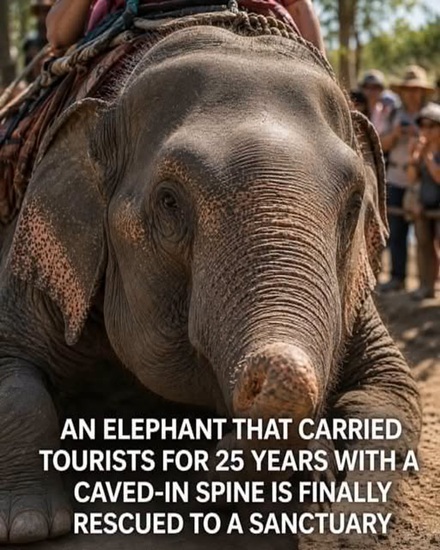
Pai Lin’s story became widely known because her body showed something that tourists may never notice during a short animal attraction. For many years, she worked in Thailand in environments where elephants were used for labor and tourism. One of the most visible consequences of that long working life was the unusual shape of her back. Instead of the rounded contour normally associated with an elephant, Pai Lin developed a deep curvature that remained visible for the rest of her life.
Her condition became closely associated with discussions about elephant welfare and the long-term effects of demanding work. It also offered a reminder that an animal’s large size does not mean its body is immune to injury or strain. According to Wildlife Friends Foundation Thailand, Pai Lin spent more than 25 years working in the elephant trekking industry. During that period, she was used to carry tourists and equipment on her back. WFFT reported that she sometimes carried a heavy seat with multiple passengers.
She had also experienced other demanding forms of work before entering sanctuary care. Her life therefore included far more than the brief moments tourists would have seen while riding her. By the time she arrived at the rescue organization, her body already showed signs of the difficult conditions she had endured. The deformation of her back became one of the most recognizable features associated with her story. Photographs later released by WFFT showed a noticeable difference between Pai Lin’s back and the more rounded shape normally seen in elephants.
The organization linked her condition to the years of demanding work she had experienced. At the same time, WFFT has noted that spinal deformities in elephants can have more than one contributing factor. Injuries associated with tourism or logging work, poor nutrition, and long-term physical stress can all potentially play a role. For that reason, it is more accurate to describe her condition as connected with a difficult working history rather than claiming that one single factor can be proven to have caused every part of the deformity.
Elephants are extremely large and powerful animals, which can make people assume that carrying humans is insignificant for them. That assumption can be misleading. Strength does not mean an animal has unlimited physical capacity, and repeated work can affect even very powerful bodies. An elephant may still walk and follow directions even while experiencing physical problems. The absence of an obvious reaction during a short tourist encounter is not enough to determine whether the activity is harmless. Long-term welfare must be evaluated over much more than a few minutes.
This is one of the central lessons of Pai Lin’s story. A tourist may spend only a short period riding an elephant before leaving the attraction and continuing with the rest of the day. The elephant, however, may repeat similar work many times and may continue doing so for years. The difference between those two experiences is enormous. One person remembers a single ride, while the animal experiences the cumulative effects of repeated work. That long-term perspective is often missing from the tourist’s view.
Pai Lin’s life reflected that difference very clearly. The people who rode her came and went, but the same body carried the weight each time. Over many years, that repeated physical demand became part of her history. By the time her condition was publicly documented, the damage visible in her back was already permanent. The tourists who had ridden her years earlier would likely never have seen what her spine eventually looked like. Her later photographs therefore provided a view of consequences that were invisible during the original experiences.
Her working history extended beyond tourism alone. WFFT later described Pai Lin as having spent decades in different forms of exploitation, including tourism, logging, and begging. This broader context is important because her physical condition should not be reduced to a simplistic before-and-after story based only on tourist rides. Her body had experienced many years of demanding use. That long working history helps explain why her case became such a strong example in animal welfare discussions. It also reminds readers that long-term damage often develops through repeated conditions rather than one isolated event.
By the time she reached Wildlife Friends Foundation Thailand, Pai Lin was already an older elephant. Early sanctuary reports described her as underweight and dehydrated when she arrived. She also required veterinary attention for health concerns beyond her back. Staff began providing food, fluids, supplements, and ongoing care. Her arrival marked a dramatic change from the working life she had previously known.
The rescue did not magically restore her spine to its original shape. Structural damage that develops over many years may not be reversible simply because the work stops. Pai Lin’s curved back remained visible throughout her later life. That permanence is an important part of the story because rescue should not be measured only by whether every injury disappears. Sometimes the most important achievement is preventing further damage and allowing an animal to live without continuing the activity that contributed to its condition.
After entering sanctuary care, Pai Lin no longer had to carry tourists. The heavy loads and passenger seat that had been part of her earlier working life were removed from her daily routine. Instead, she was able to spend her time in an environment where her needs rather than tourist entertainment became the priority. She could walk without passengers, rest more freely, and move at a pace appropriate for her age and condition. That change did not erase the past, but it fundamentally changed her future.
Her later life also allowed people to see more of her personality beyond the famous images of her deformed back. WFFT described Pai Lin as an independent and gentle elephant. She enjoyed activities such as bathing, walking, eating vegetation, and interacting with objects in her environment. Staff learned that she sometimes preferred having her own space, particularly as she became older. Respecting those individual preferences became part of her care.
This aspect of her retirement matters because animals are often discussed only through their injuries or the work they once performed. Pai Lin was more than the curve in her spine. She was an individual animal with habits, preferences, and behaviors that caregivers became familiar with over many years. Her sanctuary life provided an opportunity for those characteristics to become visible. Instead of being valued for how much weight she could carry, she was valued simply as an elephant deserving care.
Animal welfare science also provides important context for cases like Pai Lin’s. Researchers studying elephants in tourism environments have examined issues such as skin wounds, body condition, foot health, working conditions, equipment, and behavior. These studies demonstrate that evaluating an elephant’s welfare requires looking at many different factors. No single photograph or short observation can reveal everything about an animal’s condition. This is another reason Pai Lin’s story should be used carefully and accurately rather than turned into an exaggerated claim about every elephant ride in every location.
The presence of saddle-related lesions documented in some studies has shown that equipment can contribute to physical problems under certain conditions. Padding, fit, workload, terrain, and the amount of time an elephant spends working may all matter. These details are important because they move the discussion away from the assumption that an elephant can safely carry anything simply because it is large. They also demonstrate that management practices need to be assessed objectively. The welfare of each animal depends on far more than its apparent strength.
Pai Lin became especially important in public discussions because her condition was so easy to see. Many welfare problems are less visible. Chronic strain, poor nutrition, stress, or repeated minor injuries may accumulate slowly without producing an obvious dramatic sign at first. In Pai Lin’s case, however, the curve of her back eventually created a visual record that could not easily be ignored. The damage had become part of her physical appearance. Her body preserved evidence of a difficult period long after the work itself had ended.
That does not mean every tourist who ever rode an elephant knowingly intended to cause harm. Many people participate in animal attractions because they assume that an activity being openly sold to tourists must be safe. Some may have been told that elephants are strong enough to carry people comfortably. Others may never have considered how many times the same animal performs the activity. Pai Lin’s story provides information that can help future travelers ask more questions before making similar choices.
Those questions can be simple but meaningful. How long does the animal work each day? How much weight is being carried? What kind of equipment is used? Does the animal receive adequate rest, food, veterinary care, and opportunities for normal behavior? What happens when the animal becomes old or injured? Asking questions like these shifts attention away from the visitor’s experience alone and toward the conditions the animal lives with every day.
The idea that an activity has existed for many years does not automatically prove that it is harmless. Traditions can continue long after better information becomes available about their effects. Elephant tourism has changed in many places as public understanding of animal welfare has developed. Some facilities now focus more heavily on observation and reduced-contact experiences. Others still rely on rides or performances. The details of how animals are actually treated remain more important than the label used to describe a facility.
The word “sanctuary,” for example, can mean different things in different places. A responsible visitor should look beyond the name and examine what the animals are required to do. A facility centered on observation, veterinary care, space, social opportunities, and appropriate behavior may be very different from one that requires constant performances or physical interaction. Transparency about daily routines can help visitors distinguish between those environments. Pai Lin’s experience shows why those details matter.
For her, the most important change was that the work ended. After decades during which her body had been used as part of an industry, she entered a period where carrying tourists was no longer expected. The visible curve of her spine remained, but the repeated physical burden did not continue. That difference is central to understanding what rescue meant in her case. It was not about making her body look untouched by the past; it was about making sure the past was not repeated every day.
As Pai Lin aged, her sanctuary life became increasingly quiet. She was eventually the oldest elephant in WFFT’s care. Staff described her as enjoying simple routines and having strong preferences about how she spent her time. She could eat, bathe, walk, or rest without being required to perform for groups of visitors. Those opportunities may appear ordinary, but for an elephant with such a long history of human-directed work, they represented a substantial change.
Her advanced age also made veterinary monitoring important. Older elephants can experience age-related health concerns just as other animals do. Sanctuary care cannot eliminate the effects of aging, but it can provide monitoring, appropriate food, and treatment when needed. Pai Lin remained under WFFT’s care for almost two decades after her arrival. That period became a very different final chapter compared with the many years of labor that preceded it.
Pai Lin eventually died on December 15, 2025, at nearly 80 years old. Wildlife Friends Foundation Thailand announced her death and remembered her as more than the elephant whose damaged back had drawn international attention. Staff shared memories of her routines, including bathing, playing, eating, and enjoying her surroundings. A Buddhist ceremony was held following her death. Her passing marked the end of an exceptionally long life that had included both decades of exploitation and many years of sanctuary care.
This later update is important because older stories about Pai Lin sometimes continue to describe her as though she is still living at the sanctuary. Those stories may have been accurate when originally published, but they are now outdated. A current and factual account should acknowledge that she died in December 2025. It should also recognize that she spent almost two decades away from tourist rides before her death. That period forms an important part of her complete story.
Remembering her only for her injuries would therefore give an incomplete picture. The deformity of her back was significant because it showed the long-term consequences associated with her earlier life. But her later years also demonstrated what could change after rescue. She no longer had to prove her value through physical work. She could exist without constantly being useful to people.
This difference between entertainment and sanctuary is important. In an entertainment setting, the animal’s value can become connected with what it provides to visitors. That may involve rides, performances, photographs, or direct interaction. In sanctuary care, the focus should instead be the animal’s welfare and quality of life. Pai Lin’s transition represented that change in purpose.
Her story also challenges the common idea that an animal must visibly resist before an activity can be considered stressful or harmful. Animals can continue responding to training and instructions even when their physical condition is not ideal. A calm appearance does not automatically prove that every aspect of the situation is comfortable. Welfare assessments require more careful information than outward compliance alone. Pai Lin’s damaged spine made that distinction particularly clear.
Repeated physical strain can be difficult to recognize because it develops over time. One ride may not create an obvious visible difference. Neither may the next. But years of repetitive work can produce a very different outcome. This is one reason long-term records and veterinary observations are important when evaluating working animals.
The same principle applies beyond elephants. Horses, camels, donkeys, and other animals used for transportation or tourist activities can also experience welfare problems when workloads, equipment, nutrition, or rest are poorly managed. Each species and individual animal has different needs. The broader lesson is that visible strength should never replace careful assessment. An animal being capable of performing a task does not automatically mean the task is harmless when repeated indefinitely.
Pai Lin’s condition became powerful because it turned an abstract discussion into something people could see. Her curved back was not theoretical. It was visible in photographs and remained with her after she retired. That visual evidence encouraged many people to consider what happens to working elephants when tourists are no longer watching. It also raised questions about how retirement and long-term care should be handled for animals that have spent decades serving human industries.
Retirement is especially important because older working animals may eventually lose the ability to perform at the same level. A responsible system should consider what happens to them afterward. Animals should not be valued only while they are profitable or physically capable of working. Pai Lin’s later life offered an example of an elephant being cared for after her working years had ended. Her needs continued even when she was no longer carrying passengers.
Her story therefore shifts attention from a single tourist experience to the entire lifespan of the animal. A ride may last minutes, but an elephant can live for many decades. Decisions about training, workload, equipment, nutrition, veterinary treatment, and retirement can affect that entire life. Looking at the full timeline changes the way the activity is understood. It becomes less about whether one person enjoyed a ride and more about what the elephant experiences repeatedly over years.
There is also a difference between appreciating elephants and requiring them to perform. People can observe elephants walking, feeding, bathing, interacting socially, or exploring their surroundings without necessarily sitting on them or asking them to complete a particular routine. Observation-focused experiences can still allow visitors to appreciate the animals while placing less emphasis on direct physical entertainment. The quality of such experiences depends on how responsibly the facility operates, but the basic principle places the elephant’s behavior closer to the center.
Pai Lin’s history encourages travelers to consider that distinction. A memorable wildlife experience does not have to involve controlling or riding the animal. Watching an elephant behave naturally can provide a different kind of encounter. It may also help visitors understand elephants as complex animals rather than simply attractions designed for photographs.
Her case should still not be used to claim that every elephant involved in tourism will inevitably develop the same spinal deformity. Scientific accuracy requires acknowledging individual differences and multiple contributing factors. Pai Lin had a long and complicated working history that included tourism, logging, and other forms of labor. WFFT itself has noted that several factors can contribute to spinal abnormalities. Her story is therefore most useful when presented as a documented individual example rather than a universal prediction.
That careful framing does not weaken the message. Pai Lin’s life already contains enough documented hardship to demonstrate why elephant welfare deserves serious attention. There is no need to exaggerate or invent additional suffering. The visible deformation, the years of work, her poor condition when she entered care, and her long retirement provide a substantial factual story on their own.
Her life also shows that stopping further harm can be meaningful even when complete recovery is impossible. Pai Lin could not return to the physical condition she might have had before decades of demanding work. Her spine remained permanently changed. But she could stop carrying tourists. She could receive food, veterinary care, space, and opportunities to rest.
That type of outcome is sometimes overlooked when people imagine animal rescue as a dramatic transformation where every injury disappears. Real rehabilitation is often more complicated. Some animals live with permanent disabilities or chronic conditions. Success may mean helping them live comfortably with those conditions rather than pretending the past can be erased.
For Pai Lin, being allowed to carry nothing became a meaningful symbol of that change. For decades, her physical strength had been treated as something people could use. In retirement, she no longer had to demonstrate that strength for anyone. Her daily life was no longer organized around passengers or work. That simplicity carried enormous significance.
Her story also demonstrates why responsible tourism depends on information. Travelers cannot make informed decisions if they are shown only the attractive part of an experience. Knowing how animals are trained, housed, worked, and retired allows visitors to understand the full system they are supporting. Transparency helps people distinguish between attractions that prioritize animal welfare and those that primarily prioritize customer entertainment.
The goal should not be to shame people who previously participated without understanding those issues. Information is most useful when it helps people make better decisions in the future. Many travelers genuinely care about animals and would choose differently if they knew that a particular activity involved poor welfare conditions. Pai Lin’s story became one way those hidden conditions entered public discussion.
The emotional power of her photographs came partly from the contrast between expectations and reality. Elephants are often portrayed as symbols of enormous strength. Seeing such a large animal with a permanently deformed back challenged the assumption that strength made her invulnerable. Large animals can still be injured. Powerful animals can still have physical limits.
Those limits deserve respect. The ability to carry a load does not mean the body should be asked to carry that load repeatedly without careful consideration of health and welfare. The same principle applies to working animals generally. Capability is not the same thing as unlimited tolerance.
Pai Lin’s final years showed a different way of valuing an elephant. She was no longer important because tourists could sit on her back. She was important because she was a living animal with individual needs. Her caregivers remembered her habits and personality, not simply her usefulness. That change in perspective may be one of the strongest lessons her story offers.
After her death, the photographs of her curved spine remain. They continue to show the physical condition that drew attention to her life in the first place. But those photographs should be understood alongside the full timeline. Pai Lin did not spend her entire life carrying tourists. She eventually entered sanctuary care and remained there for many years.
That final chapter does not erase the earlier one, just as the earlier injuries do not erase the quieter years that followed. Both belong to the same story. One part shows what prolonged exploitation can leave behind. The other shows what can change when an animal is finally removed from those demands.
Pai Lin’s life therefore should not be reduced to a dramatic headline alone. Her story includes decades of difficult work, visible physical consequences, rescue, veterinary care, retirement, individual personality, old age, and ultimately her death at nearly 80 years old. Each part provides context for understanding why she became so widely discussed.
The deepest lesson may be that animal welfare needs to be considered from the animal’s full lifetime rather than from the visitor’s short encounter. Tourists come and go. The elephant continues living with the physical and psychological consequences of whatever conditions it experiences. That difference in perspective matters.
Pai Lin could not explain her working history to the people who once rode her. She could not tell them what decades of repeated labor might eventually mean for her body. Years later, the shape of her spine provided a visible record of part of that history. The damage had become impossible to separate from her appearance.
Yet her life after rescue added another message. Even when past harm cannot be completely undone, future harm can still be stopped. An animal can still receive rest, care, protection, and greater freedom from human demands. For Pai Lin, those changes defined almost two decades of her later life.
Her story remains relevant because wildlife tourism continues to raise questions about how animals are used for human entertainment. Those questions should be answered using evidence, transparent welfare standards, and careful observation rather than assumptions based on size or tradition. Pai Lin’s case provides a powerful example of why those questions are worth asking.
In the end, her curved spine was not simply an unusual physical feature. It was part of the record of a long and demanding working life. Her retirement showed that she no longer had to continue carrying the same burden. And her final years demonstrated that an elephant does not need to perform, transport, or entertain people in order to deserve protection and care.
Pai Lin died in December 2025 after reaching an extraordinary age and spending almost two decades in sanctuary care. Her back never returned to its original shape, but the life built around that damaged body changed dramatically after rescue. She was given years without tourist loads, years in which her daily existence no longer revolved around what people expected from her. That is why her story remains both difficult and meaningful: it shows that some damage can last a lifetime, but ending the conditions that caused or contributed to that damage can still profoundly change what remains of that life.

