
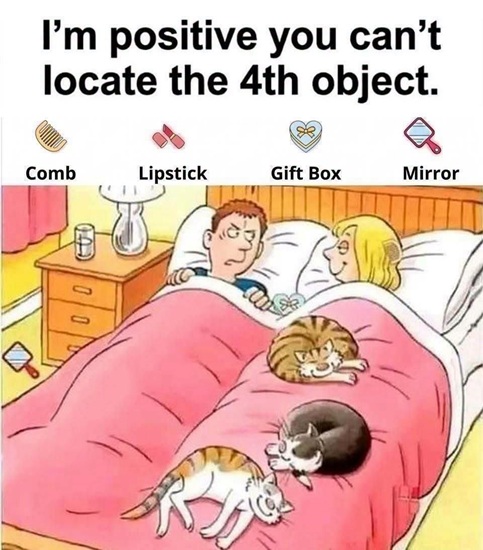
At first, this bedroom illustration may appear to show nothing more than an ordinary couple relaxing together in bed. There is furniture around them, bedding covering much of the center of the scene, and part of the floor visible below. However, the drawing contains another challenge that is easy to overlook. Four familiar objects have been incorporated into different parts of the picture: a comb, a small gift box, a mirror, and a tube of lipstick. They are visible, but none has been positioned where people would normally expect to find it.
That unusual placement is what makes the puzzle more difficult than it initially appears. Most viewers naturally begin by looking at the couple because people and faces tend to attract attention quickly. After that, the eye may move toward the pillows, blanket, furniture, and other large elements of the bedroom. The four missing objects are much smaller and have been designed to resemble parts of those larger features. Instead of being completely covered, they are disguised through their shapes and surroundings.
A line that belongs to an object may look like part of someone’s hair, while another outline can resemble a fold in the bedding. The challenge is therefore less about eyesight alone and more about recognizing familiar shapes in unexpected places. The comb is a particularly clever example. It has been incorporated into the woman’s hair rather than placed somewhere obvious such as a bedside table or dresser. Its narrow teeth follow the direction of the surrounding hair closely enough to appear like additional strands.
Because the viewer has already identified that area as hair, the brain has little reason to search for a separate grooming item inside it. Looking for repeated straight lines can reveal the trick. The comb’s teeth are more regular than the natural-looking texture around them.
Once the comb has been identified, it becomes surprisingly difficult to stop seeing it. This is a common feature of hidden-object puzzles. Before recognition occurs, the brain treats several lines as part of a larger background pattern. After someone realizes those same lines form a familiar object, they are mentally grouped together differently. Nothing in the illustration itself has changed. The only change is the interpretation of what was visible from the beginning.
The gift box requires a slightly different search strategy. It is positioned between the couple on the bed, surrounded by shapes created by their bodies, pillows, and bedding. The small rectangular form can easily disappear into that visually busy area. Straight edges that would immediately reveal a box on an empty table are much less noticeable when surrounded by folds and overlapping shapes. Searching specifically for corners and geometric lines can make the object easier to recognize. Instead of seeing the entire bed as one scene, viewers need to inspect its smaller components.
This hiding method works because bedding naturally produces irregular lines, folds, shadows, and corners. The artist can use those existing features to disguise the outline of another object without making it completely invisible. A gift box has a simple geometric structure, but the viewer does not expect to find one embedded within the middle of the bed. That mismatch between appearance and expected location provides effective camouflage. The eye receives enough information to see the object, while the surrounding context encourages the brain to interpret it as something else.
The mirror is hidden away from the main focus of the illustration. It can be found closer to the floor, where many people may not spend much time looking during their first attempt. Viewers often repeatedly examine the couple and the bed because those areas contain most of the visual activity. The lower portion of the room receives less attention, allowing the mirror to remain unnoticed. Its outline blends with the surrounding features rather than standing out as an obvious household item. A systematic scan of the entire picture is therefore more effective than staring repeatedly at the center.
Mirrors can also be challenging targets because they come in many different shapes. A person searching for a large rectangular wall mirror may completely overlook a smaller design. Rather than imagining one particular type, it helps to search for recognizable components such as a frame, reflective-looking area, or handle. Breaking an object into simpler visual characteristics often makes hidden-object puzzles easier. The goal is to identify the unusual lines before the complete object becomes obvious.
The fourth item is the lipstick. It appears toward the lower right side of the comforter, close to the floor. Its long and narrow form follows the visual direction of the bedding, allowing it to resemble a decorative feature or another line in the blanket. Since lipstick would normally be expected near a mirror, handbag, or dressing area, its position works against immediate recognition. The object is not necessarily difficult because its shape is complicated. It is difficult because the brain has already decided that the area contains fabric rather than cosmetics.
Looking specifically for a short cylindrical or tube-like shape can help. This is often more effective than repeatedly asking, “Where is the lipstick?” The complete image of a lipstick tube carries expectations about color and location that may not match the illustration. Searching only for its basic geometry removes some of those assumptions. The same technique can be used for all four hidden objects. Focus on the characteristics that define the object rather than where it should logically appear.
Taken together, the four hiding places reveal the basic strategy behind the puzzle. The comb disappears into hair because both contain repeated narrow lines. The gift box blends into a visually crowded section of bedding where geometric shapes do not immediately attract attention. The mirror benefits from being positioned near the less frequently examined floor area. The lipstick follows the edge and pattern of the comforter. Each object uses the surrounding scene differently, but all four rely on the viewer accepting the most obvious interpretation first.
This is why hidden-object puzzles can remain challenging even when the list of missing items is provided in advance. Knowing that a comb exists somewhere in the picture does not necessarily mean someone will immediately recognize it inside a hairstyle. Familiarity with an object’s normal environment can actually make the search more difficult. People know what combs and lipstick look like, but they also know where those things usually belong. The puzzle deliberately separates appearance from expected location.
Context plays an important role in everyday visual recognition. People rarely analyze every line, edge, and color individually. Instead, the brain rapidly combines visual information with previous experience to determine what is probably present. This process makes ordinary perception fast and efficient. A hidden-object illustration takes advantage of the same efficiency by creating situations where the most likely interpretation is temporarily incorrect. What looks like hair may contain a comb, and what looks like bedding may contain lipstick.
A good strategy is therefore to stop thinking about the bedroom as a complete scene. Divide the illustration mentally into smaller regions and inspect them one at a time. Begin with the people, including their hair, clothing, hands, and nearby areas. Then examine the pillows, sheets, comforter, and the space between the couple. Afterward, move to the furniture, walls, and floor. Finally, check the edges and corners of the image, which are easy to overlook.
A systematic search prevents attention from repeatedly returning to the same visually interesting areas. Without a plan, viewers may inspect the couple and center of the bed again and again while barely looking elsewhere. Moving deliberately from one section to another ensures that every part of the illustration receives attention. This method can be particularly useful when only one hidden object remains. The missing item is often located in an area that the viewer has unconsciously neglected.
Searching by shape is another effective technique. A comb should contain multiple parallel teeth. A gift box is likely to include straight edges and corners. A mirror may contain a frame, oval or rectangular surface, or handle. Lipstick usually has a narrow tube-like form. These basic characteristics remain useful even when colors and surrounding details have been changed to provide camouflage.
Color can actually be one of the least reliable clues in this type of puzzle. Hidden objects are often intentionally colored or shaded to match their surroundings. A brightly colored lipstick would be easy to spot if everything around it were neutral, so an illustrator can make its tone resemble the blanket. The same principle applies to the comb inside the woman’s hair. When color stops separating an object from its background, outline and geometry become more important.
Viewing the picture at a different size may also help. Zooming in can reveal tiny edges and repeated lines that are difficult to notice on a small screen. On the other hand, extreme magnification can sometimes make the complete shape harder to recognize because only individual pieces are visible. Moving slightly farther away can cause those pieces to combine into a familiar silhouette. Alternating between close and wider views can therefore reveal details that were previously missed.
Some people find that briefly looking away from the image is useful as well. After staring at the same section for a long time, the brain can become increasingly committed to its original interpretation. A short break followed by a fresh scan may make an unusual line suddenly stand out. This is particularly useful when someone knows an object must be present but cannot stop seeing the background instead. A new viewing angle can disrupt that familiar interpretation.
Another option is to cover part of the illustration while searching. If the faces keep drawing attention, temporarily hide the upper section and concentrate on the bed and floor. Then reverse the process. Reducing the visible information makes it easier to inspect details that might otherwise compete with more noticeable features. The method turns one complicated puzzle into several smaller searches.
None of these strategies should be interpreted as a formal assessment of intelligence. Hidden-object illustrations are primarily recreational visual puzzles. How quickly someone solves them can depend on screen size, eyesight, image quality, familiarity with similar puzzles, and whether the person already knows common hiding techniques. Someone who has completed dozens of these challenges may immediately search hair, fabric folds, shadows, and corners. A first-time player may use a completely different strategy.
Experience can therefore produce a major advantage. Once a person learns that artists frequently hide objects by matching their shapes with surrounding features, future puzzles become easier. Instead of simply looking for a complete item, experienced solvers begin searching for suspicious lines. They may notice that one section of hair contains unusually regular teeth or that a fold in a blanket is too geometric. This is learned pattern recognition rather than evidence of a particular intelligence level.
The puzzle can also be enjoyable when several people attempt it together. Friends or family members may discover that each person naturally focuses on a different part of the scene. One viewer might find the comb almost immediately while spending several minutes searching for the mirror. Another may spot the mirror first but repeatedly overlook the gift box. Comparing those experiences demonstrates how differently attention can be distributed even when everyone is looking at exactly the same picture.
If the puzzle is being used as a friendly competition, everyone should ideally view the same version of the image. A larger or clearer picture may make some hidden objects significantly easier to identify. Giving participants approximately the same amount of time also makes the comparison more meaningful. The goal, however, should remain entertainment rather than determining who has superior intelligence or eyesight. Differences in performance can have many ordinary explanations.
Hints can keep the challenge enjoyable when someone becomes stuck. The first hint can simply explain that the objects are not positioned where they would normally be used or stored. A second hint might say that some have been integrated into people or fabric. If more assistance is needed, the general areas can be identified without pointing directly to the objects. For example, telling someone to inspect the hair still leaves the actual comb for them to discover.
Providing the complete answer immediately removes the perceptual challenge. A gradual hint system allows the viewer to experience the satisfying moment of recognition independently. That moment is often the most enjoyable part of the puzzle. An apparently meaningless collection of lines suddenly forms an obvious familiar object. Once that recognition happens, it is difficult to return to the earlier interpretation.
Children can use the puzzle as an opportunity to practice observation and description. Instead of simply asking them to point at the hidden object, someone can ask what visual clue helped them find it. A child might notice the regular teeth of the comb or the unusually straight edges of the gift box. Explaining those clues encourages attention to shapes and patterns. The activity remains a game while also promoting descriptive language.
Adults can try the same approach. After solving the puzzle, compare not only the time required but the method used. Did someone search the entire image randomly, or divide it into sections? Did they focus on color, outline, or expected location? Which object caused the most difficulty? Those questions can make the challenge more interesting than simply recording a finishing time.
The puzzle also demonstrates the difference between seeing something and recognizing it. A viewer’s eyes may pass directly across the comb several times. The visual information reaches the person, but it is categorized as part of the woman’s hair. In that sense, the object is not physically hidden at all. It is perceptually disguised.
The same phenomenon explains why the solution can seem almost embarrassingly obvious afterward. Once the brain receives the correct interpretation, the object’s outline becomes dominant. The comb stops looking like hair. The gift box separates from the bedding. The mirror becomes distinct from the floor area, and the lipstick stops appearing to be part of the comforter.
This change is sometimes described informally as being unable to “unsee” the solution. The underlying illustration remains identical, yet perception has been permanently reorganized. Future views of the image begin with knowledge of the four objects rather than uncertainty about them. The camouflage that worked during the first attempt loses much of its power.
Hidden-object puzzles rely heavily on this relationship between attention and expectation. Artists do not necessarily need to make an object extremely small. A reasonably large object can remain difficult to detect if its lines are incorporated effectively into another recognizable form. The surrounding context effectively tells the viewer what to see. Only deliberate inspection reveals the alternative interpretation.
Edges are particularly useful hiding locations because they naturally contain strong lines. The edge of a blanket can disguise a cylindrical object such as lipstick. Hair provides repeated narrow lines that can conceal the teeth of a comb. Furniture and flooring contain geometric shapes capable of hiding frames and boxes. Puzzle design often involves matching the geometry of the target object with the geometry already present in the scene.
The bedroom setting provides many opportunities for this technique. Bedding contains folds and patterns, people provide hair and clothing, and furniture supplies straight lines and corners. A floor offers another relatively low-attention region where a small object can disappear. The artist can therefore distribute the targets across several different visual environments instead of placing everything in one area.
This distribution also encourages a complete scan of the picture. Finding one object does not necessarily reveal where the next will be. The comb teaches the viewer to inspect the people, while the gift box redirects attention to the bed. The mirror requires looking lower in the room, and the lipstick demands attention to the comforter’s edge. Successful completion requires moving beyond the illustration’s main focal point.
For anyone still searching, it may help to stop looking for recognizable colors and begin tracing outlines. Follow the woman’s hair and look for lines that seem unusually evenly spaced. Examine the area between the couple for a small rectangular structure. Scan the floor for a mirror-like outline. Finally, inspect the lower right side of the comforter for something that resembles a narrow cosmetic tube.
If those clues reveal all four objects, the puzzle is complete. The comb is concealed in the woman’s hair. The gift box is positioned between the couple on the bed. The mirror is hidden near the floor. The lipstick is incorporated into the lower right edge of the comforter.
The locations may seem surprisingly straightforward once they have been revealed. That is precisely why the illustration works. None of the objects needs to be completely invisible. Each one only needs to remain visually compatible with its surroundings long enough for the viewer to overlook it.
The puzzle is therefore a small demonstration of how strongly context guides perception. People do not simply record the world around them like cameras. The brain constantly interprets visual information using expectations and previous experience. Usually, that process helps people understand complex scenes quickly. In this illustration, it creates four entertaining mistakes.
A comb becomes hair because hair is what the viewer expects to see in that location. A rectangular gift box becomes part of the bedding because the bed already contains numerous overlapping shapes. A mirror near the floor receives less attention because viewers remain focused on the couple. Lipstick becomes part of the comforter because a cosmetic tube seems unlikely to appear there.
Once those assumptions are challenged, all four items become visible. That makes the bedroom puzzle an enjoyable example of how ordinary objects can effectively disappear without being covered or removed. Their outlines are present from the beginning, but the surrounding illustration provides a more convincing interpretation.
Whether someone finds all four objects in seconds or needs several minutes does not change the purpose of the challenge. It is a casual visual puzzle intended to test attention in an entertaining way, not a scientific measurement of intelligence. Different viewers will naturally solve it at different speeds.
The most interesting part may be discovering which object caused the greatest difficulty. Some people will struggle with the comb because the teeth merge so naturally with the hair. Others will repeatedly overlook the floor and therefore miss the mirror. The lipstick may fool viewers who interpret every line along the comforter as fabric, while the gift box can disappear among the crowded shapes in the middle of the bed.
Ultimately, all four objects were visible throughout the challenge. The comb was in the woman’s hair, the gift box was between the couple, the mirror was near the floor, and the lipstick was along the lower right side of the comforter. Nothing magically appeared when the answers were revealed. Only the viewer’s interpretation changed.
That simple effect is what makes hidden-object puzzles so satisfying. They demonstrate how easily familiar shapes can disappear when placed in unexpected contexts and how quickly they return once the correct pattern is recognized. The bedroom scene may look ordinary at first, but careful observation reveals a second layer that was waiting in plain sight all along.

