
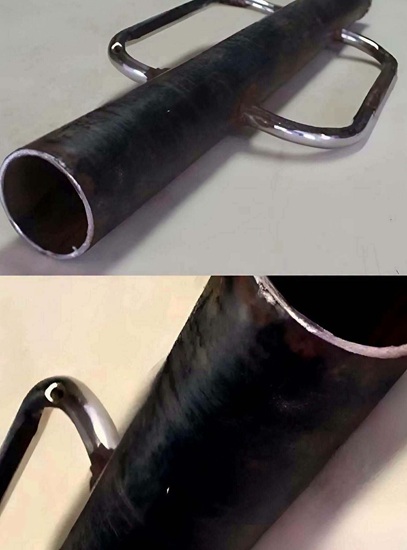
At first sight, this heavy piece of metal could easily be mistaken for discarded industrial equipment. Its thick cylindrical body, rough construction, and handles welded to the sides give it the appearance of something that might belong in a workshop, scrapyard, or piece of old machinery. Without seeing the object being used, its function is far from obvious. That lack of context is precisely why similar photographs can generate so many different guesses. The real explanation, however, is considerably more practical than many of the theories that an unfamiliar image might inspire.
Objects built in this general form are commonly used as manual post drivers, also known as post pounders or fence-post drivers. They are practical tools associated with fencing, agriculture, landscaping, and some construction work. Their purpose is straightforward: they help drive suitable posts into the ground through repeated downward impacts. A traditional manual version does not require electricity, fuel, or a complicated mechanical system. Instead, its effectiveness comes from a combination of weight, gravity, and the physical effort of the person operating it.
The construction of the tool provides important clues about how it functions. A typical manual post driver consists of a strong metal tube with an open lower end and a reinforced or closed upper section. Handles are normally positioned on opposite sides of the body so an operator can lift and lower the device while keeping it under control. To begin using it, the hollow section is placed over the top of an appropriate post. The operator then raises the driver using the handles before bringing it downward onto the post.
Each downward movement transfers energy from the heavy driver into the post below it. Repeating the process gradually pushes the post farther into the soil until it reaches the required depth. Because the tool surrounds part of the upper section of the post, the impact can remain more centered than it might when repeatedly striking a narrow post with an ordinary hammer. The design is therefore uncomplicated but purposeful. Its weight, shape, handles, and hollow interior all contribute to the same basic task.
This straightforward explanation also shows why the object can appear mysterious when photographed on its own. If the post, operator, and surrounding fence are removed from view, there are few immediate visual clues explaining what the cylinder actually does. People naturally compare unfamiliar objects with things they already know, so a rugged steel device may prompt guesses involving machinery, automotive equipment, military hardware, or construction components. Those guesses can sound plausible until the object is shown in the environment for which it was designed.
Not every post driver has exactly the same appearance. Different manufacturers and applications have produced tools of varying sizes, weights, handle designs, and construction methods. Manual post drivers represent one of the simplest versions, but powered alternatives are also available. Depending on the job, workers may use pneumatic, hydraulic, gasoline-powered, or machine-mounted equipment. These alternatives can reduce the physical effort required when a project involves many posts or difficult ground conditions.
The usefulness of these tools becomes easier to appreciate when considering how frequently posts are needed. Agricultural fencing may be installed to manage livestock, protect certain areas, establish boundaries, or separate sections of property. Residential and commercial fences also depend on properly positioned supports. Landscaping projects can require stakes or posts for a variety of purposes. Although driving a post into the ground may appear to be a small part of these projects, the stability of the finished structure often depends heavily on how well its supports are installed.
One notable characteristic of the traditional manual driver is how much it accomplishes with relatively few components. There is no complicated transmission, motor, electronic control system, or elaborate internal mechanism. The operator provides the lifting movement, gravity assists the downward motion, and the mass of the steel body contributes to the impact. The tool demonstrates how effective equipment can sometimes emerge from very simple engineering. Complexity is not always necessary when the physical design is well matched to the problem being solved.
That simplicity does not mean using the tool requires little effort. A substantial steel post driver can be heavy, and repeatedly lifting it can become physically demanding. Installing a large number of posts manually may require considerable time and energy. Ground conditions can make the work even more difficult. Rocky, compacted, unusually dry, or otherwise challenging soil can increase resistance and may require different equipment, preparation, or installation methods.
Safety is therefore an important consideration whenever equipment of this kind is used. A heavy metal object moving repeatedly above a post can cause serious injury if handled incorrectly. Users should follow the instructions supplied for their specific equipment, maintain control of the designated handles, and keep hands and other body parts away from impact and pinch areas. Appropriate protective equipment may also be necessary depending on the work environment. Before installing posts, relevant underground hazards and utilities should be identified as required for the particular location and project.
The position of the handles is one of the strongest visual clues to the object’s intended function. They are not simply there to make the heavy cylinder easier to carry from one location to another. During operation, the handles provide controlled gripping points for the repeated upward and downward movement of the driver. Their placement allows the operator to remain outside the main impact area while controlling the device. Once this function is understood, a feature that initially appears unusual becomes entirely logical.
The weight of the cylinder is equally important. A post driver is not merely a hollow sleeve designed to guide a post. Its mass contributes directly to the force generated during the downward movement. Instead of relying entirely on muscular strength to strike the post with another tool, the operator repeatedly raises a substantial weight and allows the resulting motion to help perform the work. This principle is simple, but it can be highly effective when used with equipment appropriate for the post and ground conditions.
The concept is related to one of humanity’s oldest approaches to practical work: using impact to move or shape materials. A hammer is the most familiar example, but the same general principle can be adapted to many specialized tasks. A post driver essentially modifies that concept for a vertical object that needs to be pushed into soil. By surrounding the upper portion of the post, the device directs repeated impacts from above while helping the operator maintain alignment.
For fencing work, this apparently small function can become an important part of a much larger project. A fence extending across a significant area may require numerous posts positioned at suitable intervals. Only after those supports have been installed can other fencing materials be secured to them. Depending on the design, that could include wire, mesh, boards, rails, or other components. The post driver does not build the entire fence, but it can help establish the foundation upon which the rest of the structure depends.
The same idea applies beyond farms and large rural properties. Gardens, residential boundaries, landscaping installations, temporary barriers, and other outdoor projects may involve posts or stakes. The exact equipment required varies considerably because not all posts are alike. A lightweight garden stake and a substantial structural support have very different installation requirements. For this reason, the broad category of post-driving equipment includes many designs rather than one single universal tool.
Powered post drivers extend the basic concept for jobs where manual operation would be inefficient. Mechanical systems can create repeated impacts without requiring the user to lift the full weight of a manual driver for every stroke. Larger equipment may also be mounted to vehicles or construction machinery for demanding applications. These designs can look dramatically different from the simple handled cylinder. Nevertheless, they share the same fundamental objective of transferring force into a post so that it can be installed in the ground.
Identifying an unknown metal object from a photograph still requires some caution. Similar-looking pieces of equipment can have different functions, and a generic description alone may not establish the exact model, manufacturer, age, or intended application. Measurements, markings, openings, welds, attachments, materials, and the location where an item was found can provide valuable additional information. For that reason, it is more responsible to identify the general type of tool when the available evidence does not justify a more specific conclusion.
This is particularly relevant to photographs shared online with dramatic captions. An image can circulate without information about where it was taken or who originally photographed the object. As that context disappears, speculation can gradually be repeated as though it were established fact. An industrial-looking object may then be described as rare, military, historical, or mysterious without reliable evidence supporting those descriptions. Careful identification begins with observable characteristics rather than the most dramatic explanation available.
The same caution applies to claims suggesting that “99% of people” cannot identify an object. Unless such a figure comes from a genuine and appropriately conducted survey, it should not be presented as a factual statistic. In many online headlines, percentages of this kind are simply attention-grabbing language. It is entirely reasonable to say that a tool may be unfamiliar to many viewers, particularly when shown without context. That observation does not require inventing a numerical measurement of how many people recognize it.
Once a manual post driver is shown in operation, much of the mystery disappears immediately. The open cylinder fits over the post because the post needs to remain inside the tool during each stroke. The handles provide control because the device must repeatedly be raised and lowered. Its substantial weight assists with the impact, while the durable metal construction allows it to withstand repeated use. Every major feature begins to correspond with a specific practical requirement.
This transformation illustrates how strongly context influences perception. The same piece of steel can look like meaningless scrap in one photograph and an obviously functional tool in another. Nothing about the object itself has changed. What changes is the information available to the viewer. Seeing the tool connected to its normal task provides the missing relationship between its unusual appearance and its practical design.
There is also an interesting engineering lesson hidden inside such an ordinary device. Tools intended for farms, construction sites, and outdoor work are often designed around durability rather than appearance. They may need to tolerate repeated impacts, dirt, transportation, weather exposure, and demanding physical conditions. Decorative details would add little value in those circumstances. A rugged steel cylinder may look crude precisely because reliability and function were given priority over aesthetics.
That practical philosophy explains why many older or specialized tools can be difficult to identify today. A person who regularly installs fencing might recognize a manual post driver immediately, while someone who has never performed that type of work may have no reason to know what it is. Familiarity depends heavily on experience. An object can therefore be completely ordinary within one profession or activity while appearing genuinely mysterious to people outside that environment.
For viewers encountering the device for the first time, understanding its function can make the design surprisingly intuitive. The hollow body accommodates the post. The handles allow the operator to control a heavy object. The mass of the steel assists in producing useful impact. The reinforced upper portion receives repeated contact with the post beneath it. What originally appeared to be an odd collection of welded components becomes a carefully practical arrangement once the intended task is known.
The object also demonstrates why the simplest explanation deserves consideration before more dramatic theories are accepted. Industrial and agricultural work has produced countless specialized tools that may look unusual when removed from their original environments. Many were designed for one specific job and therefore have shapes that make little sense until that job is understood. A strange appearance alone is not evidence that an object has an extraordinary origin.
In this case, a heavy hollow steel cylinder with appropriately positioned side handles is consistent with the familiar design of a manual post driver used for fencing and related work. Individual examples can differ, so an exact identification would require enough visual and physical information to rule out similar equipment. The general operating principle, however, is well established. The tool converts repeated lifting and downward movement into impacts that help drive an appropriate post into the soil.
Ultimately, the fascination surrounding this strange-looking steel object comes from the difference between first impressions and practical reality. Without context, it can resemble industrial scrap or a component from a much more complicated machine. Once its purpose is explained, its features become straightforward and logical. The object is a reminder that useful engineering does not always need motors, electronics, or complicated mechanisms. Sometimes a durable steel tube, carefully positioned handles, gravity, and a simple physical principle are enough to perform an important job.
Rather than being mysterious battlefield equipment or an unexplained mechanical artifact, the familiar manual post-driver design represents a practical solution developed for real work. Tools of this kind have helped people install posts for fences and other outdoor projects where secure supports are required. Their rugged appearance reflects the demanding environments in which they are intended to operate. What initially seems strange becomes understandable once the missing context is restored, turning an apparent mystery into a clear example of simple, functional engineering.

