
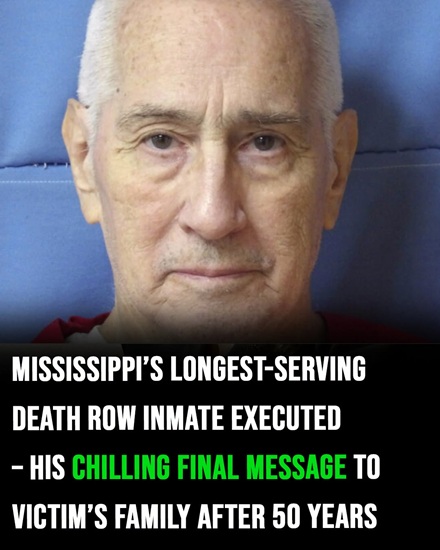
Nearly 49 years after the kidnapping and killing of Edwina Marter, one of Mississippi’s longest-running death penalty cases came to an end. Richard Gerald Jordan, a 79-year-old Vietnam War veteran who had spent almost half a century on death row, was executed by lethal injection on June 25, 2025. The execution took place at the Mississippi State Penitentiary in Parchman, where officials pronounced him dead at 6:16 p.m. His death concluded an unusually lengthy legal process involving multiple trials, death sentences, appeals and challenges in both state and federal courts.
The crime that ultimately placed Jordan on death row occurred in January 1976. According to court records and reporting on the case, Jordan contacted Gulf National Bank in Gulfport while searching for someone he believed might be able to provide a substantial amount of money. After learning the name of bank employee Charles Marter, Jordan located the Marter family’s home. He went to the residence while presenting himself as a utility worker and encountered Charles’ 37-year-old wife, Edwina Marter. Jordan then abducted her at gunpoint, beginning a sequence of events that would permanently alter the lives of her family.
Jordan took Edwina to an isolated location in DeSoto National Forest. She was subsequently killed by a gunshot to the back of the head. Prosecutors described the shooting as deliberate, while defense accounts maintained that Jordan fired as Edwina attempted to escape. After her death, Jordan contacted her husband and demanded $25,000. He falsely suggested that Edwina was still alive, creating the impression that paying the ransom could result in her safe return. Authorities arrested Jordan shortly afterward, and the investigation led to his prosecution for capital murder.

Jordan was convicted and sentenced to death, but the legal proceedings did not end with the original verdict. Over the following decades, his case repeatedly returned to the courts because of appeals and legal issues involving his convictions and sentences. Jordan ultimately faced four trials and received multiple death sentences, with the sentence imposed following his 1998 proceedings eventually remaining in effect. The extraordinary length of the case made him Mississippi’s longest-serving death row prisoner by the time an execution date was finally carried out.
His attorneys continued challenging both his sentence and the method Mississippi planned to use for the execution. Among the issues raised was the state’s three-drug lethal injection protocol. Lawyers questioned whether the procedure provided adequate protection against unnecessary suffering if the first drug failed to produce sufficient unconsciousness. A federal judge ultimately permitted the execution to proceed while requiring prison officials to verify that Jordan was unconscious before administering the remaining drugs in the protocol.
Jordan’s background as a Vietnam War veteran was also raised during efforts to obtain clemency. He had served multiple tours during the war, and his attorneys and supporters pointed to evidence concerning post-traumatic stress disorder and the psychological effects of his military experiences. They argued that these circumstances, together with his behavior during decades of incarceration and expressions of remorse, should be considered when deciding whether his death sentence should be carried out. Supporters asked officials to commute his sentence rather than proceed with the execution.
Edwina Marter’s relatives viewed the situation from a very different perspective. Her two sons were children when their mother was taken from them. Eric Marter was 11 years old at the time, while his younger brother Kevin was only three. Decades later, Eric said publicly that he believed Jordan should be held accountable for what he had done and expressed frustration over how long the case had continued. For the Marter family, every additional legal proceeding occurred against the background of a loss that could never be reversed.
As the scheduled execution approached in June 2025, Jordan’s legal team continued seeking judicial intervention. The 5th U.S. Circuit Court of Appeals declined to prevent the execution from moving forward, and requests for intervention eventually reached the U.S. Supreme Court. The Supreme Court declined to stop the execution on June 25. Mississippi Governor Tate Reeves also rejected Jordan’s request for clemency, allowing the sentence imposed by the courts to proceed as scheduled.
Jordan spent his final hours meeting with people close to him, including relatives, attorneys and a spiritual adviser. Reports from prison officials also documented his requested final meal, which included chicken tenders, French fries, strawberry ice cream and a root beer float. His wife, Marsha, was among those present to witness the execution, along with attorney Krissy Nobile and spiritual adviser Rev. Tim Murphy. At the same time, opponents of capital punishment gathered separately to express their objections to the execution.
Shortly after 6 p.m., Jordan was given the opportunity to make a final statement. He thanked those involved for what he described as a humane process and addressed Edwina Marter’s family with an apology. Jordan also expressed appreciation for the people who had supported him during his years in prison, including his attorneys and his wife. Toward the end of his remarks, he expressed his love for those close to him and said that he expected to see them “on the other side.”
The lethal injection process then proceeded under the requirements established by the court. After the first drug was administered, officials checked Jordan to determine whether he had become unconscious before continuing with the remaining drugs. He was pronounced dead at 6:16 p.m. His execution ended an incarceration on Mississippi’s death row that had lasted almost five decades, making the conclusion of the case notable not only because of the underlying crime but also because of the extraordinary length of the legal proceedings.
Members of Edwina Marter’s immediate family did not all attend the execution. Following Jordan’s death, family member Keith de Gruy delivered a statement representing the views of her husband and sons. The statement emphasized the suffering Edwina experienced and the lasting consequences of her death. Her relatives made clear that the execution could not restore what had been taken from them or erase the decades they had lived without a wife, mother, sister and friend.
The family also addressed Jordan’s attempts to avoid execution and spend the remainder of his life in prison. From their perspective, Edwina never received the opportunity to choose what happened to her, while Jordan had been able to pursue legal challenges for decades. Their statement reflected frustration with the length of the judicial process and the fact that nearly half a century had passed between the crime and the execution. Eric Marter similarly indicated that he believed the sentence should have been resolved much earlier.
At the same time, Jordan’s execution once again highlighted the broader disagreements surrounding capital punishment in the United States. His supporters focused on his military service, reported PTSD, remorse and the many decades he had already spent incarcerated. The Marter family and supporters of the sentence instead emphasized the circumstances of Edwina’s kidnapping and killing and the repeated decisions by juries and courts that Jordan should receive the death penalty. Those competing perspectives remained present until the final hours of the case.
Beyond those disagreements, the central facts concern a family that suffered an irreversible loss. Edwina Marter was 37 years old and raising two young sons when she was abducted from her home in 1976. She was taken to a remote area and killed, after which her husband received a ransom demand that falsely suggested she remained alive. Her death became the foundation of a legal case that continued through multiple generations and numerous stages of the American court system.
For nearly 49 years, Richard Gerald Jordan remained incarcerated while courts examined different aspects of his conviction, sentence and planned execution. Those proceedings demonstrate why describing the case simply as a crime followed by an execution would leave out much of its complicated history. Multiple trials, constitutional questions, appeals, clemency efforts and litigation surrounding lethal injection all became part of a case that began with Edwina’s murder and continued until Jordan’s final day.
The execution on June 25, 2025, ultimately brought the judicial process to its conclusion, but it could not reverse the event that began it. Edwina Marter’s family had already spent almost five decades living with the consequences of her death. Jordan’s family and supporters, meanwhile, witnessed the execution after years of unsuccessful attempts to obtain a different outcome. His death closed the legal proceedings, while the history of the case remains a reminder of both the lasting effects of violent crime and the complex, often lengthy process surrounding capital punishment in the United States.

