
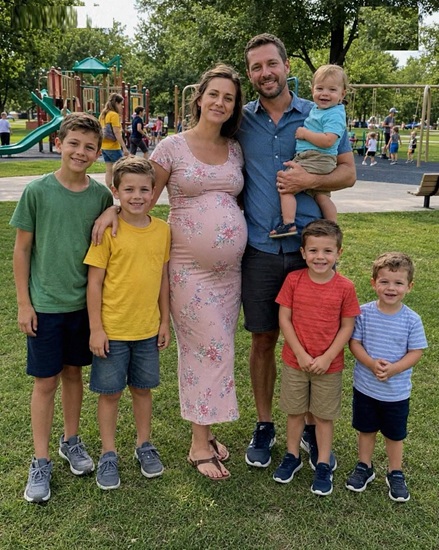
Our house was rarely quiet. With five boys running from room to room, there was always someone laughing, arguing, asking for food, or accusing a brother of taking something that did not belong to him. I was thirty-four and had become used to the constant noise, the overflowing laundry baskets, and the endless negotiations over showers, homework, and bedtime. Claire often joked that our home felt more like a locker room than a family house. She adored every one of our sons, but she had carried one small wish for years: she had always imagined what it would be like to raise a daughter.
Claire never made the boys feel as though they were not enough. She loved them fiercely, and they knew it. Still, when the house finally settled at night, she occasionally admitted that she had pictured having one little girl someday. After our fifth son was born, she told me she had accepted that it probably would not happen. We had a full house, busy schedules, and more responsibilities than either of us could comfortably manage. We agreed that our family was complete and that we were finished having children.
Two years later, Claire walked out of the bathroom holding a pregnancy test and staring at me in disbelief. For several seconds, neither of us said anything. I thought about diapers, bottles, sleepless nights, and the fact that our youngest had only recently stopped waking us before sunrise. Claire looked just as overwhelmed. Then she laughed. I laughed too, and within minutes our five boys were gathered around us asking why their parents were acting so strangely.
At the ultrasound appointment several weeks later, the technician studied the screen and smiled. Then came the words Claire had secretly hoped to hear for years.
“It looks like a girl.”
Claire squeezed my hand and immediately started crying.
“A girl?” she whispered.
The technician nodded.
Claire repeated the word several times as if saying it aloud might make it more real. I kissed her forehead and felt something inside me settle. After five sons, the daughter she had dreamed about was finally on the way.
For a short time, Claire seemed lighter than she had been in years. She began looking at nursery ideas, tiny blankets, and clothes that looked impossibly small compared with what our boys wore. The boys argued over who would teach their sister to ride a bicycle, who would protect her at school, and who would be allowed to hold her first. The whole house seemed excited.
Then something changed.
As the pregnancy continued, Claire became increasingly quiet. She would stand in the nursery staring at the crib without moving. Sometimes she snapped at the boys over ordinary messes and immediately apologized. She stopped eating some dinners and began waking in the middle of the night. When I asked what was wrong, she always had an explanation: she was tired, hormonal, overwhelmed, or worried about having another baby.
The answers made sense, but something in her expression told me they were incomplete.
There had always been one area of Claire’s life that felt closed to me. Her parents, Margaret and Robert, lived less than an hour away, yet we almost never visited them. I had met them only a few times, and their relationship with Claire was distant and uncomfortable. Early in our marriage, I asked why she avoided them.
“We just don’t have that kind of relationship,” she said.
When I asked what had happened, she told me only that she had gone through a difficult period after high school and that her parents had not handled it well.
That was usually where the conversation ended.
I hated incomplete explanations because my instinct was always to understand a problem so I could fix it. But Claire had made it clear that this part of her past was something she did not want to discuss. Eventually, I stopped asking.
During the final months of her pregnancy, she began attending prenatal yoga. Strangely, those classes seemed to be the only thing that consistently improved her mood. She would leave the house tense and come back humming or smiling. One Saturday, I asked if I could attend with her.
She hesitated.
Only for a moment, but I noticed.
“It’s mostly breathing and stretching,” she said.
“Then I should survive.”
She gave me a tired smile.
“Fine. Come if you want.”
At the studio, I met a man named Ethan who appeared to know Claire fairly well. He was helping organize mats when she introduced us.
“Ethan, this is my husband.”
He looked up.
“Steve, right?”
“Sam,” I corrected.
“Sorry. Sam.”
It was nothing. A simple mistake. But because I was already unsettled, my mind gave the moment more importance than it deserved.
Throughout the class, I noticed something else.
Claire relaxed.
Her shoulders dropped. She smiled. At one point, she laughed at something Ethan said, and it was the first easy, unguarded laugh I had heard from her in weeks.
On the drive home, I tried to keep my voice neutral.
“You seem different there.”
“It’s one hour when nobody needs anything from me.”
“That’s not exactly what I meant.”
She immediately understood.
“Sam, Ethan is my friend.”
“I didn’t say anything.”
“You didn’t have to.”
She looked out the window.
“Please don’t turn this into something it isn’t.”
I let the subject go, but not completely.
Three weeks later, Claire woke me shortly after two in the morning.
“My water broke.”
From that moment, everything moved quickly. We called my mother to stay with the boys and drove to the hospital through nearly empty streets. Hours later, surrounded by nurses, bright lights, and the familiar mixture of exhaustion and fear that comes with childbirth, Claire squeezed my hand as hard as she could.
Then we heard a cry.
Our daughter had arrived.
The nurse placed the baby in Claire’s arms.
“This is your little girl.”
I expected Claire to laugh, cry, or say something about finally meeting the daughter she had waited so long for.
Instead, she froze.
Our baby had soft blonde hair, a tiny red face, and unusual eyes. One looked green. The other appeared more hazel-brown.
Claire stared at them.
The color disappeared from her face.
“Claire?” I asked.
She did not answer.
Then she whispered something I barely heard.
“I’ve seen those eyes before.”
I thought she meant a relative.
“Maybe they remind you of your mother?”
She shook her head.
“No.”
“Then who?”
Tears filled her eyes.
“I don’t know.”
She looked frightened rather than happy.
“I just know I’ve seen them.”
During the next two days, Claire withdrew into herself. She cared for our daughter, whom we named Lily, but sometimes stared at her with an expression I could not understand. Whenever I asked how she felt, she told me she was tired. I wondered whether the emotional strain of pregnancy and childbirth had simply overwhelmed her.
Once we returned home, things became more confusing.
Claire sometimes stood beside Lily’s bassinet without speaking. Other times, she avoided the nursery entirely. Then I began hearing quiet phone calls from the laundry room late at night. Whenever I entered, she ended the conversation.
My concern slowly became suspicion.
And because Ethan was the one person I had seen her relax around, I made an assumption I would later regret.
One morning, I woke and reached across the bed.
Claire was gone.
Her keys were missing.
Her phone went directly to voicemail.
Lily’s bassinet was empty.
Panic took over.
I called my mother and asked her to come stay with the boys. Our oldest walked into the kitchen while I was grabbing my jacket.
“Dad, where’s Mom?”
“Grandma’s coming over.”
“Where are you going?”
“To find her.”
The first place I went was the yoga studio.
Ethan had just finished a morning class when I walked through the door.
He looked surprised.
“Sam?”
“Where is Claire?”
“What?”
“Don’t pretend you don’t know.”
He set down the mat he was cleaning.
“I don’t know where she is.”
I stepped closer.
“How long has this been going on?”
His expression tightened.
“How long has what been going on?”
“You and my wife.”
He stared at me.
Then he understood.
“No.”
“Don’t lie.”
“I’m not.”
“How long have you been sleeping with her?”
His face changed from confusion to disbelief.
“I have never touched Claire.”
I mentioned the late-night phone calls.
That was when his expression became serious.
“She called me because she was scared.”
“Scared of what?”
Ethan looked toward the studio door and closed it.
“She thought something was happening to her memory.”
That answer stopped me.
“What are you talking about?”
He told me that Claire had started experiencing strange flashes of memory during the pregnancy. They were not complete memories, only fragments: a young man’s face, a road, hospital lights, and a feeling of loss she could not explain.
After Lily was born, the memories became stronger.
“She thought she was losing her mind,” Ethan said.
“And she told you?”
“She needed someone to talk to who wasn’t connected to the baby.”
That hurt, but I understood what he meant.
“Where did she go?”
He hesitated.
“Her parents.”
I almost laughed.
“She barely speaks to them.”
“I know.”
“Then why would she go there?”
“Because she thinks whatever she’s remembering started with them.”
I drove straight to Margaret and Robert’s house.
When I reached their street, I immediately saw Claire’s car.
But it was not parked outside their home.
It was in the driveway across the street.
I parked quickly and went to Margaret and Robert’s house.
Lily was sleeping safely in a bassinet near the sofa.
That was the first moment I could breathe again.
Margaret and Robert were sitting nearby, both looking exhausted.
“Where is Claire?”
Margaret looked at Robert.
“She isn’t here.”
“I saw her car.”
Neither answered.
Then I noticed several photographs on a shelf. Many showed the same blonde girl at different ages. She appeared in birthday pictures, school photographs, and family gatherings.
Something about her face felt familiar.
“Who is that?”
Margaret’s eyes filled with tears.
Before she could answer, the front door opened.
Claire rushed inside.
“Where is she?”
Then she saw me.
The room became silent.
“Where is who?” I asked.
Claire looked at her parents.
Margaret finally spoke.
“Emma.”
“Who is Emma?”
Claire closed her eyes.
Margaret took a shaky breath.
“She is Claire’s daughter.”
For several seconds, the sentence did not register.
I looked at Claire.
“You have a daughter?”
“I didn’t know,” she whispered.
Margaret began explaining.
In this fictional story, Claire had been nineteen when she fell in love with a young man named Daniel. They planned to marry, and Claire became pregnant. During the final weeks of the pregnancy, the couple was involved in a serious accident.
Daniel died.
Claire survived but was badly injured.
Their daughter was delivered early while Claire remained unconscious.
When Claire eventually woke, she had lost memories from an important period of her life. She did not remember Daniel clearly. She did not remember being pregnant. She did not remember giving birth.
Her parents made decisions while she recovered.
One of those decisions changed everything.
A couple living across the street adopted the baby.
They named her Emma.
I stared at Margaret.
“You never told Claire?”
She began crying.
“We thought we were protecting her.”
“From her own daughter?”
“She had already been through so much.”
Claire’s voice rose.
“You decided that for me?”
Margaret looked down.
“We thought knowing would destroy you.”
But there was more.
Margaret and Robert remained close to Emma as she grew up.
They saw her birthdays.
They attended events.
They watched her become a young woman.
Emma believed they were simply caring neighbors who had always taken a special interest in her life.
She never knew they were her biological grandparents.
Claire sometimes saw Emma during rare visits to her parents but could never explain why the girl seemed strangely familiar.
Now she understood.
“The eyes,” Claire whispered.
She looked at Lily.
“That was what brought it back.”
After Lily’s birth, seeing the baby’s differently colored eyes had triggered a fragment of memory. Claire remembered another set of unusual eyes. Then came a young man’s laugh. A road at night. A hospital ceiling.
Slowly, she realized the memories were connected.
She had called Ethan because she was terrified that she was imagining things.
Eventually, she confronted her parents.
That was when they finally told her about Daniel and Emma.
I was still trying to understand everything when footsteps came from upstairs.
A young woman appeared on the staircase.
She was the girl from the photographs.
Emma.
She looked at Claire.
Then at Lily.
Then at Margaret and Robert.
Her face was pale.
“So it’s true?”
Margaret stood.
“Emma…”
“You knew?”
“Please let us explain.”
“You knew this entire time?”
Her voice broke.
“You watched me grow up, and you knew?”
Margaret tried to approach her.
Emma backed away.
“I thought you were just our neighbors.”
“You were loved.”
“That isn’t the point.”
Claire stepped forward.
“Emma…”
Emma immediately lifted a hand.
“Please don’t.”
Claire stopped.
The pain on her face was almost unbearable to watch.
“I didn’t know about you,” she said.
Emma stared at her.
“I know.”
“I would have come for you.”
“I know.”
“But I understand if you don’t want anything from me right now.”
Emma’s eyes filled with tears.
“I don’t know what I want.”
Then she turned toward Margaret and Robert.
“My whole childhood suddenly means something different.”
“No,” Margaret said. “Your parents loved you. Nothing changes that.”
Emma shook her head.
“I’m not talking about them. I’m talking about you.”
She left the house.
Claire instinctively moved toward the door, but I reached for her hand.
“Give her space.”
She stood there crying.
Emma returned to the home across the street with the parents who had raised her.
Claire did not follow.
That decision mattered.
She understood that learning Emma was her biological daughter did not erase the life Emma already had. Emma had parents who had raised her, traditions that belonged to her, and memories Claire had not shared.
That night, we returned home with Lily.
Nothing felt simple anymore.
Claire was grieving several things at once.
She grieved Daniel, a young man she had apparently loved deeply but remembered only in fragments.
She grieved the years of Emma’s childhood she had missed.
She was furious with her parents.
And she was afraid Emma might never want a relationship with her.
Still, she refused to pressure her.
Claire sent Emma one message.
I will answer any question you ever want to ask. I won’t contact you again unless you want me to.
Then she waited.
Twelve days passed.
On the twelfth morning, Claire’s phone vibrated while we were eating breakfast.
She stared at the screen.
Her hands began shaking.
“What is it?”
She turned the phone toward me.
Emma had sent a short message.
Could I meet my brothers?
That Sunday, Emma came to our house for dinner.
The boys had been told to behave normally, which guaranteed that none of them behaved normally.
They waited in the living room like they were expecting a celebrity.
When Emma walked in, they stared.
Finally, one of them asked the question all five were thinking.
“So you’re actually our sister?”
Emma smiled nervously.
“I guess I am.”
Another boy immediately asked whether that made her the oldest.
“Yes.”
He looked disappointed.
“That means you’re in charge now.”
Emma laughed.
The tension disappeared.
Within minutes, the boys were showing her old photographs and arguing over who looked most like Claire. Emma asked questions about each of them. They asked questions about her childhood.
Claire sat nearby and listened.
She did not try to dominate the conversation.
She seemed to understand that Emma needed room to discover this new family connection at her own pace.
Later that evening, Emma asked if she could hold Lily.
Claire placed the baby carefully in her arms.
Emma studied Lily’s face.
Then she looked at the baby’s eyes.
“So these are the eyes that started everything?”
Claire smiled.
“Apparently.”
Emma laughed softly.
“One green and one hazel.”
“Just like yours.”
Emma looked up.
Their eyes met.
For several seconds, nobody spoke.
There was no dramatic transformation.
No one pretended that decades of separation could disappear during one dinner.
But something changed.
Emma stayed for dessert.
Then she stayed another hour.
When she finally prepared to leave, she hugged each of the boys.
She reached Claire last.
Claire did not move toward her.
Emma hesitated.
Then she stepped forward.
They hugged.
Only briefly.
But Claire closed her eyes.
After Emma left, we sat together on the couch while the boys argued upstairs.
Lily was asleep nearby.
I looked at Claire.
“How are you?”
She thought about it.
“I’m angry.”
“I know.”
“And sad.”
“I know.”
She squeezed my hand.
“But I’m also grateful.”
“For what?”
“That I know now.”
She looked toward the stairs.
“And that Emma gets to decide what happens next.”
That was the part of the story that stayed with me most.
The truth had not repaired everything.
It had not erased grief, restore lost years, or guarantee forgiveness.
But it gave everyone involved the chance to make decisions with honesty instead of secrecy.
Claire could not recover Emma’s childhood.
Emma did not have to replace the parents who had raised her.
Margaret and Robert would have to live with the consequences of their choices.
And I had to accept that there were parts of my wife’s history neither of us had fully understood.
Our family was no longer the simple picture I once imagined.
It was larger.
More complicated.
And filled with questions.
But for the first time, those questions were being asked openly.
A few weeks later, Emma came over again.
Then again.
Sometimes she talked with Claire.
Sometimes she spent most of the evening joking with her brothers.
Sometimes she held Lily for an hour.
Other times she left early because everything felt overwhelming.
Nobody pressured her.
That became our rule.
No forced closeness.
No pretending everything was fixed.
No expectations about what anyone should call anyone else.
Just time.
One evening, I walked into the kitchen and found Claire and Emma sitting at the table looking through photographs.
Emma was laughing.
Claire was crying.
I almost interrupted, but Claire looked at me and smiled.
So I left them alone.
Later that night, Claire came upstairs.
“What were you two talking about?”
“Daniel.”
I waited.
“Emma wanted to know what I remembered.”
“And?”
“Not much.”
She sat beside me.
“But maybe that’s okay.”
“Why?”
“Because she doesn’t need me to recreate a life that disappeared.”
She looked toward Lily’s crib.
“She just needs me to be honest about the life we have now.”
Months later, our house was still noisy.
The boys still argued.
Laundry still appeared faster than we could wash it.
Lily cried whenever we wanted her to sleep.
And Emma slowly became a familiar presence.
Nothing looked perfect.
But it looked real.
Claire once believed that having a daughter would complete our family.
She had been wrong.
Families are not completed by one person.
They change.
They expand.
Sometimes they fracture.
Sometimes they rebuild.
And sometimes the truth reveals connections that were there long before anyone was ready to see them.
Lily’s birth had not created the past Claire was forced to confront.
It had simply opened the door.
What came afterward depended on patience, honesty, and allowing every person involved to choose what kind of relationship they wanted.
For Claire and Emma, that process had only begun.
But it had begun.
And for the first time in years, that was enough.

