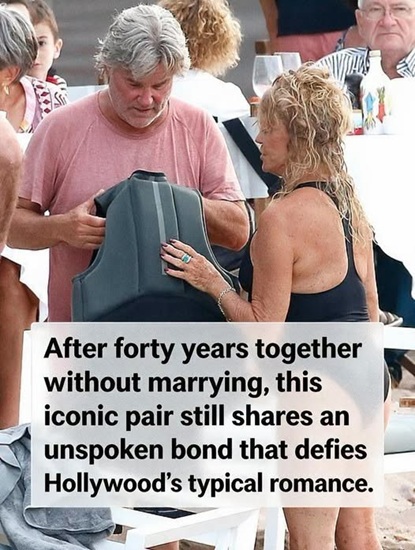
Goldie Hawn and Kurt Russell have spent more than four decades together without ever deciding to marry. Their relationship, which began in 1983, has lasted through changing careers, family milestones, public attention, and the many ordinary challenges that come with building a life alongside another person. Despite never signing a marriage certificate, they have created a family, shared homes, raised children, worked together professionally, and remained committed to one another for decades.
Hawn has repeatedly explained that for her, marriage was never necessary to prove the seriousness of the relationship. Instead, she has emphasized independence, trust, personal choice, and the importance of continuing to want the relationship rather than feeling defined by a legal status. Their history together did not begin with romance. Hawn and Russell first crossed paths when they were much younger and worked on Disney’s The One and Only, Genuine, Original Family Band, released in 1968.
At that point, they were at very different stages of their lives, and nothing serious developed between them. Both moved forward with their own careers and relationships. Years later, they met again while working on Swing Shift, and this time the connection was different. By then, both had experienced marriage, parenthood, professional success, and the realities of adult relationships. Their romance is generally traced to Valentine’s Day in 1983.
While working together during the production of Swing Shift, the pair spent more time together and eventually began dating. Hawn has described their early connection as spontaneous and playful rather than carefully planned. One well-known story from the beginning of their relationship involves the two going to the Playboy Club in Westwood to practice the Jitterbug, which was connected to work they were doing for the film. What began as a practical evening connected to choreography became part of a memorable first date.
That early spontaneity became one of the stories frequently associated with their relationship. The evening did not follow the pattern of an elaborate celebrity romance arranged for cameras or publicity. It was informal, energetic, and somewhat unpredictable. In later interviews, Hawn has looked back on those early experiences with humor. That sense of ease appears to have been important to the relationship from the beginning and may help explain why neither person seemed interested in forcing their partnership into a traditional timetable.
By the time the relationship became serious, both Hawn and Russell had already experienced marriage. Hawn had previously been married to Gus Trikonis and later to Bill Hudson. Russell had been married to actress Season Hubley. Those relationships had ended in divorce, which meant that both entered their new partnership with personal experience of what marriage and separation could involve. Their previous histories became part of the reasoning behind their decision not to marry one another.
Hawn has spoken openly about this subject on several occasions. During an appearance on ITV’s Loose Women, she said that she believed she would have been divorced long ago if she and Russell had married. Her comment was delivered with humor, but it reflected a serious idea she has expressed repeatedly. She believes the ability to continue choosing the relationship has been important to her. In her view, staying because both partners genuinely want to stay carries meaning.
She has never suggested that this approach should apply to everyone. Her explanation concerns what worked for her and Russell. Marriage is important to many couples for emotional, legal, cultural, religious, or personal reasons. Hawn and Russell simply reached a different conclusion for their own relationship. Their previous experiences and their individual personalities led them to believe that formal marriage was not necessary for the life they were building together.
Hawn expanded on that idea during an interview with Chris Wallace. When asked why she and Russell had never married, she discussed the importance of independence. She explained that she valued waking up each day with the knowledge that she could decide whether she still wanted to be in the relationship. For her, that freedom did not weaken the commitment. She saw it as part of what made the commitment meaningful.
The idea of independent thinking has been central to Hawn’s description of their partnership. She has said that maintaining a sense of self is important even when two people share a long life together. Loving another person, in her view, does not require giving up individuality. People can remain emotionally close while still preserving personal interests, opinions, boundaries, and ways of thinking.
This approach challenges the idea that a successful relationship requires two people to become completely inseparable. Hawn and Russell have shared a life while continuing to maintain individual identities. Both have had long careers and personal interests outside their relationship. They have supported one another without making the relationship the only defining part of either person’s life.
Their decision not to marry should therefore not be confused with avoiding commitment. More than four decades together demonstrate the opposite. The couple has remained together through major career changes, family developments, growing older, and the pressures of living much of their lives in public. Their commitment has been expressed through time and shared experience rather than through a wedding ceremony.
Family became especially important because both already had children before their relationship began. Hawn had Oliver Hudson and Kate Hudson from her marriage to Bill Hudson. Russell had a son, Boston Russell, from his marriage to Season Hubley. When Hawn and Russell became a couple, they gradually brought these existing family relationships together.
In 1986, Hawn and Russell welcomed a son together, Wyatt Russell. Their household therefore became a blended family of four children. Oliver, Kate, Boston, and Wyatt did not all share the same biological parents, but they became part of the same larger family structure. Over time, the relationships among them became a major part of Hawn and Russell’s public story.
Russell became an important parental figure in the lives of Hawn’s older children. Kate Hudson in particular has spoken warmly about the role Russell played while she was growing up. His importance in the family developed through years of presence, care, and everyday parenting rather than through biology alone. This family dynamic became one of the clearest examples of the seriousness of Hawn and Russell’s partnership.
For Russell, becoming part of a blended family was not entirely unfamiliar because he was already a father. His experience with Boston gave him an understanding of parenthood before his relationship with Hawn became serious. Hawn has recalled being impressed by the way Russell interacted with her children during the early years of their romance.
Those interactions mattered because Hawn was not only considering whether she enjoyed being with Russell. She also had to consider how the relationship would affect her children. A long-term partnership involving parents inevitably reaches beyond the two adults. The way Russell connected with Oliver and Kate therefore became part of the foundation of the family they eventually built.
Over time, the family grew closer and later expanded through marriages, partners, and grandchildren. By the time Hawn and Russell had spent several decades together, their relationship was no longer simply a Hollywood romance. It had become the center of an extensive family history involving multiple generations.
This helps explain why the absence of a marriage certificate became less significant with time. Hawn and Russell already had a family, shared memories, responsibilities, traditions, and a long history together. They did not appear to feel that a wedding was necessary to make those existing relationships more legitimate.
Their children were even included in conversations about marriage. Hawn has said that she and Russell asked the children how they felt about the idea. According to her, the children were comfortable with the relationship the way it already existed. That response reinforced the couple’s belief that there was no urgent reason to change the structure of their family.
Hawn has also connected her views with the complications that can accompany divorce. She has discussed legal and financial disputes, as well as the emotional consequences separation can have for families. Those observations came from her personal experience rather than from a general argument against marriage. She and Russell simply did not feel a need to re-enter a legal structure they had both previously experienced.
For them, the distinction between legal marriage and emotional commitment became important. A couple can be legally married and still face relationship difficulties, just as an unmarried couple can remain deeply committed for decades. Hawn has consistently focused more on the daily relationship than on the label attached to it.
That idea is reflected in the way she speaks about choice. Rather than seeing commitment as something established once during a ceremony, she appears to view it as something that must continue over time. Two people keep supporting each other, communicating, adapting, and deciding that the relationship is still meaningful.
This way of thinking places responsibility on both partners. If a relationship continues because both people want it to continue, neither can simply assume that a legal status will maintain the emotional bond automatically. Attention and effort still matter. Respect remains necessary. Trust still needs to be protected.
Hawn and Russell’s history shows that the couple has continued making those choices for a very long time. They have been together since 1983, meaning their relationship has passed through several different stages of life. They began as working actors with young children and eventually became grandparents while still remaining partners.
Their careers also created unusual pressures. Both became major Hollywood stars, which meant periods of filming, travel, interviews, red carpets, media attention, and professional uncertainty. Maintaining a stable private life while working in entertainment can be complicated because professional schedules often require long periods away from home.
Despite those pressures, Hawn and Russell continued building their family life. Their careers remained important, but neither seems to have allowed celebrity itself to become the foundation of the relationship. The public may have known them through movies and appearances, while the more important parts of their partnership took place privately.
They built routines away from cameras. They raised children. They shared homes. They celebrated birthdays, holidays, and family milestones. Those ordinary experiences accumulated over decades and eventually became more significant than the glamorous moments associated with their careers.
Hawn’s career includes major films and an Academy Award, while Russell built a long career across action movies, comedies, dramas, and family entertainment. Each maintained a separate professional identity, which fits with Hawn’s broader belief in preserving individuality within a relationship.
At times, the two also worked together. Their 1987 romantic comedy Overboard became one of the best-known projects associated with them as a couple. Decades later, they appeared together again in The Christmas Chronicles films. Russell played Santa Claus, while Hawn appeared as Mrs. Claus.
Their ability to work together without becoming professionally dependent on each other reflects the same balance seen in their personal lives. They could share projects while still maintaining separate careers. They could share a household while still maintaining individual identities.
This balance appears repeatedly in the way Hawn discusses long-term partnership. She values closeness but does not equate closeness with complete dependence. She values family but does not suggest that family requires every person to abandon individual interests. She values commitment but does not believe commitment must always be expressed through legal marriage.
Her approach also acknowledges that relationships are imperfect. Hawn has never claimed that she and Russell have agreed on everything. Long relationships involve arguments, changing priorities, stress, and periods when two people may see situations differently. More than four decades together inevitably include difficult periods as well as happy ones.
People also change substantially over that length of time. The person someone is at the beginning of a relationship may not be exactly the same person decades later. Careers change, children grow up, health changes, and priorities evolve. Successful partnerships often require both people to adjust to those changes.
Hawn’s emphasis on individuality may have helped create room for that evolution. Neither partner had to remain exactly as they were in 1983. They were able to develop as individuals while still maintaining a shared relationship.
This is one reason their story should not be reduced to a simple claim such as “never getting married is the secret to staying together.” Their longevity cannot be explained by one decision alone. The relationship includes family, compatibility, affection, humor, trust, patience, and decades of shared experience.
Hawn herself has often emphasized laughter and enjoyment. She has spoken about the importance of actually liking the person you are with, even while acknowledging that no couple likes everything about each other all the time. Humor appears frequently when she discusses Russell and their history.
Their early date involving dancing already suggested that playful quality. Years later, the stories they tell about their relationship still often contain laughter. That does not mean humor solved every difficulty, but it appears to have been one important element in how they related to each other.
Mutual respect seems equally important. Maintaining independence requires confidence that a partner can have different opinions without threatening the relationship. Allowing personal space requires trust. Supporting independent careers requires respect for another person’s ambitions.
These qualities can exist in married and unmarried relationships alike. Hawn and Russell simply found a structure in which those values could function without marriage.
The couple’s story is therefore not an argument that marriage does not work. Many marriages last for decades and provide couples with security, meaning, and stability. Hawn and Russell have never proved otherwise, nor have they claimed to.
Their experience shows only that marriage is not the single possible structure for a serious long-term partnership. Different couples may make different decisions depending on their circumstances, values, legal needs, cultures, and personal histories.
For Hawn and Russell, not marrying gradually became completely normal. After enough years together, the question of when they would finally have a wedding became less relevant to their actual lives. They were not waiting for marriage to begin their family or to establish commitment. Those things had already happened.
A marriage certificate therefore did not represent an unfinished part of the relationship for them. They had already created the home, the family, the memories, and the shared history that many people associate with marriage.
Their longevity also makes their partnership unusual within celebrity culture. Hollywood relationships often receive intense attention when they begin and equally intense coverage if they end. Hawn and Russell managed to move beyond that cycle.
After decades together, their relationship stopped being simply a celebrity dating story. It became part of their family identity and public history.
Watching their children grow is one way to understand how much time has passed. When Hawn and Russell began their romance, their family included young children. Those children eventually became adults with careers and families of their own.
The relationship continued through those transitions. It lasted through childhoods, teenage years, adulthood, and the arrival of grandchildren.
That continuity represents a deeper form of history than a collection of red-carpet photographs. Their relationship became connected with generations of family memories.
Hawn has also made clear that avoiding marriage was not intended as a political or social statement. She and Russell were not trying to tell the world that traditional relationships were wrong. Their choice developed from their personal experiences and preferences.
That distinction matters because celebrity relationships are sometimes turned into broad lessons about how everyone else should live. Hawn and Russell’s experience does not need to become a universal lesson. It can simply be understood as one couple finding an arrangement that suited them.
Their previous marriages certainly influenced that decision. Having experienced divorce, both knew that marriage itself could not guarantee permanence. Rather than repeating a structure simply because it was expected, they allowed their new relationship to develop differently.
Over time, that arrangement became increasingly permanent without ever becoming a legal marriage. The longer they remained together, the less temporary the choice appeared.
Their relationship eventually lasted longer than many marriages. That fact does not prove unmarried relationships are stronger, but it does demonstrate that legal marriage was not necessary for this particular couple to remain committed.
Time itself became the strongest evidence.
A wedding can happen in a single day. A legal document can be signed quickly. Forty years of shared life, however, requires thousands of smaller decisions.
Those decisions happen during ordinary mornings, family difficulties, professional disappointments, celebrations, illnesses, disagreements, vacations, birthdays, and quiet evenings at home.
Hawn’s daily-choice philosophy fits naturally with that reality. Commitment, in her view, is not only what someone promises once. It is also what they continue doing afterward.
For more than four decades, she and Russell continued making that decision.
Their blended family remains one of the clearest results of that commitment. Oliver, Kate, Boston, and Wyatt came into the family through different relationships, but the household developed around bonds that were built over time.
Russell’s parental relationship with Hawn’s children demonstrates that family roles can develop through consistency and care. Biological relationships matter, but they are not the only way strong family connections form.
The same is true of Hawn’s place within Russell’s wider family.
Their relationship connected people who might otherwise have remained separate branches of different households. Over time, those branches became part of a larger family.
This family structure likely mattered more to Hawn and Russell than satisfying outside expectations about marriage. They were already living the relationship rather than preparing for it.
Their partnership also gave them room to preserve separate identities. Hawn continued working in film, production, philanthropy, and other projects. Russell continued pursuing a wide range of acting roles.
Neither person’s professional identity disappeared into the couple.
This independence may help explain why Hawn continues to emphasize the importance of knowing who you are outside a romantic relationship. A person can be deeply committed and still maintain a separate sense of self.
For some couples, marriage supports that same balance. For Hawn and Russell, remaining unmarried did.
The point is not which structure is better.
The point is that the structure matched the people inside it.
Hawn’s comments about waking up and choosing the relationship capture this idea more clearly than almost anything else she has said about Russell.
She appears to value the knowledge that remaining together is something both people continue to want.
That freedom, in her eyes, adds meaning rather than uncertainty.
After more than four decades, the theory has become part of their shared history.
They began dating in 1983.
They created a blended family.
They welcomed Wyatt together.
They maintained separate careers.
They supported one another through decades of personal and professional change.
And they never decided that marriage was necessary to make any of those experiences real.
Their relationship remains one of Hollywood’s most recognizable examples of long-term commitment outside marriage.
Yet its significance is personal rather than universal.
Goldie Hawn and Kurt Russell did not prove that marriage is unnecessary for everyone.
They demonstrated that it was unnecessary for them.
For more than 40 years, their partnership has been built around family, respect, individual identity, humor, shared history, and the repeated decision to continue the relationship.
That decision has lasted far longer than the excitement surrounding their first date.
It survived beyond movie sets, publicity, and the early stage of romance.
It became a family life.
It became decades of memories.
And it became a partnership that neither Hawn nor Russell believed needed a wedding certificate to be considered complete.
For Goldie Hawn, the explanation has remained remarkably consistent.
She values independence.
She values family.
She values being able to think for herself.
And she values knowing that staying with Kurt Russell is still something she chooses.
After more than four decades together, that continuing choice remains the defining feature of their unusual but enduring relationship.
