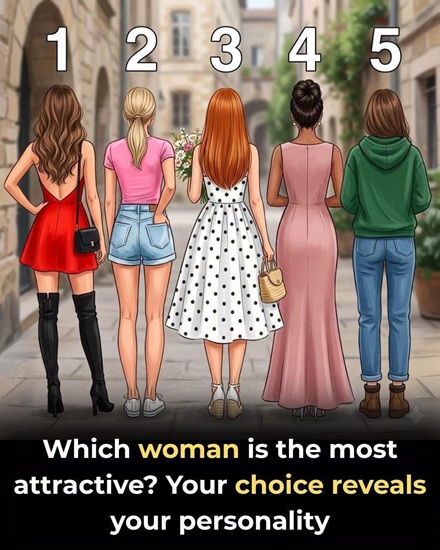
A visual puzzle shows several women from behind and asks the viewer to decide which one will be the most attractive when she turns around. After making a choice, the image connects each answer with a personality description. The format is entertaining because the viewer is being asked to make a prediction with very little information. The faces are hidden, expressions are unavailable, and the only visible clues come from posture, clothing, hairstyle, body position, and color. That makes the exercise more useful as a reflection on first impressions than as a genuine test of personality.
The interesting part of the puzzle is not whether someone correctly predicts which hidden face would be considered attractive. The more revealing question is what made one figure stand out in the first place. A viewer may notice straight posture and interpret it as confidence. Someone else may pay attention to clothing and assume that a particular style suggests elegance or ambition. Another person may focus on hair or movement. These judgments happen quickly, even though the image provides very little evidence about the people being represented.
Because the women are shown from behind, viewers naturally fill in missing details. Human perception often works this way. When information is incomplete, the mind tries to create a complete story using familiar patterns and expectations. A relaxed pose may be interpreted as calm, while an upright pose may be associated with confidence. These associations can feel convincing, but they do not prove anything about the personality of the person shown.
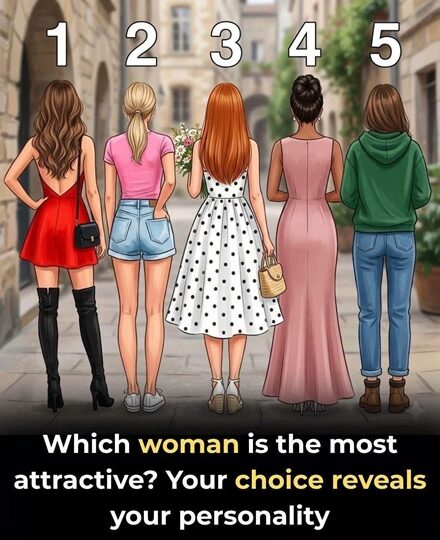
Posture can be influenced by many factors. Someone might stand upright because they are posing for a picture, following instructions, stretching, or simply feeling comfortable at that particular moment. A person with relaxed shoulders might be tired, distracted, or naturally standing that way. Neither posture can reliably tell us whether someone is shy, confident, ambitious, kind, or emotionally strong.
Clothing can create similar impressions. A formal outfit may be associated with professionalism or seriousness. Casual clothing might be interpreted as relaxed or creative. Bright colors may appear bold, while dark colors may seem reserved or mysterious. These meanings are learned through culture and personal experience, but they are not reliable measurements of someone’s character.
A person’s clothing may have been chosen because of weather, work, comfort, budget, tradition, personal taste, or the event they are attending. Someone dressed formally is not automatically more responsible than someone dressed casually. A bright outfit does not prove confidence. A simple style does not prove shyness. Clothing can communicate style, but it cannot reveal an entire personality.
Hairstyle can also influence the viewer’s imagination. Long hair, short hair, curls, straight styles, or tied-back hair may create different impressions. A viewer might associate one hairstyle with elegance and another with independence. Yet hairstyle is often chosen for practical or aesthetic reasons and says very little about someone’s moral character, intelligence, kindness, or emotional life.
This is why the puzzle is better understood as a game about perception. The figures do not reveal enough information to support the personality conclusions assigned to them. Instead, the viewer brings personal expectations to the image. Two people can look at the same woman and imagine completely different personalities.
One viewer may see confidence where another sees formality. Someone may interpret a certain style as sophisticated while another considers it ordinary. A particular color may remind one person of happiness and another of an unpleasant memory. The meaning is partly created by the observer.
Why the Personality Results Can Feel Personal
After viewers select a figure, the puzzle typically provides broad personality descriptions. One choice might be linked with independence. Another could be associated with sensitivity. A third might describe loyalty, ambition, or emotional strength. These qualities are usually presented in a positive way while including a small weakness to make the description feel realistic.
For example, someone may be told that they are strong but occasionally doubt themselves. Another result may say that the viewer cares deeply about others but sometimes protects their feelings. Someone else might be described as independent while also wanting meaningful relationships. These statements sound specific, but they can apply to many different people.
This is related to a psychological phenomenon often called the Barnum effect. People can find broad descriptions highly accurate when they believe those statements were created specifically for them. When the viewer first chooses a picture and then receives a description, the result can feel more personal because the choice seems to have produced the information.
The process creates a sense of discovery. Instead of simply reading a general statement, the viewer believes the result was revealed through a decision they made. That small difference can make ordinary personality language seem much more precise than it really is.
The Barnum effect does not mean people are careless. Humans naturally compare new information with their own experiences. If part of a description matches something familiar, that section may feel very meaningful. Statements that do not fit may receive less attention.
This is why personality-style images can be entertaining even when they are not scientific. People enjoy recognizing parts of themselves in a description. The important thing is keeping the conclusion proportional to what the image can actually support.
Attractiveness Is Personal and Cannot Be Predicted From a Hidden Face
The main question in the puzzle also assumes that attractiveness can somehow be predicted from the back of a person’s body. In reality, attraction is highly personal and can depend on much more than posture or clothing. Facial expressions, voice, movement, humor, personality, confidence, kindness, and personal chemistry can all influence how attractive someone appears.
Different people also have different physical preferences. One viewer may like a certain facial shape while another prefers something entirely different. A feature considered attractive in one culture or period may not carry the same meaning elsewhere. Beauty standards are not universal.
Even two people with similar backgrounds can disagree completely about which person they find most attractive. Attraction does not have one correct answer. That means the viewer is not actually solving an objective puzzle when choosing one of the women. They are expressing a personal expectation.
The hidden faces make this especially clear. The viewer cannot know how the women will look when they turn around. Any prediction is therefore based on imagination rather than evidence.
That uncertainty is part of what makes the game enjoyable. It encourages the mind to fill in the blanks. However, the result should remain entertainment rather than a claim about beauty or personality.
First Impressions Are Built From Limited Information
First impressions happen quickly in everyday life. Before someone speaks, other people may already form expectations based on appearance, posture, clothing, age, facial expression, or surroundings. These reactions can occur without conscious effort.
A person standing confidently may immediately be assumed to be capable or outgoing. Someone who looks down may be interpreted as shy. A person wearing formal clothing may appear more professional. Yet these assumptions can easily be wrong.
Someone who looks confident may actually be nervous. A person who appears quiet may be highly expressive around close friends. Someone dressed casually may hold a demanding professional position. Visual information can guide first impressions, but it does not provide a complete picture.
The puzzle exaggerates this process because it intentionally removes important information. By hiding the faces, it forces viewers to rely heavily on limited clues. This makes it useful for thinking about how easily assumptions are formed.
The goal should not be to eliminate first impressions entirely. That would be unrealistic. A better goal is recognizing that an initial impression is incomplete and may need to be revised after more information becomes available.
Image Design Can Influence Which Figure You Choose
The composition of the puzzle itself can strongly influence the answer. A woman placed in the center may attract attention before someone standing near the edge. Bright colors may appear more noticeable than muted shades. A larger silhouette may seem more important than a smaller one.
Contrast also guides attention. If one figure is surrounded by more empty space, she may stand out visually. Another figure may blend into the background. These design choices can affect preference before the viewer consciously begins comparing the women.
Screen size can make a difference as well. The image may look different on a phone than on a computer. Some platforms crop pictures or reduce their size. Brightness, color settings, and resolution can also change which figure appears most prominent.
This matters because a personality result based on the choice assumes the decision came entirely from the viewer’s character. In reality, visual design may have influenced the answer.
If the positions of the women were rearranged, some viewers would probably choose differently. Their personalities would not have changed. Only the presentation would be different.
This is one reason the puzzle cannot function as a scientific personality measurement. The answer is influenced by the image as well as the person looking at it.
What Happens If the Clothing Changes?
A simple thought experiment can make this easier to see. Imagine that the women remain in exactly the same positions, but their clothing colors are exchanged. Would the same figure still appear most attractive?
Some viewers might immediately change their answer. That would suggest that color played an important role in the original decision.
Now imagine that every woman is wearing identical clothing. The differences in posture and hairstyle would become more important.
Next, imagine that every hairstyle is also identical. The viewer would have even fewer clues and might make another choice.
These changes demonstrate how much the original selection depends on visual details rather than personality.
The viewer is not necessarily choosing a person. They may be choosing a combination of color, style, balance, position, and posture.
That is perfectly reasonable in a visual game. It simply should not be interpreted as evidence about character.
Cultural Expectations Matter
Different cultures attach different meanings to clothing, posture, and appearance. A style that appears formal in one place may be considered ordinary somewhere else. A particular body posture may communicate confidence in one context and politeness in another.
Hair also carries cultural meanings that vary widely. The same hairstyle can be traditional, fashionable, practical, rebellious, or completely neutral depending on the viewer’s background.
Color carries similar differences. Black may appear elegant, serious, or formal. Red can suggest romance, confidence, celebration, or danger. White can represent simplicity in one context and mourning in another.
These meanings are not universal.
That makes it impossible to create one accurate personality interpretation from a visual choice. The same image can produce very different reactions depending on the viewer’s experiences and cultural background.
Personal Memory Can Shape the Decision
A viewer may also choose a woman because something in the image reminds them of someone they know. A hairstyle could resemble a friend or family member. A certain outfit might bring back memories of school, work, or a special event.
These associations can happen almost automatically. The viewer may not consciously realize that memory influenced the choice.
A certain color can also carry a personal meaning. Someone may love blue because it reminds them of a favorite place. Another person might dislike the same color because of an unpleasant experience.
These emotional connections are real, but they do not prove personality traits. They simply show that perception is shaped by experience.
This is another reason two people can look at the same image and make completely different decisions.
Appearance Does Not Reveal Kindness
One of the most important limits of this type of puzzle is that appearance cannot reliably reveal how someone treats others. Kindness is demonstrated through behavior.
A person can look elegant and behave selfishly. Another can appear ordinary and be deeply compassionate. Clothing, posture, hair, and physical attractiveness cannot measure generosity or empathy.
The same applies to honesty. There is no visual feature that reliably identifies an honest person.
Trustworthiness also develops through actions over time. A photograph or illustration cannot provide the necessary evidence.
The puzzle should therefore never be used to judge actual women or make serious conclusions about their character.
Appearance Does Not Reveal Intelligence
Intelligence cannot be determined from clothing, posture, body shape, hairstyle, or attractiveness. Intelligence itself is complex and includes many different abilities.
Someone may be academically talented, creatively gifted, practically skilled, socially perceptive, or strong in several areas at once.
None of those qualities can be accurately identified from an illustration viewed from behind.
A person wearing formal clothing is not automatically more intelligent than someone wearing casual clothes. Likewise, someone who appears glamorous is not less intelligent.
Judging ability from appearance risks confusing visual stereotypes with real evidence.
The personality puzzle does not have enough information to make such conclusions.
Appearance Cannot Reveal Health
Health is another area where visual assumptions should be avoided. A person’s appearance in one image cannot reliably reveal overall physical or mental health.
Someone may appear energetic while dealing with a health problem. Another person might look tired after simply having a long day.
Body shape is also not a reliable way to determine someone’s health status. Many important health factors are not visible.
The same applies to emotional well-being. A smile does not prove that someone is happy all the time, just as a serious expression does not prove sadness.
An illustration certainly cannot provide meaningful health information.
The Puzzle Cannot Reveal Relationship Status
It is also impossible to know whether any of the women are single, married, dating, or uninterested in relationships based on appearance.
A wedding ring might provide information in a real photograph, but even that would require context. Clothing and hairstyle cannot reliably reveal romantic status.
Personality tests sometimes attach relationship stories to visual choices, but those descriptions remain imaginative rather than factual.
Real relationships depend on personal history and circumstances that cannot be seen in a silhouette.
The same caution applies to assumptions about whether someone is romantic, loyal, or emotionally available.
Those qualities require far more information.
A Better Way to Play the Game
Instead of asking what your choice supposedly proves about your personality, ask what specifically attracted your attention.
Did you notice posture first?
Was it clothing?
Was it hair?
Did a particular color stand out?
Did you choose the figure in the center without consciously realizing it?
Or did you deliberately pick the least obvious option because you wanted to avoid the expected answer?
All of these reasons can make the game more interesting.
They encourage reflection without pretending that the illustration has measured personality.
Try Changing One Detail at a Time
Imagine every figure wearing the same color.
Would your answer remain the same?
Now imagine exchanging the hairstyles.
Would another woman become more noticeable?
Next, rearrange their positions mentally.
If the woman you originally chose moved to the edge of the image, would she still attract your attention first?
These questions reveal how visual context shapes preference.
If a choice changes after one small visual detail changes, that is strong evidence that the original decision depended partly on image design.
There is nothing wrong with that. It simply shows why the result should remain playful.
Imagine That Every Woman Has the Same Face
Another useful experiment is imagining that all the women turn around and have exactly the same face.
Would one still seem more attractive?
If the answer changes, then much of the original preference depended on what you imagined rather than what was actually visible.
This is exactly what the puzzle encourages.
The missing faces create a blank space for the viewer’s expectations.
The mind supplies information that is not there.
That ability is fascinating, but it should not be confused with accurate prediction.
Personality Requires More Than One Choice
Real personality is expressed through patterns over time and across different situations. Someone may behave confidently at work and feel nervous in a new social environment.
A person can be independent while still valuing emotional closeness. Someone can be sensitive and resilient at the same time.
People are not limited to one simple category.
Scientific personality research therefore does not rely on a single visual choice. Structured assessments require many questions and careful interpretation.
Even professionally designed personality measures have limitations.
An online illustration cannot diagnose personality.
It can only provide entertainment and perhaps encourage reflection.
Why Broad Descriptions Work So Well
Personality games often use statements that contain both a strength and a vulnerability.
“You are confident, but sometimes you question yourself.”
“You care deeply, but you do not trust everyone immediately.”
“You enjoy independence, but close relationships are extremely important to you.”
Most people can recognize themselves in at least part of these statements.
That makes the result feel personal.
The viewer then connects the description with the picture they selected, strengthening the impression that something meaningful was revealed.
In reality, the language is often broad enough to fit many different personalities.
Attraction and Character Are Separate Things
Physical attraction does not provide reliable information about character.
Someone can be visually attractive to a viewer and still behave poorly.
Another person may not immediately match someone’s physical preferences but become highly attractive after their personality becomes known.
Humor, kindness, intelligence, warmth, reliability, shared interests, voice, and emotional connection can all change attraction over time.
A static illustration cannot capture these qualities.
That is why the puzzle’s question should remain playful rather than becoming a serious judgment.
Attraction is personal.
Character requires evidence.
They are not the same thing.
First Impressions Can Change
People regularly discover that their first impression of someone was incomplete.
A person who initially seems distant may turn out to be shy.
Someone who appears serious may have an excellent sense of humor.
A person who looks extremely confident may admit later that they were nervous.
Real interaction adds information that appearance cannot provide.
This is why initial assumptions should remain flexible.
There is nothing wrong with noticing visual details.
The mistake occurs when a quick impression becomes a permanent conclusion without additional evidence.
What the Puzzle Actually Demonstrates
The most useful thing the puzzle may reveal is how quickly the mind constructs a story.
The faces are missing.
There is no conversation.
There is no behavior.
There is no personal history.
Yet viewers may immediately imagine confidence, elegance, friendliness, ambition, or sensitivity.
Those qualities were not shown.
They were inferred.
Recognizing that difference can make the puzzle much more interesting.
The viewer begins noticing not only the women in the picture but also the assumptions taking place inside their own mind.
There Is No Correct Answer
Because attractiveness is subjective and the faces are hidden, there is no objectively correct answer to the question.
One viewer may choose the first woman.
Another may immediately prefer the fourth.
Someone else may change their mind several times.
All of these responses are normal.
The selection reflects what caught someone’s attention at that particular moment.
It does not rank the women as people.
It also does not establish one viewer as having a better personality than another.
The choices are simply different.
Enjoy the Description Without Treating It as a Label
If the personality result feels accurate, there is nothing wrong with enjoying it.
You might even use it as a starting point for reflection.
Ask which sentence felt accurate and why.
Perhaps it reminded you of a real experience.
Maybe it described something you already believe about yourself.
If the result feels completely inaccurate, that is also fine.
There is no reason to force the description to fit.
An illustrated test does not know your history.
The Most Valuable Question Comes After the Choice
After choosing a woman, ask yourself one simple question:
Why did I choose her?
The answer may be more interesting than the prepared personality result.
Maybe the posture looked confident.
Perhaps the clothing seemed elegant.
A certain color may have attracted your attention.
The hairstyle could have reminded you of someone.
Or you might not know why at all.
That uncertainty is also interesting.
It shows that not every preference begins with a conscious explanation.
Keep the Conclusion Proportionate
A visual personality puzzle can be fun.
It can start conversations.
It can encourage people to notice how first impressions form.
It can even make someone think about their own preferences.
But it cannot scientifically reveal personality.
It cannot predict a hidden face.
It cannot determine intelligence.
It cannot identify kindness, honesty, health, or relationship status.
And it should never be used to judge a real person’s worth.
The Real Lesson Is About Expectations
The most interesting part of the image is not which woman eventually turns out to be beautiful.
The real lesson is how much information the viewer creates before anyone turns around.
With only posture, clothing, color, and hairstyle available, the mind begins filling the missing space.
It builds expectations.
It creates personality stories.
It predicts appearance.
Sometimes those guesses might happen to be correct.
Other times they may be completely wrong.
The image itself cannot tell the difference.
First Impressions Are Natural, but They Are Not Final
People will always notice appearance.
That is part of ordinary perception.
The goal is not to pretend visual impressions do not exist.
Instead, it is useful to remember that an impression is only a beginning.
Actual behavior provides better evidence.
Conversation provides context.
Time reveals patterns.
A silhouette cannot do any of those things.
So choose whichever woman catches your attention first and enjoy the result if you like.
Then look at the picture one more time and ask what you actually knew about her before making the choice.
Probably very little.
Most of the story came from expectation.
That is what makes this simple visual puzzle genuinely interesting: not because it can reveal your personality, but because it demonstrates how quickly the mind can build a complete story from incomplete information.
