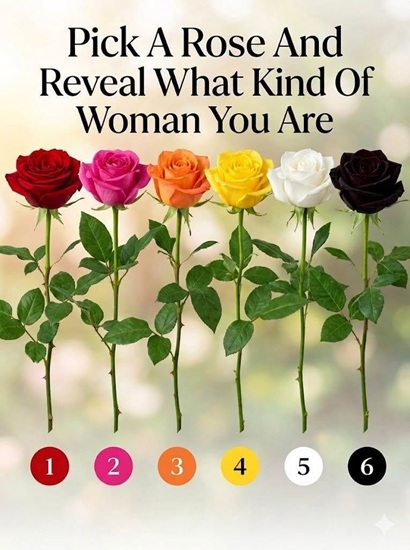
A colorful image showing six different roses can easily become a fun and engaging personality-style game. The viewer is asked to choose between a red, pink, orange, yellow, white, or black rose and then read a short interpretation connected with that color. These kinds of images are popular because they are simple, visual, and easy to share with other people. However, choosing one rose does not scientifically reveal someone’s personality, emotional nature, relationships, or future.
Preferences can be shaped by mood, memories, culture, personal taste, color combinations, and even the way the flowers are arranged in the image. The descriptions are therefore better understood as symbolic and entertaining rather than factual psychological assessments. Flowers have carried symbolic meanings for generations, but those meanings are not universal or permanent. A color that represents romance in one tradition may represent something completely different in another.
Even two people from the same background may attach very different memories to the same flower. One person may connect red roses with love, while another may think of a garden from childhood. Someone may choose yellow because it reminds them of sunshine, while another may simply like the way the color stands out. These differences show why personal associations can often be more important than any prepared interpretation.
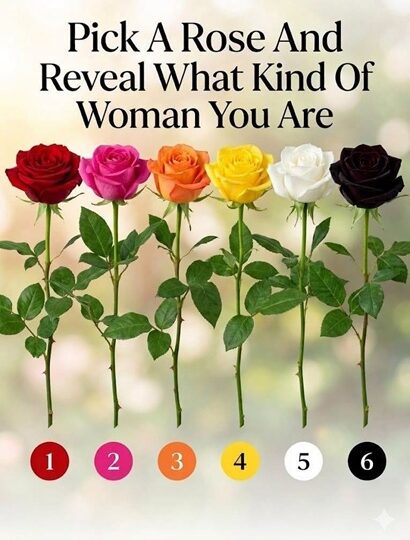
The Red Rose — Strength, Passion and Loyalty
The red rose is one of the most familiar symbols in flower culture and is often connected with love, passion, courage, and emotional intensity. In playful personality descriptions, someone who chooses red is frequently portrayed as strong, loyal, expressive, and determined. This interpretation makes sense from a symbolic point of view because red has long been used to represent strong feelings and dramatic moments. Still, the choice itself does not prove that a person has these qualities. A viewer may simply select the red rose because the color is bold, familiar, or more visually striking than the other options.
Red is also one of the colors that naturally attracts attention. It appears in many forms of design because it can create a strong visual contrast. When a red flower is placed beside pale or neutral colors, it may immediately become the first thing the eye notices. That means a person could choose it for purely visual reasons rather than because of any connection with personality. The symbolic description can still be fun, but it should not be treated as a serious psychological conclusion.
If the red rose caught your attention first, it may be interesting to ask yourself what you associate with it. Perhaps it reminds you of a romantic relationship, a celebration, a family member, or a meaningful gift. Maybe red is simply your favorite color. Those explanations are personal and valid, and they do not need to be turned into a permanent label about who you are.
The Pink Rose — Warmth, Kindness and Affection
Pink roses are commonly connected with affection, tenderness, gratitude, gentleness, and romance. A personality-style image may describe someone choosing pink as caring, empathetic, emotionally sensitive, and quietly strong. These descriptions are pleasant and easy for many people to relate to, which helps explain why they can feel accurate. However, liking a pink rose does not prove that someone is more caring or emotionally open than a person who chooses another color.
The appearance of pink can also change depending on the shade. Pale pink may feel soft and calming, while brighter pink can appear energetic and expressive. Lighting, contrast, and image editing can all affect how attractive the color appears on a screen. If the same flower were shown with a different background or brightness level, a viewer might make a completely different choice. This is another reason visual preference should not be mistaken for a psychological measurement.
A person might choose pink for reasons connected with memory rather than personality. It could remind them of a wedding, a childhood bedroom, a favorite piece of clothing, or flowers that grew in a family garden. These memories can be meaningful, but they remain personal associations. The flower itself does not reveal hidden information about the viewer.
The Orange Rose — Energy, Creativity and Curiosity
Orange roses are often used in symbolic descriptions to represent enthusiasm, creativity, energy, and a willingness to explore new experiences. The color can feel lively because it combines some of the intensity associated with red and some of the brightness associated with yellow. As a result, a personality image may describe people who choose orange as adventurous, expressive, and full of ideas. This can be entertaining, but it is still based on symbolism rather than science.
Orange roses may also attract attention simply because they are less common than traditional red, pink, or white roses. People often notice something unusual more quickly than something familiar. A viewer may therefore choose orange because it looks distinctive or because they have not seen many roses in that color before. Curiosity about appearance is enough to explain the preference.
The color orange can also bring to mind autumn, sunsets, warmth, fruit, sports teams, or other personal experiences. Someone may associate the flower with a happy memory or a specific place. These associations can influence preference without the viewer even realizing it. That makes the choice interesting, but it does not make it a reliable personality test.
The Yellow Rose — Friendship, Happiness and Optimism
Yellow roses are often associated today with friendship, joy, warmth, and positive social connections. In many modern personality games, a person selecting yellow may be described as cheerful, sociable, optimistic, and someone who brings positive energy to others. The brightness of yellow helps explain this interpretation because the color is often connected with sunlight and warmth.
However, the meaning of yellow roses has changed over time. In some historical or cultural contexts, yellow flowers have also been linked with jealousy, change, or separation. This demonstrates that flower symbolism is not fixed. Meanings are created by people and traditions, and they can change across generations.
A viewer may simply choose the yellow rose because it is the brightest option. On a screen, yellow can be especially noticeable depending on contrast and background. If the image were redesigned, another flower might become more visually dominant. The person’s personality would not have changed, only the presentation of the choices.
If yellow is your favorite, think about what the color means to you personally. Perhaps it reminds you of summer, friendship, a sunny garden, or a special bouquet. Those associations can be enjoyable to reflect on without turning them into claims about your entire character.
The White Rose — Peace, Simplicity and Reflection
White roses are frequently connected with peace, purity, simplicity, honesty, and new beginnings. Personality-style descriptions may portray people who select white as calm, thoughtful, sincere, or wise. These ideas come partly from the clean and understated appearance of the color. However, white does not carry exactly the same meaning everywhere.
In some traditions, white flowers are strongly associated with mourning and remembrance. In other contexts, they are common at weddings and celebrations. This shows how one color can communicate very different ideas depending on culture and personal experience. A white rose may therefore feel peaceful to one person and deeply emotional to another.
Someone may choose white because it appears elegant and simple beside more intense colors. Another person may associate it with a ceremony or a meaningful family event. These reasons can be personally important, but they cannot be used to determine personality traits such as honesty or wisdom.
The white rose can still be enjoyed as a symbol. It may represent calm or simplicity within the game, but the person choosing it remains far more complex than the interpretation suggests.
The Black Rose — Mystery, Independence and Change
The black rose is often the most unusual option in personality images. In stories and symbolic descriptions, it may represent mystery, independence, individuality, transformation, or dramatic change. Someone selecting the black rose may be described as someone who values freedom, prefers to think differently, or enjoys standing apart from convention. These ideas fit the unusual appearance of the flower, but they are not scientific conclusions.
Roses described as black are usually not naturally pure black. In reality, very dark red, burgundy, or purple varieties can appear almost black under certain lighting conditions. Digital images may also be edited to create a stronger black appearance. The unusual look alone may be enough to attract attention.
People often enjoy rare or uncommon designs, and that may explain the choice better than any personality description. Someone who selects the black rose might simply find it beautiful, elegant, or visually different. There is no reason to assume the choice means they are secretive, dangerous, or preparing for a major life change.
Black itself has many meanings depending on context. It can represent elegance, formality, grief, sophistication, rebellion, or simplicity. That wide range of meanings is another reminder that symbolism should not be treated as a fixed rule.
Why Personality Descriptions Can Feel So Accurate
One reason these personality-style images can feel surprisingly personal is a psychological tendency known as the Barnum effect. People often recognize themselves in broad descriptions that could apply to many different individuals. Statements such as “You care deeply about people but sometimes protect your feelings” are flexible enough to feel meaningful to a large audience.
These descriptions often combine positive qualities with enough variation to make them relatable. A person might be described as independent but loving, strong but sensitive, adventurous but thoughtful, or calm until something important happens. Because most people behave differently in different situations, these statements can easily feel familiar.
The act of choosing a flower also makes the description feel more personal. Instead of receiving a random statement, the viewer believes the result came from a decision they made. That small ritual can make the interpretation seem more specific than it really is.
This does not mean that people are being careless or easily fooled. Humans naturally look for patterns and connections. Recognizing that tendency simply helps keep these games in perspective.
The Design of the Image Can Influence the Result
The way the flowers are presented can have a strong effect on which one someone chooses. Position, size, brightness, background, lighting, and color saturation can all influence attention. A flower placed in the center may be noticed first, while another may stand out because it is brighter than the rest.
If the same six roses were rearranged, some people would probably make a different selection. If one flower were enlarged or shown with stronger lighting, preferences might shift again. The viewer’s personality would not have changed during that time. Only the visual presentation would be different.
This is another reason a visual choice cannot be used to measure personality. The image itself influences the result. What it can show is which option was most appealing under one particular set of visual conditions.
That is enough for a fun game, but it is not enough for a psychological conclusion.
Culture Plays a Major Role in Flower Symbolism
The meanings attached to roses have developed through many different traditions. Writers, artists, florists, families, and communities have all contributed to how colors are interpreted. These meanings have changed over time and continue to evolve.
Red may represent romantic love in one situation and courage in another. White may symbolize weddings in one culture and mourning in another. Yellow can represent friendship today even though older traditions sometimes gave it very different meanings. Black roses may symbolize transformation in fiction while simply being admired for their unusual beauty.
These variations show that symbols are agreements created by people. The flower itself does not contain a universal psychological message. The meaning depends on context.
That flexibility is part of what makes flower symbolism interesting. It gives people room to attach their own experiences and memories to the image.
Personal Memory Can Be More Meaningful Than the Prepared Result
A person may choose a rose because it reminds them of someone or something important. A red rose might bring back memories of an anniversary. Pink may remind someone of a childhood garden. Yellow could recall a close friendship. White may be connected with a wedding or memorial.
These personal memories can be more meaningful than any personality description written beneath the image. The flower becomes a trigger for reflection rather than a test.
Sometimes people do not immediately understand why a particular color attracts them. The reason may be connected with a memory they have not thought about in years. That is one reason visual choices can feel emotionally significant even when they are not scientifically informative.
Personal associations can also change. A color someone disliked in the past may later become a favorite because of a positive experience. Taste is not fixed forever.
Human Personality Is More Complex Than Six Colors
No person can be completely described by one flower. Someone can be passionate like the symbolic red rose, gentle like pink, energetic like orange, cheerful like yellow, reflective like white, and independent like black at different times.
People behave differently depending on situation, relationships, responsibilities, and mood. A person may be confident at work but shy in a new social environment. They may enjoy adventure while also valuing quiet routines. They may be emotionally expressive with close friends but private around strangers.
This complexity is normal. Personality contains many traits that can appear differently in different circumstances. A six-choice image cannot capture all of that.
That is why none of the rose choices should be considered better than another. Choosing red does not make someone more passionate. Choosing white does not make someone more honest. Choosing black does not make someone more mysterious.
They are simply different visual preferences.
A More Meaningful Way to Enjoy the Rose Game
Instead of asking, “What does this rose prove about me?” try asking, “Why did this flower catch my attention today?” That question makes the activity more reflective without turning it into a personality judgment.
Perhaps you like the color. Maybe it reminds you of a person. The shape of the petals may be especially attractive. You could also be responding to the position of the flower in the image without realizing it.
You can even ask yourself whether your choice would remain the same if the flowers were rearranged. Would you still select red if it were smaller? Would black still feel unusual if several dark flowers appeared beside it? Would white remain your favorite against a lighter background?
These questions help show how personal preference and visual design interact.
There Is No Right or Wrong Rose
There is no correct flower to choose in this kind of game. Every rose has its own visual appeal, and every viewer brings a different history and set of preferences to the image.
The red rose is not better than the pink rose. Yellow is not more positive than black. White is not more mature than orange. The personality stories are simply symbolic interpretations attached to each option.
You also do not need to choose the result that sounds most flattering. Select the rose that genuinely attracts you.
If the description feels accurate, you can enjoy the connection. If it feels completely wrong, that is equally valid. The result does not know your life, experiences, relationships, or values.
Roses Can Be Meaningful Without Defining Anyone
Roses have played an important role in art, literature, celebrations, romance, and remembrance for a very long time. Their symbolic value can be powerful without becoming a method for measuring personality.
A red rose can symbolize love without proving that the person holding it is passionate. A white rose can represent peace without proving that someone is calm. A black rose can represent transformation in a story without predicting that someone’s life is about to change.
Symbols are valuable because they allow interpretation. They do not need to function as facts.
That distinction also prevents people from using someone else’s flower choice to judge them unfairly. A rose selection should never be used to make conclusions about another person’s emotional health, relationships, intelligence, honesty, or worth.
The Differences Are What Make the Game Interesting
Imagine a garden where every rose had exactly the same color and shape. It would lose much of the variety that makes gardens visually interesting. The same idea applies to personal taste.
Some people prefer bright colors. Others enjoy softer shades. Some love traditional red roses, while others are immediately attracted to unusual dark varieties.
None of those preferences need to be ranked.
The six roses can simply represent six different visual stories. Red suggests intensity, pink suggests tenderness, orange suggests enthusiasm, yellow suggests brightness, white suggests simplicity, and black suggests mystery.
These associations help explain the personality descriptions, but they do not define the people making the choices.
Choose the Rose That Appeals to You Right Now
Look at the six roses again and notice which one catches your attention first. Do not worry about finding the “best” result. There is no best answer.
Choose the flower because you like it.
Then read the symbolic interpretation and decide whether any part of it feels familiar. If it does, consider why. If it does not, simply move on.
The most interesting part may not be the prepared description at all. It may be the memory or feeling that the flower brings to mind.
Perhaps red reminds you of love. Pink may remind you of childhood. Orange might bring to mind autumn. Yellow could represent friendship. White may be connected with an important ceremony, while black might appeal because it feels unusual and elegant.
Those associations belong to you.
Tomorrow, you may look at the exact same image and select a different rose.
That does not mean anything is wrong or that your personality changed overnight.
It simply shows that taste can move with mood, memory, context, and experience.
Enjoy the flowers, enjoy the symbolism, and let the game remain what it is meant to be: a lighthearted invitation to think about the colors and memories that catch your attention. Human personality is far more complex than six roses on a screen, and no single flower can fully describe who someone is.
