
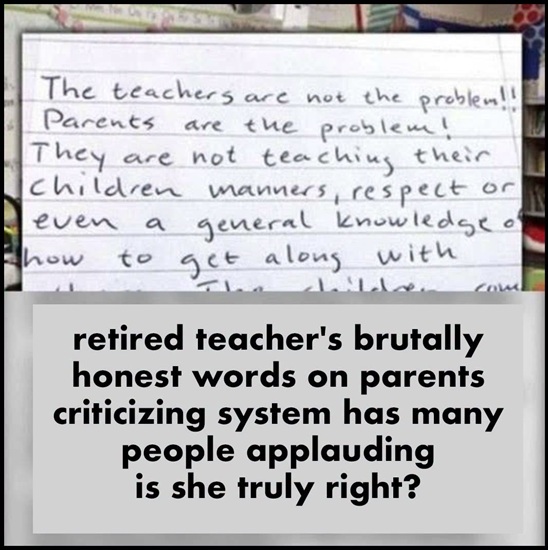
Education is one of those subjects that almost everyone has an opinion about. Parents naturally want their children to receive a strong education, teachers want classrooms where students can learn effectively, and communities want schools that prepare young people for adulthood. Yet there is often disagreement over who should carry responsibility when students struggle. One widely shared example of that debate came from retired teacher Lisa Roberson, whose short but strongly worded letter attracted widespread attention in 2017.
Roberson’s letter appeared in The Augusta Chronicle in February 2017 and was subsequently circulated extensively online. Writing from the perspective of a retired educator, she expressed frustration with criticism directed toward teachers and public schools. In her view, many discussions about educational problems placed too much responsibility on educators while paying insufficient attention to what happens outside the classroom. Her argument was direct and deliberately provocative, which helped explain why it generated such a strong reaction.
An important distinction should be made before considering her argument. Roberson’s statements represented her personal opinion and experience as a retired teacher. Her letter was not a scientific study demonstrating that parents are responsible for struggling schools, nor did it establish that teachers or educational institutions bear no responsibility. Instead, it offered one educator’s perspective on the importance of family participation, student behavior and shared responsibility.
Roberson began by criticizing people who, in her opinion, attempted to propose solutions for public education without sufficiently understanding what modern teachers experience inside classrooms. She strongly rejected the idea that educators alone were responsible for problems within schools. Her frustration centered on situations in which teachers were expected to address academic difficulties while simultaneously dealing with behavioral and preparedness issues.
One of the strongest statements in the letter involved parents. Roberson argued that some children arrived at school without having learned basic manners, respect or appropriate ways of interacting with others. She believed those responsibilities should begin at home rather than being left entirely to teachers.
The wording was broad, and that became one of the reasons the letter was controversial. Families differ greatly, and it would be inaccurate to assume that every behavioral difficulty in a classroom results from inadequate parenting. Nevertheless, Roberson was highlighting something many educators recognize: successful classroom instruction becomes more difficult when significant behavioral problems repeatedly interrupt learning.
Another example Roberson provided involved school supplies. She described students arriving without basic items such as pencils or paper while sometimes wearing expensive shoes or clothing. According to her letter, teachers frequently purchased missing supplies with their own money.
Her example was intended to raise questions about priorities and the expectations placed on educators. If a student arrives without something necessary for a lesson, a teacher may provide it simply because instruction needs to continue. Repeated over many students and many school days, those small purchases can become an additional burden.
However, that example should also be interpreted carefully. A student arriving without supplies does not automatically mean a family has deliberately ignored educational responsibilities. Financial hardship, unstable housing, family emergencies and other circumstances can affect whether children arrive fully prepared.
Similarly, expensive-looking clothing does not necessarily reveal a family’s financial situation or priorities. Items may have been gifts, purchased secondhand or obtained under circumstances a teacher cannot know. Roberson’s example reflected the frustration she wanted to communicate, but it should not become a basis for judging every family facing similar circumstances.
The broader point of her letter concerned parental involvement. Roberson encouraged readers to consider whether parents attend school events, communicate with teachers and make sure their children have the materials necessary for class.
She also asked whether parents check that homework is completed and whether schools have reliable contact information for families. Those questions shifted the discussion away from simply evaluating teachers and toward examining the network of responsibilities surrounding a student.
Communication between home and school can be particularly important when academic problems appear. A teacher may notice that a student has stopped completing assignments, but the family may know about circumstances affecting the child outside school.
Conversely, parents may notice frustration, anxiety or confusion about schoolwork without knowing what is happening in the classroom. Regular communication can help both sides understand the situation more accurately.
Roberson also directed part of her argument toward students. She asked whether students take notes, complete homework, listen during lessons and avoid disrupting their classmates.
That portion of the letter is significant because discussions about educational outcomes sometimes focus almost entirely on adults. As children grow older, however, they gradually assume more responsibility for their own preparation, behavior and academic work.
The amount of responsibility expected from students should naturally reflect their age and circumstances. A young elementary school student cannot reasonably be held to the same standard of independence as a teenager approaching graduation.
Individual differences also matter. Some students need additional academic assistance, behavioral support or accommodations. Others may be experiencing circumstances that affect concentration and participation.
For these reasons, there is rarely one explanation for why a student struggles.
Roberson nevertheless believed that student choices should be considered when evaluating classroom performance. If a student repeatedly refuses to participate, disrupts lessons or leaves assignments unfinished, those behaviors can affect both that student’s education and the classroom environment.
From those observations, Roberson reached the central conclusion of her letter: teachers cannot perform their professional responsibilities while simultaneously assuming every responsibility normally associated with parenting.
She believed stronger involvement from parents was necessary if schools were expected to improve.
That conclusion resonated with some readers, particularly educators who had experienced similar frustrations.
Others believed Roberson placed too much blame on parents and insufficient attention on challenges within school systems themselves.
Both responses help explain why the letter spread so widely.
It presented a complicated issue in extremely direct terms.
The reality of education is considerably more complex.
Student achievement can be influenced by teacher quality, family support, school leadership, curriculum, attendance, classroom environment, available resources and individual circumstances.
Economic conditions can also affect students in ways schools cannot completely control.
A family experiencing financial pressure may have less time or flexibility to participate in school activities. Parents working irregular hours may find it difficult to attend meetings even when they care deeply about their child’s education.
Transportation and childcare can create additional barriers.
Language differences may complicate communication between families and schools.
None of these factors eliminates the importance of parental involvement, but they demonstrate why absence from a school event cannot automatically be interpreted as indifference.
Teachers face their own pressures.
Educators may work with large groups of students who have different academic abilities and behavioral needs. In addition to teaching lessons, they may grade assignments, communicate with families, prepare materials and complete administrative requirements.
When teachers also purchase supplies personally or repeatedly address problems unrelated to instruction, frustration can grow.
Roberson’s letter gave voice to that frustration.
Yet recognizing teachers’ challenges does not require accepting the claim that schools themselves are never responsible when something goes wrong.
Educational institutions can have problems involving staffing, leadership, curriculum, discipline policies or resource distribution.
Teacher performance can also vary, just as performance varies within any profession.
Schools therefore need mechanisms for evaluating their own effectiveness.
Parents should not automatically receive blame for every student difficulty any more than teachers should.
This is where Roberson’s letter can be used as the beginning of a conversation rather than the final answer.
Her argument encouraged people to consider responsibilities that may be overlooked when public discussions focus exclusively on schools.
The strongest interpretation of that message is not that parents should replace teachers.
It is that schools and families perform different roles that work best when they support one another.
Teachers bring professional knowledge of instruction and classroom management.
Parents and guardians bring detailed knowledge of their children and influence habits that develop outside school.
Students themselves become increasingly responsible for their choices as they mature.
Administrators create policies and provide support that affect how classrooms function.
Educational authorities influence funding, curriculum and broader institutional requirements.
Each group therefore contributes something different.
Problems become especially difficult when one group is expected to compensate completely for another.
A teacher cannot control everything happening in a student’s home.
A parent cannot personally manage everything happening during the school day.
Administrators cannot solve every individual family problem.
Students cannot always overcome difficult circumstances without adult support.
Shared responsibility becomes essential precisely because no single group controls every factor.
Roberson wrote her letter in 2017, several years before the COVID-19 pandemic transformed education around the world.
That timing is important.
Her comments should be understood within the educational environment that existed when she wrote them rather than interpreted as a response to later developments.
Beginning in 2020, school closures and remote learning dramatically changed relationships among teachers, parents and students.
Many parents suddenly became much more directly involved with daily schoolwork because children were learning from home.
Teachers simultaneously had to redesign lessons for online environments and find new ways to maintain contact with students.
Students had to adapt to unfamiliar routines and varying levels of access to technology.
Those experiences created additional debates about educational responsibility.
They also demonstrated how interconnected schools and families really are.
When traditional classroom structures disappeared temporarily, both educators and parents encountered responsibilities they had not previously experienced in the same way.
Roberson could not have known those changes were coming when she wrote her letter.
Nevertheless, her central question about where responsibility begins and ends remained relevant.
Who is responsible for making sure a child arrives prepared?
Who should address inappropriate classroom behavior?
Who ensures homework is completed?
What should teachers reasonably be expected to provide?
What responsibility belongs to students themselves?
There are no universal answers that work equally well in every situation.
Age matters.
Family circumstances matter.
School resources matter.
Individual student needs matter.
That complexity is why reducing educational problems to a simple conflict between teachers and parents can be misleading.
There are families who are deeply involved in their children’s education.
There are teachers who devote substantial time and personal resources to their students.
There are also situations in which families could participate more actively.
And there are schools that could provide stronger support.
All of those realities can exist simultaneously.
Roberson’s letter became popular partly because it rejected what she believed was an overly simple narrative blaming teachers.
Ironically, replacing that narrative with one that blames parents exclusively would create the same problem in reverse.
A more balanced interpretation recognizes that educational outcomes emerge from multiple influences.
One useful example is homework.
Suppose a student repeatedly fails to submit assignments.
A teacher might initially assume the student is not making enough effort.
A parent might assume the assignments are too difficult or poorly explained.
The student may be struggling with something neither adult fully understands.
Communication can reveal the actual problem.
Perhaps the student needs additional instruction.
Perhaps there is no quiet place to work at home.
Perhaps the student simply needs clearer expectations and stronger accountability.
The appropriate response depends on understanding the individual circumstances.
Classroom behavior works similarly.
Teachers need authority to maintain an environment where students can learn.
Parents can reinforce expectations about respect and behavior.
But schools may also need counselors, support staff or other resources when behavioral problems have deeper causes.
Blame alone does not identify those causes.
Communication sometimes can.
The same applies to school supplies.
Teachers should ideally have the resources necessary to conduct lessons without regularly spending significant amounts of their own money.
Families should make reasonable efforts to provide required personal materials when they can.
Schools and communities can also create programs to support students whose families cannot afford those supplies.
Such an approach recognizes responsibility without turning financial difficulty into moral judgment.
Roberson’s letter did not explore all these possibilities because it was a short opinion letter rather than a comprehensive education policy proposal.
That context is worth remembering.
Its purpose was to express frustration and make a forceful point.
It succeeded.
People noticed it.
They shared it.
Some strongly agreed.
Others strongly disagreed.
Years later, the letter continues to appear online because the underlying argument remains familiar.
Teachers still discuss workload and classroom behavior.
Parents still debate school policies and educational quality.
Students still face expectations from both groups.
Those conversations are unlikely to disappear because education involves responsibilities shared across different parts of society.
What has changed is the broader context.
The pandemic demonstrated how quickly education can be disrupted.
Technology has become increasingly important in classrooms.
Communication between families and schools can now happen through email, apps and online learning platforms.
Yet technology cannot replace cooperation.
A message sent through a school app is useful only if both sides communicate effectively.
Likewise, access to online assignments does not guarantee that a student understands them.
Human relationships remain central to education.
Teachers need families to communicate relevant information.
Parents need educators to explain academic expectations clearly.
Students need adults who can recognize when they are struggling.
Schools need resources that allow teachers to perform their jobs effectively.
Those needs overlap.
That is why the most productive response to Roberson’s letter may not be deciding whether she was completely right or completely wrong.
Some of her concerns can be legitimate without every generalization being accepted.
Teachers can genuinely feel overwhelmed by responsibilities beyond instruction.
Parents can genuinely face barriers that teachers may not see.
Students can genuinely make choices that affect their academic performance.
Schools can genuinely have structural problems requiring reform.
Recognizing one does not require denying the others.
Roberson’s perspective deserves to be represented accurately because it came from her experience as a retired educator.
But accuracy also requires identifying opinion as opinion.
Her assertion that parents were the primary problem was an argument she made, not an established fact about public education.
That distinction allows readers to evaluate her reasoning for themselves.
It also prevents individual families from being unfairly characterized.
Most importantly, it keeps attention on the larger question.
What conditions help children learn?
Strong teachers clearly matter.
Supportive families matter.
Appropriate resources matter.
Student participation matters.
Effective leadership matters.
Safe and orderly classrooms matter.
Communication matters.
When those elements work together, children have a stronger foundation for academic and personal development.
When several are missing, teachers or families may find themselves attempting to compensate.
That can create frustration on all sides.
Roberson’s 2017 letter captured one version of that frustration.
She believed teachers were being asked to solve problems they could not solve alone.
Her response was to call for greater responsibility from parents and students.
Many educators understood what she meant.
Many parents believed her wording failed to recognize the complexity of family life.
That disagreement itself illustrates why the conversation remains relevant.
Education is rarely improved by assuming one group has all the answers.
Nor is it improved by assuming one group deserves all the blame.
The interests of teachers and parents do not have to be opposing.
Both generally want students to succeed.
Their perspectives differ because they see different parts of a child’s life.
Teachers see what happens inside classrooms.
Parents see much of what happens outside them.
Students experience both environments.
Sharing information between those worlds can provide a more complete understanding of what a child needs.
Roberson’s letter remains a striking example of how strongly people feel about this issue.
It was written before the pandemic and before many of the educational disruptions that followed.
Yet its questions about responsibility, preparation, communication and behavior remain recognizable.
The letter should therefore be remembered for what it actually was: a retired teacher’s forceful opinion about problems she believed were being incorrectly placed entirely on educators.
It was not proof that all parents are failing.
It was not proof that all schools are functioning perfectly.
And it was not a comprehensive explanation for every difficulty in public education.
It was one perspective in a much larger debate.
Nearly a decade later, perhaps the most constructive conclusion is one that moves beyond deciding whether parents or teachers deserve blame.
Children benefit when the adults responsible for their development cooperate.
Parents cannot replace trained educators.
Teachers cannot replace families.
Schools cannot control every influence outside their walls.
And families cannot control everything happening inside classrooms.
Students themselves also become increasingly responsible as they mature.
Education therefore works through partnership.
Roberson’s letter became memorable because its language was direct enough to start an argument.
The more useful conversation begins after that argument.
Instead of asking whether parents or teachers are “the problem,” a better question is what each group can realistically do to help students succeed.
That approach does not remove accountability.
It distributes accountability more accurately.
Teachers should be responsible for professional instruction and appropriate classroom practices.
Parents and guardians should support learning and reasonable behavioral expectations when circumstances allow.
Students should develop increasing responsibility for their work and conduct.
Schools and educational authorities should provide the resources and structures necessary for all of those responsibilities to function.
When those pieces work together, education becomes less about assigning blame and more about solving problems.
And despite the controversy surrounding Lisa Roberson’s 2017 letter, that shared objective remains the most important part of the discussion: creating conditions in which children have the strongest possible opportunity to learn, develop and succeed.

