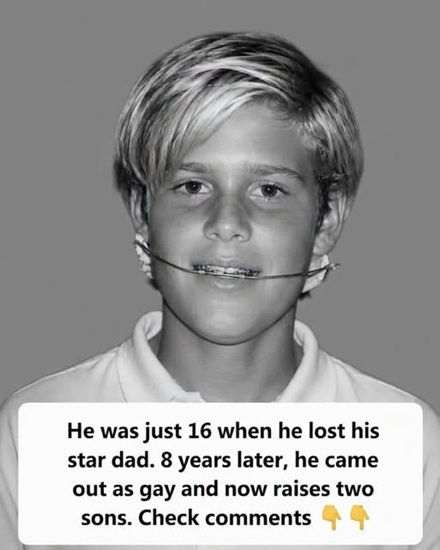
Michael Landon became one of the most recognizable figures in American television, but for his children he was first and foremost a father. Among them was Christopher Landon, who would later become a successful screenwriter, director and producer. Christopher’s life changed permanently in 1991, when Michael was diagnosed with pancreatic cancer and died only months later. Michael Landon passed away on July 1, 1991, at the age of 54.
Christopher was just 16, still a teenager and years away from understanding many of the personal and professional decisions that would eventually shape his adult life. For viewers, Michael’s death meant losing the star of some of television’s most enduring programs. For Christopher, it meant losing a parent before reaching adulthood. He had not yet begun the filmmaking career that would later establish him independently in Hollywood. He had not yet publicly come out as gay, become a husband or become a father himself.
Many of the conversations that might naturally take place between a father and an adult son therefore never had a chance to happen. Michael Landon had already achieved enormous television success long before Christopher began building a professional identity of his own. His role as Little Joe Cartwright on Bonanza first made him widely known.
He later became closely associated with Little House on the Prairie, where he played Charles Ingalls and was also heavily involved behind the scenes. In the 1980s, Highway to Heaven became another major part of his career. Across those projects, Michael developed a reputation for emotionally driven storytelling and family-centered television.
Growing up with such a famous father meant Christopher carried a recognizable surname from an early age. That connection could bring attention, but it also created expectations. Michael had become a television institution, and any child entering entertainment would inevitably face comparisons. Christopher eventually chose not to imitate his father’s career. Instead, he developed his own creative identity in film, particularly through horror, suspense and dark comedy.
Christopher Landon was born on February 27, 1975, in Los Angeles. He was the son of Michael Landon and Lynn Noe. By the time Christopher reached his teenage years, his father was still a major public figure, but their family life was about to be transformed by Michael’s illness. In 1991, doctors diagnosed Michael with pancreatic cancer. The disease progressed rapidly, and he died only a few months later.
The speed of the illness made the loss especially difficult. Christopher was old enough to understand what was happening but still young enough to have much of his identity and future ahead of him. At 16, he had not yet experienced many of the adult milestones that might have created new conversations with his father. Michael would never see the professional direction his son eventually chose or witness many important personal developments in Christopher’s life.
One of those developments involved Christopher’s sexuality. In 1999, eight years after Michael’s death, Christopher publicly came out as gay. At the time, openly gay people working in mainstream Hollywood still faced substantial prejudice and professional uncertainty. Christopher nevertheless chose to live openly rather than allow fear about how the industry might react to determine how he presented himself.
That decision became an important part of his personal story. Because Michael had already been gone for years, Christopher never had the opportunity to come out to his father directly as an adult. There was no later conversation in which he could explain his feelings and hear Michael’s response. That absence left an emotional question that could never be answered completely.
Years later, Christopher received information from his stepmother, Cindy Landon, that gave him another perspective on the situation. Cindy reportedly told Christopher that she and Michael had already suspected that he was gay. The information suggested that Michael may have understood more about his son than Christopher had realized while his father was alive.
It is important not to invent a response Michael never had the opportunity to give. No one can know exactly what he would have said if Christopher had come out to him personally. What can be said is that Christopher later learned that his father may already have recognized that part of him. For Christopher, that possibility helped change the emotional meaning of a conversation that had never happened.
Losing a parent as a teenager can leave many unanswered questions. People continue changing throughout their twenties, thirties and later years, and relationships between parents and children often change with them. Christopher never had the opportunity to return to conversations from adolescence with the perspective of adulthood. Michael’s death froze their relationship at a point when Christopher was still discovering who he was.
The reassurance provided by Cindy could not replace an actual conversation between father and son. It did, however, allow Christopher to consider the possibility that Michael had already noticed more than he openly discussed. That distinction became meaningful because it gave Christopher a way to think differently about his father’s understanding of him.
While Christopher’s personal identity continued to develop, his professional life also began taking shape. He entered the entertainment industry, but his path looked very different from Michael’s. Rather than pursuing traditional family television or Westerns, Christopher became interested in screenwriting and genre filmmaking.
He studied screenwriting at Loyola Marymount University before leaving school to pursue professional opportunities. His early work gradually led to larger projects, allowing him to establish himself on his own terms rather than relying solely on the Landon family name.
One of Christopher’s notable early credits came with Disturbia, the 2007 thriller starring Shia LaBeouf. Christopher received a screenwriting credit on the film, which became commercially successful and helped strengthen his reputation as a writer. The project was very different in tone from the programs that had made Michael famous.
That difference would become even more pronounced as Christopher became involved with the Paranormal Activity franchise. He wrote several installments, including Paranormal Activity 2, Paranormal Activity 3 and Paranormal Activity 4. His work on those films established him within contemporary horror and gave him increasing responsibility as a filmmaker.
Christopher eventually moved into directing within the franchise. In 2014, he wrote and directed Paranormal Activity: The Marked Ones. The film expanded the mythology of the series while also demonstrating that Christopher could manage an entire feature production rather than working only as a screenwriter.
His next projects continued developing the combination of horror and humor that would become associated with his work. In 2015, he directed and co-wrote Scouts Guide to the Zombie Apocalypse. The film mixed horror, comedy and teenage adventure, signaling Christopher’s growing interest in combining genre conventions rather than remaining within one strict style.
That approach became particularly successful with Happy Death Day in 2017. Christopher directed the film, which follows a college student trapped in a time loop in which she repeatedly experiences her own murder. The movie blended slasher elements, comedy and a science-fiction-style premise. It became one of the most recognizable projects of Christopher’s career.
He returned to the story with Happy Death Day 2U in 2019, serving as both writer and director. The sequel expanded the time-loop concept and introduced additional science-fiction ideas. Together, the films helped establish Christopher as a filmmaker with a distinctive voice in contemporary horror.
In 2020, Christopher directed and co-wrote Freaky, starring Vince Vaughn and Kathryn Newton. The film combined a traditional body-swap concept with slasher horror. Instead of treating genre boundaries as fixed, Christopher again used comedy and suspense together, creating a project that fit comfortably within the creative style he had been developing for years.
His career continued with We Have a Ghost, released by Netflix in 2023. Christopher wrote and directed the film, which mixed supernatural elements with comedy and family themes. The project showed that his interest in genre storytelling extended beyond conventional horror.
Christopher also remained connected to the Paranormal Activity universe through additional writing and producing work. By this stage, he had built a career long enough and substantial enough that he was no longer simply discussed as Michael Landon’s son. His own body of work had become recognizable.
More recently, Christopher directed the 2025 thriller Drop, starring Meghann Fahy. The film added another major directing credit to his résumé and demonstrated his continued interest in suspense-based storytelling. By the mid-2020s, Christopher had spent decades working as a writer, director and producer.
The contrast between father and son is easy to see. Michael became famous through classic network television, Westerns and family dramas. Christopher developed his reputation through horror, thrillers and dark comedy. Their projects looked very different in style and tone.
Yet they also shared something fundamental. Michael did much more than act. He wrote, directed and produced many of the programs associated with his career. Christopher similarly became someone who writes, directs and produces. Although their genres were different, both men built careers around creating stories.
That connection became especially visible when Christopher became involved with a television movie adaptation of Highway to Heaven. The title had been strongly associated with Michael, and Christopher’s participation created a direct bridge between the television work of his father and his own career decades later.
Even with that connection, most of Christopher’s professional life has remained separate from Michael’s legacy. His most successful films are not attempts to recreate the kind of television his father made. Instead, they reflect Christopher’s own interests and creative instincts.
This independence is significant because children of famous entertainers often face assumptions about how much of their success comes from their family name. A well-known surname can create opportunities, but it can also bring constant comparison. Christopher eventually developed a filmography broad enough to be evaluated independently.
His personal life also continued to change. Christopher built a family with Cody Morris, and the couple became parents to two sons. That milestone gave Christopher a role his own father once had: raising children and watching them develop their own identities.
The transition from losing a father at 16 to becoming a father himself adds another layer to Christopher’s life story. Michael never had the opportunity to see his son experience parenthood. He also never saw the filmmaker Christopher would become.
It would be speculative to claim that every decision Christopher made as a father was shaped directly by losing Michael. His life is more complicated than a single event. Still, the chronology is unavoidable. Michael died before most of Christopher’s adult life had begun.
Christopher’s public coming out in 1999 was also part of that adult life Michael never witnessed. The entertainment industry of the late 1990s was different from the one that exists today. Openly gay professionals often faced stronger pressures to remain private, particularly when building mainstream careers.
Christopher nevertheless chose openness. His later professional success showed that his sexuality did not prevent him from creating a sustained career in Hollywood. Over time, he became known for his work rather than for speculation surrounding his personal identity.
That distinction matters because Christopher’s story is not simply one about overcoming the shadow of a famous father. It is also about becoming comfortable enough to define himself independently, both professionally and personally.
The Landon name remained part of his identity, but it did not dictate every choice he made. Christopher could honor his family connection without recreating his father’s career. He could acknowledge Michael’s influence while still developing projects that reflected his own sensibilities.
Michael’s work continues to occupy an important place in American television history. Bonanza remains one of the most famous Western series ever produced. Little House on the Prairie continues to reach new audiences through reruns and streaming. Highway to Heaven remains associated with Michael’s later years as an actor, writer, director and producer.
For Christopher, however, those programs were connected to something more personal than television history. The man behind them was his father. The loss he experienced in 1991 was therefore fundamentally different from the grief felt by audiences.
That difference also explains why questions about what Michael understood regarding Christopher’s sexuality can carry emotional importance. For the public, such details may seem like part of a celebrity biography. For Christopher, they concern a conversation he never had with someone he lost as a teenager.
Cindy’s later comments therefore offered a kind of reassurance without providing certainty. Christopher could not know exactly what Michael would have said, but he could believe his father may already have recognized this part of him.
That possibility may have helped soften one unanswered question, but it did not erase the larger absence. Michael was not there when Christopher became established in Hollywood. He was not there when Christopher publicly came out. He was not there when his son became a husband or father.
Those missing experiences remained part of Christopher’s story even as his life continued moving forward.
Professionally, Christopher kept building. His involvement with horror films expanded into directing, producing and developing original concepts. Projects such as Happy Death Day and Freaky became especially important because they demonstrated a recognizable style rather than simply competence within an established franchise.
His films often combine fear with humor. They may begin with familiar horror concepts, then introduce ideas associated with comedy, science fiction or character-driven drama. That approach has helped distinguish his work in a crowded genre.
Happy Death Day, for example, used a slasher structure but centered its story around a repeating day. Freaky combined a serial-killer narrative with a body-swap comedy. We Have a Ghost approached supernatural material in a more family-oriented way.
These differences demonstrate why Christopher’s career cannot easily be reduced to one formula. Horror has remained important, but his projects vary significantly in tone and structure.
His later work also shows professional durability. Building one successful project can happen quickly, but maintaining a career across decades requires repeated adaptation. Christopher moved from screenwriting into directing and producing, expanding his responsibilities as the industry itself changed.
Streaming services, theatrical releases and long-running franchises all became part of his professional environment. That world is very different from the network-television system in which Michael built his career.
The differences between their eras are substantial. Michael rose to fame when a relatively small number of major television networks dominated American entertainment. Christopher built his career during an age of theatrical franchises, streaming platforms and rapidly changing viewing habits.
Despite that gap, storytelling remained central to both careers.
Michael used television to tell stories about family, morality, hardship and relationships. Christopher often uses genre films to explore characters through suspense, humor and supernatural or high-concept situations.
Their creative methods differ, but both careers demonstrate an interest in shaping stories rather than merely performing within them.
Christopher’s experience also shows how a famous family legacy can coexist with personal independence. He did not need to reject his father’s name in order to become his own person. Nor did he need to reproduce Michael’s work to honor him.
The same principle applies to his personal life. Christopher’s identity was not determined by what others expected the son of Michael Landon to be. Coming out publicly allowed him to live more openly and define his own adult life.
His marriage and children further expanded that life beyond the circumstances of his youth.
The teenager who lost his father in 1991 eventually became responsible for raising children himself.
That fact does not transform his life into a simple story about tragedy leading automatically to happiness. Real lives do not work so neatly. Loss remains loss even when someone later achieves success.
What changed was Christopher’s ability to continue building a life around that absence.
He developed professionally.
He lived openly.
He created a family.
He became a father.
And he eventually received information suggesting that Michael may have understood more about him than Christopher once thought.
The story therefore contains both certainty and uncertainty. Michael’s death date, Christopher’s age, his public coming out and his filmmaking career are established facts. Exactly how Michael would have responded to every part of Christopher’s adult identity cannot be known.
Keeping that distinction clear matters when telling the story responsibly.
Michael Landon died on July 1, 1991, after being diagnosed with pancreatic cancer. Christopher was 16.
Eight years later, Christopher publicly came out as gay.
He later learned through Cindy Landon that Michael may already have suspected that part of his identity.
Christopher then continued building a career that included Disturbia, several Paranormal Activity films, Happy Death Day, Freaky, We Have a Ghost and Drop.
He also built a family with Cody Morris and became a father to two children.
Taken together, those facts show how dramatically Christopher’s life expanded beyond the moment of loss that marked his teenage years.
Michael’s cultural legacy remained enormous, but Christopher did not allow that legacy to become the only definition attached to his name.
He found another route through the same entertainment industry.
Michael became known through some of the most famous television dramas of his era.
Christopher became known through contemporary horror and suspense filmmaking.
Their professional worlds were different, but both were built around storytelling.
More than three decades after Michael Landon’s death, Christopher’s life reflects both continuity and independence.
He remained Michael Landon’s son.
But he also became a filmmaker in his own right, a husband, a father and a person who chose to live openly.
That distinction is what makes his story more than a simple continuation of a famous family name.
Christopher did not try to become another Michael Landon.
He built a life that was unmistakably his own.
