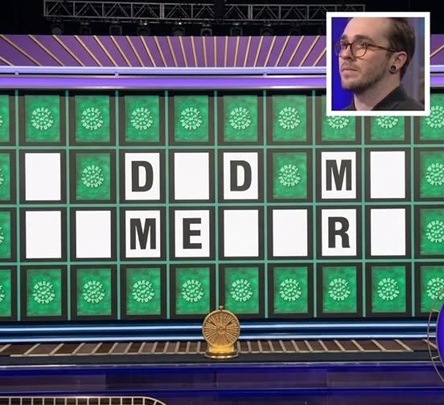
A Valentine’s Day episode of Wheel of Fortune became the subject of widespread viewer discussion after contestant Conner Kemmsies reached the Bonus Round but could not solve the final puzzle in time. The episode aired on February 14, 2025, during Season 42 of the long-running game show. Kemmsies, a commercial pilot from Lakeside, California, had already won the main portion of the game and advanced to the final round with a chance to add a significant amount of money to his total.
What happened next turned an otherwise ordinary Bonus Round into a moment that many viewers continued debating after the episode ended. The final puzzle consisted of four simple words: “I DID MY HOMEWORK.” Once the full answer appeared on the board, the sentence looked immediately familiar. During the actual Bonus Round, however, Kemmsies saw only a limited number of letters and had just seconds to identify the complete answer. He managed to say “I did my,” meaning he had already solved three of the four words.
The final word, “HOMEWORK,” remained out of reach before the timer expired. That near miss became especially significant once the hidden prize was revealed. The envelope Kemmsies had selected contained $40,000. If he had correctly completed the puzzle within the allotted time, that amount would have been added to his winnings from the regular game. Instead, he kept the $19,080 in cash and prizes he had already earned, while the additional Bonus Round money remained unclaimed.
The outcome immediately sparked discussion among viewers. Some people watching at home said they solved the puzzle quickly and were surprised Kemmsies did not arrive at “HOMEWORK.” Others defended him, arguing that television viewers have a major advantage because they are not standing under studio lights with a countdown running and thousands of dollars potentially at stake.
A separate part of the debate involved the category. The show presented the Bonus Round puzzle under “Phrase.” Several viewers questioned whether “I DID MY HOMEWORK” fit what they personally expected from that category. Their criticism focused less on whether the sentence itself was understandable and more on whether the category provided enough guidance toward the answer.
That point should be described carefully. Wheel of Fortune officially classified “I DID MY HOMEWORK” as a “Phrase.” Viewer disagreement about that classification does not establish that the show violated any rule or that the puzzle was objectively unfair. It simply shows that some fans interpreted the category more narrowly than the program did.
Other viewers saw no problem with the classification at all. To them, “I DID MY HOMEWORK” was a perfectly acceptable verbal expression for the category and the real challenge was simply identifying the missing letters quickly enough. This difference in interpretation is what made the reaction genuinely divided rather than uniformly negative.
Kemmsies had already demonstrated strong puzzle-solving ability before reaching the final round. He competed against Noor Ramay and Shameca Freeman during the episode and finished the regular game with the highest total. That result is important because the viral discussion around the Bonus Round can otherwise make it seem as though his entire appearance was defined by one missed answer.
The episode included several successful solves before the final puzzle. Among the earlier answers were “MAKING A HOLE IN ONE,” “FORGETTING MY PASSWORD,” “GENTLY FALLING SNOWFLAKES,” “THE BIG BAD WOLF BLITZER,” “SPOTTING A GRAY WHALE,” and “CHIEF OF STAFF.” The Triple Toss-Up segment also featured “WATCH OUT BELOW,” “WATCH YOUR STEP,” and “WATCH YOUR LANGUAGE.”
By the time Kemmsies reached the Bonus Round, he had already earned his place as the episode’s winner. The final stage therefore represented an opportunity to increase his winnings rather than a chance to avoid going home empty-handed.
During the Bonus Round, contestants receive the standard letters R, S, T, L, N and E. They are then allowed to choose three additional consonants and one more vowel. Kemmsies selected C, M, D and A.
Those choices helped reveal parts of the puzzle. In particular, they gave him enough information to identify the first three words. But they did not uncover the letters that would have made “HOMEWORK” more immediately recognizable.
The final word was the main obstacle. Without enough distinctive letters appearing, Kemmsies had to generate possible completions while the countdown was running. That is considerably more difficult than looking at the answer afterward and feeling that it should have been obvious.
The phrase “I DID MY” can lead to many different possibilities before the rest of the letters are known. Someone might think of an activity, a task, an obligation or another action. The contestant has to test potential answers mentally while also listening to the countdown and reacting quickly.
Once “HOMEWORK” appeared, the puzzle naturally seemed much easier. That difference between solving and recognizing is one reason game-show moments can generate strong reactions online.
Recognition happens after the missing information has been supplied.
Solving requires reaching the answer while the information is still incomplete.
Those are very different tasks.
Kemmsies’ situation also illustrates how pressure can affect performance. Viewers at home can pause mentally, reconsider alternatives and continue thinking even after the official timer has expired. A contestant on stage cannot.
There is also a financial element. Kemmsies knew that the envelope beside the host could contain a substantial prize. Even without knowing the exact amount, the possibility of a large payout can add pressure.
Once time expired, host Ryan Seacrest revealed the complete answer.
Kemmsies reacted with humor rather than anger. He joked that he did not do homework anymore because he was no longer in school.
That reaction kept the on-air moment light despite the disappointment.
Then the $40,000 amount was revealed.
Kemmsies again responded playfully, noting that at least it was not $100,000.
Seacrest reminded him that he was still leaving with $19,080.
The exchange showed that the contestant himself did not turn the loss into a confrontation with the show.
The larger controversy developed primarily among viewers afterward.
Some criticized the difficulty of the puzzle.
Others criticized the category.
Some criticized Kemmsies for missing what they considered an easy answer.
Others defended him and emphasized the difference between home viewing and competing inside a television studio.
That range of reactions makes it inaccurate to describe the audience as having one single opinion.
The response was mixed.
The Valentine’s Day theme also gave the episode additional visibility. Holiday editions of game shows often attract attention because viewers expect unusual decorations, themed puzzles or memorable moments.
In this case, the holiday atmosphere was overshadowed by the final puzzle.
Instead of ending with a dramatic cash win, the episode ended with a near-solve and a divided online reaction.
The phrase “I DID MY HOMEWORK” was ordinary enough to make the missed answer feel surprising.
That simplicity is part of what made the moment memorable.
If the solution had included an obscure place name or unusual vocabulary, viewers might have accepted the difficulty immediately.
Instead, every word in the answer was familiar.
That led some people to believe the puzzle should have been easy.
Yet simple words can sometimes be harder to predict because they fit so many possible combinations.
An unusual word may become obvious once a few distinctive letters are revealed.
Common words often leave more options.
“HOMEWORK” is familiar, but it is not necessarily the first word everyone will imagine after seeing “I DID MY…”
The category becomes important at that point because contestants use it to narrow the possibilities.
This explains why several viewers focused so heavily on “Phrase.”
Some fans apparently expected the category to point toward a familiar saying or established expression rather than an ordinary declarative sentence.
Others interpreted “Phrase” more broadly and had no problem with the clue.
Neither reaction changes what happened during the actual game.
The answer was officially accepted by the show under the category presented.
Kemmsies did not complete it within the allowed time.
The prize was $40,000.
Those are the central facts.
Whether the puzzle felt fair is a matter of opinion.
That distinction matters because online discussions can easily transform subjective reactions into claims of wrongdoing.
There is no documented evidence that Kemmsies was denied a letter, that the timing rules were altered or that normal Bonus Round procedures were changed.
The episode followed the established structure of the game.
The disagreement was about how viewers interpreted the puzzle.
That makes the event a debate rather than a proven controversy involving misconduct.
Another part of the conversation involved the value of the envelope.
At the time, $40,000 was the lowest cash amount on the Bonus Wheel.
Some regular viewers had already been commenting that the $40,000 prize seemed to appear frequently during that season.
When Kemmsies’ envelope revealed the same amount, those complaints resurfaced.
Again, that observation should not be confused with evidence of manipulation.
The fact that viewers noticed the amount appearing often does not by itself show that anything improper occurred.
It simply became another topic associated with the episode.
For Kemmsies, the amount mattered because it represented a significant opportunity.
Adding $40,000 to $19,080 would have transformed his total.
Missing one word therefore carried a visible financial consequence.
Yet his existing winnings were still substantial.
He had already won the episode.
That fact is often lost when viral clips focus only on the Bonus Round failure.
Game shows naturally produce moments where a successful contestant is remembered for the one answer they did not get.
This episode was a clear example.
Kemmsies had solved enough puzzles to outperform his competitors.
He then reached the final round and came within one word of a $40,000 bonus.
The story is therefore more accurately described as a close Bonus Round loss than a poor overall performance.
His profession also became part of the lighthearted coverage. Kemmsies was identified as a commercial pilot, and some reports noted that he had recently earned his commercial pilot credentials.
That detail gave the episode an easy human-interest angle, but it had no direct connection to the difficulty of the puzzle.
His performance should be judged by what happened on the game board.
And on the board, he did well enough to reach the final stage.
The Bonus Round itself has always been designed to create exactly this kind of tension.
Contestants do not choose every letter freely.
They receive the six standard letters first.
Then they have only four additional selections.
A good combination can reveal most of a puzzle.
An unlucky combination can leave crucial sections almost blank.
Letter selection therefore combines strategy with uncertainty.
Kemmsies’ choices were not obviously unreasonable.
C, M and D are common consonants, and A is a frequently useful vowel.
The problem was that the final word required different letters to become clearer.
Had he selected an O or an H, for example, the board might have looked very different.
But that observation is based on hindsight.
Contestants do not know which letters will be useful until after they choose them.
That uncertainty is part of the game.
It is also what makes the Bonus Round so compelling.
A contestant can make sensible choices and still end up with very little help.
Another contestant can choose less obvious letters and accidentally unlock the entire answer.
The format depends on that balance between skill and chance.
The same principle applies to the hidden prize.
Contestants know they are playing for something valuable, but they do not know the exact amount until the round ends.
That uncertainty adds another layer of suspense.
Kemmsies therefore entered the final puzzle with two unknowns.
He did not know the answer.
And he did not know the value of the envelope.
Only after the round ended were both revealed.
The answer was “I DID MY HOMEWORK.”
The prize was $40,000.
Those two reveals transformed the moment from a simple missed puzzle into a widely discussed television clip.
The reaction also demonstrates why Wheel of Fortune remains easy for audiences to engage with.
Unlike many trivia shows, viewers do not need specialized knowledge to participate from home.
They can see the same letter pattern and attempt the same solve.
That creates an immediate sense of competition between viewer and contestant.
When a viewer solves first, they feel successful.
When a contestant solves first, they can still follow the logic.
And when nobody solves quickly, the puzzle becomes a topic of discussion.
Kemmsies’ Bonus Round produced all three reactions among different viewers.
Some solved it instantly.
Some solved it only after more time.
Some did not see it until the answer was revealed.
That variety helps explain why there was no consensus.
The category debate also touches on an interesting language issue.
In everyday use, “phrase” can refer broadly to a group of words or an expression.
In formal grammar, however, a phrase does not normally function as a complete sentence with both a subject and predicate.
“I DID MY HOMEWORK” is grammatically a complete sentence.
That difference appears to be what bothered some viewers.
But game-show categories do not necessarily follow narrow grammatical terminology in the same way a language textbook would.
The show’s use of “Phrase” is broader and has historically included many types of expressions.
Whether viewers like that convention is a separate question from whether the puzzle followed the show’s established format.
The disagreement therefore tells us more about audience expectations than about an objective rule violation.
Some viewers wanted the category to offer more specific guidance.
Others believed the incomplete letters alone should have been enough.
That split kept the conversation alive.
It also shows how a seemingly small detail can become central when large prizes are involved.
If Kemmsies had been playing for a minor amount, fewer people might have scrutinized the category.
The $40,000 reveal gave the puzzle greater emotional weight.
A single word now represented tens of thousands of dollars.
That naturally encouraged viewers to revisit the board and ask whether the contestant had been given a reasonable chance.
Those questions are understandable.
But they remain subjective.
There is no universal standard for exactly how easy or difficult a Bonus Round puzzle should be.
The game intentionally includes varying levels of difficulty.
If every final puzzle were obvious, the suspense would disappear.
If every puzzle were nearly impossible, the Bonus Round would become frustrating.
The show therefore operates somewhere between those extremes.
Individual viewers will inevitably disagree about where a particular puzzle falls.
“I DID MY HOMEWORK” became one of those cases.
For one viewer, it might be obvious.
For another, it might remain hidden until the reveal.
For Kemmsies, it was close but not close enough.
The phrase’s opening was clear to him.
The ending was not.
That is what makes the moment so easy to understand.
He was not completely lost.
He was one word away.
That final word carried the entire value of the prize.
The situation also became memorable because Kemmsies handled it calmly.
There was no dramatic complaint on stage.
There was no accusation that the show had treated him unfairly.
He joked.
Seacrest reassured him about his existing total.
The episode ended normally.
The argument began elsewhere.
Social media and entertainment websites amplified viewer reactions.
That is increasingly common with long-running game shows.
A moment that might once have disappeared after one television broadcast can now circulate for days or years through clips, recaps and online discussions.
People who never watched the original episode can encounter only the Bonus Round and form an opinion from that segment.
That can make context especially important.
Kemmsies did not simply appear, miss one puzzle and leave.
He won the main game.
He earned $19,080.
He reached the Bonus Round.
He solved most of the final answer.
Then time expired before he found the final word.
That fuller sequence provides a fairer picture of his performance.
It also makes the result more dramatic.
A contestant who performs badly all episode and then struggles in the Bonus Round is less surprising.
A contestant who performs well and then misses one familiar word creates a stronger emotional reaction.
That is exactly what happened here.
The Valentine’s Day timing added another contrast.
The broadcast was designed around a celebratory holiday.
The final moment, however, became one of disappointment.
Even then, Kemmsies’ reaction prevented it from feeling bitter.
His joke about not doing homework anymore gave the moment a self-aware ending.
It also highlighted the irony of the answer.
A commercial pilot lost $40,000 because he could not identify a sentence associated with schoolwork.
That kind of contrast naturally makes a television moment more memorable.
Still, it would be unfair to suggest that his profession should have made the answer easier.
Puzzle solving under pressure has little to do with whether someone works as a pilot, teacher, lawyer or any other profession.
Anyone can become stuck on a familiar word.
That is another reason viewer criticism should be kept in perspective.
Game-show contestants are real people making decisions in real time.
Their mistakes become entertainment, but they are not necessarily evidence of poor intelligence or ability.
Kemmsies had already shown he was capable of solving multiple puzzles.
The Bonus Round simply did not go his way.
The result also offers a good example of hindsight bias.
After seeing “HOMEWORK,” people may feel they would obviously have guessed it.
But once the answer is known, the mind naturally treats the path toward it as simpler than it was beforehand.
The missing letters no longer feel ambiguous.
The category no longer feels broad.
Everything suddenly points toward the known solution.
Contestants do not have that luxury.
They experience the uncertainty first.
That distinction does not mean viewers are wrong to say they solved the puzzle.
Many clearly did.
It simply means one person’s quick solve does not prove another person’s failure was unreasonable.
Different people recognize word patterns differently.
Stress can also change how quickly those patterns appear.
For Wheel of Fortune, that variability is part of the appeal.
The game gives viewers the satisfaction of solving while also creating moments where obvious-looking answers remain hidden.
Kemmsies’ Valentine’s Day appearance became memorable precisely because the final answer looked so ordinary once revealed.
Four words changed the ending.
“I.”
“Did.”
“My.”
“Homework.”
There were no obscure references.
No difficult names.
No unusual spellings.
Yet the $40,000 remained behind the envelope.
That contrast drove the conversation.
Some viewers came away believing the puzzle was surprisingly easy.
Others believed the category made it harder than it should have been.
Still others simply felt sympathy for a contestant who came close.
All of those reactions can be reported without treating any one of them as fact.
The factual record is straightforward.
The episode aired February 14, 2025.
Conner Kemmsies won the regular game.
He entered the Bonus Round under the category “Phrase.”
He selected C, M, D and A in addition to the standard letters.
He reached “I DID MY” but did not solve “HOMEWORK.”
The full answer was “I DID MY HOMEWORK.”
The hidden prize was $40,000.
He finished with $19,080 in cash and prizes.
Everything beyond those points belongs largely to interpretation.
Was the category misleading?
Some viewers thought so.
Was the puzzle easy?
Some viewers thought so.
Was it unusually difficult?
Others believed it was.
Was Kemmsies treated unfairly?
There is no documented evidence establishing that claim.
That distinction keeps the story accurate.
It also makes the viewer debate more meaningful because it shows that people were reacting to the same set of facts in different ways.
Long-running game shows often create exactly this kind of discussion.
People understand the rules well enough to develop strong expectations.
When a puzzle falls outside those expectations, even slightly, fans notice.
The fact that Wheel of Fortune has been on television for decades means many viewers have seen hundreds or thousands of puzzles.
They develop their own ideas about what belongs in each category.
“I DID MY HOMEWORK” challenged some of those expectations.
That was enough to make four ordinary words unusually controversial.
For Kemmsies, however, the episode remained a successful appearance despite the painful final miss.
He won.
He earned a five-figure total.
He reached the most prestigious stage of the game.
And he came within one word of an additional $40,000.
That is a very different picture from simply saying he failed a puzzle.
The Bonus Round created disappointment, but it did not erase everything that happened before it.
The same balance applies to the online reaction.
The episode did not produce universal outrage.
It produced disagreement.
That disagreement involved language, puzzle difficulty, game-show pressure and expectations about how Bonus Round clues should work.
Those subjects helped the moment travel beyond the original broadcast.
Years later, the puzzle remains easy to discuss because the central question is so simple.
Would you have solved “I DID MY HOMEWORK” in time?
Some people confidently say yes.
Others are less certain.
And that uncertainty is exactly why the Valentine’s Day Bonus Round became memorable.
For Conner Kemmsies, the answer arrived only after the clock had already run out.
For viewers, the debate began the moment the letters finally filled the board.
