
The sudden appearance of red and blue emergency lights in a rearview mirror can make even an experienced driver feel nervous. A person’s heartbeat may increase while they quickly try to remember whether they were speeding, missed a traffic sign or had a problem with their vehicle. Yet a traffic stop does not automatically mean something serious has happened. Officers can initiate stops for a variety of reasons, including observed traffic violations, vehicle-equipment concerns or other circumstances requiring investigation.
Understanding some of the general procedures involved can make the experience less mysterious while avoiding assumptions about what an officer’s actions necessarily mean. When a driver realizes that an officer is signaling them to stop, the immediate priority is generally to respond in a predictable and safe manner. Rather than braking suddenly or making an abrupt maneuver, the driver should acknowledge the signal, reduce speed and look for an appropriate place to pull over according to applicable traffic rules.
Using a turn signal when appropriate can communicate the driver’s intention to stop. The safest location will depend on the road, surrounding traffic and local conditions. Specific legal requirements vary between jurisdictions, so official local guidance should always take priority over generalized information found online. After the vehicle stops, the officer normally remains behind it for at least a short period before approaching. From inside the car, that delay can feel uncomfortable, particularly when the driver does not yet know why they have been stopped.
However, waiting does not by itself indicate that the situation is serious. An officer may be observing the surroundings, communicating information, checking vehicle details or preparing for the interaction. A traffic stop occurs in an active roadway environment, and approaching a vehicle without first assessing that environment could create unnecessary risks. The location of the patrol vehicle can also have a practical purpose.
Officers generally need enough space to approach while remaining aware of other vehicles passing nearby. Depending on training, road conditions and agency procedures, the patrol vehicle may be positioned in a way intended to improve visibility or provide some separation from moving traffic. This positioning can look unusual to someone viewing it only through a mirror. It should not automatically be interpreted as a signal that the officer believes the driver is dangerous or that a more serious investigation is underway.
The roadside itself can be one of the most significant hazards during an ordinary traffic stop. Cars and trucks may pass only a short distance from an officer standing outside a vehicle, and the danger can increase at night, during bad weather or on high-speed roads. Consequently, an officer’s position may be influenced as much by passing traffic as by the stopped driver. The safest approach on a quiet residential street may differ considerably from the approach used on a busy highway. Understanding this basic reality explains why procedures cannot be identical in every traffic stop.
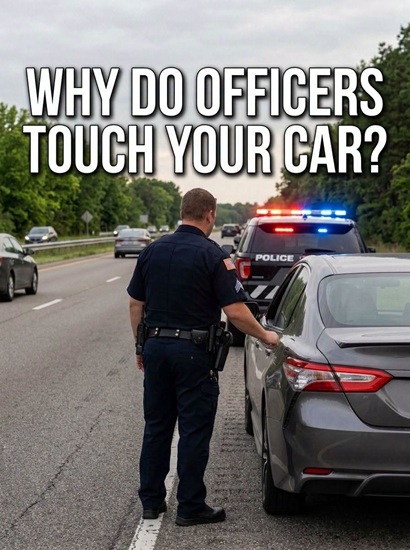
Another practice that has generated considerable curiosity is an officer touching the rear of a vehicle during the approach. Historically, some officers have been trained to briefly touch the trunk or another rear area of a stopped vehicle. Several explanations have been associated with the practice, including checking that the trunk is secure and historically leaving evidence that the officer physically approached the vehicle. However, this is not a universal procedure performed by every officer or agency. Modern technology, including body-worn and dashboard cameras, has also changed how traffic stops are documented.
For that reason, viral claims suggesting that every officer taps the back of every car for one secret purpose can be misleading. Some officers may still perform the action because it is part of their training or established habit, while others may not do it at all. Procedures can vary according to department, location, circumstances and changes in technology. Seeing an officer touch a vehicle should therefore not be interpreted as proof that something unusual has been discovered. Likewise, an officer who does not touch the vehicle is not necessarily following a fundamentally different type of stop.
Drivers may also notice that an officer does not always approach from the driver’s side. In certain circumstances, the passenger side may provide greater separation from passing vehicles or a better position for communication. Road width, traffic speed, visibility and the location where the vehicle stopped can all influence this choice. What appears surprising to the person inside the car may therefore be a straightforward safety decision. There is no single approach direction that applies to every officer, agency or traffic stop.
Once an officer reaches the vehicle, communication usually becomes the central part of the interaction. Depending on local law and the circumstances, an officer may explain the reason for the stop and request documents such as a driver’s license, registration or proof of insurance. The exact documents drivers are legally required to provide vary by jurisdiction. This is why broad online statements about what someone “must” or “must not” do during every traffic stop should be treated cautiously. Drivers seeking specific legal guidance should consult authoritative information applicable to the place where they are driving.
Keeping commonly required documents reasonably accessible can help prevent unnecessary confusion. If retrieving a document requires reaching into a compartment, bag or another location, communicating clearly about what is being done can make the movement easier to understand. The objective is not to interpret every action as dangerous but to keep the interaction predictable. Sudden unexplained movements can create uncertainty in situations where the officer and driver know relatively little about each other. Calm communication can reduce that uncertainty for everyone involved.
After receiving the requested information, an officer may return to the patrol vehicle. For a nervous driver, this portion of the stop can seem particularly long. A few minutes of waiting can easily feel much longer when someone is watching flashing lights through the mirror and wondering what will happen next. Nevertheless, the delay alone does not reveal the likely outcome. Officers may need time to verify information, review relevant records or complete administrative work associated with the stop.
It is also worth remembering that an officer may spend time observing the stopped vehicle and surrounding area. Observation is a routine part of assessing an unfamiliar roadside situation. Officers have to remain aware of passing traffic while also paying attention to the circumstances that led to the stop. This does not mean every glance or movement contains a hidden message. Attempts to decode ordinary actions as universal police signals can produce inaccurate conclusions because procedures differ widely and the context of individual stops matters.
The same principle applies to where an officer stands while speaking with a driver. Positioning can be influenced by traffic, vehicle design, visibility, environmental conditions and training. An officer might stand slightly behind a window or choose another position that provides a view of the surrounding environment. It would be inaccurate to claim that one particular stance always means the officer suspects a specific offense or considers someone dangerous. Roadside safety procedures are generally more complicated than those simplified interpretations suggest.
Nighttime traffic stops introduce additional considerations. Flashing emergency lights can be intense, while darkness makes it more difficult for everyone involved to see the surrounding environment clearly. Drivers may have trouble understanding exactly what an officer is doing behind their vehicle, while the officer must approach an unfamiliar vehicle under limited visibility. These conditions can increase anxiety even when the reason for the stop is relatively routine. Clear communication and predictable behavior become especially useful when visibility is reduced.
Weather can create similar complications. Rain, snow, fog or strong winds can affect visibility and make the roadside more hazardous. A driver may need additional time to locate a safe stopping place, while an officer may adjust where the patrol vehicle is positioned or which side of the stopped vehicle is approached. Construction zones and narrow shoulders create additional variables. These examples demonstrate why there cannot be one universal sequence describing every traffic stop in every location.
Another important point is that a traffic stop does not automatically establish that the driver has committed an offense. The officer may be investigating something observed before initiating the stop, but the ultimate outcome depends on the circumstances and applicable law. Some interactions conclude with a warning, others result in a citation or another lawful action, and circumstances can vary substantially. Simply seeing emergency lights provides no reliable way to predict how the interaction will conclude.
Technology has also transformed roadside enforcement over the years. Many law-enforcement agencies now use dashboard cameras, body-worn cameras, digital communications and computerized information systems. These tools can document portions of an encounter and provide officers with information that previously required different procedures. Consequently, descriptions of traffic-stop practices from decades ago may not perfectly reflect what happens today. Training itself can evolve as equipment, policies and laws change.
This technological development is especially relevant to older explanations for touching the rear of a vehicle. Before widespread video recording, leaving a fingerprint on a vehicle could potentially provide physical evidence connecting an officer with the car if a serious incident occurred. Modern recording systems can provide much more extensive documentation. That does not mean the older practice has completely disappeared, but it helps explain why it should not be presented as something every officer necessarily does today.
It is equally useful to recognize the different perspectives involved in a roadside stop. The driver may be thinking about a possible ticket, wondering what mistake was made or worrying because they do not understand the reason for the stop. The officer approaches with different uncertainties and must simultaneously consider the stopped vehicle, its occupants, passing traffic and the surrounding environment. Recognizing these different perspectives does not determine anyone’s legal rights, but it does help explain why structured procedures and clear communication are important.
A driver who feels nervous should therefore resist the temptation to interpret every movement as evidence that the situation is escalating. An officer taking additional time before approaching, standing in an unexpected location or returning to the patrol vehicle does not necessarily indicate a serious problem. There may be an ordinary procedural or safety explanation. Focusing on information that is actually communicated is more reliable than attempting to guess what individual movements mean.
At the same time, understanding general procedures should never be confused with surrendering legal rights. The laws governing traffic stops differ across countries and even between states, provinces or other jurisdictions within the same country. Questions concerning searches, identification requirements, questioning or other legal obligations may have different answers depending on where the interaction occurs and the specific circumstances. Anyone needing legal advice about a particular encounter should consult official resources or a qualified professional familiar with the relevant jurisdiction.
This distinction is especially important because social media frequently presents traffic-stop advice as though a single rule applies everywhere. Statements such as “an officer always does this because of that” may sound convincing while leaving out important differences in training and law. A practice documented in one police department should not automatically be attributed to every officer elsewhere. Responsible educational information should make those limitations clear instead of turning routine procedures into sensational claims.
Most traffic stops are easier to understand when viewed through practical considerations rather than hidden meanings. Where the patrol vehicle stops can relate to visibility and roadside safety. The direction of an officer’s approach can depend on passing traffic. A short delay may involve routine checks or administrative work. A touch on the rear of the vehicle may reflect older training or personal habit. None of these actions, viewed alone, reliably tells a driver what the final outcome of the stop will be.
For drivers, remaining attentive can be more useful than trying to memorize supposed secret police signals. After recognizing the emergency lights, the immediate task is to stop in an appropriate manner consistent with applicable law and road safety. Once stopped, listening carefully and communicating clearly can reduce misunderstandings. If something requires reaching or another unexpected movement, explaining what is happening can help keep the interaction understandable.
If a disagreement arises, the roadside is not necessarily the place to settle every legal question. Depending on the jurisdiction and circumstances, formal procedures may exist for contesting citations or raising concerns about an officer’s conduct. Those processes allow evidence and legal questions to be reviewed outside the immediate pressures of a roadside encounter. Drivers should rely on the procedures available in their jurisdiction rather than assuming that an argument during the stop will resolve a disputed issue.
Understanding traffic stops therefore requires separating documented practices from myths. Some widely discussed behaviors have legitimate historical or safety explanations, but those explanations are often simplified when repeated online. Police departments do not all use identical training, officers do not all behave exactly alike, and roads do not present identical conditions. Context remains essential.
The next time red and blue lights appear in a rearview mirror, the initial nervous reaction may be difficult to avoid. What can change is the way that moment is interpreted. Flashing lights do not automatically signal a dramatic confrontation, and every movement outside the vehicle does not need to have a hidden meaning. Many of the procedures observed during a stop are connected to ordinary concerns such as communication, documentation, visibility and roadside safety.
Ultimately, understanding those practical considerations can make traffic stops feel less mysterious without pretending that every encounter is identical. The most reliable approach is to stay focused on what is actually happening, follow applicable traffic laws, communicate clearly and avoid drawing conclusions from isolated gestures. When a question involves specific legal rights or obligations, official guidance for the relevant jurisdiction or qualified legal advice is more dependable than viral social-media claims. Traffic stops can certainly be stressful, but accurate information is far more useful than speculation when trying to understand what is happening behind those flashing lights.

