
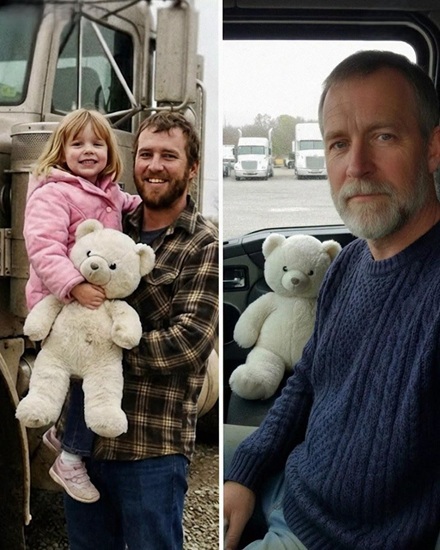
For most of his life, Jake believed grief would arrive like a violent storm. He imagined raised voices, shattered objects, and a pain so loud that the whole world would immediately recognize it. He assumed sorrow would announce itself with the force of thunder and refuse to leave until it had destroyed everything familiar. When loss finally entered his life, however, it did not behave that way. It came quietly, settled into the passenger seat of his truck, and followed him down roads that seemed to have no end.
Grief became the empty space between radio stations and the silence that remained after a phone call ended. It appeared in long stretches of highway illuminated only by headlights and in the bitter taste of coffee purchased from service stations after midnight. It waited beside him when traffic disappeared and the road became a dark ribbon beneath the tires. During those hours, there was no one to impress and no reason to pretend. There was only Jake, the sound of the engine, and memories he had never learned how to carry.
Ten years earlier, Jake had been a young father trying to build a stable life with very little money and even less certainty. He had recently begun working as a long-distance truck driver, a job that offered steady income but demanded days and sometimes weeks away from home. Most of his pay disappeared into rent, fuel, food, and old debts that seemed to multiply whenever he made progress. He often worried that his daughter would remember his absences more clearly than the moments he managed to be present.
His daughter, Emily, was almost four years old when she asked him for a birthday gift that seemed simple enough. She did not want an expensive electronic toy, a fashionable outfit, or an elaborate party. She wanted a teddy bear, and she had one very specific requirement. It had to be as large as she was. Jake promised he would find one, although he had no idea how he would afford it before her birthday arrived.
Several days later, during a delivery near Dayton, Jake noticed a weathered flea-market sign beside the highway. He had a few hours before his next scheduled stop, so he pulled into the gravel parking lot and walked among crowded tables covered with lamps, dishes, books, and forgotten household objects. Near the back of the market, he saw an enormous white teddy bear leaning against a wooden chair. One eye was stitched slightly higher than the other, and its fur showed signs of age, but Jake knew immediately that it was exactly what Emily had imagined.
The woman selling the bear introduced herself as Linda and watched as Jake checked the remaining bills in his wallet. She appeared to understand his hesitation before he said a word. Instead of naming the price written on the tag, she folded her arms and smiled. “Ten dollars,” she told him. “That’s the price for a father who looks like he has somewhere important to be.” Jake thanked her, carried the oversized bear to his truck, and spent the rest of the journey smiling whenever he glanced at it.
Emily’s reaction was greater than anything he had expected. She ran toward the bear, wrapped both arms around its wide body, and nearly disappeared beneath its soft white fur. Before Jake could suggest a name, she announced that the bear would be called Snow. She said the name suited him because he looked like the first snow of winter, clean, bright, and slightly magical. From that afternoon onward, Snow became part of nearly every important family routine.
Whenever Jake prepared for a long trip, Emily dragged the bear from her bedroom to the driveway. Snow was almost too large for her to carry, but she refused to let anyone help. She would struggle step by step until she reached the truck and then point toward the passenger seat. “Buckle him in,” she instructed every time. Jake always obeyed, fastening the seatbelt carefully across the bear’s round stomach as though Snow were another member of the family.
The ritual began as a game, but over time it gained a deeper meaning. Emily believed Snow protected her father while he was away, and Jake never tried to convince her otherwise. On lonely nights, when he had been driving for hours and every familiar voice seemed far away, the bear’s presence made the truck feel less empty. Its crooked expression reminded him of home, bedtime stories, spilled breakfast cereal, and the sound of Emily laughing when he made ridiculous animal noises.
When Jake returned from a journey, Emily always ran to the truck before he had finished parking. She climbed onto the step, reached across the seat, and released Snow from the safety belt. Then she looked at her father with great seriousness and asked whether the bear had performed his duty. Jake would tap Snow on the head and say that his partner had done an excellent job. Emily accepted the report proudly, as though she had personally organized a successful rescue mission.
As the years passed, Emily grew taller, more independent, and increasingly aware that carrying an enormous stuffed bear into the driveway was not considered fashionable. By the time she reached middle school, she often rolled her eyes and described the tradition as embarrassing. Nevertheless, she never allowed Jake to leave without Snow. Sometimes she placed the bear in the truck before he woke up, hoping to avoid being seen participating in the ritual she claimed to have outgrown.
For Jake, the bear became a bridge between two lives that rarely fit together easily. One life existed on the road, governed by delivery schedules, weather reports, mechanical problems, and countless miles. The other waited at home, where Emily continued growing whether he was present or not. Snow belonged to both worlds. The bear travelled with Jake but always returned to Emily, carrying the invisible promise that her father would come home as well.
Emily’s mother, Sarah, never completely understood the importance of the tradition. She believed Jake relied too heavily on a child’s toy to ease his guilt about being away. During arguments, she sometimes accused him of using the bear as proof of fatherhood while missing school events, dinners, and ordinary evenings that could never be recovered. Jake knew there was truth in her frustration, but he also knew that trucking was the only reliable work he had found. The bear did not replace his daughter; it reminded him why he continued driving.
Jake and Sarah did not end their relationship through one dramatic betrayal or a single explosive argument. Their marriage weakened gradually under the pressure of distance, exhaustion, and communication reduced to calendars and unpaid bills. They spent more time discussing when Jake would return than asking how either of them felt. By the time Emily was twelve, they had become respectful strangers who shared responsibility for the same child. Their divorce was quiet, practical, and deeply painful in ways neither of them knew how to express.
Through every change, Emily protected the tradition surrounding Snow. When Jake collected her for weekends, the bear sometimes appeared in the back seat even though she insisted she had not placed it there. Before major trips, she inspected the passenger seat and reminded him to use the safety belt. The ritual offered continuity during a period when nearly everything else in her life seemed uncertain. It assured her that some promises could survive separation, arguments, and changing addresses.
The first warning that something was wrong appeared as a collection of small details that were easy to dismiss. Emily began feeling tired after ordinary activities and developed bruises she could not explain. At first, the adults assumed she was experiencing stress, a vitamin deficiency, or the effects of a demanding school schedule. When the exhaustion worsened and the bruises continued appearing, Sarah scheduled a medical appointment. That visit led to tests, additional consultations, and eventually a conversation no parent expects to have.
The diagnosis was cancer. In a matter of days, the family’s routines were replaced by hospital corridors, treatment schedules, medication lists, and conversations filled with unfamiliar medical language. Jake reduced his work as much as possible and spent long hours beside Emily’s bed, struggling to accept how quickly their world had changed. He wanted someone to give him a task that could fix everything, but there was no road he could drive and no delivery he could complete that would restore the life they had known.
Emily responded to the hospital with a courage that surprised everyone around her. She gave nicknames to the medical equipment, asked nurses questions, and attempted to make her parents laugh whenever she saw fear on their faces. She named her IV pole “R2-Drip2,” explaining that every hospital room needed a robot companion. Her humor did not erase the difficulty of treatment, but it gave the family brief moments in which illness did not control every conversation.
One evening, while the hospital hallway grew quiet and rain moved softly against the window, Emily reached for Jake’s hand. Her voice was tired but firm, and she asked him to make a promise. Jake immediately said he would agree to anything she wanted. She looked directly at him and told him to keep driving. He shook his head, insisting that he would remain beside her and that work no longer mattered.
Emily squeezed his fingers and repeated the request. She explained that the road was part of who he was and that she did not want fear to stop his life completely. Jake tried to change the subject, but she refused to let him avoid the conversation. Finally, with tears he hoped she would not notice, he promised that he would continue moving forward. Neither of them said aloud what the promise might eventually mean.
Two weeks later, Emily died.
In the days following the funeral, Jake moved through the house as though someone else were controlling his body. Visitors arrived with food, condolences, and well-intentioned words that seemed to dissolve before he could understand them. When the house became quiet again, he entered Emily’s room and began placing her belongings into black bags. He packed clothes, drawings, toys, notebooks, and small objects that carried memories too painful for him to face.
Sarah discovered the bags near the front door and immediately understood what he had done. She asked him to stop, but Jake insisted that he was trying to survive. Sarah accused him of erasing their daughter, while Jake accused her of expecting him to live in a museum of grief. Their argument was not truly about the belongings. It was the collision of two people who had lost the same child but had no shared language for the pain.
After that confrontation, their already fragile communication nearly disappeared. They spoke only when necessary and avoided subjects that might reopen the argument. Jake continued working, taking longer routes and volunteering for assignments other drivers did not want. The road allowed him to remain occupied, and exhaustion often helped him sleep without dreaming. To friends and colleagues, he appeared functional, but functioning was not the same as healing.
Snow was the only object from Emily’s childhood that Jake could not place in a bag. The bear did not feel like a decoration or a reminder to be stored away. It represented years of departures and returns, a private tradition that belonged only to him and his daughter. He carried Snow to the truck, placed him in the passenger seat, and fastened the familiar safety belt across his stomach. Then Jake started the engine and returned to the road, trying to honor a promise he did not yet understand.
For several years after Emily’s death, Jake kept moving because stopping felt impossible. He drove through snowstorms, summer heat, construction zones, and long stretches of highway where the only signs of life were distant headlights. Snow remained in the passenger seat, secured by the same seatbelt Emily had once fastened with both hands. Jake rarely spoke about the bear, but he checked that it was there before every trip, just as his daughter had done.
At first, the familiar ritual brought comfort. The crooked white bear reminded Jake of happier years, of small hands tugging at its fur and a little girl insisting that it had an important job to perform. Over time, however, grief changed shape. It no longer arrived only as sharp pain but as a permanent heaviness that followed him into restaurants, truck stops, and empty motel rooms. He learned how to smile when people asked how he was doing, even when the honest answer felt too complicated to explain.
Jake told colleagues that he was managing. He accepted invitations to eat with other drivers, laughed at familiar jokes, and remembered delivery schedules without difficulty. From the outside, he appeared to have returned to ordinary life. Yet he avoided conversations about children, illness, or family traditions. Whenever those subjects arose, he changed the topic or found a reason to leave.
His relationship with Sarah remained distant. Their calls were brief and careful, usually limited to practical matters connected to old accounts, paperwork, or belongings that still needed to be divided. Neither of them mentioned the argument over Emily’s possessions. Both understood that the conflict had grown far larger than the bags by the door, but neither knew how to begin repairing what had been damaged.
Snow continued travelling with Jake until one winter, when the bear was moved into storage during repairs to the truck. Jake intended to return it to the passenger seat as soon as the work was finished. Instead, one trip became several, and the bear remained buried beneath blankets in the back of a closet. Jake did not consciously decide to leave it there. He simply allowed the absence to become part of his routine.
Months passed before he noticed how strange the empty passenger seat felt. During a late-night drive, he reached across the cab without thinking, expecting his hand to meet soft fur. Instead, his fingers touched cold upholstery. The emptiness unsettled him, and for the remainder of the journey he could not stop thinking about the tradition he had allowed to disappear.
When he returned home, Jake opened the closet and began searching beneath old clothes, winter coats, and boxes he had not touched in years. Eventually, he found Snow pressed against the back wall. The bear looked smaller than he remembered, though its uneven eyes and worn fur had not changed. As Jake lifted it, he heard a faint cracking sound from inside its body.
He lowered the bear carefully and ran his hands along its back. Near one seam, the stitching had loosened enough to reveal a small opening. Something firm was hidden beneath the stuffing. Jake hesitated before widening the seam, afraid that he might damage the one object he had preserved from Emily’s childhood.
Using a small pair of scissors, he cut only the loose thread and slowly moved the stuffing aside. Inside the bear, he found a sealed envelope and a small voice recorder wrapped in a piece of cloth. The envelope carried Sarah’s handwriting. Across the recorder, someone had placed a label written in uneven letters: “FOR DAD.”
Jake sat on the floor with the bear beside him. For several minutes, he stared at the recorder without touching its buttons. His hands began shaking, and his breathing became shallow. He understood immediately whose handwriting appeared on the label, yet part of him feared hearing a voice he had spent years trying to remember.
Finally, he pressed play.
There was a brief burst of static, followed by silence. Then Emily’s voice filled the room.
“Hi, Daddy.”
The words were simple, but they shattered the careful distance Jake had built around his grief. He covered his mouth and leaned forward, unable to breathe normally. Hearing her voice again did not feel like remembering. It felt as though time had opened briefly and allowed her to return.
Emily laughed on the recording and congratulated him for finding the surprise. In the background, Sarah could be heard encouraging her to continue. Emily explained that her mother had helped hide the recorder inside Snow because Jake was not very good at noticing surprises. Her voice sounded weak at moments, yet the humor and determination he remembered remained unmistakable.
Then her tone became more serious.
“I need you to be okay, even if I’m not,” she said.
Jake lowered his head and allowed the grief he had resisted for years to move through him. He cried without trying to remain quiet, without checking the time, and without worrying whether anyone could hear. The recording continued while he sat beside the open bear, holding the small device against his chest.
Emily told him there was a box buried near the old maple tree in the yard of the house where she had grown up. She reminded him of his promise and repeated the words she had spoken in the hospital: “Keep driving. Don’t get stuck.” Her message ended in static, but just before the recording stopped, Sarah’s voice could be heard beginning an apology.
Jake opened the envelope next. Inside was a letter from Sarah explaining how the recording had been made. Emily had planned the surprise during the final months of her illness and had insisted that it remain secret. Sarah originally intended to give it to Jake after the funeral, but when she saw him throwing away Emily’s belongings, she became afraid that the recorder might be discarded before he ever heard it.
The letter did not accuse him or attempt to justify everything that had happened between them. Sarah wrote that she had been frightened, angry, and overwhelmed by her own grief. She admitted that hiding the message had become another burden she did not know how to carry. At the bottom of the page, she added one final sentence: “I hoped Snow would keep it safe until you were ready.”
Jake did not wait until morning. He pulled on his boots, carried a shovel outside, and walked toward the maple tree behind the old house. The night air was cold, but he barely noticed it. He dug beneath the branches with a desperation that felt almost like hope, following Emily’s instructions as though her voice were guiding each movement.
After several minutes, the shovel struck something solid. Jake dropped to his knees and cleared the soil with his hands until he uncovered a small weatherproof box. The metal edges were stained, but the lid remained sealed. He carried it inside, placed it on the kitchen table, and opened it with trembling fingers.
The box contained photographs, folded letters, and small objects Emily had chosen to preserve. Some pictures were familiar, while others captured moments Jake had never known anyone had photographed. There was an image of him asleep on the couch with Emily’s feet resting across his lap, another of them eating breakfast in a roadside diner, and several showing Snow buckled into the truck.
One photograph had been taken in the hospital. Emily was smiling, her hair gone from treatment, while she held the oversized bear against her side. Along the white border, she had written two words in dark ink: “Still magic.”
Jake held the picture for a long time before unfolding the letter beneath it. Emily began by telling him that finding the box meant he was still alive and still moving forward. She wrote that he had always been a good father, even during the years when he doubted himself. She remembered the birthdays he nearly missed but still managed to reach, the calls made from distant highways, and the way he always treated Snow like a real travelling companion.
Near the end of the letter, Emily wrote about Sarah.
“Tell Mom you’re not mad,” she said. “She cries in the car.”
Jake remained seated at the table until sunrise. For the first time, he understood that Sarah’s silence had not been indifference. She had been surviving in a different way, carrying guilt, anger, and memories that she had never known how to share. Their distance had protected neither of them. It had only given their sorrow more room to grow.
He called Sarah as soon as the sky began to brighten. When she answered, her voice was cautious, as though she expected another practical conversation. Jake said only that he had found the recorder. The silence that followed lasted several seconds, and then he heard her inhale sharply.
“You found it?” she asked.
Jake looked at Emily’s letter on the table. “She told me to tell you I’m not mad.”
Sarah began to cry. Jake did not interrupt or attempt to make the moment easier. He simply remained on the phone, allowing her grief to exist beside his own. For the first time in years, they spoke honestly about the funeral, the bags, the anger, and the loneliness that had followed.
Later that day, Jake drove to Sarah’s home with Snow fastened into the passenger seat. The bear’s seam had been repaired, though the line of new stitching remained visible. When Sarah opened the door, she looked first at Jake and then at the familiar white bear beside him.
Neither of them spoke immediately. Sarah reached through the open truck door and touched Snow’s ear with the tips of her fingers. She smiled through tears and said that Emily had loved him deeply. Jake apologized for the things he had thrown away and for the years he had spent avoiding her.
Sarah apologized as well. She admitted that she had hidden the message too long and that fear had allowed silence to become a habit. They did not pretend a single conversation could erase years of pain. They simply acknowledged that both had lost the same child and had been grieving in different, equally imperfect ways.
Over the following months, Jake and Sarah began speaking regularly. They shared the photographs from the box, remembered stories that had once been too painful to discuss, and recovered several of Emily’s drawings from relatives who had saved them. Their relationship did not return to what it had been before the divorce or the illness. Instead, it became something quieter and more honest, built around shared memory rather than unresolved blame.
Snow returned permanently to Jake’s truck. The bear travelled beside him through familiar cities and unfamiliar roads, still secured by the seatbelt across its wide stomach. Other drivers occasionally asked about it, and Jake no longer avoided the question. He explained that the bear had belonged to his daughter and that carrying it helped him remember a promise.
Some nights, when the highway was nearly empty, Jake played the recording. He listened to Emily say hello, laugh about his inability to find surprises, and remind him not to become trapped by grief. He no longer used the message to reopen the wound. Instead, he allowed it to remind him that love could remain present without preventing life from continuing.
Jake eventually understood that moving forward did not mean abandoning his daughter. It meant carrying her memory without allowing the pain to destroy every possibility that remained. The roads he travelled still contained lonely hours, and grief never disappeared completely. But it no longer occupied every seat in the truck.
The repaired seam on Snow’s back remained visible, and Jake chose not to hide it. To him, the stitching represented something important: what had been opened could be mended without becoming exactly as it was before. Damage did not erase value, and healing did not require forgetting where the wound had been.
Years later, Jake continued driving. At every departure, he checked the mirrors, reviewed his route, and made sure the bear was safely buckled beside him. The ritual was no longer only about protection or grief. It had become a reminder of love, forgiveness, and the promise he had made beside a hospital bed.
“Keep driving,” Emily had told him. “Don’t get stuck.”
At last, Jake understood.
The promise was not an order to escape the past. It was permission to keep living while carrying the past with him.

