
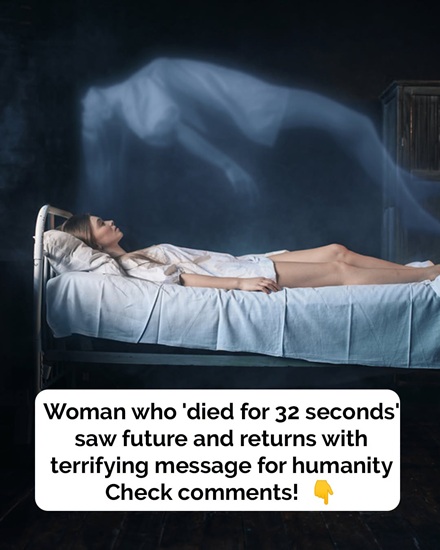
Stories describing near-death experiences (NDEs) have fascinated researchers, medical professionals, and the public for decades. People who survive life-threatening medical emergencies sometimes report vivid memories that they associate with the period when they were unconscious or clinically unstable. These accounts often include descriptions of bright light, a feeling of peace, encounters with deceased loved ones, or a profound sense of leaving the physical body.
Scientists continue to study these experiences, but there is no scientific consensus that they provide evidence of an afterlife. Instead, researchers recognize them as genuine personal experiences while acknowledging that their underlying causes remain the subject of ongoing investigation. One person who has publicly shared such an experience is Angela Harris, who says her life changed dramatically after suffering a medical emergency during a tilt-table test, a procedure doctors commonly use to investigate unexplained fainting episodes.
According to Harris, she experienced severe seizures during the test, and her heart reportedly stopped for approximately 32 seconds before medical staff successfully revived her. She has described that moment as the beginning of a profound spiritual transformation that influenced every aspect of her life. Following the experience, Harris began speaking publicly about what she believes she witnessed and later became a spiritual coach, sharing her personal journey through interviews, presentations, and her website.
On her website, Harris explains that her near-death experience in 2015 completely altered her understanding of life. She writes that the event awakened what she describes as a deeper awareness of human existence and convinced her that people are “loving spirits” experiencing life in physical form. These statements reflect Harris’s personal spiritual beliefs and interpretations of her experience rather than scientifically established facts. Her account is one of many individual narratives shared by people who report having undergone near-death experiences, each of which is unique to the individual describing it.
Among the most widely discussed aspects of Harris’s story are her descriptions of encountering deceased relatives during the experience. Similar reports have appeared in numerous published accounts of near-death experiences around the world, although the details vary considerably from person to person. Researchers studying NDEs have documented that some individuals report seeing family members who had previously died, while others describe feelings of overwhelming peace, vivid landscapes, or symbolic imagery. Scientists emphasize that these experiences are highly subjective and cannot currently be independently verified as objective events.
Harris’s account differs from many traditional near-death narratives because she also describes what she interpreted as visits to other inhabited planets. According to her interviews, she believes she experienced another existence in which she lived as a different being on another world. She has explained that what many people might call “aliens” were, in her interpretation, simply other souls living different lives elsewhere in the universe. These descriptions represent Harris’s personal recollections and beliefs and are not supported by independent scientific evidence. Because such experiences cannot be objectively confirmed, they should be understood as individual testimony rather than verified fact.
Another element of Harris’s story involves what she interpreted as visions of humanity’s future. In interviews, she has stated that she saw a world transformed by major conflicts and significant population loss, followed by communities living in smaller, more localized societies. Harris has described these images as part of her personal experience during the medical emergency. There is no evidence that these visions constitute verified predictions of future events, and they should not be interpreted as established forecasts. Throughout history, many individuals have reported symbolic or visionary experiences after traumatic medical events, but such accounts remain matters of personal belief rather than scientific prediction.
Medical researchers continue to investigate why near-death experiences occur. Some studies have explored whether changes in brain activity during periods of reduced oxygen, altered blood flow, anesthesia, or other physiological conditions may contribute to vivid perceptions during life-threatening events. Other researchers examine the psychological and neurological processes that may influence memory formation during medical crises. Although several theories have been proposed, no single explanation has gained universal scientific acceptance, and the phenomenon continues to be actively studied by specialists in neuroscience, psychology, and emergency medicine.
Regardless of how these experiences are interpreted, many people who report near-death experiences describe lasting changes in their outlook on life. Individuals often say they develop a greater appreciation for relationships, compassion, personal purpose, or spirituality following recovery. Harris has similarly explained that her experience motivated her to focus on personal growth and helping others explore questions about meaning and spirituality. While interpretations differ widely between individuals, her story illustrates how a profound medical event can influence a person’s beliefs and priorities for many years afterward.
After her recovery, Angela Harris explained that the experience influenced nearly every aspect of her life. In interviews and on her website, she has said that it changed the way she viewed relationships, personal purpose, and spirituality. She describes feeling a stronger sense of compassion and a greater appreciation for everyday life following the medical emergency. These reflections are consistent with many personal accounts from people who report near-death experiences, although the details and interpretations vary significantly from one individual to another. It is important to recognize that Harris is describing her own experiences and beliefs rather than making claims that have been scientifically verified.
Among the most widely discussed parts of Harris’s account are her descriptions of what she interpreted as other inhabited worlds. She has said that she experienced another existence in which she saw herself living as a different being on another planet. According to Harris, these experiences led her to believe that consciousness extends beyond a single lifetime. These statements reflect her personal interpretation of her near-death experience and are not supported by independently verified scientific evidence. As with many reports of extraordinary experiences, they remain matters of individual belief rather than established fact.
Harris has also spoken about symbolic visions that she interpreted as possible images of humanity’s future. She described seeing societies organized into smaller, more localized communities after periods of conflict and population decline. However, there is no evidence that these experiences represent actual predictions of future events, and neither Harris nor scientific research can confirm that such visions are prophetic. Researchers who study near-death experiences generally emphasize that vivid imagery reported during medical emergencies should not automatically be interpreted as objective descriptions of future reality.
The scientific community continues to examine near-death experiences from several different perspectives. Neurologists, psychologists, and critical care specialists have proposed theories involving changes in brain activity, oxygen levels, memory formation, and consciousness during life-threatening medical events. Although many studies have documented common patterns reported by patients, there is currently no universally accepted scientific explanation that fully accounts for every aspect of these experiences. As a result, near-death experiences remain an active area of research, where questions continue to be explored through careful scientific investigation.
One observation that researchers have made is that many individuals report lasting psychological changes after surviving life-threatening events. Some people describe feeling less afraid of death, while others report placing greater value on relationships, kindness, gratitude, or spiritual reflection. These long-term changes have been documented in numerous studies involving people who experienced serious medical emergencies. However, the specific beliefs people adopt afterward often depend on their personal backgrounds, cultures, and individual interpretations rather than following a single universal pattern.
Harris has used her own experience as the foundation for her work as a spiritual coach, sharing what she believes she learned through her recovery. While many people find her story meaningful or inspiring, others interpret near-death experiences differently or approach them from a medical or scientific perspective. Both viewpoints can coexist respectfully. Personal testimony provides insight into an individual’s lived experience, while scientific research seeks evidence that can be independently tested and verified. Distinguishing between those two perspectives helps readers understand the subject with greater clarity.
Stories like Harris’s continue to attract attention because they touch on questions that have interested humanity for centuries: the nature of consciousness, what may happen after death, and how extraordinary experiences shape people’s lives. Although definitive answers remain elusive, these accounts often encourage thoughtful discussion about medicine, psychology, spirituality, and human resilience. At the same time, experts encourage readers to approach such stories with both curiosity and critical thinking, recognizing the difference between personal belief and conclusions supported by scientific evidence.
Ultimately, Angela Harris’s account is best understood as her personal description of an experience that she believes transformed her life. Her reflections on spirituality, compassion, and personal growth have become central themes of her public work. Whether readers interpret her story through a spiritual, philosophical, or scientific lens, it remains important to distinguish verified medical facts from individual interpretations. Approaching these accounts with respect, careful reasoning, and an openness to ongoing research allows for thoughtful discussion while avoiding conclusions that extend beyond the available evidence.

