
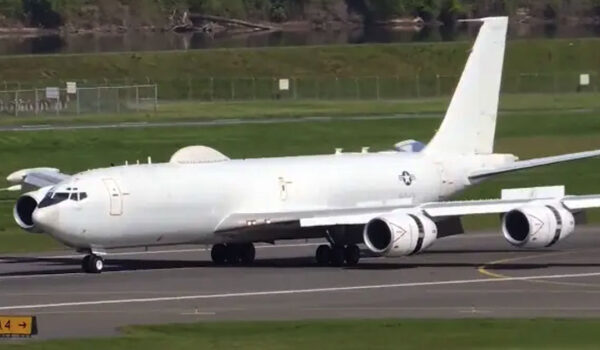
Several U.S. Navy E-6B Mercury aircraft drew attention after flight-tracking observers reported seeing multiple planes operating over different parts of the United States. The activity occurred around the same period that CIA Director John Ratcliffe traveled to Moscow for discussions with Russian intelligence officials. Because the E-6B has an important role in America’s nuclear command and communications network, the timing quickly prompted discussion and speculation online.
However, no publicly confirmed evidence currently shows that the aircraft activity was connected to Ratcliffe’s visit. Ratcliffe traveled to Moscow on August 25, 2026, for what was considered an unusual high-level contact between American and Russian intelligence officials. The trip was not publicly announced beforehand by U.S. authorities, which increased interest in both its timing and purpose. Reports later established that Ratcliffe met representatives of Russia’s intelligence services during the visit, which took place while relations between Washington and Moscow remained deeply strained.
Kremlin spokesperson Dmitry Peskov confirmed that communication had taken place through intelligence channels. According to Peskov, Ratcliffe did not meet directly with Russian President Vladimir Putin, although Putin was informed about the results of the discussions. Sergei Naryshkin, director of Russia’s Foreign Intelligence Service, also confirmed meeting Ratcliffe and characterized their encounter as a working-level discussion.
Neither side has publicly disclosed a complete account of what was discussed. For that reason, claims about specific private conversations should be approached carefully unless they are supported by official statements or reliable reporting. Intelligence officials can communicate about many sensitive subjects, particularly during periods of international tension, and such meetings do not automatically indicate that an immediate military or nuclear crisis is developing.
Peskov also cautioned against expecting Ratcliffe’s visit to produce an immediate change in relations between Russia and the United States. While he described continued communication between intelligence services as a positive development, he acknowledged the broader difficulties affecting relations between the two countries. Intelligence channels can remain open even when diplomatic relations are strained because they provide governments with a way to exchange sensitive information and potentially reduce misunderstandings.
The Moscow visit attracted additional attention because trips of this kind by CIA directors are relatively uncommon. The previous publicly known visit by a CIA director to Moscow occurred in November 2021, when William Burns traveled there before Russia’s full-scale invasion of Ukraine. Ratcliffe’s 2026 visit was therefore significant, although the circumstances surrounding the two trips should not automatically be treated as the same.
President Donald Trump later described Ratcliffe’s trip as essentially routine or “semi-routine.” His characterization contrasted with some of the more dramatic theories that appeared online after news of the meeting became public. With relatively little official information available about the discussions, distinguishing confirmed developments from speculation remains especially important.
Around the same period, aviation observers began reporting another development. Multiple Boeing E-6B Mercury aircraft were reportedly operating over parts of the United States. The aircraft are closely associated with the country’s strategic communications infrastructure, which explains why their appearance attracted considerable attention on social media and flight-tracking communities.
The E-6B is sometimes described informally as a “doomsday plane,” but that nickname can make its routine operations sound more alarming than they necessarily are. The Mercury is primarily a highly specialized communications relay and airborne strategic command aircraft. Its purpose is to help ensure that senior U.S. leadership can maintain reliable communications with strategic forces even if conventional communications systems become unavailable during a severe national emergency.
According to the U.S. Navy, the aircraft provides survivable airborne Nuclear Command, Control and Communications capabilities involving national leadership and U.S. Strategic Command. A particularly important part of its mission is maintaining communication with U.S. Navy ballistic-missile submarines, which represent the sea-based component of the American nuclear triad.
The aircraft performs the mission commonly known as TACAMO, short for “Take Charge and Move Out.” This mission existed before the E-6 entered service and was developed to maintain communications between national command authorities and ballistic-missile submarines during emergencies. The aircraft carries specialized communications equipment, including very-low-frequency technology and trailing-wire antennas.
The E-6B can also operate as an airborne command post for U.S. strategic forces. Its equipment includes an Airborne Launch Control System that can support authorized operations involving land-based intercontinental ballistic missiles. These responsibilities explain why the aircraft occupies such an important place within the broader U.S. nuclear command-and-control system.
Its strategic mission, however, does not mean that every E-6B flight indicates preparations for the use of nuclear weapons. The aircraft operate regularly for training, readiness, maintenance and other operational purposes. Crews must continually practice complicated procedures, while equipment and communications systems must remain ready to function if they are ever required during a genuine emergency.
The E-6B force operates primarily from Tinker Air Force Base in Oklahoma, while aircraft and crews can deploy to other locations across the United States. Facilities associated with E-6 operations have included Travis Air Force Base in California, Offutt Air Force Base in Nebraska and Naval Air Station Patuxent River in Maryland.
Because of this geographic distribution, E-6 aircraft can appear over different parts of the country during normal operations. Several aircraft being airborne at approximately the same time can have various explanations, including training exercises and routine strategic-readiness missions. Their presence alone does not establish that an emergency is taking place.
Reports circulating after Ratcliffe’s Moscow trip described E-6B activity over western and central parts of the United States. Flight-tracking observations reportedly showed aircraft around areas including Colorado and Wyoming, the central United States, and regions near Oklahoma and Texas. Some accounts suggested that as many as five aircraft might have been operating, although every reported identification was not independently confirmed.
Public flight-tracking information also has important limitations. Military aircraft do not always transmit information in the same manner as civilian commercial aircraft, and identification details shown by tracking platforms can sometimes be incomplete. Flight trackers can reveal useful information about aircraft movements, but they cannot establish classified mission objectives or explain why a particular military aircraft was ordered to fly.
The timing understandably generated speculation. A CIA director had made an uncommon visit to Moscow, relations between Russia and the United States remained tense, and aircraft associated with strategic nuclear communications were being observed in American airspace. While these developments occurring close together can appear significant, timing alone does not establish that one caused the other.
There is currently no publicly confirmed evidence showing that the E-6B flights were launched because of Ratcliffe’s Moscow discussions. Likewise, the aircraft sightings themselves do not provide confirmed evidence that the United States had entered an extraordinary nuclear-alert posture. Any stronger conclusion would require information that has not been publicly established.
Another important piece of context is a previously announced North American military exercise. NORAD and U.S. Northern Command had announced that Exercise AMALGAM DART would run from August 24 through September 1, 2026. Those dates overlap with both Ratcliffe’s Moscow visit and the reported military aircraft activity.
NORAD described AMALGAM DART as a long-planned, routine and defensive exercise intended to improve readiness and strengthen the defense of North America. Personnel and forces from American and Canadian NORAD regions were scheduled to participate in the training.
The exercise involves scenarios designed to test the ability of military forces to detect, track, identify and respond to modern airborne threats. American and Canadian personnel participate in integrated operations involving fighter aircraft, command-and-control organizations, air battle management and simulated adversary aircraft.
Training also includes coordinated responses along approaches to North America and scenarios involving cruise-missile defense. Such exercises are intended to test cooperation between American and Canadian forces and ensure that different military organizations can communicate effectively during simulated threats.
The existence of the previously scheduled exercise provides useful context for unusual military aviation activity during the same period. However, it does not prove that every E-6B aircraft reported by civilian trackers was participating in AMALGAM DART. No publicly available confirmation establishes that connection for each individual flight.
For the same reason, two conclusions should be avoided. It would be unsupported to say that the E-6B flights definitely represented preparations for a nuclear confrontation simply because they occurred near the time of Ratcliffe’s Moscow visit. It would also be unsupported to state definitively that every observed E-6B was involved in the NORAD exercise.
Understanding the aircraft’s normal mission helps put the sightings into perspective. The E-6B is not primarily an attack aircraft. Its central purpose involves maintaining communications and continuity of command, ensuring that authorized national leaders can remain connected with strategic forces even under extremely difficult circumstances.
The aircraft has been part of the American strategic system for decades. The E-6 program originated with the E-6A, which the Navy began accepting in 1989 as a replacement for older EC-130Q aircraft used for the TACAMO mission. The later E-6B configuration expanded those capabilities by incorporating additional strategic command equipment.
Regular training is essential for such an aircraft. Strategic communications systems cannot realistically be tested only after an emergency begins. Pilots, communications specialists, command personnel and ground crews require continuing training so that both equipment and procedures remain operational.
This principle applies throughout military aviation. Fighter aircraft conduct interception exercises even when no hostile aircraft is attacking, while air-defense personnel practice responding to simulated missile threats without an actual strike occurring. Strategic communications aircraft similarly conduct training flights without those flights necessarily signaling an approaching nuclear conflict.
The dramatic “doomsday plane” nickname can sometimes obscure this distinction. Military systems designed for worst-case emergencies must still operate and train during peacetime. Regular activity is part of maintaining readiness rather than, by itself, proof that the emergency they were designed for is about to occur.
The E-6B should also not be confused with the U.S. Air Force E-4B, another aircraft frequently described with the same nickname. Although both aircraft have strategic command roles, they are different platforms with distinct missions. The E-6B is particularly associated with TACAMO communications and command functions involving U.S. strategic forces.
These distinctions become especially important when flight-tracking screenshots circulate online without additional context. A map displaying several strategic military aircraft in the air can look alarming, particularly during periods of geopolitical tension. Yet a flight path does not reveal the classified instructions given to a crew or the precise reason an aircraft is operating.
The wider international situation nevertheless explains why the sightings attracted attention. Relations between Washington and Moscow remain difficult, while Russia’s war against Ukraine continues to influence security discussions across Europe and internationally. Because both Russia and the United States possess large nuclear arsenals, communication between the two governments can carry particular importance during periods of heightened tension.
Maintaining intelligence contacts can therefore serve a practical purpose even when governments strongly disagree. Communication between intelligence services can provide another channel for exchanging sensitive information and reducing the risk of misunderstanding when ordinary diplomatic relations are under pressure.
Ratcliffe’s meeting with Naryshkin can be considered within that broader context. Naryshkin described their encounter as a working meeting, while Trump characterized Ratcliffe’s trip as broadly routine. Neither statement provides evidence that the meeting itself signaled that nuclear conflict was approaching.
Likewise, no credible public evidence currently establishes that Ratcliffe returned from Moscow with information that caused several E-6B aircraft to be launched. That theory appears to be based primarily on the fact that the developments occurred within a similar period. Without further evidence, describing them as directly connected would go beyond what has been confirmed.
There is an important difference between reporting that two events occurred and claiming that one caused the other. Ratcliffe did travel to Moscow for intelligence-level discussions, and multiple E-6B Mercury aircraft were reported operating over parts of the United States around the same time. A direct operational connection between those events, however, has not been publicly demonstrated.
The scheduled NORAD exercise adds another reason for caution. AMALGAM DART had already been publicly announced several days before Ratcliffe’s August 25 visit. Significant North American military training was therefore planned before the Moscow meeting became publicly known.
No publicly available evidence from the aircraft sightings alone indicates that civilians faced an immediate nuclear threat. The E-6B exists as part of a command, communications and deterrence structure designed to remain operational continuously, including during normal peacetime conditions.
The most evidence-based interpretation is therefore a cautious one. Ratcliffe made a rare visit to Moscow and met Russian intelligence officials. Multiple E-6B Mercury aircraft were reported operating over parts of the United States during approximately the same period, while NORAD and U.S. Northern Command were conducting a previously announced defense exercise across North America.
What remains unconfirmed is just as important as what is known. There is no publicly established evidence that Ratcliffe’s Moscow visit caused the E-6B activity, no confirmed evidence from the flights themselves that an imminent nuclear confrontation was underway, and no official confirmation that every reported E-6B flight was connected to AMALGAM DART.
The events are still noteworthy individually. A CIA director visiting Moscow during strained U.S.-Russian relations is significant. Strategic communications aircraft operating in noticeable numbers naturally attract public interest, and a major U.S.-Canadian defense exercise is also newsworthy. But combining these separate developments into a more dramatic conclusion than the available evidence supports would risk turning speculation into apparent fact.
For now, publicly available information supports a simpler conclusion: several significant military and intelligence developments happened to overlap during an unusually active period. Until additional verified information becomes available, any claim of a direct connection between the Moscow discussions and the E-6B flights should be presented as speculation rather than established fact.
