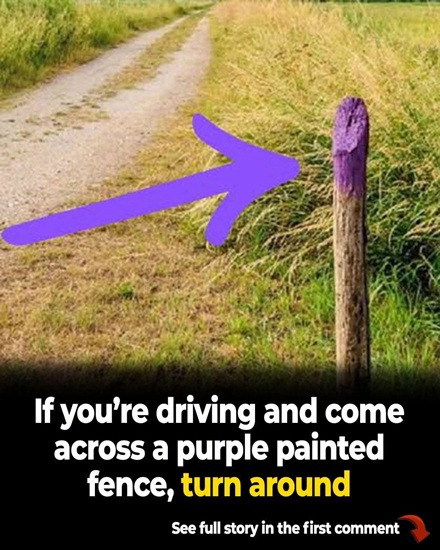
While driving through a rural area, hiking near private land, or exploring the outdoors in parts of the United States, you may occasionally notice something unusual on a fence post or tree: a vertical stripe of purple paint. To someone unfamiliar with the practice, the marking can look decorative or completely random. In some states, however, properly placed purple paint can carry a legal meaning connected with private property and restricted access. It may serve as an alternative to traditional posted or no-trespassing signs.
Because the laws differ significantly between jurisdictions, the safest interpretation is not that every purple mark means exactly the same thing everywhere, but that it may be an important property notice that should not be ignored. The basic concept is straightforward. Property owners have long needed practical ways to tell other people where private property begins and when entry is restricted.
Traditional signs can accomplish this, but signs have disadvantages. They can become faded by sunlight, damaged by weather, knocked down, covered by vegetation, vandalized, or removed. Paint applied directly to a suitable tree or post can remain visible for a long period and does not require attaching a separate sign. This practical advantage helped lead several states to adopt laws recognizing specified paint markings as a method of posting property. Purple is commonly associated with these laws, which is why the practice is frequently called the “purple paint law.”
The legal effect, however, depends on the state and on whether the markings satisfy that state’s requirements. A random splash of purple paint should not automatically be treated as legally equivalent to a properly posted boundary. Statutes may specify where the paint must appear, how large each mark must be, how high it must be above the ground, and how far apart the markings can be. Those details are important because the purpose is to provide visible notice rather than simply decorate a fence.
Arkansas Was an Early Adopter of Posting Paint
Arkansas played an important role in the history of this approach. In 1989, the state approved legislation establishing a system that allowed real property to be posted through paint markings meeting specified requirements. The original law required vertical paint lines of at least eight inches and specified that the bottom of the mark be between three and five feet above the ground. It also established requirements concerning visibility and spacing. The legislation directed the appropriate forestry authority to prescribe the color used for the system.
Arkansas’s current posting-paint rule identifies the approved paint as light purple exterior-grade paint. The state’s rules demonstrate why it is misleading to describe any purple object as automatically carrying a legal warning. The recognized system involves a specific type of marking used according to legal requirements. A purple garden decoration, painted gate, or unrelated mark is not necessarily the same thing.
The reason for establishing these rules is notice. Someone approaching posted property should have a reasonable opportunity to see the markings and understand that access is restricted. This is similar to the purpose served by a traditional “Posted” or “No Trespassing” sign. The communication method changes, but the basic idea remains recognizable.
Texas Also Recognizes Purple Paint as Notice
Texas provides another clear example of why people should pay attention to purple markings. Under the Texas Penal Code, notice that entry is forbidden can be provided through properly placed identifying purple paint marks on trees or posts. The statute contains specific requirements rather than simply stating that any purple paint is sufficient.
Under the Texas provision, the marks must be vertical lines measuring at least eight inches long and at least one inch wide. The bottom of each mark must be at least three feet but no more than five feet above the ground. The marks must also be positioned so they are readily visible to someone approaching the property.
Texas law additionally specifies spacing. On forest land, qualifying marks must be no more than 100 feet apart. On land other than forest land, the spacing can be up to 1,000 feet. These requirements demonstrate that the system is designed to provide repeated, recognizable notice along property boundaries.
When a person encounters markings that meet those requirements in Texas, they should not treat them as ordinary decoration. The law recognizes them as one method of communicating that entry is forbidden. Continuing onto the property without authorization can therefore create legal problems.
North Carolina Uses Purple Paint in a More Specific Context
North Carolina illustrates why it is important not to publish a blanket statement saying purple paint has exactly the same meaning throughout the United States. State law allows identifying purple paint marks as a method of posting certain property for purposes related to hunting, fishing, and trapping.
Under the relevant North Carolina provision, a property owner or lessee can place purple marks on trees or posts around the posted area. Each mark must be a vertical line at least eight inches long. The bottom of the mark must be between three and five feet from the base of the tree or post.
The markings must also be readily visible to someone approaching the property and generally cannot be placed more than 100 yards apart under that posting provision. Special rules also address markings along streams, lakes, and ponds when the purpose involves fishing.
The legal context therefore differs from Texas. It would be inaccurate to tell readers that North Carolina’s purple-paint provision simply creates an identical statewide no-entry rule for every possible activity. The statute being discussed specifically concerns posted property in connection with hunting, fishing, trapping, and related activities.
That difference provides one of the most important lessons about purple paint laws: never assume that a rule learned in one state automatically applies in another.
Why Use Paint Instead of a Traditional Sign?
Traditional signs remain useful and are still widely used. A large sign reading “Private Property” or “No Trespassing” communicates its message in ordinary language and may be immediately understandable to someone unfamiliar with purple paint laws.
The disadvantage is durability. Outdoor signs are exposed to rain, wind, snow, sunlight, falling branches, animals, vegetation, and other environmental conditions. Paper and cardboard signs can deteriorate quickly. Plastic signs can crack or fade. Metal signs can loosen from posts or become damaged.
Signs can also be removed. Whether intentionally stolen, vandalized, or accidentally knocked down, a missing sign can leave a portion of a property boundary without the notice the owner intended.
Paint offers a different solution. When appropriate exterior paint is applied directly to a post or other legally permitted surface, it can remain visible without requiring nails, wire, screws, or another attachment.
That does not make paint universally superior. It simply explains why some property owners and lawmakers considered it a useful additional method.
Not Every Purple Fence Has a Legal Meaning
This point is particularly important.
Seeing something purple outdoors does not automatically mean you have encountered a legally posted boundary.
Someone may simply like purple.
A fence could be painted purple for decorative reasons.
A utility company, forestry operation, surveyor, land manager, or other organization might use colored markings for another purpose depending on local practices.
The legally recognized systems generally depend on particular markings rather than the mere presence of the color.
That is why context matters.
A repeated series of vertical purple lines appearing on posts or trees along what looks like a property boundary deserves considerably more attention than a single decorative purple fence surrounding someone’s garden.
When in doubt, do not assume that an unfamiliar marking gives permission to continue.
Paint Markings Have Specific Dimensions for a Reason
Rules governing the length, height, and spacing of paint marks are not arbitrary details. They help create a recognizable system.
If every property owner used a completely different pattern, people approaching private land would have difficulty distinguishing a legal notice from random paint.
Vertical lines provide consistency.
Height requirements help position the marks where they are likely to be visible.
Spacing requirements reduce the possibility that someone approaches a boundary without encountering any notice.
Visibility is especially important in wooded areas, where vegetation can make signs and property lines difficult to see.
The system works best when both property owners and outdoor visitors understand what the markings mean.
Hikers Should Be Particularly Attentive Near Property Boundaries
Hiking can bring people close to land ownership boundaries that are not obvious from the landscape.
A forest does not visually announce where one parcel ends and another begins.
A path may continue naturally even though ownership changes.
An old trail may cross private property.
A shortcut that appears harmless may lead beyond an established public route.
For these reasons, hikers should pay attention to posted signs, fences, gates, and legally recognized boundary markings.
If repeated purple paint markings appear along a boundary in a jurisdiction where they carry legal significance, the sensible response is to stop and determine whether continuing is permitted.
Do not assume that the absence of a conventional sign means access is allowed.
Hunters and Anglers Need to Be Especially Careful
Purple paint laws can be particularly relevant to hunters, anglers, and trappers because some state statutes specifically address recreational access and wildlife activities.
North Carolina provides a good example. Its relevant purple-marking provision is part of a statutory framework dealing with posted property and activities such as hunting, fishing, and trapping.
Someone planning these activities should therefore understand the specific rules that apply in the state where the activity occurs.
Permission requirements may also exist independently of purple paint.
A lack of purple markings does not necessarily create a right to hunt, fish, or trap on another person’s property.
Land ownership, posted notices, written permission requirements, wildlife regulations, and other laws may all be relevant.
The safest approach is to know whose property you are using and whether you have the required permission before beginning an activity.
Do Not Assume a Trail Automatically Means Public Access
One common mistake outdoors is assuming that an established-looking trail must be public.
That is not necessarily true.
Private land can contain roads, paths, farm tracks, logging routes, utility access points, and trails used by the property owner.
A trail can look well maintained while still crossing land where public access is restricted.
Likewise, an open gate is not automatically an invitation.
A gate may be open temporarily for livestock, equipment, deliveries, forestry work, or another reason.
Property notices should be taken seriously even when physical access appears easy.
Property Boundaries Are Not Always Visually Obvious
In residential neighborhoods, fences and buildings often make property lines easy to understand.
Rural areas can be very different.
Hundreds of acres of woodland may look continuous even though several people own different portions.
A field can extend toward a forest without any obvious visual break.
A creek may cross multiple properties.
Roads and paths can pass through privately owned parcels.
Because the landscape itself may not communicate ownership clearly, posting systems become important.
Purple paint is one of several methods some jurisdictions recognize for that purpose.
Purple Paint Does Not Replace the Need to Know Local Rules
If you frequently hike, hunt, fish, camp, ride off-road vehicles, or explore rural areas, learning the relevant access rules can prevent misunderstandings.
The exact legal effect of purple paint depends on jurisdiction.
The dimensions may differ.
Spacing may differ.
The activities prohibited may differ.
Additional signage may sometimes be relevant.
Other forms of notice may have the same legal effect.
For that reason, a generalized online article should never be treated as a substitute for checking the current law where the property is located.
Why Purple Became Associated With the System
A posting color needs to be noticeable enough to function as a warning or boundary marker.
Purple became associated with posting laws in multiple states, although individual legal requirements remain jurisdiction-specific.
The important practical feature is recognizability.
Once people understand that repeated purple marks can communicate a property restriction, the color becomes a simple visual signal.
The system also avoids depending entirely on written language.
A paint mark does not fade because the letters on a sign have become unreadable.
However, this advantage works only when people know what the mark represents.
Public awareness is therefore part of the system’s effectiveness.
Color-Blindness Claims Should Be Made Carefully
Purple-paint explanations sometimes claim that purple was chosen specifically because every color-blind person can easily identify it.
That statement is too broad.
Color-vision differences vary, and no single simplified claim accurately describes how every person with color-vision deficiency perceives purple.
It is safer to say that purple provides a distinctive standardized marking in jurisdictions that have adopted it.
The legal meaning comes from the law and the specified form of the mark, not from an assumption that every individual perceives the color identically.
This is another example of why familiar explanations should be checked before being repeated as fact.
Respecting a Boundary Is Usually the Simplest Option
When someone encounters a clearly posted property boundary, there is rarely a good reason to test whether the warning will be enforced.
If the route ahead appears private, stop.
Look for an authorized public route.
Check a reliable map if appropriate.
Seek permission from the landowner when necessary.
Do not remove signs or alter paint markings.
Do not assume that entering briefly makes no difference.
A short shortcut can still involve crossing property where entry is restricted.
Respecting boundaries avoids conflict and allows outdoor activities to continue without unnecessary problems.
Criminal Trespass Rules Also Vary
It is tempting to give readers one dramatic penalty for ignoring purple paint, but that would be misleading.
Trespass penalties vary by state and depend on the circumstances.
The legal classification of an offense can differ.
The required type of notice can differ.
The person’s conduct after receiving notice can matter.
Other circumstances surrounding the entry can also affect the legal consequences.
For this reason, claims that ignoring purple paint always results in a particular fine or a specific amount of jail time should be avoided unless they are tied to a particular statute and factual situation.
The important general point is that entering property after legally sufficient notice can have legal consequences.
Texas Shows How Paint Can Function as Legal Notice
Texas law offers a particularly useful example because its statute explicitly lists purple paint among the methods by which notice can be provided.
The law does not simply say “purple means private.”
It describes the physical requirements for the marks.
That distinction matters.
A qualifying mark is part of a legal notice system.
A random purple object is not automatically the same thing.
Anyone regularly spending time on rural Texas land should therefore be familiar with the statutory marking pattern rather than relying on a vague memory that “purple means something.”
Understanding the actual rule is more useful than remembering only the color.
Arkansas Shows the Long History of the Practice
Arkansas’s 1989 legislation demonstrates that posting paint is not a new social-media trend.
The system has existed for decades.
The original law established a method for posting property through paint and gave state authorities responsibility for determining an appropriate posting color.
Current Arkansas rules identify light purple exterior-grade paint for that purpose.
The longevity of the system helps explain why similar concepts later became familiar in other jurisdictions.
It also shows that what might appear to a visitor as a strange stripe of paint can be part of an established legal framework.
North Carolina Demonstrates Why Details Matter
North Carolina is perhaps the best reminder not to oversimplify purple paint laws.
The relevant provision discussed here concerns posted land for hunting, fishing, trapping, and certain related activities.
It would therefore be inaccurate to take a rule from Texas and simply apply the same interpretation to North Carolina.
Both use purple paint.
The statutory contexts are not identical.
This is precisely why outdoor advice should remain jurisdiction-specific.
The safest general rule is simple: treat unfamiliar property markings seriously and check the law before assuming you may cross.
A Purple Mark Is a Signal to Pay Attention
You do not need to memorize every state’s statute before going outdoors.
You do need to recognize when something may be communicating a boundary.
Repeated purple marks on trees or posts are worth noticing.
Look around.
Is there a fence?
Are there signs?
Does the landscape appear to transition onto private land?
Are you still on the public trail?
If there is uncertainty, stopping to check is better than assuming.
Maps Can Help, but They Are Not Perfect
Modern mapping tools can make outdoor navigation easier, but they should not automatically be treated as perfect records of property rights.
Digital maps can contain outdated information.
Property ownership can change.
Trail routes can change.
A line displayed on a recreational app may not establish a legal right of access.
Official land-management information and current local rules are more reliable when determining whether a route is open to the public.
Physical notices encountered on the ground should not simply be ignored because an app appears to show a path continuing through the area.
Technology is useful.
It does not eliminate the need for judgment.
Permission Removes Much of the Uncertainty
When access depends on a private landowner’s consent, obtaining permission is the clearest approach.
This is particularly important for activities such as hunting, fishing, trapping, camping, or using vehicles on private property.
Do not rely on what another visitor says unless that person actually has authority to grant access.
Do not assume that permission from several years ago remains valid indefinitely.
And do not assume that because a landowner allowed one activity, every other activity is automatically permitted.
Clear permission protects both visitors and property owners from misunderstandings.
Never Alter Property Markings
A visitor should not paint over, remove, cover, or deliberately damage boundary markings.
The markings belong to the property owner or are being used in connection with the property.
Changing them can create confusion for everyone who approaches afterward.
The same principle applies to posted signs.
Even if someone believes a sign is incorrectly placed, removing it personally is not the appropriate solution.
Disputes over boundaries or access should be handled through the relevant landowner, agency, or legal process.
Outdoor visitors should leave markings as they find them.
Purple Paint Can Appear on Trees as Well as Posts
The phrase “purple fence law” can create the impression that the color appears only on fences.
That is not correct.
Statutes such as the Texas provision specifically recognize qualifying purple marks on trees or posts.
Arkansas’s posting system likewise involves markings on trees or posts under applicable rules.
This is why hikers may encounter purple paint even when there is no fence nearby.
A line of similarly marked trees can function as the visible posting system.
If the markings appear deliberate and repeated, they should not be dismissed as random forestry paint without first understanding the context.
Other Paint Colors May Mean Something Entirely Different
Forests and rural properties can contain many painted markings unrelated to trespass laws.
Surveyors may mark locations.
Forestry operations may identify trees.
Utilities may use their own marking systems.
Trail organizations may use colored blazes.
Land managers may mark boundaries or management areas.
The meaning of a color depends on the system in which it is being used.
That is another reason the shape, repetition, location, and jurisdiction matter.
Purple posting laws are specific legal systems, not a universal dictionary for every painted tree.
