
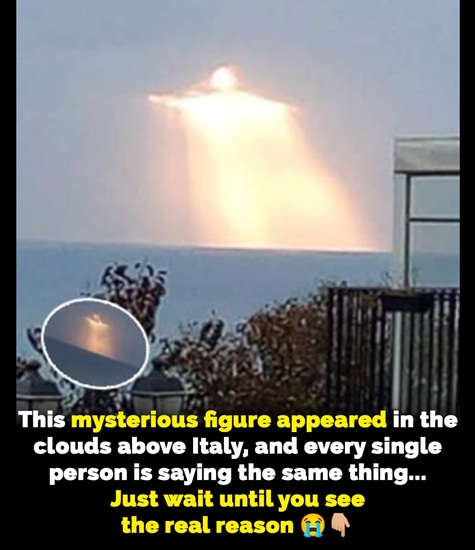
Nature occasionally creates scenes so unusual that they immediately capture people’s attention. Clouds, sunlight, shadows, and perspective can combine for only a few moments and produce shapes that look surprisingly familiar. One such photograph attracted widespread interest after an Italian man captured an extraordinary formation above the sea. Some people looking at the image believed the silhouette resembled a human figure with its arms extended, while others saw a fascinating but entirely natural cloud formation.
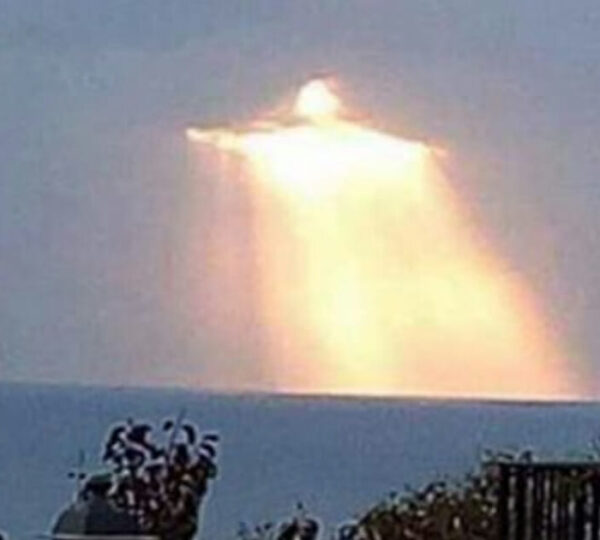
The photograph was taken by Alfredo Lo Brutto, who was reported to be from Agropoli, a coastal town in southern Italy. According to reports published in 2019, Lo Brutto was looking toward the Tyrrhenian Sea when he noticed a dramatic scene developing above the horizon. Sunlight was shining through gaps in the clouds and creating powerful rays over the water. Within the illuminated sky, a darker formation appeared to create the outline of a large standing figure.
After the photograph was shared online, some viewers quickly compared the shape with Christ the Redeemer, the famous statue overlooking Rio de Janeiro in Brazil. The monument depicts Jesus Christ with his arms stretched outward, creating one of the world’s most recognizable silhouettes. From a distance, the formation in Lo Brutto’s photograph appeared to some observers to have a similar shape, particularly because of what looked like a central body with horizontal features extending on either side.
The resemblance generated considerable discussion online, especially among viewers who interpreted the photograph from a religious perspective. Some considered the unusual formation personally meaningful or symbolic. However, there is no verified evidence establishing that the image shows a supernatural event. What can be stated factually is that the combination of clouds, sunlight, and viewing angle created an appearance that some people associated with the familiar image of Christ.
Lo Brutto himself spoke about the photograph after it attracted attention. In comments reported by the Daily Mail in 2019, he explained that he had been captivated by the view. Although he said he did not frequently post photographs on social media, he felt compelled to share this particular image because he found the scene exceptionally beautiful. His reported comments focused on his admiration for what he witnessed rather than presenting the photograph as proof of a miracle.
The location helped make the scene especially dramatic. Agropoli lies along Italy’s southern coastline, with expansive views across the Tyrrhenian Sea. Coastal horizons can provide spectacular conditions for observing sunsets and unusual patterns of light. When the sun is partly hidden behind clouds, beams of sunlight can become highly visible as they pass through openings in the cloud cover and extend toward the horizon.
These visible shafts of sunlight are commonly known as crepuscular rays. Depending on the position of the sun, clouds, and observer, they can create dramatic patterns in the sky. A darker cloud positioned between several bright rays may appear especially prominent. When photographed from the right angle, such a cloud can seem to form a recognizable silhouette even though its shape is the result of ordinary atmospheric conditions.
Another factor that can influence how people interpret photographs like this is a phenomenon known as pareidolia. This describes the human tendency to recognize meaningful or familiar patterns in otherwise random visual information. Seeing faces in clouds is perhaps the best-known example, but people can also recognize animals, human figures, buildings, or other familiar objects in rocks, shadows, smoke, and natural formations.
The phenomenon helps explain why different people can look at exactly the same image and see different things. Someone familiar with religious imagery may immediately associate the Italian photograph with Christ the Redeemer. Another viewer might simply notice an unusually shaped cloud surrounded by sunlight. These interpretations can coexist as personal perceptions, but they should not be confused with evidence demonstrating what physically occurred in the sky.
The comparison with Christ the Redeemer is understandable because of the statue’s distinctive design. Standing high above Rio de Janeiro on Mount Corcovado, the monument depicts Christ with both arms extended outward. Its recognizable silhouette has appeared in countless photographs and has become strongly associated with Rio de Janeiro. When a cloud formation takes on a roughly similar outline, people who know the monument may naturally make that connection.
Still, visual similarity does not establish that the cloud formation had any intentional or supernatural origin. Clouds are constantly changing as moisture, temperature, wind, and atmospheric pressure interact. Their shapes can transform within seconds or minutes. Combined with dramatic lighting, these temporary formations can produce images that appear remarkably structured even though they developed naturally.
Photographs of unusual natural events have long inspired discussion about coincidence, spirituality, and human perception. Before social media, such images might have remained known only to the photographer and a small group of people. Today, a photograph can quickly reach audiences around the world, allowing thousands of individuals with different backgrounds and beliefs to offer their own interpretations.
That widespread sharing also makes careful descriptions particularly important. A photograph may be genuine while the interpretation attached to it remains unverified. In this case, the documented part of the story concerns Lo Brutto taking a photograph of an unusual scene above the Tyrrhenian Sea near Agropoli. The idea that the formation represented a divine sign is an interpretation rather than an established fact.
The original photograph was reported internationally in 2019 and should therefore not be presented as a newly captured event. Contemporary coverage described the image and reported Lo Brutto’s reaction to what he had photographed. Over time, the picture continued to circulate because of its striking appearance and the debate surrounding what different viewers believed they could see within the clouds.
For people with religious beliefs, the image may still hold personal significance. An individual does not need scientific confirmation in order to find spiritual meaning in a sunset, rainbow, cloud formation, or another natural event. Personal meaning, however, is different from making a factual claim about the physical cause of an event. Maintaining that distinction allows the story to respect different beliefs without presenting speculation as confirmed information.
For viewers approaching the photograph from a scientific perspective, the combination of cloud formation, sunlight, and human pattern recognition provides a straightforward explanation. Atmospheric conditions regularly create remarkable visual effects, and photographs can preserve a fraction of a second in which those effects appear particularly dramatic. The resulting image can look far more deliberate or structured than the constantly changing scene actually was.
Neither explanation prevents people from appreciating the photograph itself. Regardless of whether someone sees religious symbolism or simply an impressive atmospheric phenomenon, the image captures an extraordinary-looking moment above the sea. The brightness of the sunlight, the darker silhouette, and the open horizon combine to produce a photograph that understandably attracted attention.
Lo Brutto’s decision to capture the moment also demonstrates the importance of timing in photography. Natural scenes can change rapidly, particularly when clouds are moving across the sun. A formation visible at one moment may look completely different shortly afterward. Being in the right place at the right time can therefore result in an image that would be extremely difficult to reproduce under identical natural conditions.
The story also offers an interesting example of how perception works. Human beings constantly search their surroundings for recognizable patterns because doing so is an important part of how the brain processes visual information. Most of the time this ability helps people quickly identify objects and faces. Occasionally, however, the same process causes familiar shapes to emerge from random patterns such as clouds.
This does not mean that viewers are wrong to find the photograph remarkable. Understanding a possible natural explanation does not remove the beauty or emotional impact of an unusual scene. Sunlight passing through clouds above an open sea can be spectacular even without any additional interpretation. For some people, understanding how the phenomenon occurs may make the photograph even more interesting.
The image therefore does not require a definitive spiritual conclusion to remain memorable. It can simultaneously be viewed as a beautiful photograph, an example of atmospheric lighting, and an illustration of how people recognize familiar forms in nature. Individual viewers may also attach their own personal or religious meaning to it, provided those interpretations are distinguished from verified facts.
What can reasonably be established is relatively straightforward: Alfredo Lo Brutto photographed a dramatic scene over the Tyrrhenian Sea near Agropoli, the resulting formation reminded some viewers of Christ the Redeemer, and the photograph attracted considerable online discussion after being shared. There is no verified evidence showing that an actual figure was present in the sky or proving that the formation had a supernatural cause.
Ultimately, perhaps the most interesting aspect of the photograph is how differently people can respond to the same natural scene. Some see religious symbolism, others see an example of pareidolia, and still others simply admire an impressive combination of clouds and sunlight. Those reactions reveal as much about human perception and personal interpretation as they do about the photograph itself.
Years after the picture first gained attention, it remains a striking example of the unexpected images nature can produce. The clouds eventually changed, the sunlight shifted, and the unusual silhouette disappeared, but the photograph preserved that brief moment. Whether someone considers it personally meaningful or views it purely as a natural phenomenon, the image demonstrates how an ordinary sky can sometimes produce an extraordinary sight.

