
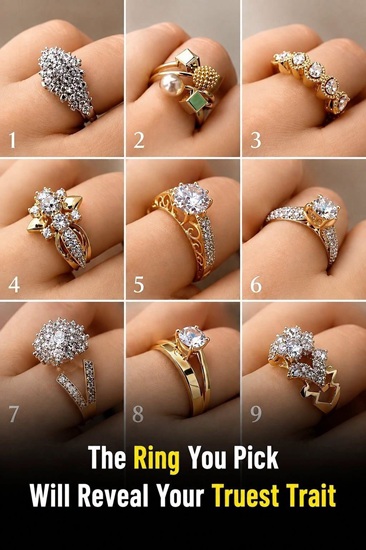
Personality quizzes have remained popular for decades because they offer a quick and entertaining way to think about personal preferences. One version shared online asks participants to look at several ring designs and select the one that attracts them first. The chosen ring is then connected with a description involving qualities such as leadership, compassion, creativity, loyalty, or ambition. There is no established scientific evidence showing that choosing a particular ring can reliably determine a person’s personality.
For that reason, the exercise is best understood as entertainment rather than a psychological assessment. Still, choosing among different designs can encourage people to think about their tastes and the qualities they value. The enjoyment comes from comparing the descriptions with how participants already see themselves.
Ring #1: The Natural Leader
In the interpretation commonly presented with this type of quiz, the first ring represents confidence, independence, and leadership. Someone who selects it might identify with being comfortable making decisions or taking responsibility when a problem appears. The description may also appeal to people who value straightforward communication and prefer practical solutions to unnecessary complications. These characteristics, however, should not be treated as facts about a person simply because they selected a particular piece of jewelry. Leadership is influenced by many factors, including experience, environment, skills, circumstances, and individual temperament. A visual preference cannot establish whether someone is naturally suited to leading other people. The description is therefore better used as an invitation to consider whether these qualities feel personally meaningful.
Ring #2: The Compassionate Personality
The second ring is often associated in the quiz with kindness, empathy, emotional awareness, and concern for other people. Participants attracted to this design may enjoy the description if relationships and meaningful personal connections are particularly important to them. Compassion can involve listening carefully, recognizing another person’s feelings, providing support, or simply treating people with consideration. At the same time, selecting this ring does not scientifically demonstrate that someone possesses greater empathy than a person who selects another design. Real personality characteristics are considerably more complicated than a single visual decision can reveal. People can also demonstrate compassion differently depending on their relationships and circumstances. In this exercise, the description should therefore be interpreted as a positive theme rather than a psychological conclusion.
Ring #3: The Creative Thinker
The third choice is connected with imagination, curiosity, originality, and an interest in exploring new possibilities. People who enjoy unusual or artistic designs may find this description especially relatable because aesthetic preferences can be an important form of personal expression. Creativity itself can appear in many different areas, including art, writing, music, design, problem-solving, cooking, technology, and everyday decision-making. It is important, however, not to assume that choosing an unconventional ring proves that someone is more creative than other participants. Scientific personality assessment requires considerably more information than a preference between several images. A person who chooses a simple ring can be highly imaginative, while someone attracted to an elaborate design may simply like its appearance. The quiz works best when its descriptions encourage reflection without turning visual preferences into unsupported conclusions.
Ring #4: The Loyal Friend
The fourth ring is presented as representing loyalty, reliability, stability, and appreciation for lasting relationships. Someone attracted to a balanced or traditional design might recognize themselves in a description emphasizing trust and consistency. Loyalty is often expressed through actions such as keeping commitments, supporting people during difficult periods, respecting confidence, and remaining dependable over time. Nevertheless, none of those behaviors can be accurately measured by asking someone to choose a ring from a picture. Personal relationships are shaped by experiences, values, communication, boundaries, and many other factors. The ring selection is therefore symbolic within the quiz rather than evidence about someone’s behavior. Participants can simply ask themselves whether reliability and long-term relationships are qualities they consider especially important.
Ring #5: The Ambitious Achiever
The fifth ring is associated with determination, ambition, persistence, and a desire to accomplish meaningful goals. People who identify with this description may enjoy setting objectives, learning new skills, or working steadily toward improvements in their personal or professional lives. Ambition does not necessarily mean competing with other people, because it can also involve personal development or achieving individually meaningful milestones. As with every other result in the exercise, however, the ring itself cannot measure motivation or predict future success. Achievement depends on numerous circumstances, including opportunities, resources, effort, education, support, decisions, and sometimes factors outside an individual’s control. A person’s goals may also change considerably throughout life. The description should consequently be viewed as a conversation starter rather than a prediction about what someone will accomplish.
Personality quizzes like this one can feel surprisingly relevant because many of their descriptions contain broadly relatable and generally positive characteristics. Psychology has long recognized a phenomenon known as the Barnum effect, also called the Forer effect, in which people may perceive generalized personality descriptions as being specifically applicable to themselves. Statements involving qualities such as loyalty, independence, sensitivity, determination, or creativity can resonate with many different individuals. Most people also display different characteristics in different circumstances rather than fitting perfectly into one simple personality category. Someone can be ambitious at work, compassionate with family members, creative during a hobby, and dependable among friends. This complexity is one reason a single ring choice cannot provide a scientific personality profile. Understanding that limitation does not necessarily remove the entertainment value of participating in the quiz.
Scientifically developed personality assessments are very different from casual visual quizzes circulating online. Researchers studying personality generally rely on carefully designed methods, larger sets of questions, statistical analysis, validation procedures, and repeated research rather than one aesthetic decision. Even established psychological measurements have limitations and should be interpreted within the context in which they were designed. A casual ring quiz does not provide the information required for a clinical diagnosis, mental-health evaluation, or professional psychological conclusion. It should also not be used to judge another person’s character, abilities, relationships, or future behavior. Selecting a ring mainly demonstrates that a particular design appealed to someone at that particular moment. Preferences can even change depending on mood, fashion, context, or the available choices.
That distinction allows the ring exercise to remain enjoyable without presenting entertainment as scientific fact. Participants can choose their favorite design, read the corresponding description, and decide for themselves which parts seem relatable. Friends or family members can compare selections and discuss why certain styles attracted them. Someone might discover that they prefer traditional jewelry, while another participant might favor unusual shapes or decorative details. Those preferences can produce interesting conversations without requiring claims that a ring reveals hidden psychological truths. The exercise can also encourage harmless self-reflection about characteristics people admire in themselves or would like to develop. When presented with appropriate context, the quiz becomes a simple interactive activity rather than an unsupported personality diagnosis.
The broader lesson is that online personality content deserves the same careful reading as other information encountered on social media or websites. Readers should distinguish clearly between an entertaining interpretation, a personal opinion, and a conclusion supported by scientific research. Attractive graphics and confident descriptions do not automatically make a claim scientifically established. Looking for context can prevent a playful activity from being misunderstood as professional psychological guidance. It is equally useful to avoid making assumptions about other people solely from their choices in an online quiz. Human behavior is influenced by a complicated combination of personality, experience, culture, relationships, circumstances, and individual decisions. No single jewelry preference can capture all of those influences.
Ultimately, there is nothing wrong with enjoying a ring personality exercise for what it is: a lighthearted opportunity to consider personal preferences. If Ring #1 reminds someone of leadership, Ring #2 of compassion, Ring #3 of creativity, Ring #4 of loyalty, or Ring #5 of ambition, those associations can provide interesting topics for discussion. Participants do not need to accept every description or believe that their selection defines who they are. They can agree with certain qualities, disagree with others, or simply appreciate the ring they found most attractive. The important distinction is between playful interpretation and verified psychological knowledge. Personality is far richer than any five categories can represent, and people routinely possess characteristics associated with several categories at once. Viewed with that context, the ring test can remain enjoyable, shareable, and informative without making claims that go beyond the evidence.

