
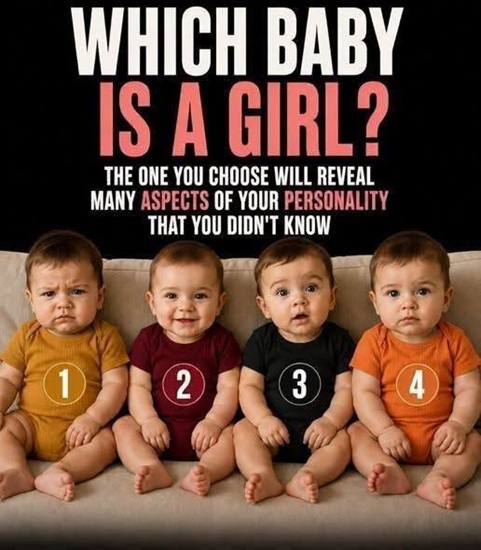
Online personality quizzes are popular because they make self-reflection feel simple, visual, and entertaining. One common format asks people to look at several faces or figures and choose whichever one catches their attention first. The result is then connected to a personality description that may sound surprisingly personal. These quizzes can be enjoyable, but they should not be confused with professional psychological assessment. A quick visual choice cannot reliably reveal a person’s complete personality, hidden motives, or emotional history.
It is better understood as a lighthearted prompt that may encourage people to think about their preferences and habits. The basic idea behind this quiz is straightforward. Look at the group of babies and notice which one draws your attention first. Some versions ask viewers to guess which baby is a girl, while others simply ask which face stands out most. That distinction matters because appearance alone is not a reliable way to determine a child’s sex or gender.
Hairstyles, clothing colors, facial expressions, and accessories are influenced by culture and personal choices rather than functioning as dependable biological indicators. The quiz therefore works best when treated as a visual preference game rather than a factual identification test.
Our attention is influenced by many different factors. Contrast, facial expression, position in the image, lighting, familiarity, and even mood can affect where the eyes move first. One person may notice a smiling face, while another focuses on a quieter expression. Someone else may be drawn to the baby positioned closest to the center. These reactions are not necessarily random, but they are also not simple codes that reveal a hidden personality. Human attention is far more complex than that.
If you want to try the quiz, it can be more fun to make your choice before reading the descriptions. Look at the image for only a few seconds and notice which baby your gaze returns to first. Try not to spend too much time comparing every detail. The point is not to find a scientifically correct answer. It is simply to observe your first reaction and see whether the related description gives you anything interesting to think about.
If the first baby was the one you noticed immediately, the playful interpretation connects your choice with reliability and structure. You may be someone who prefers knowing what to expect before making an important decision. Planning ahead can help you feel more comfortable, especially when responsibilities are involved. Friends and relatives may see you as dependable because you usually take promises seriously. When problems arise, you may prefer solving them carefully rather than reacting impulsively.
People who identify with this description often value stability. That does not mean they dislike adventure or change. A person can enjoy surprises and still prefer strong foundations in areas such as work, finances, or relationships. The description simply suggests that consistency may matter to you more than constant unpredictability. In stressful situations, that preference can become a strength.
Being organized can also make someone useful in group settings. People who enjoy structure often notice schedules, details, deadlines, and practical concerns that others overlook. They may naturally become the person friends call when something needs to be planned. That does not mean they are always serious or rigid. Organization is only one part of a much larger personality.
The first interpretation should therefore be viewed as a possibility rather than a fixed identity. You may recognize the dependable side but not the cautious side. You might be highly structured at work and spontaneous during vacations. Human behavior changes across situations. One visual choice cannot capture every version of you.
If the second baby stood out, the entertainment description emphasizes warmth, social connection, and optimism. You may enjoy being around people and helping others feel comfortable. Meeting someone new might feel exciting rather than intimidating, especially when the environment is relaxed. You may also be quick to notice opportunities for humor or conversation. That social energy can help create a welcoming atmosphere.
Optimism is often connected with this choice as well. When something goes wrong, you may naturally start searching for what can still be done. That does not mean you ignore serious problems. Healthy optimism is not pretending everything is perfect. It is the belief that difficult situations can sometimes improve with effort, adaptation, or support.
People who relate to this description may also enjoy collaboration. Working with others, sharing ideas, and celebrating group accomplishments can be rewarding. Some socially oriented people are highly outgoing, while others are friendly without seeking constant attention. There are many ways to enjoy connection.
It is also possible to be sociable and still need time alone. Personality traits exist on spectrums rather than in rigid categories. Someone may be energetic with close friends and quiet around strangers. Another person may enjoy parties but need several hours of solitude afterward. The quiz cannot measure those differences.
If the third baby was your first choice, the playful interpretation emphasizes curiosity. You may enjoy learning how things work, asking questions, and exploring unfamiliar subjects. New ideas can hold your attention for long periods, especially when they challenge what you already know. Curiosity can appear through books, travel, technology, conversation, hobbies, or research. It does not have to look the same for everyone.
People who identify with curiosity often prefer gathering information before forming strong conclusions. They may ask why something happened rather than accepting the first explanation. This can be useful when situations are complicated because it encourages careful thinking. At the same time, too much analysis can sometimes make decisions slower. Balance remains important.
Curiosity can also lead people toward new experiences. Someone may enjoy trying unfamiliar food, learning languages, exploring different cultures, or experimenting with creative projects. Another person may focus deeply on one specialized subject for years. Both approaches involve a desire to understand more.
The third description is sometimes associated with thoughtfulness because curious people often enjoy considering several perspectives. That can make conversations richer and help prevent rushed conclusions. Still, curiosity alone does not automatically make someone wiser than others. Wisdom usually develops through experience, reflection, and learning over time.
If the fourth baby attracted your attention first, the entertainment-style interpretation emphasizes compassion and empathy. You may be sensitive to changes in other people’s moods and quick to notice when someone seems discouraged. Friends may appreciate your willingness to listen without immediately interrupting or judging. You may also prefer understanding someone’s circumstances before forming an opinion about their behavior.
Empathy is not the same as agreement. A person can understand why someone feels hurt while still disagreeing with what they did. That distinction is important because healthy relationships require both compassion and boundaries. Caring about someone does not mean accepting every decision they make.
People who strongly identify with empathy can sometimes become the person others turn to during difficult moments. Listening, encouraging, and offering perspective can create deep relationships. However, constantly absorbing other people’s problems can also become exhausting. Compassion works best when it is combined with awareness of personal limits.
The fourth description should therefore be interpreted in a balanced way. Caring about others can be a significant strength, but self-care matters too. A person does not need to solve every problem in order to be supportive. Sometimes listening is enough.
Many people are surprised when one of these descriptions feels highly accurate. Psychology offers a useful explanation for part of that reaction. The Barnum effect, sometimes called the Forer effect, describes the tendency to experience broad personality descriptions as uniquely personal even when the same statements could apply to many people. This is common in horoscopes, personality quizzes, fortune-telling, and other generalized descriptions.
Statements such as “you care deeply about people close to you” or “you sometimes question your decisions” sound specific because readers connect them with personal memories. Most people can think of examples that make those statements feel true. Details that do not fit may receive less attention. That does not mean someone is foolish. It is a normal feature of how people process information.
This is one reason online quizzes should not be treated as scientifically validated personality tests. Formal psychological assessment uses carefully designed questionnaires, standardized scoring, statistical research, and professional interpretation. A four-image quiz does not follow those methods. Its purpose is entertainment and reflection rather than diagnosis.
Confirmation bias can also influence how convincing the result feels. People naturally notice information that supports beliefs they already have. If someone already sees themselves as compassionate and receives a description emphasizing empathy, they may immediately remember examples that confirm it. Moments when they were impatient may not come to mind as quickly.
Visual salience is another important factor. A face may attract attention simply because it is brighter, larger, more centered, or showing a stronger expression. If one baby is positioned differently from the others, viewers may notice that difference before anything else. The visual design itself can therefore influence the result.
Culture also affects perception. People learn associations involving clothing, color, emotion, and social roles through their environment. Those associations are not universal truths. Someone raised in another cultural setting may interpret the same image differently. That is another reason a simple visual choice cannot reliably reveal deep psychological traits.
This matters especially when a quiz asks viewers to identify a girl from appearance alone. Clothing and hairstyles are not reliable evidence of gender. A photograph does not provide enough information to make that determination confidently. The safer approach is to keep the focus on visual preference rather than making assumptions about the children themselves.
The same caution applies to personality. A smiling baby should not automatically be described as outgoing, and a serious expression does not prove a child is shy. Photographs capture brief moments. They do not reveal an entire temperament or future personality.
The real subject of the quiz is the viewer, not the babies. The image simply provides a visual prompt. What matters is which detail attracts attention and how the viewer responds to the description afterward. That makes the exercise closer to self-reflection than psychological testing.
One interesting way to use the quiz is to ask friends or relatives what they noticed first. People often choose different babies for completely different reasons. Someone may focus on a smile, while another notices posture or eye direction. Those explanations can be more interesting than the assigned personality categories.
The choice may even change if someone looks at the picture again later. After reading the descriptions, another face may suddenly become more noticeable. This demonstrates that attention is flexible. What we expect to find can influence what we notice.
If someone tells you to search for the happiest-looking face, your eyes may move differently than if you are told to find the quietest one. The image remains the same, but the goal changes. That simple example shows why first-glance choices should not be treated as fixed psychological signatures.
Mood can influence attention too. Someone who is relaxed may focus on different expressions than someone who is stressed or tired. Researchers study complex relationships between mood, memory, and perception, but a casual online quiz cannot separate those factors. That limitation should be kept in mind.
Memory may also play a role. A particular face might remind someone of a relative, childhood photo, or familiar expression. The viewer may not even consciously recognize the connection. Familiarity alone can make one image feel more noticeable.
Screen size and image quality can change the experience as well. On a small phone screen, one face may appear clearer than another. Cropping, brightness, and contrast can affect which details are easiest to see. Two people may therefore receive slightly different visual experiences even when they are viewing the same basic puzzle.
For these reasons, dramatic claims that a choice “exposes your deepest secret” should be treated as playful language rather than scientific fact. Human personality develops through genetics, family, culture, experience, relationships, education, and many other influences. No single glance can reveal all of that.
A more reasonable way to use the quiz is to ask whether the result gives you a useful question. If the first description feels familiar, perhaps you value stability strongly. If the second resonates, maybe social connection is important to you. If the third feels accurate, curiosity may play a large role in your life. If the fourth stands out, empathy may be one of your priorities.
You do not need to accept every sentence. In fact, noticing what does not fit can be useful. Maybe you picked baby two but consider yourself highly reserved. That mismatch simply shows the limits of the quiz. It does not mean you chose incorrectly.
Most people probably contain qualities from all four descriptions. Someone can be dependable, optimistic, curious, and compassionate at the same time. Different traits become more visible in different situations. A person may be highly organized at work, playful with friends, intellectually curious alone, and deeply empathetic with family.
This flexibility is normal. Personality does show patterns, but people are not single labels. Behavior changes depending on context, stress, relationships, responsibilities, and goals. Any quiz that places everyone into four categories is necessarily simplified.
That is why these tests are more enjoyable when they remain lighthearted. They become less helpful when people use them to judge themselves or others rigidly. Saying “you chose number four, so you must always be emotional” would be an oversimplification. A better question is whether any part of the description feels familiar.
These quizzes can also reveal what qualities people admire. Someone may be attracted to a cheerful expression because they value warmth. Another may prefer a calm face because it feels reassuring. That preference can be interesting without proving a personality trait.
Preferences themselves can change over time. A person who once valued excitement may later prioritize stability. Someone focused heavily on career success may eventually place more importance on relationships or creativity. Life experiences shape what attracts attention and what feels meaningful.
Personality can also change gradually. Research suggests that many traits remain relatively stable while still showing development across adulthood. People gain confidence, become more disciplined, change social habits, or develop new priorities. Identity is not completely fixed.
The popularity of these quizzes reflects a broader human interest in self-understanding. People have always created ways to describe character and temperament. Modern psychology studies personality scientifically, while internet quizzes offer a much simpler and more entertaining version of the same curiosity.
Scientific personality models such as the Big Five examine broad traits like openness, conscientiousness, extraversion, agreeableness, and emotional stability. Even those validated approaches do not reveal every detail of a person. They describe tendencies rather than producing a complete biography.
An image-based quiz is far less precise. That is perfectly acceptable as long as its limits are clear. Entertainment does not need to pretend to be clinical science in order to be enjoyable. Accuracy comes from being honest about what the quiz can and cannot do.
The language used around the result matters for that reason. Saying a choice “may suggest” certain tendencies is more responsible than saying it “proves” a hidden truth. That small difference helps prevent readers from treating entertainment as diagnosis.
It also reduces unnecessary anxiety. No one should worry because a visual quiz gives them a result they dislike. Choosing one baby does not reveal a dangerous secret, predict future behavior, or expose a mental-health condition. It is simply one visual preference at one moment.
If someone genuinely wants to understand their personality in greater depth, there are better options. Validated personality questionnaires can provide more useful information. If concerns involve anxiety, mood, relationships, or mental health, a qualified professional is more appropriate. A casual social-media quiz cannot replace that process.
For everyday entertainment, however, the exercise can still be enjoyable. Make your choice, read the description, and notice what feels familiar. Keep the parts that encourage reflection and ignore the parts that do not fit. There is no requirement to force yourself into the category.
Baby one is associated with reliability and structure.
Baby two is connected with sociability and optimism.
Baby three emphasizes curiosity and learning.
Baby four highlights compassion and emotional awareness.
None of those qualities is better than another.
Different strengths are useful in different situations.
Groups benefit from organized people who create structure.
They benefit from optimistic people who encourage others.
They benefit from curious people who ask important questions.
And they benefit from compassionate people who notice emotional needs.
Most healthy communities need a mixture.
The same is true within individuals. A single person may move between these qualities depending on what life requires. That complexity is more realistic than dividing everyone into fixed types.
It is also important to keep the babies themselves out of the personality interpretation. Their expressions should not be used to predict who they are. The quiz is about the viewer’s attention, not about making claims about children based on appearance.
That makes the exercise more respectful and more accurate. Instead of asking what the babies “are,” ask what you noticed. That question can actually be interesting.
Was it the smile?
The position?
The eyes?
The lighting?
Did the face remind you of someone?
There may not be one answer.
Human attention often results from several processes working together. Not every reaction needs a dramatic explanation.
The Barnum effect adds another layer of interest because it explains why the personality descriptions can feel so personal. Once readers know about it, they can enjoy the quiz while also observing their own thinking. That makes the experience more educational rather than less fun.
For example, if a description says you sometimes feel misunderstood, ask how many people you know who could also say the same. Probably quite a few. Broad human experiences feel personal because everyone connects them with different memories.
That does not make self-reflection meaningless. It simply reminds us that the meaning comes from our interpretation rather than from the image itself. The quiz provides the prompt. The reader creates the connection.
That can still be valuable. Someone may recognize that they genuinely want more stability. Another may realize they have neglected social relationships. Someone else may rediscover how much they enjoy learning or notice that they have been emotionally overextended while helping others.
Those insights come from thinking, not from magic.
The image starts the process.
The person does the real work.
Seen that way, online personality quizzes can function like informal journaling prompts. They give people a reason to pause and consider qualities they might not otherwise think about during a busy day.
The quiz can also be used as a conversation game. Ask everyone to make a choice before reading the descriptions. Then compare why each person picked differently. The conversation may reveal more than the actual results.
Someone might choose baby one because the expression looks familiar.
Another may choose baby three because the positioning immediately caught their attention.
Those explanations are personal and often more interesting than the labels themselves.
This social aspect helps explain why visual quizzes spread quickly online. They create easy participation. There is no specialized knowledge required. Everyone can make a choice and join the discussion.
The important thing is not to let the entertainment become misinformation. A playful personality description should remain clearly playful. Claims about psychology, intelligence, gender, or mental health need stronger evidence than an image-based game can provide.
Ultimately, the first baby you notice does not scientifically expose your deepest hidden self. What it may do is give you a small opportunity to observe your preferences and think about familiar personality traits. That is enough.
If the first baby caught your eye, consider how important structure and reliability are in your life.
If the second stood out, think about your relationship with social connection and optimism.
If the third drew your attention, reflect on curiosity and learning.
If the fourth was your choice, consider how empathy influences the way you relate to people.
Then step back from the categories.
You are more complicated than any one of them.
People can be reliable and spontaneous.
Social and private.
Curious and cautious.
Compassionate and firm.
Those combinations are part of what makes personality interesting.
No four-picture quiz can fully describe a human being.
So enjoy the result without giving it more authority than it deserves. Share it with friends if it starts a fun conversation. Compare answers, laugh about the mismatches, and keep the parts that encourage useful reflection.
The most accurate conclusion is also the simplest one.
The image may reveal what caught your attention first.
What that means about your life is something only you can explore.

