
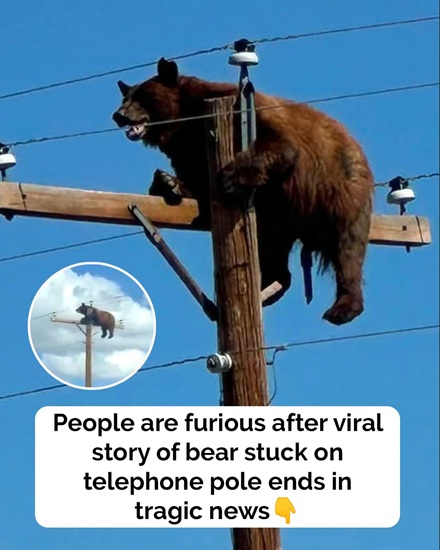
A black bear that captured widespread public attention after becoming stranded high atop a utility pole in northeastern New Mexico has died, bringing a heartbreaking end to a story that many people across the country followed with hope. Images and videos of the bear balancing on the wooden pole circulated rapidly online, prompting thousands of comments from people expressing concern for the animal’s safety. Wildlife officials later confirmed that the bear died after coming into contact with energized electrical equipment while attempting to climb down.
The incident has since prompted renewed discussion about wildlife rescues, public safety, and the difficult decisions authorities sometimes face when responding to emergencies involving wild animals. The unusual situation began on July 20, when Shannon Mullens and members of her family were traveling near Highway 56 outside Clayton, New Mexico.
At first, they believed they were looking at a motionless animal that had already died. After turning their vehicle around for a closer look, however, they realized the bear was still alive. According to accounts shared afterward, the animal appeared exhausted and remained perched dozens of feet above the ground on a wooden utility pole. Concerned about what they had seen, Mullens contacted the New Mexico Department of Game and Fish so wildlife officials could respond to the scene.
As emergency personnel evaluated the situation, additional motorists stopped along the highway after noticing the bear. Many photographed or recorded videos of the remarkable sight, and those images quickly spread across social media platforms. Within hours, the bear’s predicament had become an international news story. Thousands of people expressed hope that wildlife officials would be able to rescue the animal safely, while others asked questions about why an immediate rescue had not already taken place. The incident illustrated how rapidly unusual wildlife encounters can attract widespread public attention in today’s connected digital environment.
Wildlife specialists explained that, despite appearances, the rescue presented several serious challenges. One of the most common suggestions from members of the public was to tranquilize the bear and lower it safely to the ground. However, experts noted that tranquilizing an animal positioned high above the ground can create an even greater danger. Sedatives generally take effect within a short period, and once the medication begins working, the animal loses coordination and muscle control. If that had occurred while the bear remained high on the utility pole, it could have fallen before rescue teams had an opportunity to secure it, potentially resulting in severe injury or death.
Officials instead hoped the bear would eventually descend on its own after conditions around the area became calmer. Black bears are naturally skilled climbers and frequently climb trees or elevated structures when frightened or attempting to escape perceived danger. Wildlife experts suggested that the bear may have climbed the utility pole after becoming startled and then remained there because traffic, nearby activity, unfamiliar noises, or the presence of people below made it reluctant to climb back down. Their approach focused on minimizing additional stress while allowing the animal the opportunity to return safely once it no longer felt threatened.
Another significant concern involved the energized electrical equipment surrounding the bear. Utility poles carrying high-voltage power lines present obvious hazards not only to wildlife but also to emergency responders. Any rescue effort requiring personnel to climb the pole would have demanded careful coordination between wildlife officials, utility companies, and emergency services. Before anyone could safely approach the bear, electrical service would likely have needed to be interrupted, safety procedures implemented, and specialized personnel positioned to reduce the risk to both the animal and the rescue teams. Those operational requirements can take time, particularly in situations involving active power infrastructure.
As news coverage expanded, more people reportedly stopped near the location hoping to witness the unusual event firsthand. Wildlife professionals frequently remind the public that maintaining distance from distressed wild animals is important because additional noise, movement, and human activity can increase an animal’s stress. Although many people gathered out of genuine concern, officials generally encourage observers to avoid approaching wildlife during emergency situations so trained personnel have the best opportunity to assess conditions and determine the safest course of action. Reducing unnecessary disturbances can sometimes improve the chances of a successful outcome.
Throughout the day, many people continued hoping the bear would eventually make its own way back to the ground without injury. Messages of concern appeared across social media, where countless users shared photographs, expressed sympathy for the exhausted animal, and encouraged authorities to find a safe solution. The incident became an emotional reminder of the challenges wildlife can encounter when human infrastructure intersects with natural habitats. Even before the outcome was known, many observers recognized that the situation involved complex safety considerations that required careful judgment rather than a simple or immediate solution.
As the situation continued, wildlife officials remained hopeful that the bear would eventually descend safely without requiring a high-risk intervention. According to the New Mexico Department of Game and Fish, responders carefully monitored the animal while considering the significant dangers posed by the surrounding electrical infrastructure. Wildlife experts have explained that rescue operations involving energized utility poles require close coordination between emergency personnel and utility providers because both responders and the animal face substantial risks. Every possible action must balance public safety with the welfare of the wildlife involved, particularly when high-voltage equipment is present.
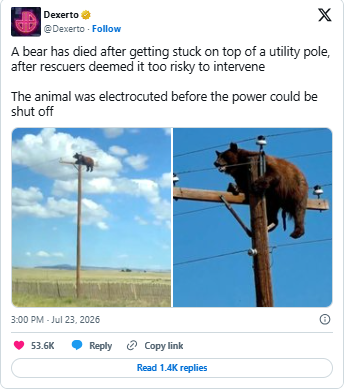
Eventually, the exhausted bear began climbing down from the pole. During its descent, however, it came into contact with energized electrical equipment. The New Mexico Department of Game and Fish later confirmed that the bear was electrocuted and died. The announcement brought a sad conclusion to a story that had captured the attention of thousands of people who had been following updates online. Many who had hoped for a successful rescue expressed disappointment, while wildlife officials acknowledged the unfortunate outcome of an exceptionally difficult situation.
The incident generated widespread discussion across social media and news platforms. Many people expressed sympathy for the animal and appreciation for those who responded to the emergency. Others asked questions about whether different rescue methods might have been possible. Public conversations reflected the emotional impact that wildlife stories often have, particularly when they involve animals in visible distress. At the same time, wildlife agencies reminded the public that rescue decisions are based on safety assessments, available resources, and the specific circumstances present at the scene.
Wildlife professionals also used the incident as an opportunity to explain why tranquilizing animals in elevated locations is generally considered a last resort. Sedation affects an animal’s coordination and balance, making falls far more likely if the animal is positioned high above the ground. Experts noted that although tranquilizer darts are valuable tools in many rescue operations, their use depends heavily on the environment and surrounding hazards. In situations involving utility poles, cliffs, rooftops, or other elevated structures, sedation may create additional risks rather than reducing them.
The bear’s story also highlighted the increasing interaction between wildlife and human-built environments. As communities continue expanding into areas where wild animals naturally live and travel, encounters with roads, fences, utility equipment, and other infrastructure become more common. Wildlife agencies throughout North America frequently encourage residents to avoid approaching wild animals, to report unusual situations promptly, and to allow trained personnel to manage rescue efforts. These recommendations are intended to protect both people and animals while reducing additional stress during emergencies.
Some observers compared the New Mexico incident with a separate rescue that occurred in Arizona in 2021, when a young black bear became stranded on a power pole near Willcox. In that case, utility crews were able to temporarily disconnect electrical service before trained personnel encouraged the bear to climb safely back to the ground. Wildlife experts noted that although both situations involved bears on utility poles, every rescue is unique. Factors such as electrical infrastructure, terrain, weather, available personnel, and the animal’s exact location all influence which options are feasible at a given moment.
Conservation specialists say these events also demonstrate the importance of continued cooperation between wildlife agencies, utility companies, emergency responders, and local communities. Ongoing research into wildlife behavior and improvements in rescue planning may help officials respond even more effectively when unusual situations arise. Public awareness also plays an important role, as maintaining a safe distance from distressed wildlife can sometimes provide animals with a better opportunity to calm down while allowing emergency personnel to work without unnecessary distractions.
Although the story ended tragically, it prompted many people to learn more about black bears, wildlife rescue procedures, and the challenges involved in protecting animals that unexpectedly encounter human infrastructure. The incident serves as a reminder that wildlife professionals often face complex decisions where every available option carries potential risks. While the outcome saddened many who followed the story, it also reinforced the importance of respecting wild animals, supporting conservation efforts, and recognizing the difficult work performed by wildlife responders who strive to protect both animals and the public under challenging circumstances.

