
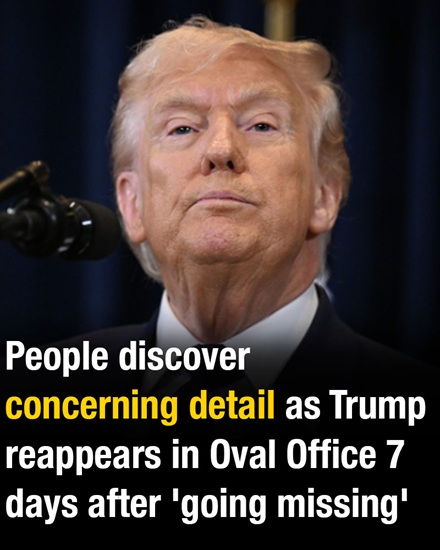
Public discussion increased in early June 2026 after reports noted that Donald Trump had not been seen in several public events for a short period before reappearing at the White House in Washington, D.C. The gap in public visibility lasted approximately one week, based on available media coverage and official scheduling information shared at the time by news organizations. His last confirmed appearance before this period was reported during a Cabinet-related meeting held in late May, where official photographs and press coverage documented his participation.
When he later returned to public view inside the Oval Office, reporters were present, and his comments were broadcast and circulated widely across television networks and online platforms. The return quickly became a topic of discussion not only for political statements but also for general public interest in his appearance and communication style during the briefing. Some viewers and social media users commented on his body language during the appearance, especially how he positioned his hands while speaking to journalists.
These observations spread rapidly online through short video clips, screenshots, and user commentary, which is common in modern political media environments. Other viewers argued that such interpretations can often be misleading because camera angles, lighting, and natural speaking gestures may create different visual impressions. At the same time, the event generated broader conversation about presidential schedules and how public appearances are distributed between official, private, and administrative duties.
In many cases, political leaders may have working schedules that are not fully visible to the public, including internal meetings, briefings, and non-public engagements. After the appearance, some online users speculated about possible patterns in his visibility, suggesting that short absences had been noticed at different times. However, no official source confirmed any pattern of concern, and such claims remained part of online commentary rather than verified reporting.
A number of posts also referenced past images showing occasional bruising or marks on his hand during earlier public events. These observations were widely shared on social media platforms, but they were not accompanied by any independent medical diagnosis or confirmed explanation beyond official statements. Public attention also revisited his recent medical evaluation conducted at Walter Reed National Military Medical Center, where routine examinations were reportedly performed.
According to official communications released at the time, the visit was described as part of a scheduled physical examination rather than an emergency procedure. The White House stated that such medical visits are part of regular health monitoring procedures for senior government officials. Following the examination, a physician’s summary was released indicating that multiple health indicators were within normal clinical ranges.
The report included assessments of cardiovascular, respiratory, and neurological functions, which were described as stable based on the evaluation data. It also referenced cognitive screening results, which were reported as scoring within the normal range on a standard assessment tool used in medical evaluations.
Medical officials concluded that he remained fit to perform his official duties at the time of the examination, based on the findings documented in the report. The summary also included general preventive health recommendations, which are commonly issued in routine medical checkups regardless of the patient’s condition. These recommendations typically involve guidance related to diet, physical activity, and long-term health maintenance strategies appropriate for age and lifestyle.
The report also noted body weight measurements, which showed a moderate change compared to previous evaluations, something that is often tracked in annual physical assessments. Public officials emphasized that such changes are not unusual and are interpreted within broader medical and lifestyle contexts rather than isolated indicators. Despite the release of official medical information, online discussion continued, reflecting the way political figures often attract significant public scrutiny.
Some commentators expressed skepticism, while others accepted official statements as sufficient clarification regarding his health status. Experts in public communication and media analysis often note that brief video clips can lead to exaggerated interpretations when circulated without full context. Medical professionals also emphasize that visible physical signs, such as bruising, can result from many non-serious causes, including routine medical procedures or minor physical contact.
Similarly, variations in energy levels or posture during public appearances can be influenced by scheduling demands, travel, or environmental conditions. The broader discussion reflects how modern political communication often intersects with social media interpretation and rapid information sharing. In such environments, unverified claims can spread quickly, especially when they involve high-profile public figures.
However, official health statements remain the primary verified source of information regarding any medical evaluations of government leaders. As of the latest available updates, no official report has confirmed any serious health concerns beyond routine monitoring and standard medical care.
Authorities have consistently maintained that the president remains capable of fulfilling all duties associated with the office based on medical assessments. The situation illustrates how public interest, political context, and media interpretation can combine to generate widespread discussion even around routine events.
Ultimately, without independently verified medical evidence beyond official reports, much of the online speculation remains unconfirmed and should be treated cautiously. The public response to the appearance of Donald Trump demonstrates how closely political leaders are observed and how quickly narratives can form in digital spaces.

