

Marine researchers are once again tracking one of the Atlantic Ocean’s most remarkable predators after the largest great white shark ever recorded in the region briefly resurfaced following several months without a confirmed location. The shark, known as Contender, has become one of the most closely monitored animals in the Atlantic since researchers from the nonprofit marine research organization OCEARCH successfully tagged him in early 2025.
His recent satellite signal has renewed scientific interest and prompted fresh discussions about the seasonal migration patterns of great white sharks along the eastern coastline of North America. According to OCEARCH, Contender was first tagged on January 17, 2025, approximately 45 miles off the Georgia-Florida border during one of the organization’s ongoing research expeditions.
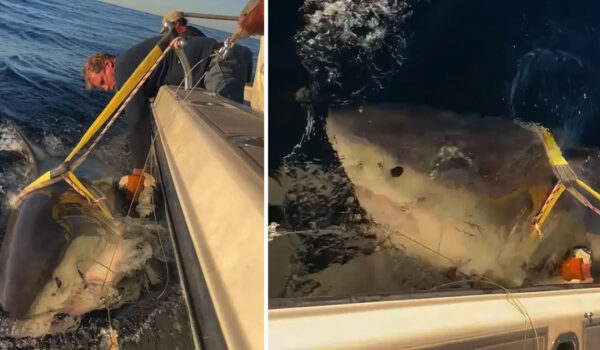
At the time of tagging, researchers measured the shark at roughly 14 feet (4.3 meters) in length, making him the largest great white shark ever scientifically recorded and tagged in the Atlantic Ocean. Although impressive in size, researchers note that even larger great whites have been documented elsewhere in the world, including the famous female shark known as Deep Blue, which is estimated to measure around 20 feet long.
Since receiving his satellite tracking tag, Contender has traveled more than 7,000 miles, offering scientists valuable information about the movement of great white sharks throughout the western North Atlantic. Each satellite transmission contributes to a growing body of research designed to better understand where these apex predators feed, migrate, reproduce, and spend different seasons of the year. Such information helps marine biologists improve conservation efforts while also increasing public understanding of one of the ocean’s most misunderstood species.
The shark recently generated renewed excitement after OCEARCH reported receiving what researchers call a “Z-ping.” Unlike a standard satellite transmission, which requires multiple signals to accurately calculate a shark’s location, a Z-ping occurs when the shark’s dorsal fin briefly breaks the ocean’s surface long enough for the satellite tag to send only a single weak signal. Because fewer than three satellite messages are received, researchers cannot determine the shark’s exact position. Nevertheless, the transmission confirms that the animal is alive, moving, and continuing its migration.
Contender’s previous confirmed location had been recorded in April near the Outer Banks of North Carolina. Following several months without additional confirmed satellite data, many researchers expected the shark to continue its annual northward migration as ocean temperatures gradually increased during late spring and early summer. The latest Z-ping appears consistent with those expectations, although scientists emphasize that its exact location remains unknown until additional satellite transmissions are received.
Based on decades of tracking data collected from numerous great white sharks, marine scientists believe Contender is likely traveling toward either Cape Cod, Massachusetts, or the waters surrounding Atlantic Canada. These regions are considered important seasonal feeding grounds because they provide cooler summer water temperatures along with abundant populations of seals, one of the preferred prey species for adult great white sharks. Cape Cod, in particular, has become internationally recognized for its recovering gray seal population, which has naturally attracted increasing numbers of great white sharks during the warmer months.
Researchers stress that the presence of large sharks near coastal areas should not automatically cause alarm. Great white sharks have migrated along the Atlantic coastline for thousands of years, long before modern coastal communities developed. Their seasonal movements are driven primarily by water temperature, prey availability, and natural biological cycles rather than any attraction to humans. Marine biologists consistently emphasize that sharks generally avoid interactions with people, and confirmed shark bites remain extremely rare compared to the millions of individuals who enter the ocean every year.
The satellite tagging program operated by OCEARCH plays an important role in helping scientists understand these migration patterns. During research expeditions, trained marine biologists carefully capture sharks for a brief period, perform health assessments, collect biological samples, and attach specialized satellite transmitters before safely releasing the animals back into the ocean. The information gathered allows researchers to identify migration routes, estimate habitat use, monitor population health, and support long-term conservation planning for great white sharks and other marine species.
Public interest in Contender has grown steadily because of both his extraordinary size and the valuable scientific information he continues to provide. Each new satellite transmission offers another opportunity for researchers to better understand the behavior of one of the ocean’s most iconic predators. While scientists await additional location data that may reveal his exact position, Contender’s latest signal serves as another reminder of the remarkable journeys these animals undertake every year across thousands of miles of the Atlantic Ocean.

