
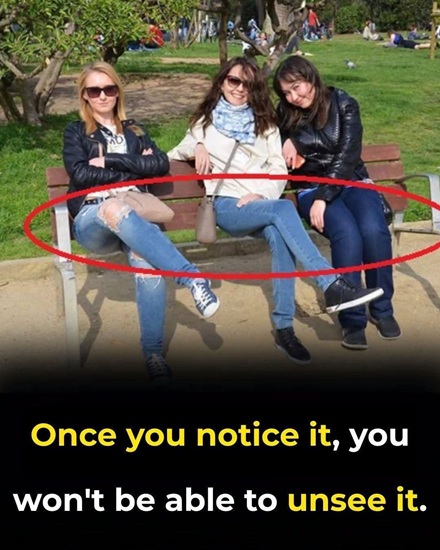
At first sight, the image described in this visual puzzle seems completely ordinary. Three women appear close together, smiling toward the camera as if they were posing for a casual group photograph. Their expressions look natural, their posture seems relaxed, and nothing immediately suggests that anything is wrong. That sense of normality is exactly what makes the puzzle effective. The brain tends to understand the overall scene quickly before checking whether every physical detail actually makes sense.
Because the arrangement looks familiar, many viewers accept it without questioning it. When people are asked to find the problem, they often begin searching in the wrong places. Some focus on the women’s faces, others study their clothing, hands, shadows, or the background. Many assume there must be a hidden object, a strange pattern, or a small editing error somewhere in the picture. That expectation can make the puzzle seem more complicated than it really is. According to the description, however, the main clue is much simpler.
The unusual detail is connected directly to the way two of the women appear to be sitting. The women are positioned in a way that strongly suggests they are seated. Their knees are bent, their bodies are held at a natural sitting height, and their upper bodies appear relaxed. Normally, a viewer would expect to see chairs or another surface supporting them. Yet in the puzzle as described, visible seats cannot clearly be seen beneath two of the women. This creates the impression that they are somehow sitting in midair. Because the rest of the scene looks convincing, the missing support may not stand out immediately.
This effect shows how strongly perception depends on familiar patterns. Human vision does not necessarily examine every object separately before deciding what a scene represents. Instead, the brain quickly compares what it sees with situations it already understands. When several people appear to be sitting together, the mind naturally assumes that chairs must be present. That assumption can be strong enough to fill in the missing information automatically. As a result, viewers may believe they are seeing an ordinary seated group even when the expected furniture is not visible.
The composition of the image strengthens this illusion. The women are arranged like people in countless normal group photos, with their shoulders close together and their legs positioned naturally. Their smiles also give the impression that nothing unusual is happening. These familiar visual signals encourage the viewer to interpret the scene as normal before examining the details more carefully. Because the brain already understands the broad situation, it may not immediately check whether the physical support beneath each person is actually present.
Once the strange detail is pointed out, the entire picture can suddenly look different. A scene that appeared perfectly normal a few seconds earlier may now seem physically impossible. Nothing in the image itself has changed. The difference comes from where the viewer is directing attention. Instead of relying on the overall impression, the viewer begins asking whether the body positions shown in the picture could actually work without visible support. That change in focus is often enough to reveal the answer.
This is one reason visual riddles can be so enjoyable. The solution usually does not require technical knowledge or a special ability. Instead, the challenge often depends on overcoming an assumption the brain made automatically. Someone who searches for an elaborate hidden trick may spend more time looking in the wrong places. A person who asks a very basic question about balance and support may notice the inconsistency much faster. The difficulty comes from expectation, not from the complexity of the answer.
The puzzle also demonstrates how useful context is in everyday vision. People constantly interpret incomplete information without consciously realizing it. If a scene resembles something familiar, the brain often fills in details that are expected to be there. This helps people understand the world quickly and efficiently. In a visual puzzle, however, that same efficiency can be used against the viewer. The image can create the impression of an ordinary situation while quietly removing one detail the brain assumes must exist.
A helpful way to solve puzzles like this is to describe the scene literally. Instead of asking what the picture is supposed to show, viewers can ask what is actually visible. Who is present? What position is each person holding? What object would normally be necessary for that position? In this example, that method leads directly to the seating arrangement. If two people appear to be sitting but no clear support can be seen beneath them, the contradiction becomes easier to identify.
Being fooled by the illusion does not mean someone has poor observation skills. In fact, it shows that the brain is doing something it normally does very well. It is using familiar visual patterns to interpret a scene quickly. The puzzle simply takes advantage of that process by presenting a scene that looks complete even though an important element appears to be missing. The viewer’s mind supplies that missing element automatically until attention is drawn specifically to it.
According to the description provided with the puzzle, the intended answer is that two of the women seem to be seated even though no visible chairs appear beneath them. Their posture makes them look as though they are sitting normally, while the absence of obvious support creates a floating effect. This is the main inconsistency viewers are supposed to notice. The solution does not depend on hidden symbols, unusual facial expressions, or background details. It comes from examining the physical relationship between the women and the space beneath them.
The puzzle works because the brain trusts familiar body language. Sitting is such an ordinary action that viewers do not usually question whether a chair must be present. If the person’s posture looks correct, the mind often assumes the support exists even without checking. That automatic interpretation allows the image to appear normal at first. Only after the viewer actively looks for the missing support does the illusion begin to break down.
There is also a broader lesson in the way people approach simple puzzles. Difficult-looking questions can sometimes encourage people to search for complicated explanations. They may assume the answer must involve a clever hidden detail or an elaborate trick. In reality, the most important clue may be directly in front of them. That does not mean simple answers are always correct, but it does show the value of examining the obvious details before inventing more complex explanations.
After the answer becomes clear, looking at the image again can feel almost completely different. The missing support may suddenly become impossible to ignore. A detail that was overlooked during the first viewing can become the most noticeable part of the picture. This change shows how much attention influences perception. The visual information remains the same, but the viewer now understands which detail matters and therefore interprets the scene differently.
The appeal of this puzzle comes from that moment of recognition. The viewer begins with an ordinary-looking scene and then discovers that something about it does not physically add up. According to the puzzle’s description, two of the women appear to be sitting despite the lack of clearly visible chairs beneath them. Their natural poses encourage the brain to accept the scene before checking the support. Once that assumption is questioned, the strange detail becomes much easier to notice.
This explanation is based only on the description of the visual puzzle provided here. It does not claim that the writer photographed the scene, knows the people shown, witnessed the event, or has firsthand knowledge about where the image originated. It also does not present the publisher as a local voice or as someone connected to a particular community or domestic issue. The purpose is simply to explain the stated visual trick and why viewers may initially overlook it. Without independently examining the original image, the explanation should be understood as a description of the puzzle’s reported premise rather than a separate verification of the photograph.

