
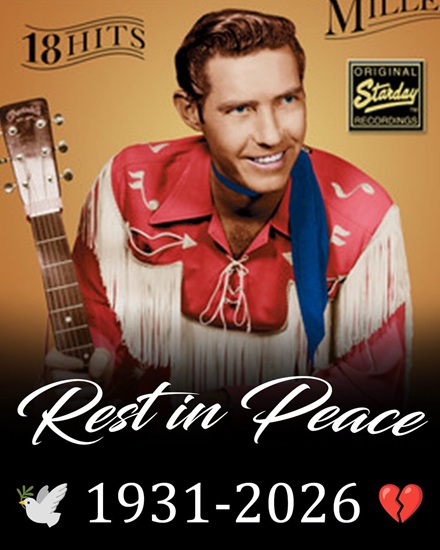
Country singer and songwriter Frankie Miller, whose recording of “Blackland Farmer” became the signature song of his long career, has died at the age of 95. Miller died at his home on Saturday, August 29, 2026, according to information provided by Heart of Texas Records President Tracy Pitcox. Pitcox said Miller died of natural causes. The Texas musician remained connected to country music well into his later years, continuing to record and make appearances decades after his greatest commercial successes.
His career stretched from the early days of postwar country music into the twenty-first century. His death closes a career that connected several generations of traditional country performers and listeners. Shortly before his death, Miller had also completed another project documenting his remarkable life in music. Pitcox said Miller had recently completed and released the biography “The Blackland Farmer: Life Among Country Music Legends,” written by Greg Wilson.
The project looked back on Miller’s experiences and the musicians he encountered throughout his career. Even in his 90s, Miller continued to take an interest in performing and recording rather than completely retiring from the industry. Pitcox also recalled that Miller had appeared as a special guest with his longtime friend Willie Nelson at the Luck Reunion. His activity late in life reflected the lasting connection he maintained with traditional country music. Miller was born on December 17, 1930, in Victoria, Texas.
His interest in music developed while he was still young, and he formed a group called The Drifting Texans during his teenage years. Appearances on local radio helped give him early exposure and eventually contributed to his first opportunities in the recording business. Miller secured a contract with Gilt Edge Records, which was associated with Four Star Records, and released his first singles in 1951. Those recordings came before the breakthrough that would eventually make his name familiar to country listeners. His early career, however, was interrupted when military service temporarily took him away from music.
Miller served in the U.S. Army during the Korean War and earned a Bronze Star during his military service. He also attained the rank of sergeant before returning to civilian life and resuming his musical career. After coming home, he signed with Columbia Records and continued developing as a country performer and songwriter. Recordings from this period included “Hey Where Ya Goin?” and “It’s No Big Thing.” Commercial success did not arrive immediately, but Miller continued working and performing. By the end of the 1950s, persistence would lead him to the recording that became the defining commercial achievement of his career.
That breakthrough came with “Blackland Farmer,” released through Starday Records in 1959. Miller said the song was inspired by his uncle, and its portrayal of rural life connected strongly with country audiences. The record reached No. 5 on the country chart and became one of Starday Records’ notable successes. It later returned to the charts and reached listeners outside its original country audience as well. Although Miller would record many other songs during his career, “Blackland Farmer” remained particularly closely associated with his name. Decades later, the song continued to serve as the title most frequently used when describing his contribution to traditional country music.
Miller followed that success with additional charting recordings. “Family Man” became another Top 10 country hit, while “Baby Rocked Her Dolly” reached No. 15 in 1960. “A Little South of Memphis” was another recording associated with his successful period. His growing reputation was recognized when Cashbox Magazine named him its “Most Promising Country Artist” in 1960. Miller also performed on the Louisiana Hayride and made guest appearances on prominent country music programs, including the Grand Ole Opry and Ozark Jubilee. Those appearances placed him alongside many performers who were shaping country music during that era.
Throughout his career, Miller shared stages and touring schedules with some of country music’s most recognizable performers. His professional history included appearances with artists such as Johnny Cash, George Jones, Patsy Cline, Ernest Tubb, Buck Owens, Lefty Frizzell and Willie Nelson. His work was not limited to performing his own recordings. Songs associated with Miller were also recorded by other artists, including Webb Pierce, Faron Young, Pat Boone and Dwight Yoakam. This songwriting and recording history gave his work a reach beyond the records released under his own name. His career therefore included contributions both as a performer and as a songwriter whose material could be interpreted by others.
Despite his success, Miller did not spend every subsequent decade continuously pursuing the mainstream country music business. During a period away from full-time performing, he worked as a car salesman in Arlington, Texas. His earlier recordings, however, continued attracting interest from traditional-country collectors and listeners. Reissues helped introduce his work to audiences who had not necessarily heard the original releases when they first appeared. This renewed attention eventually became part of a significant later chapter in his career. Rather than remaining exclusively a figure from country music’s past, Miller eventually returned to performing and recording.
By the 1990s, Miller had resumed touring and began reaching audiences again. His later career included performances not only in the United States but also overseas. He appeared in England and continued traveling internationally well into his 80s. In 2015, he performed in Sweden at approximately 84 years old, demonstrating how long his relationship with live country music continued. These later performances introduced his traditional Texas country sound to listeners separated by both geography and generations from the period when “Blackland Farmer” originally became successful. His comeback became an important second chapter in a career that had begun more than four decades earlier.
Miller’s later recording career received additional support when he signed with Heart of Texas Records in 2005. He subsequently released “The Family Man” in 2006 and continued recording new projects during the years that followed. In 2012, he released “Back When Gas Was Thirty Cents A Gallon,” demonstrating that he was still making music long after his first chart success. His discography continued to grow as he entered his 80s. Rather than relying exclusively on archival releases of his early recordings, Miller remained involved in producing material connected to the traditional country style that had characterized his career.
In 2020, Miller released “A Friend Remembered: My Tribute To George Jones,” an album honoring his longtime friend and fellow country performer George Jones. The 14-song recording was released through Heart of Texas Records and included Miller’s interpretations of material associated with Jones. The project arrived when Miller was approaching 90, providing another example of his unusually long recording career. His continued work at that age distinguished the later years of his professional life from those of many performers whose recording careers ended decades earlier. Music remained an active part of Miller’s life rather than simply something he remembered from his younger years.
Miller also maintained longstanding friendships within the country music community. Country Music Hall of Fame member Bill Anderson recalled meeting Miller during a western Canadian tour in 1959, when both musicians were still establishing themselves with country audiences. At the time, Miller was gaining attention with “Blackland Farmer,” while Anderson was also developing his own recording career. Their friendship continued across the decades that followed. Such relationships connected Miller personally to an important generation of performers who helped shape country music during the late 1950s and 1960s. His career consequently became intertwined with a significant period in the genre’s history.
His recent biography provided an opportunity to preserve many of those memories while Miller could still participate in telling his own story. Written by his son-in-law Greg Wilson, “The Blackland Farmer: Life Among Country Music Legends” documented his experiences across decades in the music business. The project covered not only commercial success but also the less visible parts of his career, including periods away from the spotlight and his eventual return to performing. Its completion shortly before his death means that a detailed account of his experiences is available alongside the recordings themselves. For listeners interested in traditional country history, those memories provide additional context for the music Miller left behind.
Miller’s musical legacy extends beyond a single successful recording, although “Blackland Farmer” remains his most recognizable song. His career included early radio performances, military service, recording contracts, chart success, songwriting, touring and a substantial return to music later in life. He performed during an era when country music was undergoing significant commercial growth and continued participating in the genre long after that period had passed. His ability to return to touring decades later also demonstrated that an audience remained for the traditional style of country music he represented. Recordings preserved and reissued over the years will continue documenting that contribution.
According to the reported family information, Miller is survived by his daughters, Sandi Wilson and Lori Chaney, their husbands, six grandchildren and two great-grandchildren. His death comes shortly after the completion of a biography devoted to preserving his experiences and memories from his decades in country music. For longtime listeners, his recordings provide the clearest record of a career that began during the early 1950s and remained active in various forms into his 90s. “Blackland Farmer,” in particular, remains closely connected to his name more than six decades after its original success.
Frankie Miller’s death marks the loss of a performer whose career reached across an unusually long period of country music history. From his teenage performances and early recordings to “Blackland Farmer,” international appearances and his later albums, Miller repeatedly returned to the music that had first interested him as a young man in Texas. His commercial peak belonged to an earlier generation of country music, but his involvement with the genre continued far beyond those chart years. His recordings, songwriting credits, performances and recently completed biography now document that history for listeners who encounter his work in the years ahead.
This account is based on publicly reported biographical and news information about Frankie Miller and is written entirely from an outside, third-person perspective. It does not claim that the publisher personally knew Miller, attended his performances, represents his family, or speaks on behalf of residents of Texas or any other community. Details concerning his death are attributed to the publicly reported confirmation from Heart of Texas Records President Tracy Pitcox. The article is intended as a factual account of Miller’s career and reported death rather than a firsthand remembrance or a claim of local involvement.

